
Red yeast rice's active compound, monacolin K, is molecularly identical to lovastatin — a prescription statin drug. That single fact is why the U.S. Food and Drug Administration has spent more than two decades treating the strongest versions of this "natural" cholesterol supplement not as a food, but as an unapproved drug, and why it has sent warning letters to companies selling it as recently as November 2022.
Key Takeaways
- Monacolin K, red yeast rice's main cholesterol-lowering compound, is structurally identical to lovastatin, according to the NIH's National Center for Complementary and Integrative Health (NCCIH).
- A 2017 analysis of 28 U.S. retail brands found monacolin K content varied more than 60-fold — from 0.09 mg to 5.48 mg per 1,200 mg of red yeast rice — and none of the 28 labels disclosed the actual amount.
- In the largest clinical trial (CCSPS, 4,870 patients with a prior heart attack, followed 4.5 years), a standardized red yeast rice extract cut all-cause mortality risk by 33% versus placebo.
- Because monacolin K works exactly like a statin, it carries the same rare but real risks: muscle, liver, and kidney damage, plus the same drug interactions as prescription statins.
- This product's own label caps intake at 4 capsules (2,400 mg) in 24 hours and warns against use during pregnancy or with liver disease — cautions lifted almost verbatim from statin drug labeling.
In this article:
- What Is Red Yeast Rice, Exactly?
- Why the FDA Treats Potent Red Yeast Rice as a Drug
- Does It Actually Lower Cholesterol? The Trial Evidence
- The Dosing Problem: Nobody Knows What's in the Bottle
- The Contamination Risk: Citrinin
- Side Effects, Interactions, and Who Should Avoid It
- What's Actually on This Bottle's Label
- Frequently Asked Questions
What Is Red Yeast Rice, Exactly?
Red yeast rice is ordinary rice fermented with a mold, Monascus purpureus, that stains it a deep red and produces a family of compounds called monacolins. It has been used in Chinese cooking and traditional medicine for over a thousand years, mostly as a food colorant and digestive aid. Its modern use as a cholesterol supplement is much newer, and it depends entirely on one of those monacolins: monacolin K.
According to NCCIH, "monacolin K is structurally identical to the medicine lovastatin." Lovastatin, like other statin drugs, works by slowing an enzyme called HMG-CoA reductase, which the body uses to manufacture cholesterol. Less enzyme activity means less cholesterol produced in the liver, and typically a lower LDL ("bad") cholesterol reading on a blood panel. This is not a case of a plant compound working "similarly" to a drug in some loose, marketing sense — it is, at the molecular level, the same substance.
Why the FDA Treats Potent Red Yeast Rice as a Drug
Because lovastatin was approved by the FDA as a prescription drug before any red yeast rice product containing meaningful amounts of it was ever sold as a supplement, the agency's position is unambiguous. Quoting NCCIH directly:
"According to the FDA, red yeast rice products that have enhanced or added lovastatin — which is structurally identical to monacolin K — cannot be marketed as a dietary supplement in the United States."
— NIH National Center for Complementary and Integrative HealthThis is not a hypothetical rule. The FDA has enforced it repeatedly. In a warning letter dated November 14, 2022, the agency told the company Essential Elements that its CholestAid product — which lists red yeast rice as a key ingredient — was being sold as an unapproved new drug, citing website and Amazon claims such as "helps reduce LDL levels" as evidence the product was intended to treat a disease rather than function as an ordinary food supplement. Earlier rounds of warning letters, going back to a 1998 ruling against a product called Cholestin, targeted companies for the underlying issue NCCIH describes: meaningful monacolin K content, full stop, regardless of exact wording on the label.
This does not mean every red yeast rice product on a shelf is illegal — most stay compliant by avoiding "enhanced" lovastatin content and by not making disease claims. But the entire category sits in a regulatory gray zone most customers never hear about: the supplement works because it contains a drug, and stays legal only by containing "not too much" of it.
Does It Actually Lower Cholesterol? The Trial Evidence
Where red yeast rice does contain a clinically meaningful amount of monacolin K, the evidence that it lowers cholesterol is genuinely strong — because it is, pharmacologically, a low-dose statin. NCCIH states plainly that products "with considerable amounts of monacolin K may effectively lower blood cholesterol levels, blood glucose levels, and blood pressure."
The best evidence comes from China, where a standardized, pharmaceutical-grade red yeast rice extract called Xuezhikang has been studied in large randomized trials. A systematic review published in PMC pooled 22 randomized trials totaling 6,520 patients, anchored by the landmark China Coronary Secondary Prevention Study (CCSPS).
| Outcome | Relative risk vs. placebo | Interpretation |
|---|---|---|
| All-cause mortality | RR 0.67 (95% CI 0.54–0.83) | 33% lower risk of death from any cause |
| Coronary heart disease mortality | RR 0.69 (95% CI 0.54–0.89) | 31% lower risk of dying from heart disease |
| Recurrent heart attack | RR 0.39 (95% CI 0.28–0.55) | 61% lower risk of a second heart attack |
| Revascularization procedures | RR 0.67 (95% CI 0.50–0.89) | 33% fewer bypass/stent procedures |
Within that review, CCSPS itself showed an LDL reduction of 0.57 mmol/L (about 22 mg/dL) against placebo — a figure from that single trial rather than one pooled across all 22 — and the reviewers reported that "the incidence of adverse events did not differ between the Xuezhikang and control group."
The important caveat: Xuezhikang is a standardized pharmaceutical extract with a controlled, known monacolin K dose, studied under medical supervision. It is not the same thing as an unregulated bottle of red yeast rice capsules purchased online or off a U.S. retail shelf, where — as the next section shows — the actual monacolin K content is rarely known even to the seller.
The Dosing Problem: Nobody Knows What's in the Bottle
This is the gap between the clinical-trial evidence and the retail-shelf product. NCCIH cites a 2017 analysis of red yeast rice supplements from mainstream U.S. retailers with a finding that should give any buyer pause:
| Metric | Finding |
|---|---|
| Brands tested | 28 |
| Brands with no detectable monacolin K | 2 of 28 |
| Monacolin K range in the remaining 26 brands | 0.09 mg – 5.48 mg per 1,200 mg red yeast rice (over 60-fold variation) |
| Brands disclosing actual monacolin K content on the label | 0 of 28 |
In plain terms: two bottles sitting side by side, both labeled "1,200 mg red yeast rice," could differ in active statin-like content by a factor of 60 — or one could contain essentially none. Neither label would say so. This is an industry-wide pattern, not a flaw specific to one brand, and it is precisely why NCCIH and clinicians alike caution that the effective dose of an over-the-counter red yeast rice product is, in practice, unknowable.
That variability has a direct consequence for this bottle's own instructions. The label permits up to four capsules — 2,400 mg of red yeast rice — in 24 hours. Applying the range NCCIH cites, 2,400 mg could deliver as little as about 0.2 mg of monacolin K or as much as about 11 mg. The upper end sits in the same territory as a low prescription dose of lovastatin — a dose no one would normally take without a doctor monitoring liver enzymes and muscle symptoms. Nothing on the outside of the bottle tells you which end of that range you are holding, which is why the label's own instruction to consult a doctor is not boilerplate.
The Contamination Risk: Citrinin
A second, separate risk comes from how red yeast rice is manufactured. The same Monascus fermentation that produces monacolin K can also produce citrinin, a mycotoxin. NCCIH is direct about this: "some red yeast rice products contain a contaminant called citrinin, which is toxic and can damage the kidneys," adding that in "a 2021 analysis of 37 red yeast rice products, only one had citrinin levels below the maximum level currently set by the European Union" — and that four products contaminated with citrinin were labeled "citrinin-free."
A 2021 review in PMC surveying international testing found contamination to be common rather than exceptional. In one survey of 109 widely consumed samples, citrinin was detected in 31 of them — every positive coming from among the 59 red yeast rice and related products tested, at 16.6 to 5,253 µg/kg, while none of the 50 medicinal plant samples tested positive. A separate analysis of 12 red yeast rice products from major Chinese production areas found 10 contaminated, at 140 to 44,240 µg/kg. For scale, the European Union caps citrinin in red yeast rice supplements at 100 µg/kg — a ceiling lowered from 2,000 µg/kg in 2019 precisely because testing kept turning up levels like these. It's worth being precise here: that is a European regulatory limit, not a U.S. one — the FDA has not established a citrinin limit for supplements sold in the United States, which means American buyers have even less regulatory backstop than European ones on this specific risk.
NutritionFacts.org's Dr. Michael Greger explains the dosing-inconsistency and contamination concerns behind his own hesitation to recommend red yeast rice supplements.
Side Effects, Interactions, and Who Should Avoid It
Because monacolin K is pharmacologically a statin, red yeast rice products with meaningful amounts of it carry the same side-effect profile as prescription statins. NCCIH summarizes it this way: potential "muscle, kidney, and liver damage," plus digestive problems such as diarrhea, nausea, and stomach pain — and "the same types of drug interactions as statin drugs."
Cleveland Clinic's patient guidance lists the interactions to watch for specifically: clarithromycin, erythromycin, grapefruit juice, HIV protease inhibitors, antifungal medications, and other cholesterol-lowering drugs can all increase the risk of muscle or liver injury when combined with red yeast rice. Cleveland Clinic also instructs patients to contact their care team right away for "unexplained muscle pain, tenderness, or weakness, especially if you also have a fever and tiredness" — a classic warning sign of the rare but serious muscle breakdown (rhabdomyolysis) associated with statin drugs.
Avoid red yeast rice if you: are pregnant, may become pregnant, or are breastfeeding (no safety studies exist, and statin-class compounds are linked to birth defects); have liver disease; drink heavily; or are already taking a prescription statin or another cholesterol medication without your doctor's involvement. Stop use and see a doctor immediately for unexplained muscle pain, weakness, dark urine, or signs of liver injury (right upper abdominal pain, loss of appetite, nausea, pale stools).
One detail worth flagging honestly: several red yeast rice labels, including the product below, recommend pairing the supplement with a CoQ10 supplement, because statins are known to lower the body's CoQ10 levels. That mechanism is real. What's less settled is whether CoQ10 supplementation actually prevents or resolves statin-type muscle symptoms. A 2022 multicenter analysis in PMC following 511 patients with a history of statin-associated muscle symptoms found symptom resolution in 25% of CoQ10 users versus 31% of non-users — no meaningful difference — and noted this aligns with American Heart Association/American College of Cardiology guidance, which does not recommend CoQ10 for this purpose despite its wide availability.
What's Actually on This Bottle's Label
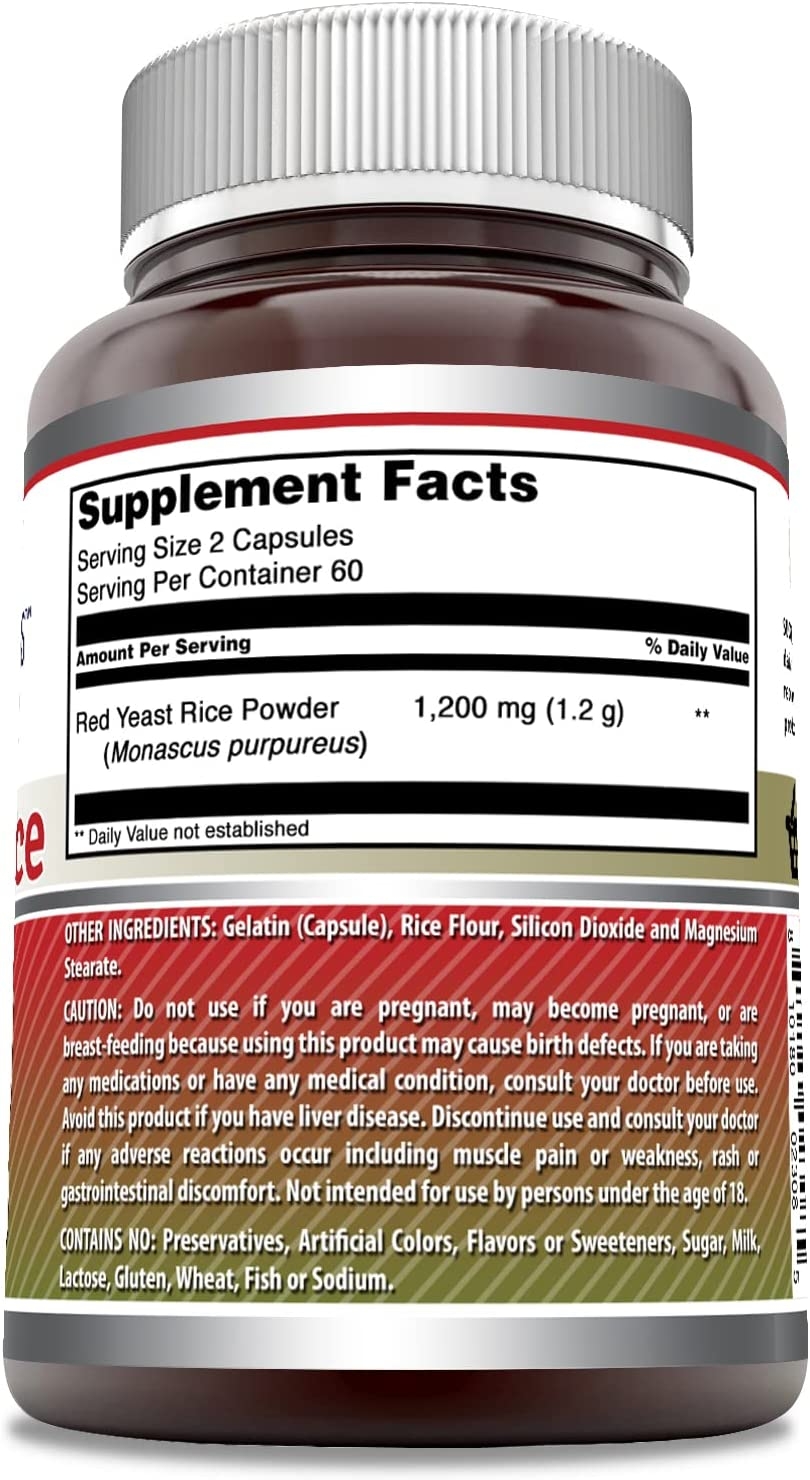
We read this product's own label images rather than trusting the dose claim from marketing text alone — and it is worth doing, because the on-site copy is not consistent with itself. The Supplement Facts panel is unambiguous: serving size two capsules, 60 servings per container, 1,200 mg of red yeast rice powder per serving. That works out to 600 mg per capsule, and it matches the bottle's front panel ("1,200 MG Per Serving — 60 Servings — 120 Capsules"). The product page's one-line summary, however, describes the same bottle as "1200 mg per capsule," which the label does not support — read the panel, not the summary. The bottle directs adults to "take two (2) capsules once or twice daily with food" and warns not to "exceed four (4) capsules in a 24-hour period," meaning the labeled daily range is 1,200–2,400 mg.
What the label does not state — consistent with the industry-wide pattern documented above — is the actual monacolin K content of that 600 mg per capsule. Amazing Formulas' own supplement facts panel lists only "Red Yeast Rice Powder (Monascus purpureus) 1,200 mg" with the Daily Value marked "**Daily Value not established," which is standard for an ingredient the FDA has not set a Daily Value for. We could not verify the monacolin K content of this specific product because the manufacturer does not test for or disclose it on the label — which, per NCCIH's 2017 finding, puts it in the same position as every other brand surveyed.
The label's own caution section states plainly: "Do not use if you are pregnant, may become pregnant, or are breast-feeding because using this product may cause birth defects," "avoid this product if you have liver disease," and "discontinue use and consult your doctor if any adverse reactions occur including muscle pain or weakness, rash or gastrointestinal discomfort." It also states the product is "not intended for use by persons under the age of 18." These are the manufacturer's own words, and they track closely with the NCCIH and Cleveland Clinic guidance above.
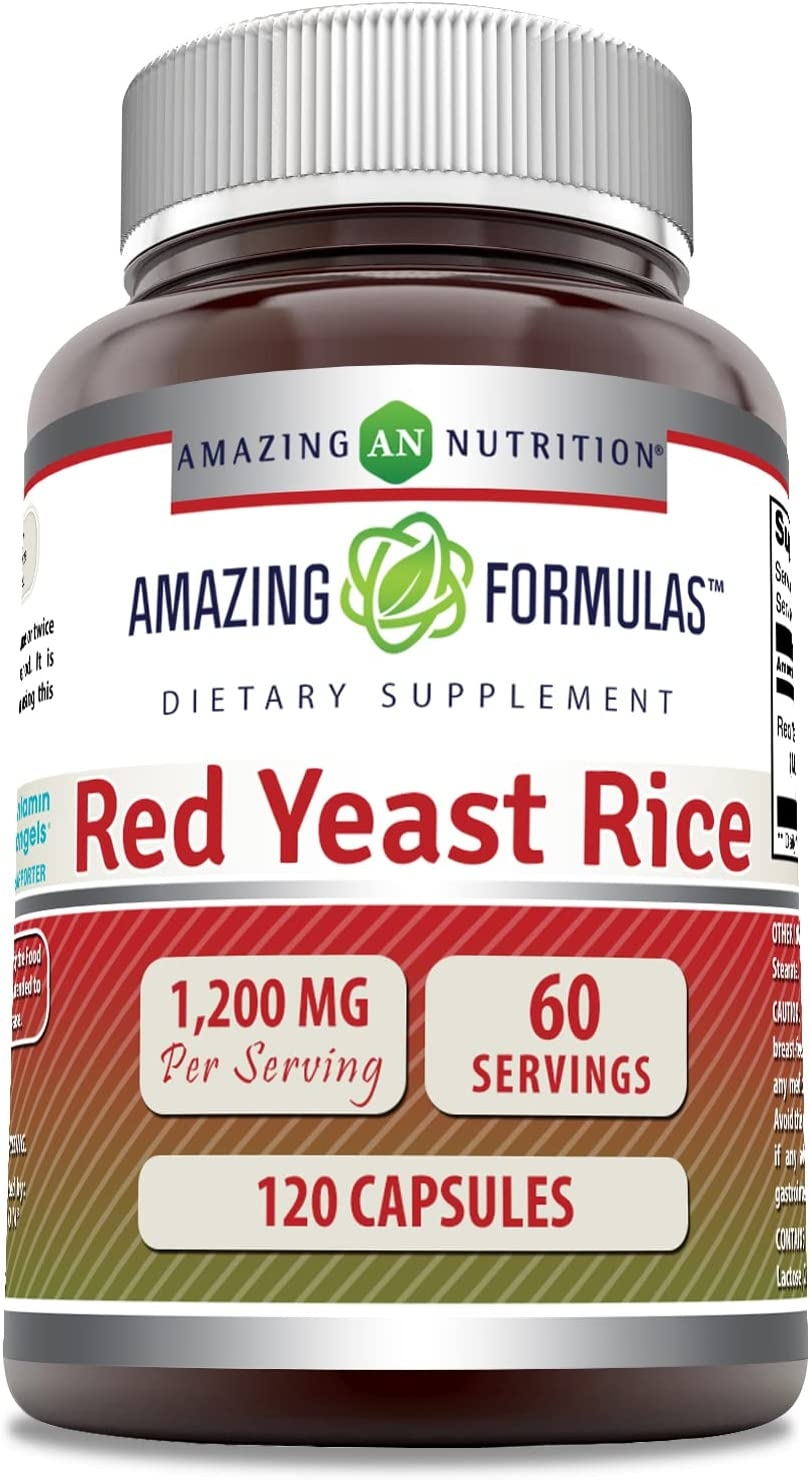
Amazing Formulas Red Yeast Rice 1200mg — 120 Capsules
Gluten-free, non-GMO red yeast rice powder (Monascus purpureus) at 600 mg per capsule, 1,200 mg per labeled 2-capsule serving. 120 capsules per bottle (60 servings). As detailed above, the manufacturer does not disclose monacolin K content, and this product should not be combined with a prescription statin or taken during pregnancy without medical guidance.
View Product DetailsFrequently Asked Questions
Is red yeast rice the same as a statin drug?
Not exactly the same product, but the same active mechanism. Its main active compound, monacolin K, is structurally identical to lovastatin, a prescription statin. A red yeast rice supplement is, in effect, an unmeasured, low-and-variable dose of a statin drug delivered through a food product rather than a regulated prescription.
Is red yeast rice legal in the United States?
Products with only trace or no monacolin K can be sold as ordinary supplements. But per NCCIH, any red yeast rice product with "enhanced or added lovastatin" — meaning meaningful monacolin K content — legally cannot be marketed as a dietary supplement in the U.S., and the FDA has issued warning letters to sellers over this since at least 1998, most recently in November 2022.
How much red yeast rice should I take?
There is no established, universal dose, because monacolin K content is not standardized or disclosed across brands. Follow the specific product's label directions exactly, do not exceed the stated daily maximum, and talk to your doctor before starting — especially if you take any other cholesterol medication.
Can I take red yeast rice with my prescription statin?
This should only be done under a doctor's supervision, if at all. Because both work through the same mechanism, combining them raises the risk of the same side effects — muscle and liver damage — without a clear benefit over adjusting the prescription dose alone.
Does red yeast rice actually lower cholesterol?
When it contains a clinically meaningful amount of monacolin K, yes — trial evidence using a standardized extract (Xuezhikang) showed significant reductions in LDL cholesterol and cardiovascular events. The unresolved problem is that most U.S. retail products don't disclose whether they contain that meaningful amount in the first place.
Is it safe to take red yeast rice during pregnancy?
No. NCCIH states there are no safety studies in pregnancy or breastfeeding, and red yeast rice products are not recommended in either case. This particular product's own label goes further, warning that use "may cause birth defects."
Sources
- NIH National Center for Complementary and Integrative Health — Red Yeast Rice
- FDA Warning Letter — Essential Elements, November 14, 2022
- Cleveland Clinic — Red Yeast Rice Capsules
- PMC — Systematic Review of Xuezhikang (Red Yeast Rice) for Coronary Heart Disease
- PMC — Citrinin in Foods and Supplements: A Review of Occurrence and Analytical Methodologies
- Commission Regulation (EU) 2019/1901 — maximum level of citrinin in red yeast rice food supplements
- PMC — CoQ10 Supplementation and Statin-Associated Muscle Symptoms
This article is for educational purposes only and is not medical advice. It is not intended to diagnose, treat, cure, or prevent any disease. These statements have not been evaluated by the Food and Drug Administration. Talk to your doctor before starting any new supplement, especially if you are pregnant, breastfeeding, have liver disease, or take any prescription medication, including statins.