
A trial followed 14,641 male physicians for 11.2 years to find out whether a daily multivitamin prevents heart disease. It does not. The same trial found an 8% reduction in cancer risk. A newer trial of over 21,000 people found no drop in total cancers — but a 38% lower rate of lung cancer, and, in its cognitive substudies, improved memory in older adults. Multivitamin evidence is not a simple yes or no; it is a set of specific findings pointing in different directions. Here is what each one actually says, and how to decide whether a daily tablet is worth it for you.
Key takeaways
- About one-third of US adults take a multivitamin — 31.2% in the past 30 days, rising to 39.4% of those aged 60+.
- Cardiovascular disease: no benefit. A 2018 meta-analysis and the 11.2-year Physicians' Health Study II both found no reduction in cardiovascular events.
- Cancer: small and inconsistent. PHS II found an 8% reduction in total cancer; the larger COSMOS trial found none overall, though lung cancer incidence was 38% lower.
- Cognition: the most promising recent finding. COSMOS substudies in over 5,000 older adults found improved global cognition and episodic memory.
- Smokers should avoid high-dose beta-carotene or vitamin A — it raises lung cancer risk. Check the label if you smoke.
Who takes multivitamins
Multivitamin and mineral supplements (MVMs) are the most widely used supplement category in the United States. According to the NIH Office of Dietary Supplements, roughly one-third of US adults take them, with clear age stratification:
| Group | Reporting MVM use in past 30 days |
|---|---|
| All adults | 31.2% |
| Adults 20–39 | 24.0% |
| Adults 40–59 | 29.8% |
| Adults 60+ | 39.4% |
| Children and adolescents | ~25% |
Use rises with age, which is intuitive — and also where the evidence happens to be most interesting, since the strongest recent findings concern older adults.
The heart health question
This is the claim most prominent on men's multivitamin packaging, and the one with the clearest negative evidence.
The Physicians' Health Study II followed 14,641 male physicians for a median of 11.2 years — an unusually long, well-controlled trial in a population with good adherence and reliable record-keeping. The NIH summary is blunt: multivitamin users "did not have fewer major cardiovascular events, myocardial infarctions, strokes, or cardiovascular-related deaths than nonusers."
A 2018 meta-analysis pooling 16 prospective cohort studies and 2 randomised controlled trials reached the same conclusion: MVM supplementation "was not associated with better cardiovascular outcomes."
This is about as settled as nutrition evidence gets. If your reason for taking a men's multivitamin is cardiovascular protection, the evidence does not support it. The things that do move cardiovascular risk are unglamorous and well established — blood pressure control, not smoking, physical activity, diet quality, sleep and lipid management. The National Heart, Lung, and Blood Institute's heart-healthy living guidance is the better place to spend your attention.
Cleveland Clinic on whether a daily multivitamin is worth taking.
Cancer: two big trials, two answers
Here the picture is genuinely mixed, and honest reporting means presenting both results rather than the flattering one.
| Trial | Population | Finding |
|---|---|---|
| Physicians' Health Study II | 14,641 male physicians, 11.2 years median | 8% reduction in total cancer risk — modest but statistically significant. No benefit for any specific cancer type. |
| COSMOS | 8,776 men and 12,666 women, 3.6 years median | No reduction in total invasive cancers. However, 38% lower lung cancer incidence. |
How to read this fairly: an 8% relative reduction in total cancer is small, and it appeared in one trial of a fairly unrepresentative population (male doctors, who differ from the general public in diet, health literacy and access to care). COSMOS, larger and more diverse but shorter, did not replicate it overall.
The 38% lung cancer figure is striking but should be treated cautiously. When a trial reports no effect on its main outcome and a large effect on one sub-outcome, that finding is hypothesis-generating — a lead worth following, not a conclusion. Sub-group results turn up by chance more often than people assume, which is precisely why the primary outcome is specified in advance.
The honest summary: multivitamins are not a cancer prevention strategy. For the risk factors that genuinely matter, the National Cancer Institute's diet and cancer risk resources are the place to look.
Cognition: the newest evidence
This is where the recent research is most encouraging, and it is the finding least reflected on packaging.
Ancillary cognitive substudies within COSMOS produced a meta-analysis covering more than 5,000 older adults. The result: multivitamin use "improved global cognition and episodic memory over time." Global cognition reflects overall ability across multiple domains; episodic memory is memory for events and experiences — the kind people notice slipping.
Caveats belong here too. These were substudies rather than the trial's primary purpose, effect sizes were modest, and cognitive outcomes are notoriously sensitive to how they are measured. But the finding replicated across three separate substudies, which is meaningfully better than a one-off result.
For older adults in particular, this shifts the calculation somewhat. The National Institute on Aging's guidance on supplements for older adults is a sensible companion read.
A hospital system's take on where multivitamins do and do not help.
Why the box can say "heart health" anyway
If trials found no cardiovascular benefit, how is "Heart Health" printed on the front of the box? The answer is regulatory, and understanding it makes you a much better label reader.
US supplement law permits structure/function claims: statements that a nutrient supports a normal body structure or function. It prohibits disease claims: statements that a product treats, prevents or cures a disease. So a label may say a product "supports heart health" — because several B vitamins genuinely participate in cardiovascular-relevant metabolism — but may not say it "prevents heart disease."
Who actually benefits
A multivitamin is insurance against dietary gaps, not a treatment. It follows that the people who benefit most are those with gaps to fill:
- Older adults. Absorption of vitamin B12 declines with age, appetite often falls, and the COSMOS cognitive findings apply specifically to this group.
- People with restricted diets. Vegans need B12; very low-calorie or narrow diets miss multiple nutrients.
- People with malabsorption conditions — coeliac disease, Crohn's, or after bariatric surgery.
- People on certain long-term medications, including some acid-reducing drugs and metformin, which affect B12 status.
- People who genuinely do not eat many fruits and vegetables, honestly assessed.
Conversely, the person least likely to benefit is a healthy adult eating a varied diet — which is roughly the population the biggest trials studied, and roughly why those trials found so little.
A note on "men's" formulations: the main defensible difference is iron. Men's multivitamins typically contain little or none, which is appropriate — adult men rarely need supplemental iron, and excess iron is genuinely harmful. Beyond that, most gender-specific tailoring is more marketing than physiology.
Safety, upper limits and the smoker warning
The NIH describes basic MVMs providing recommended nutrient amounts as generally safe. The risks come from stacking.
As the fact sheet notes, "individuals who take MVMs and other supplements and who consume fortified foods and beverages might obtain some nutrients in amounts exceeding the UL, increasing the possibility of adverse effects." Breakfast cereals, plant milks, protein powders and energy drinks are all commonly fortified. Add a multivitamin plus a separate vitamin D plus a greens powder and several nutrients can quietly exceed their Tolerable Upper Intake Levels.
The fat-soluble vitamins — A, D, E and K — accumulate in body tissue rather than being excreted in urine, so they carry more overdose risk than water-soluble ones. That is another argument for a formula near 100% of recommended values rather than a "high potency" product at several hundred percent.
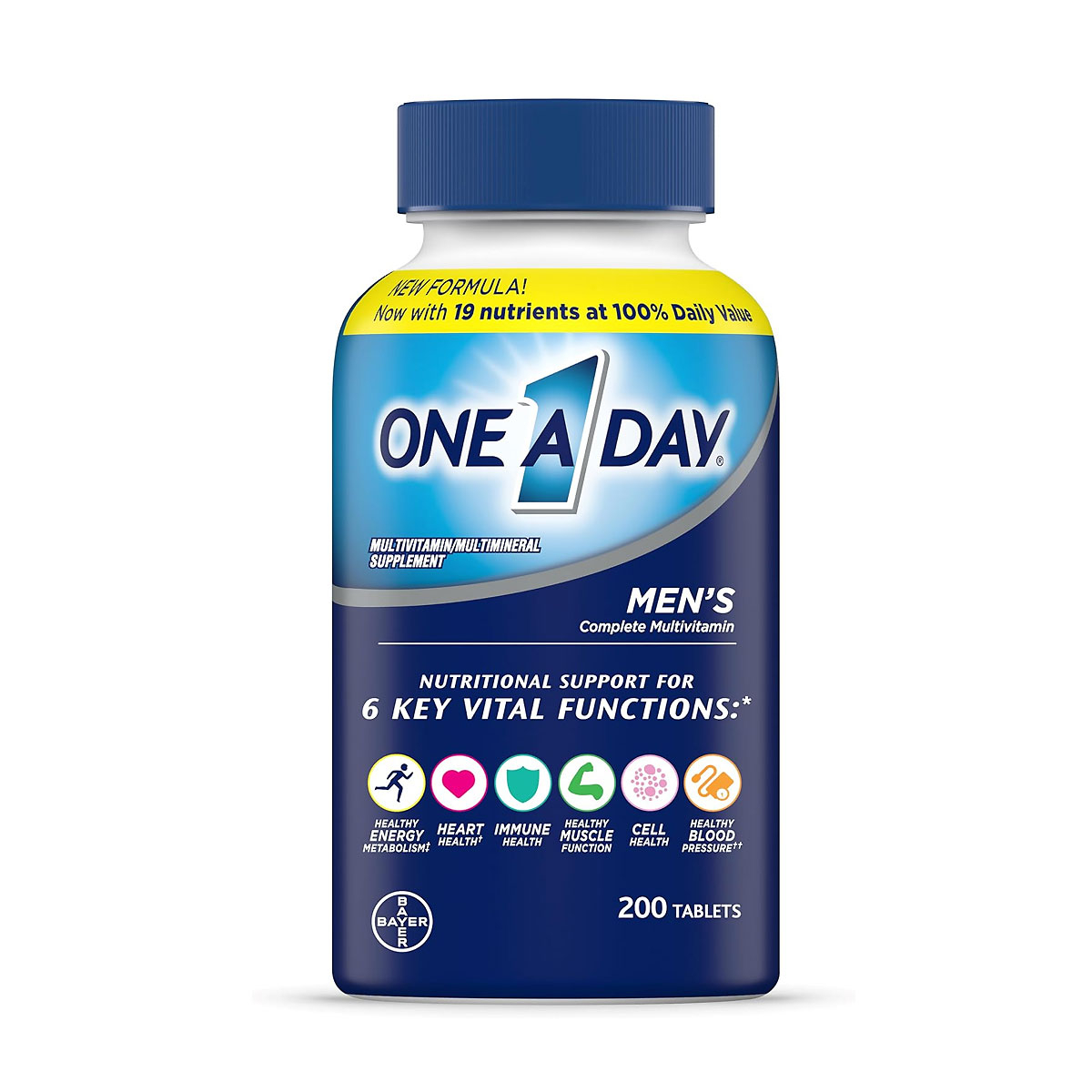
One A Day Men's Multivitamin Heart Health & Immune Support — 200 Tablets
A conventional daily men's formula containing vitamins A, B6, C, D and E along with riboflavin, thiamin and niacin. Gluten-, wheat- and dairy-free, with no artificial colours or sweeteners, and a 200-tablet count for daily use. Read the "supports heart health" labelling in light of §5 above, and if you smoke, check the vitamin A and beta-carotene content against the warning in §7.
Browse the full range in Vitamins & Minerals, or see General Wellness.
Frequently asked questions
Do multivitamins prevent heart disease?
No. The Physicians' Health Study II followed 14,641 male physicians for a median of 11.2 years and found multivitamin users had no fewer major cardiovascular events, heart attacks, strokes or cardiovascular deaths than non-users. A 2018 meta-analysis of 16 cohort studies and 2 randomised trials reached the same conclusion.
Do multivitamins reduce cancer risk?
The evidence is mixed and modest. The Physicians' Health Study II found an 8% reduction in total cancer risk, with no benefit for any specific type. The larger COSMOS trial found no reduction in total invasive cancers, though lung cancer incidence was 38% lower — a sub-outcome finding that should be treated as a lead rather than a conclusion.
Do multivitamins help memory?
This is the most promising recent finding. A meta-analysis of three cognitive substudies within the COSMOS trial, covering more than 5,000 older adults, found that multivitamin use improved global cognition and episodic memory over time. Effect sizes were modest, but the result replicated across all three substudies.
Who should take a multivitamin?
Those most likely to benefit have dietary gaps to fill: older adults, people on restricted or vegan diets, those with malabsorption conditions such as coeliac or Crohn's disease or after bariatric surgery, people taking medications that affect B12 status, and anyone who genuinely eats few fruits and vegetables. Healthy adults with varied diets benefit least.
Are multivitamins safe for smokers?
Smokers should avoid high-dose beta-carotene or vitamin A, which the NIH notes increases lung cancer risk in this group. Check the label for both before taking a multivitamin if you smoke, and discuss it with your doctor.
Why does the box say "heart health" if trials found no benefit?
US law allows structure/function claims stating that a nutrient supports a normal body function, but prohibits disease claims. "Supports heart health" refers to the biochemical roles of the nutrients; it is not a claim that the product prevents heart disease, which the trial evidence does not support.
- NIH Office of Dietary Supplements — Multivitamin/Mineral Supplements (Health Professional)
- NIH Office of Dietary Supplements — Multivitamin/Mineral Supplements (Consumer)
- NIH National Institute on Aging — Dietary Supplements for Older Adults
- NIH National Heart, Lung, and Blood Institute — Heart-Healthy Living
- National Cancer Institute — Diet and Cancer Risk
- U.S. Food and Drug Administration — Dietary Supplements
Medical disclaimer. This article is for general education and is not medical advice. It is not a substitute for diagnosis or treatment from a qualified healthcare professional. Talk to your doctor before starting a multivitamin, particularly if you smoke, take other supplements or prescription medication, or have a health condition.
These statements have not been evaluated by the Food and Drug Administration. This product is not intended to diagnose, treat, cure, or prevent any disease.