
The store listing says CocoaVia's cocoa flavanol capsules contain "the same ingredient at the same level" used in the COSMOS trial, yet that trial's main result was a miss: among 21,442 older adults, cocoa extract did not significantly reduce total cardiovascular events (hazard ratio 0.90, 95% CI 0.78 to 1.02) over a median 3.6 years (American Journal of Clinical Nutrition, 2022). Cocoa flavanols are plant compounds from the cocoa bean, a subgroup of the flavan-3-ols, sold in capsules as a concentrated alternative to chocolate. There is a second gap: the label photographs say 450 mg per serving, while the title and description say 500 mg, the trial dose.
Key Takeaways
- COSMOS gave 500 mg of cocoa flavanols a day to some of 21,442 adults aged 60 or 65 and over; total cardiovascular events fell 10% but not significantly (HR 0.90, 95% CI 0.78 to 1.02, P = 0.11) (AJCN, 2022).
- Cardiovascular death, one of 14 secondary outcomes, was 27% lower (HR 0.73, 95% CI 0.54 to 0.98), but the confidence intervals were not adjusted for multiple comparisons (AJCN, 2022).
- In 2,262 participants followed for 3 years, cocoa extract had no effect on global cognition (mean z-score 0.03, P = .28) (Alzheimer's & Dementia, 2023).
- A Cochrane review of 40 comparisons and 1,804 mostly healthy adults found a blood-pressure drop of about 1.8 mmHg in trials of 2 to 18 weeks (Cochrane, 2017).
- The label photographs show 450 mg of flavanols and 20 mg of caffeine per serving, against 500 mg and 25 mg in the listing text, and say not to use it if pregnant or lactating (product label).
In this article:
- What Are Cocoa Flavanols, and Why Take Them as Capsules?
- COSMOS: 21,442 Adults, a Placebo, and a Missed Primary Target
- The 27% Figure and What Its Fine Print Says
- Blood Pressure: Small Effect, Short Trials
- Memory and Thinking: The Brain Half of the Label
- Inside CocoaVia Heart & Brain: Label Versus Listing
- Who Might Consider It, and Who Should Skip It
- Frequently Asked Questions
What Are Cocoa Flavanols, and Why Take Them as Capsules?
Flavanols are naturally occurring compounds in cocoa beans, tea and some fruit, and short-term studies have linked them to changes in how blood vessels dilate. The COSMOS authors (2022) call earlier population studies uncertain because of "uncertainty of cocoa flavanol content and measurement error"; a large trial on cardiovascular events was missing. Capsules exist because chocolate varies in flavanol content and carries sugar and fat; this product's label shows 5 calories per serving. The listing adds that its extract is "24x more concentrated" than raw cocoa powder, a manufacturer claim this article could not verify.
COSMOS: 21,442 Adults, a Placebo, and a Missed Primary Target
The COcoa Supplement and Multivitamin Outcomes Study (COSMOS) is the trial the listing leans on. It was a randomized, double-blind, placebo-controlled trial in 21,442 US adults (12,666 women aged 65 or over and 8,776 men aged 60 or over) who were free of heart attack, stroke and recently diagnosed cancer. It also tested a multivitamin in a 2×2 design; the multivitamin side is covered in our men's multivitamin guide. Participants took two capsules a day containing 500 mg of cocoa flavanols, including 80 mg of (−)-epicatechin, or a placebo, from 2015 to the end of 2020.
| Outcome | Hazard ratio (95% CI) | Significant? |
|---|---|---|
| Total cardiovascular events (primary outcome) | 0.90 (0.78 to 1.02); 410 events on cocoa vs 456 on placebo | No (P = 0.11) |
| Cardiovascular death (secondary) | 0.73 (0.54 to 0.98) | Yes, nominally |
| Heart attack (secondary) | 0.87 (0.66 to 1.16) | No |
| Stroke (secondary) | 0.91 (0.70 to 1.17) | No |
| Coronary revascularization (secondary) | 0.95 (0.77 to 1.17) | No |
| All-cause mortality (secondary) | 0.89 (0.77 to 1.03) | No |
The paper's own conclusion is more careful than the marketing built on it:
"Cocoa extract supplementation did not significantly reduce total cardiovascular events among older adults but reduced CVD death by 27%."
— Sesso et al., American Journal of Clinical Nutrition, March 2022 (COSMOS randomized trial, 21,442 adults)The trial was supported by a grant from Mars Edge, a segment of Mars that supplied the study pills, plus National Institutes of Health grants. The paper states that neither company "had a role in the trial design or conduct."
The 27% Figure and What Its Fine Print Says
A 27% lower cardiovascular death rate is the number to quote, and the listing's version is bigger: "39% improvement on important heart health outcomes." I searched the full text of the COSMOS paper for a 39% figure and did not find one. The paper reports 10% (primary, not significant), 27% (cardiovascular death) and 16% (major cardiovascular events). Where 39% comes from, I cannot say. Three caveats matter:
- It was a secondary outcome. There were 14 secondary outcomes, with confidence intervals not adjusted for multiple comparisons; cardiovascular death was "the only secondary endpoint to reach nominal statistical significance" (AJCN, 2022).
- The components did not move significantly. Heart attack, stroke and revascularization all include no effect, so the death result "may have reflected combined effects among individual CVD outcomes."
- The friendlier analyses were not the main one. A per-protocol analysis (only people who kept taking pills) gave 0.85 (95% CI 0.72 to 0.99) for total events, and a non-prespecified composite of heart attack, stroke and cardiovascular death gave 0.84 (0.71 to 0.99).
"Given the lack of effect for our primary outcome, these results warrant cautious interpretation as we did not account for multiple testing."
— Sesso et al., American Journal of Clinical Nutrition, March 2022 (COSMOS limitations section)The authors say more research is warranted. COSMOS also tested one dose of one extract, so it cannot say what happens at 450 mg, and its older participants had no prior heart attack or stroke.
Blood Pressure: Small Effect, Short Trials
The listing says the product "helps retain healthy blood pressure levels." The best summary of the evidence is a Cochrane review by Ried and colleagues (published 25 April 2017, evidence current to November 2016), which pooled 40 treatment comparisons in 1,804 mostly healthy adults. Trials were short, mostly 2 to 12 weeks, with 30 to 1,218 mg of flavanols a day (average 670 mg).
| Group | Systolic blood pressure change | Trials and participants |
|---|---|---|
| All participants | −1.76 mmHg (95% CI −3.09 to −0.43) | 40 comparisons, 1,804 people |
| People with high blood pressure | About −4 mmHg, statistically significant | 9 comparisons, 401 people |
| People with normal blood pressure | No significant difference | 23 comparisons, 1,063 people |
The review rates the evidence as moderate quality and calls the effect small, around 2 mmHg, in mainly healthy adults in the short term. Seven included studies were company-funded, and the effect was slightly larger in those. The authors found no trials measuring heart attacks or strokes, and none testing long-term daily use. For a comparison with another supplement sold on blood-pressure numbers, see our grape seed extract guide.
A Mayo Clinic Minute on chocolate and the heart, for general background; not a review of this supplement.
Memory and Thinking: The Brain Half of the Label
The product is sold as "Heart & Brain," and the front label says it "supports brain and heart health." The brain claim has its own trial. COSMOS-Mind enrolled 2,262 participants (mean age 73, 60% women) from within COSMOS and followed them for 3 years with telephone cognitive tests. The result for the same 500 mg dose was flat: cocoa extract had no effect on global cognition (mean z-score 0.03, 95% CI −0.02 to 0.08, P = .28). The abstract's verdict on cocoa takes one sentence:
"Cocoa extract did not benefit cognition."
— Baker et al., Alzheimer's & Dementia, 2023 (COSMOS-Mind, 2,262 participants)The multivitamin in the same trial showed a small, significant benefit (mean z = 0.07, P = .007). The listing says the product "supports brain health and cognitive function"; the largest placebo-controlled test at this dose did not find that.
Inside CocoaVia Heart & Brain: Label Versus Listing
The store title reads "CocoaVia Heart & Brain Supplement – 500 mg Cocoa Flavanols (60 Capsules)," and the description repeats 500 mg per serving and "approximately 25 mg" of caffeine. The product photographs say something different. The Supplement Facts panel lists a serving of 2 vegetarian capsules, 30 servings per container, 5 calories, under 1 g carbohydrate, 1,110 mg of cocoa extract (bean) and 450 mg of cocoa flavanols, with "Daily Value not established." Other ingredients are a hypromellose capsule, silicon dioxide and ascorbyl palmitate. The front of the bottle reads "450 MG COCOA FLAVANOLS," and a second photograph repeats 450 mg and "20mg naturally occurring caffeine per serving."
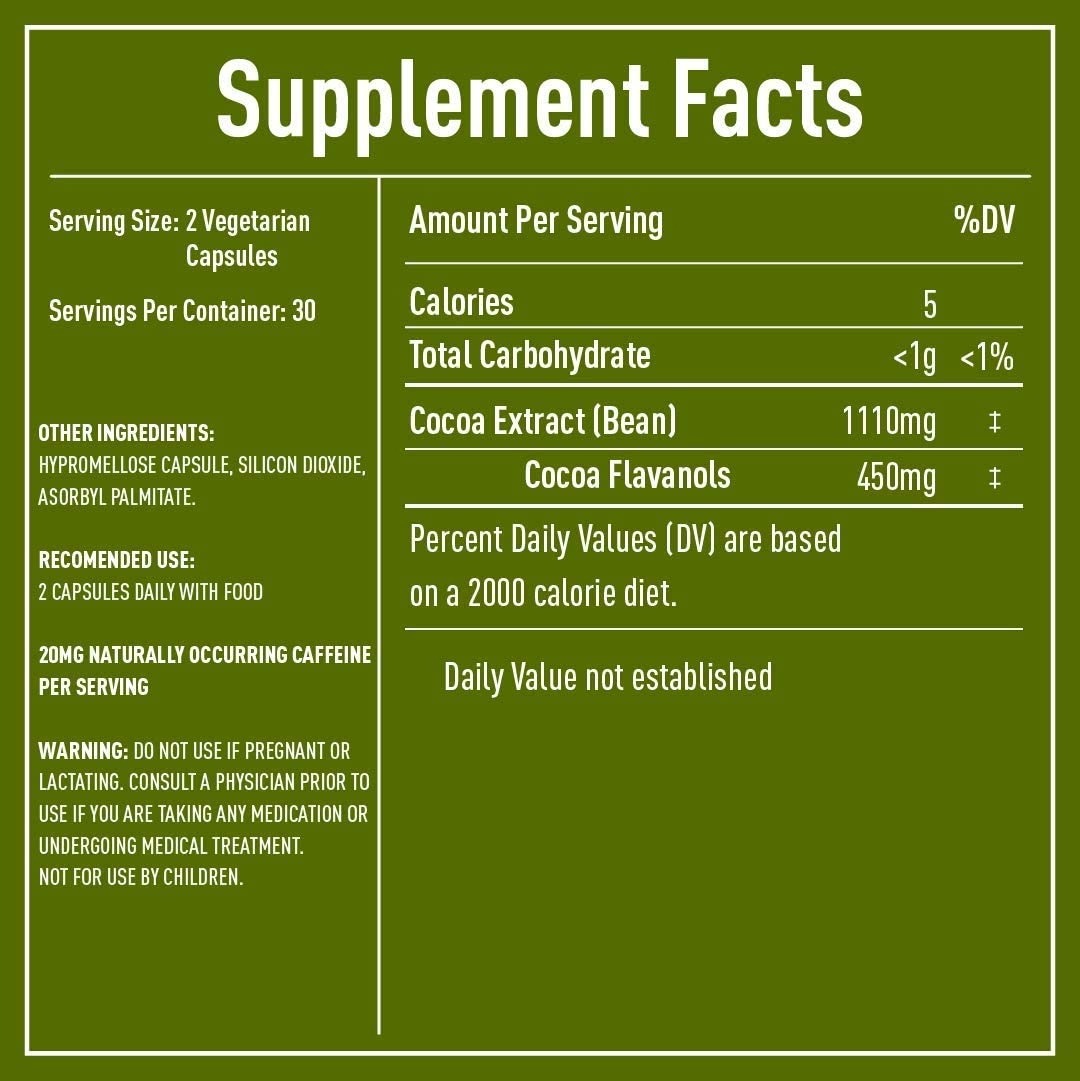
I cannot tell from here which figure is current; the formulation may have changed. This article uses the printed label, 450 mg, which is 90% of the COSMOS dose rather than the "same level." Check the bottle that arrives.
| This product | Typical studied dose | NIH RDA / AI | Tolerable Upper Limit | |
|---|---|---|---|---|
| Cocoa flavanols | 450 mg per 2-capsule serving (label photographs); 500 mg in the listing text | 500 mg a day in COSMOS (AJCN, 2022); 30 to 1,218 mg, average 670 mg, in the Cochrane trials (2017) | None established; the label says "Daily Value not established" | None established in any source reviewed |
| Caffeine | 20 mg per serving (label photographs); about 25 mg in the listing text | About 15 mg a day in the COSMOS extract (AJCN, 2022) | None established | No UL; FDA cites 400 mg a day as an amount not generally associated with negative effects for most adults (FDA, updated August 2024) |
Flavanols are not a vitamin or mineral, so there is no RDA or upper limit; "none established" is not missing data. The caffeine is small: 20 mg is about 5% of the FDA's 400 mg reference amount, though sensitivity varies widely.
The label says: "Do not use if pregnant or lactating." It also says to consult a physician before use if you are taking any medication or undergoing medical treatment, and that the product is not for children. The store listing's warning section mentions medication and medical conditions but leaves out pregnancy and lactation. MedlinePlus (review date April 2025) adds that during pregnancy caffeine intake should stay under 200 mg a day, which is context for the caffeine, not a statement that this product is safe in pregnancy.
Manufacturer and store claims to read as such: "clinically proven," "increases blood flow within 2 hours," "24x more concentrated," and a photograph panel saying you "may start to notice" increased energy, healthier skin and better circulation in 4 to 6 weeks. None is a finding of the trials above, and this article could not verify them. The FDA says it does not have the authority to approve dietary supplements before they are marketed (FDA Q&A on dietary supplements, content current as of August 2026).
Who Might Consider It, and Who Should Skip It
Who this is for: adults aged 60 or 65 and over, without a history of heart attack or stroke, who have discussed their cardiovascular risk with a clinician and want to try the one cocoa extract with a large trial behind it, understanding that the primary result was not significant and that 450 mg is not the trial's 500 mg.
Who should skip it: most people. Anyone pregnant or lactating (the label says not to use it); anyone buying it for memory, since the cognition trial was negative; anyone with heart disease or on medication who has not asked a clinician, because COSMOS excluded prior heart attack or stroke; younger adults, who were not studied; and anyone replacing prescribed care.
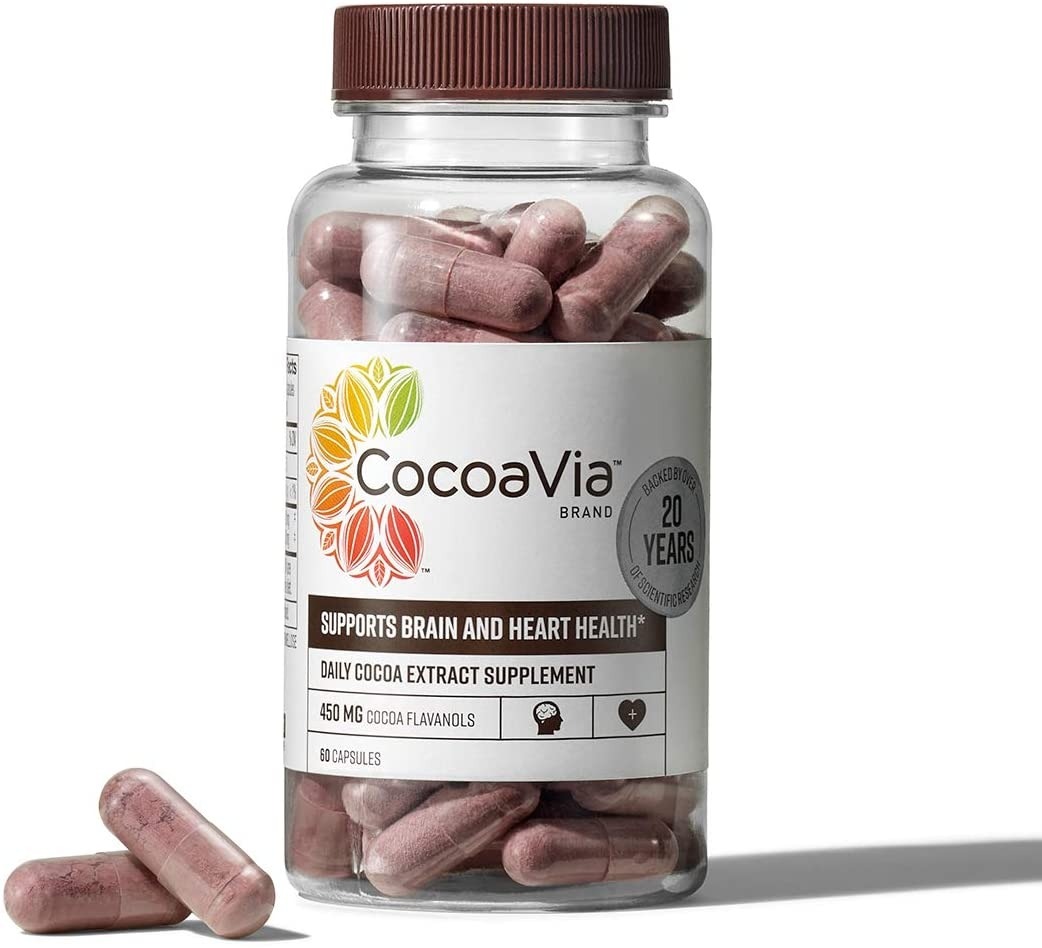
CocoaVia Heart & Brain Supplement — 60 Capsules
Cocoa extract capsules, 2 a day with food, 30 servings per bottle. The closest trial used a higher flavanol dose than this label shows, and its main result was not significant. Also browse our heart and cardiovascular range.
View Product DetailsFrequently Asked Questions
Do cocoa flavanol supplements reduce heart attacks and strokes?
Not significantly, in the largest trial. In COSMOS (21,442 adults, 2022), 500 mg of flavanols a day gave a heart attack hazard ratio of 0.87 (95% CI 0.66 to 1.16) and a stroke ratio of 0.91 (0.70 to 1.17); both intervals include no effect.
What does the 27% reduction in cardiovascular death mean?
The cocoa group had a hazard ratio of 0.73 (95% CI 0.54 to 0.98) for cardiovascular death in COSMOS. It was one of 14 secondary outcomes, with intervals not adjusted for multiple comparisons, so the authors call for more research rather than treating it as proof.
Does cocoa extract lower blood pressure?
A little, in short trials. A 2017 Cochrane review of 40 comparisons and 1,804 mostly healthy adults found systolic pressure about 1.76 mmHg lower: roughly 4 mmHg in people with high blood pressure, no significant change with normal pressure. It found no long-term trials.
Does cocoa extract improve memory or thinking?
The largest trial says no. COSMOS-Mind (2023) followed 2,262 older adults for 3 years on 500 mg of flavanols a day and found no effect on global cognition (mean z-score 0.03, P = .28). The multivitamin arm showed a small benefit.
How many milligrams of flavanols are in CocoaVia Heart & Brain?
The Supplement Facts photograph shows 450 mg per 2-capsule serving, from 1,110 mg of cocoa extract. The store title and description say 500 mg, the COSMOS dose. This article could not tell which is current, so check the bottle you receive.
How much caffeine is in cocoa extract capsules?
The product photographs say 20 mg of naturally occurring caffeine per serving, while the listing text says about 25 mg. Either is a small share of the 400 mg a day the FDA cites as not generally associated with negative effects in most adults (updated August 2024), though sensitivity varies.
Is cocoa extract safe during pregnancy or breastfeeding?
The label says not to use it if pregnant or lactating. MedlinePlus (April 2025) says to keep caffeine under 200 mg a day in pregnancy. The label also asks anyone on medication or in medical treatment to consult a physician first.
Were people with heart disease studied in COSMOS?
No. COSMOS enrolled adults free of heart attack and stroke, aged 65 or over for women and 60 or over for men. Its results cannot be applied directly to younger adults or to people with existing heart disease, who should ask their clinician.
Sources
- Sesso HD, et al. "Effect of cocoa flavanol supplementation for the prevention of cardiovascular disease events: the COcoa Supplement and Multivitamin Outcomes Study (COSMOS) randomized clinical trial." American Journal of Clinical Nutrition, published March 2022 (full text read via PubMed Central). Accessed 3 October 2026. pmc.ncbi.nlm.nih.gov
- Baker LD, et al. "Effects of cocoa extract and a multivitamin on cognitive function: A randomized clinical trial." Alzheimer's & Dementia, 2023 (abstract and full record read via PubMed Central). Accessed 3 October 2026. pmc.ncbi.nlm.nih.gov
- Cochrane. Ried K, Fakler P, Stocks NP. "Effect of cocoa on blood pressure." Cochrane Database of Systematic Reviews, 2017, Issue 4, CD008893; published 25 April 2017, evidence current to November 2016. Accessed 3 October 2026. cochrane.org
- US Food and Drug Administration. "Spilling the Beans: How Much Caffeine is Too Much?" Content current as of 28 August 2024. Accessed 3 October 2026. fda.gov
- MedlinePlus, National Library of Medicine. "Caffeine in the diet." Review date 1 April 2025. Accessed 3 October 2026. medlineplus.gov
- US Food and Drug Administration. "Questions and Answers on Dietary Supplements." Content current as of 27 August 2026. Accessed 3 October 2026. fda.gov
This article is for educational purposes only and is not medical advice. It is not intended to diagnose, treat, cure, or prevent any disease. These statements have not been evaluated by the Food and Drug Administration. Talk to your doctor before starting any new supplement, especially if you are pregnant, breastfeeding, over 65, take any medication, or have a medical condition.