
The "16,000 mg" printed on the front of this grape seed extract bottle is not what you swallow: the Supplement Facts panel shows a daily serving of 800 mg of extract, and 16,000 mg is the weight of raw seed that extract was concentrated from. The NIH's own summary of the research is more modest than either number: across 19 trials, grape seed extract lowered diastolic blood pressure by about 2 mmHg and did not significantly change systolic pressure.
Key Takeaways
- Grape seed extract (GSE) is made from the seeds of wine grapes; a 2022 meta-analysis of 19 trials found it lowered diastolic blood pressure by 2.20 mmHg but found no significant effect on systolic pressure (NCCIH, updated February 2025).
- The systolic estimate, −3.55 mmHg, had a 95% confidence interval of −7.59 to +0.49, and the trials disagreed so strongly that heterogeneity (I²) was 97.4% (Foshati et al., 2022).
- A 2020 meta-analysis of 11 trials and 536 people found LDL cholesterol fell by only 0.17 mmol/L, with a confidence interval (−0.34 to −0.01) that nearly touches zero (Anjom-Shoae et al., 2020).
- The two trials examined here used 150–300 mg of extract per day; this label lists 800 mg per 2-capsule serving, but the extracts differ and the numbers are not directly comparable.
- The store listing says "16,000 milligrams" per capsule. The label says per 2-capsule serving — so each capsule holds 400 mg of extract, with 560 mg of polyphenols per serving.
In this article:
- What Is Grape Seed Extract, and What Does "16,000 mg" Measure?
- Does It Lower Blood Pressure? A 19-Trial Answer
- Two Trials, Two Different Answers
- Cholesterol: A Small Change and a Fragile Result
- Safety, and What NCCIH Does Not Say
- Inside Amazing Formulas Grape Seed Extract: Label Versus Listing
- Who Should Consider It, and Who Should Skip It
- Frequently Asked Questions
What Is Grape Seed Extract, and What Does "16,000 mg" Measure?
Grape seed extract is a concentrated powder made from the seeds of wine grapes (Vitis vinifera), and it contains proanthocyanidins, a family of plant polyphenols. The National Center for Complementary and Integrative Health (NCCIH, page last updated February 2025) says the extract "is promoted as a dietary supplement for various purposes, including reducing blood cholesterol and blood pressure," and that its proanthocyanidins "have a variety of effects that might be beneficial in managing health conditions." Note the verbs: promoted, might be.
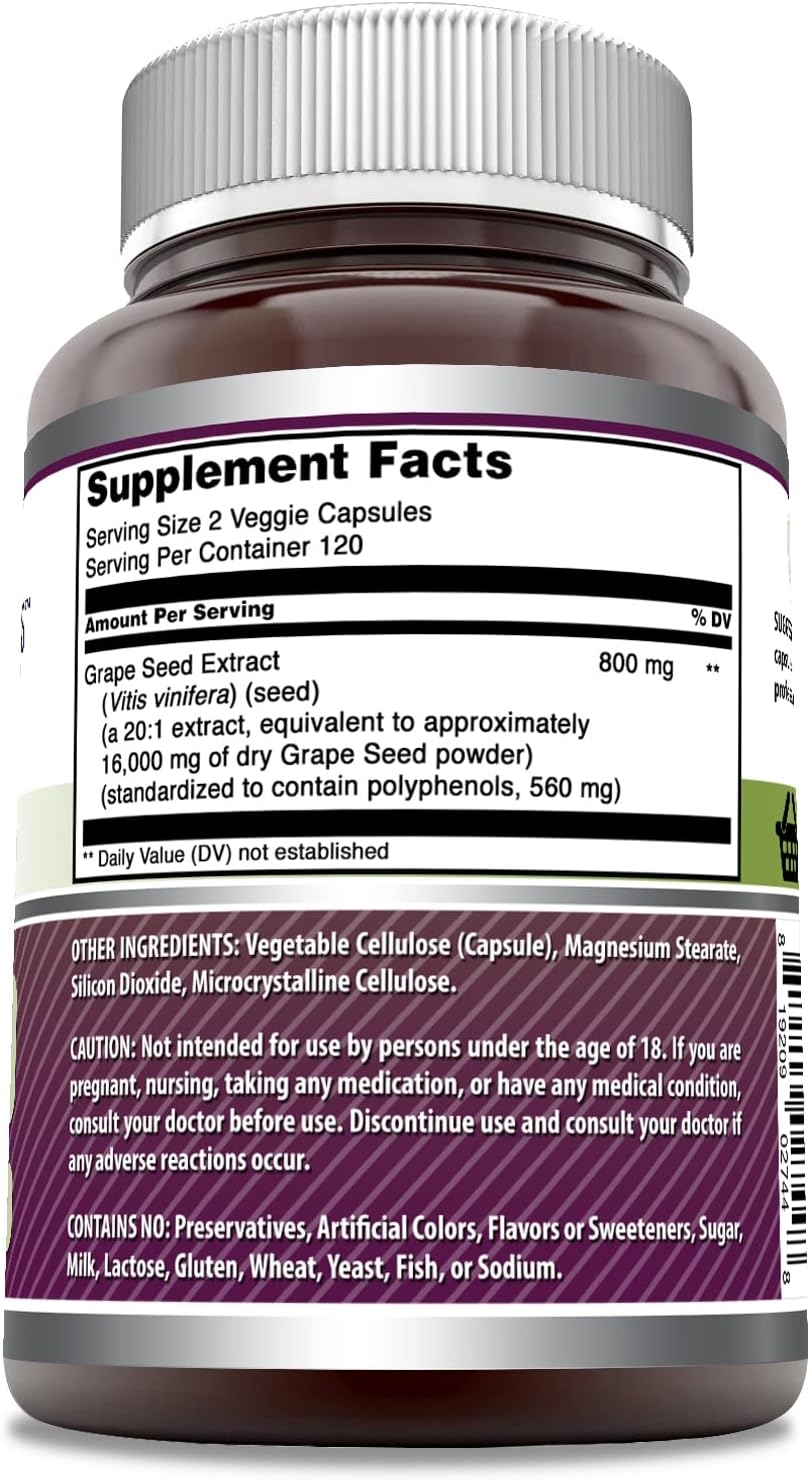
The number on the front of this bottle needs the same care. The Amazing Formulas label reads "16,000 mg per serving." The Supplement Facts panel underneath shows what that means: a serving is two capsules, containing 800 mg of grape seed extract, described as "a 20:1 extract, equivalent to approximately 16,000 mg of dry Grape Seed powder." In other words, 20 parts of raw seed were concentrated into 1 part of extract, and 800 × 20 = 16,000. The big number is the starting material, not the dose: what reaches you is 800 mg of extract, standardized to 560 mg of polyphenols.
Does It Lower Blood Pressure? A 19-Trial Answer
Blood pressure is written as two numbers, systolic over diastolic, such as 120/80 mm Hg, according to the National Heart, Lung, and Blood Institute. NCCIH's grape seed page summarizes the best pooled evidence: a 2022 review of 19 studies with 1,080 participants "showed that grape seed extract reduced diastolic blood pressure (the lower number in a blood pressure reading) but not systolic blood pressure (the higher number)." NCCIH adds that "results of individual studies differed, and the differences may have been related to the dose and duration of grape seed extract supplementation and characteristics of the study participants."
The underlying paper, published in Pharmacological Research in 2022 by Foshati and colleagues, gives the exact figures:
| Outcome | Pooled change | 95% confidence interval | Heterogeneity (I²) | Statistically significant? |
|---|---|---|---|---|
| Diastolic blood pressure | −2.20 mmHg | −3.79 to −0.60 | 88.8% | Yes |
| Systolic blood pressure | −3.55 mmHg | −7.59 to +0.49 | 97.4% | No |
| Heart rate | −1.25 beats/min | −2.32 to −0.19 | 59.5% | Yes |
| Flow-mediated dilation (artery widening) | +1.02% | −0.62 to +2.66 | 92.0% | No |
Two details matter more than the headline. First, the systolic estimate (−3.55 mmHg) is larger than the diastolic one, yet it is reported as not significant because its confidence interval crosses zero. Second, I² estimates how much of the variation between trial results reflects genuine differences between the trials rather than chance. Values of 89% and 97% mean the 19 trials were not measuring one consistent effect; the authors' subgroup analysis pointed to dose, duration and participant characteristics. They concluded that GSE "may be beneficial" for people with or at risk of cardiovascular disease, which is a hypothesis for further testing, not a treatment recommendation.
"These conclusions should not be considered definite because the studies were small, and the composition of the products varied from study to study."
— NCCIH, Grape Seed Extract, on the cholesterol trials (page last updated February 2025)Two Trials, Two Different Answers
The disagreement inside that pooled result is visible in two individual randomized trials. In a 2009 placebo-controlled study in Metabolism (Sivaprakasapillai and colleagues), people with metabolic syndrome took 150 mg or 300 mg of GSE daily, or a placebo, for 4 weeks. Systolic and diastolic pressure both fell compared with placebo; lipids and glucose did not change significantly.
A 2013 double-blind trial in the British Journal of Nutrition (Ras and colleagues) looked at 70 untreated adults with pre-hypertension or stage I hypertension, who took 300 mg per day of a polyphenol-rich extract or a placebo for 8 weeks. Blood pressure moved in the right direction — −3.0 mmHg systolic (95% CI −6.5 to 0.5) and −1.4 mmHg diastolic (95% CI −3.5 to 0.6) — but the abstract describes blood pressure as "modestly, but not significantly, affected." Blood-vessel signaling markers and platelet aggregation were also unaffected, and the authors concluded that this extract "does not significantly lower" ambulatory blood pressure in untreated people at this stage.
Two randomized trials at overlapping doses, in different populations and with different extracts, reached different conclusions. That is consistent with a heterogeneity of 97%, and it is why the honest summary is that it may lower diastolic pressure slightly in some groups, and the extract matters.
Mayo Clinic takes up the question many people have in mind when they reach for a supplement: how to lower blood pressure without medication.
Cholesterol: A Small Change and a Fragile Result
NCCIH describes a 2020 review of 11 studies (536 participants) in which grape seed extract "may have desirable effects" on LDL cholesterol and triglycerides, but not on total or HDL cholesterol. The paper behind it (Anjom-Shoae and colleagues, British Journal of Nutrition, 2020) gives the size of those effects:
| Lipid measure | Pooled change | 95% confidence interval |
|---|---|---|
| LDL cholesterol | −0.17 mmol/L | −0.34 to −0.01 |
| Triglycerides | −0.11 mmol/L | −0.18 to −0.05 |
| Total cholesterol | No significant overall effect | |
| HDL cholesterol | No significant overall effect | |
A 0.17 mmol/L LDL drop is roughly 6.6 mg/dL by our own unit conversion, and its interval ends at −0.01, barely on the significant side of zero. The paper also reports something that does not look like a straightforward dose-response: significant reductions in total and HDL cholesterol appeared in the subgroups of trials shorter than 10 weeks and of trials using under 300 mg per day. If cholesterol is the goal, the red yeast rice article covers the other supplement people take for it, and the FDA warning attached to that one.
Safety, and What NCCIH Does Not Say
NCCIH's safety statement is short: "Grape seed extract is generally well tolerated when taken orally or used topically." It adds: "If you take any type of medicine, talk with your health care provider before using grape seed extract or other herbal products; some herbs and medicines interact in harmful ways." On pregnancy and breastfeeding it says only that little is known about whether it is safe.
What the page does not do is name specific drug interactions or set a maximum dose, so this article will not either. Absence of a warning on one page is not evidence of safety. One data point: the 2013 trial above measured platelet aggregation, a clotting-related marker, and found it unaffected at 300 mg per day. That is one trial at one dose, and it does not settle what happens at 800 mg alongside a blood thinner. If you take a prescription medicine, particularly for blood pressure or clotting, ask your pharmacist or physician first.
NCCIH also reminds readers that "unlike drugs, dietary supplements are not approved by the U.S. Food and Drug Administration (FDA) before they are sold to the public." Its guide to using dietary supplements wisely is a good checklist before buying anything in this category.
Inside Amazing Formulas Grape Seed Extract: Label Versus Listing
The bottle holds 240 vegetable capsules, and the label suggests two capsules daily, preferably with a meal — a 120-day supply. It is made in the USA and distributed by Amazing Nutrition of South Hackensack, New Jersey; other ingredients are vegetable cellulose (the capsule), magnesium stearate, silicon dioxide and microcrystalline cellulose. Two claims on the store listing do not survive a comparison with the label:
| Topic | Store listing | Product label (Supplement Facts photo) |
|---|---|---|
| Amount | "16,000 milligrams of grapeseed" in each capsule | Per serving of 2 capsules: 800 mg extract, 20:1, equal to about 16,000 mg dry seed |
| Active class | Proanthocyanidins (OPCs) | "Standardized to contain polyphenols, 560 mg" — polyphenols, not a stated proanthocyanidin figure |
| Resveratrol | Says grapeseed contains natural resveratrol | No resveratrol amount declared |
| Vitamin C | Said to be present in grapeseed | No vitamin C declared |
| Count | 240 capsules | 120 servings × 2 capsules = 240 (matches) |
A correction, for accuracy: This store's description says each capsule contains "a massive 16,000 milligrams," and its short description says "per veggie capsule." The bottle's label, which we use throughout, says 16,000 mg is the seed equivalent of a two-capsule serving: 400 mg of extract and 280 mg of polyphenols per capsule. The description also credits the extract with effects on joints, skin collagen and "detoxifying" the blood. NCCIH says only that "not much is known about grape seed extract's effects on other conditions," and this article does not repeat those claims.
The table below sets the product's serving beside the two trials' doses. It compares scale, not equivalence: the trials used specific, differently standardized extracts.
| This product | Typical trial dose | NIH RDA / AI | Tolerable Upper Limit | |
|---|---|---|---|---|
| Grape seed extract | 800 mg extract per 2-capsule serving (560 mg polyphenols) | 150–300 mg extract per day (two trials above) | None: not an essential nutrient | None established: NCCIH's page states no dose or limit |
The label's serving is about 2.7 times the 300 mg used in the larger trial. That is a fact about scale, not a claim that more is better: the pooled blood pressure analysis found a non-linear dose relationship, and the lipid analysis found significant total and HDL changes in the subgroup dosed below 300 mg per day.
Who Should Consider It, and Who Should Skip It
The first-line message from the medical sources is not about supplements. MedlinePlus says treatments for high blood pressure "include heart-healthy lifestyle changes and medicines," and that you will work with your provider on a treatment plan. A supplement is something to raise with that provider, not a substitute for the plan. The CoQ10 and statin article looks at another supplement that sits alongside prescribed cardiovascular medicine.
Who this is for: adults who have discussed a grape seed extract with a clinician as a possible add-on, are not pregnant or breastfeeding, are not on a prescription that could interact, and understand the expected effect is small: about 2 mmHg diastolic in the pooled data, with real disagreement between trials.
Who should skip it: anyone pregnant or breastfeeding (NCCIH says little is known); anyone under 18 (the label says not to); anyone on blood-pressure or blood-thinning medication without their prescriber's agreement; and, frankly, most people, who should start with the steps their own provider recommends.
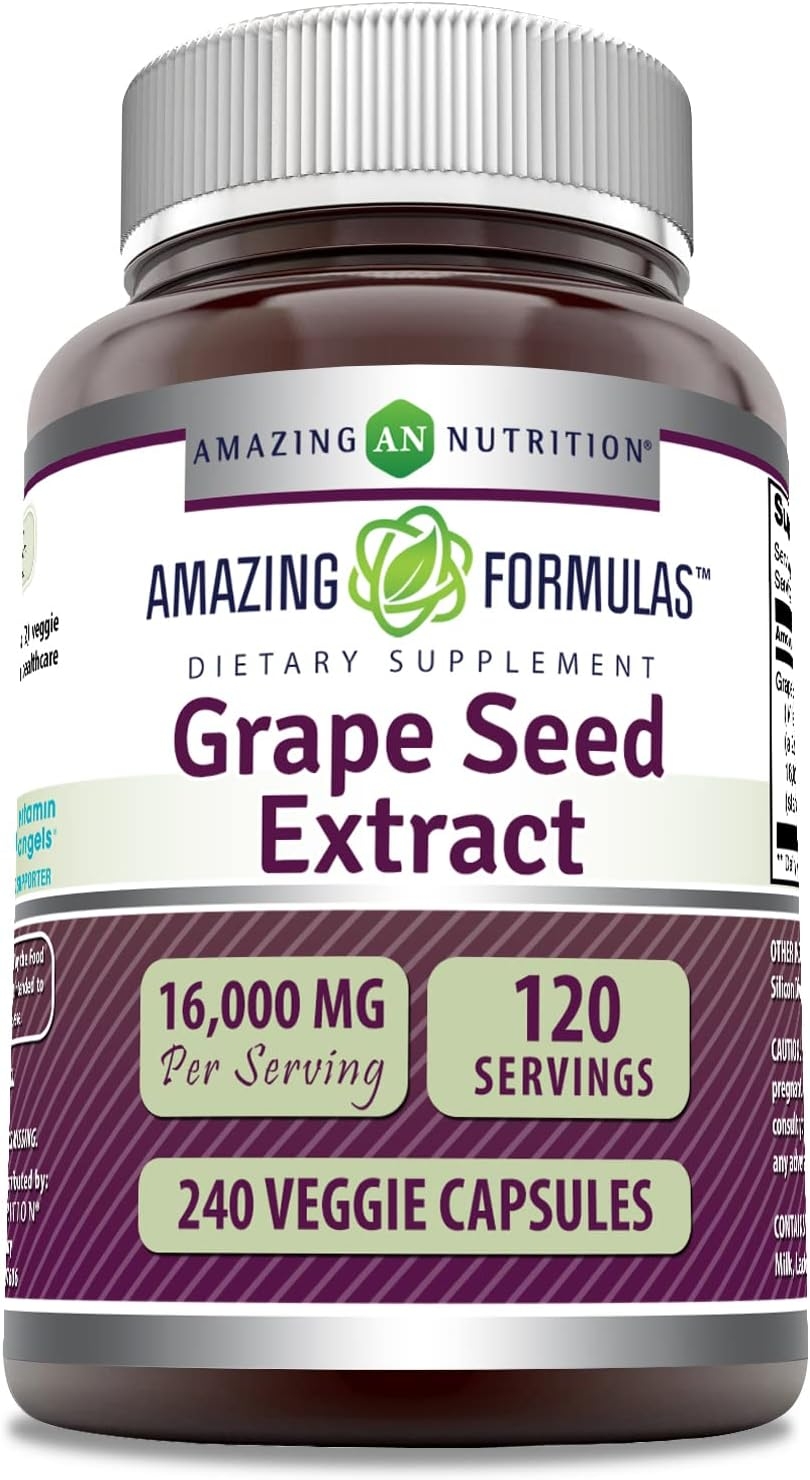
Amazing Formulas Grape Seed Extract — 240 Veggie Capsules
800 mg of 20:1 grape seed extract per two-capsule serving, standardized to 560 mg of polyphenols, 120 servings per bottle. As covered above, "16,000 mg" is the seed equivalent per serving, not per capsule. Check with your provider first if you take any medication.
View Product DetailsFrequently Asked Questions
Does grape seed extract lower blood pressure?
Slightly, and only the lower number. A 2022 meta-analysis of 19 trials found a 2.20 mmHg drop in diastolic pressure but no significant change in systolic pressure. The trials disagreed strongly with each other, so results depend on the extract, the dose and who took it.
How much grape seed extract should I take per day?
No official dose exists, because it is not an essential nutrient. The two trials discussed here used 150 to 300 mg of specific extracts daily; this label suggests two capsules, or 800 mg of extract. Follow the label or your clinician's advice.
What does "16,000 mg" on a grape seed bottle mean?
It is usually the weight of raw seed the extract was made from, not the amount in the capsule. On this bottle, 800 mg of 20:1 extract per two-capsule serving equals about 16,000 mg of dry seed. Read the Supplement Facts panel, not the front label.
Does grape seed extract lower cholesterol?
Modestly. A 2020 meta-analysis of 11 trials (536 people) found LDL fell 0.17 mmol/L, with a confidence interval of −0.34 to −0.01, and triglycerides fell 0.11 mmol/L. Total and HDL cholesterol did not change significantly. NCCIH says these conclusions are not definite.
Is grape seed extract safe?
NCCIH says it is generally well tolerated when taken by mouth or applied to skin, but little is known about safety in pregnancy or breastfeeding. Herbs and medicines can interact in harmful ways, so talk to a health care provider first if you take any medicine.
Is grape seed extract the same as resveratrol?
No. Grape seed extract is standardized here to polyphenols, and this label declares no resveratrol amount. Resveratrol is a separate compound found in grape products and red wine. If a specific compound matters to you, look for its milligram amount on the Supplement Facts panel.
Does grape seed extract help skin, joints or wound healing?
The evidence is thin. NCCIH says not much is known about effects beyond cholesterol and blood pressure, and there is not enough evidence to conclude whether skin application helps wound healing. Treat those claims as unproven.
Can I take grape seed extract with blood pressure medication?
Ask your prescriber first. NCCIH does not list specific interactions, but it warns that some herbs and medicines interact harmfully. If you already take blood pressure medication, an additional pressure-lowering supplement is exactly the combination your clinician should know about.
Sources
- NIH National Center for Complementary and Integrative Health. "Grape Seed Extract." Last updated February 2025. Accessed 29 September 2026. nccih.nih.gov
- Foshati S, et al. The effect of grape seed extract supplementation on flow-mediated dilation, blood pressure, and heart rate: a systematic review and meta-analysis. Pharmacological Research, 2022;175:105905. Accessed 29 September 2026. doi.org/10.1016/j.phrs.2021.105905
- Anjom-Shoae J, et al. Effects of grape seed extract on dyslipidaemia: a systematic review and dose-response meta-analysis of randomised controlled trials. British Journal of Nutrition, 2020;124(2):121-134. Accessed 29 September 2026. doi.org/10.1017/s0007114520000902
- Ras RT, et al. Effect of polyphenol-rich grape seed extract on ambulatory blood pressure in subjects with pre- and stage I hypertension. British Journal of Nutrition, 2013;110(12):2234-2241. Accessed 29 September 2026. doi.org/10.1017/s000711451300161x
- Sivaprakasapillai B, et al. Effect of grape seed extract on blood pressure in subjects with the metabolic syndrome. Metabolism, 2009;58(12):1743-1746. Accessed 29 September 2026. doi.org/10.1016/j.metabol.2009.05.030
- National Heart, Lung, and Blood Institute. "High Blood Pressure - What Is High Blood Pressure?" Accessed 29 September 2026. nhlbi.nih.gov
- MedlinePlus (National Library of Medicine). "High Blood Pressure." Accessed 29 September 2026. medlineplus.gov
- NIH National Center for Complementary and Integrative Health. "Using Dietary Supplements Wisely." Accessed 29 September 2026. nccih.nih.gov
This article is for educational purposes only and is not medical advice. It is not intended to diagnose, treat, cure, or prevent any disease. These statements have not been evaluated by the Food and Drug Administration. Talk to your doctor before starting any new supplement, especially if you are pregnant, breastfeeding, under 18, take any prescription medication (including for blood pressure or blood clotting), or have a medical condition.