
A 2011 meta-analysis of 11 placebo-controlled trials found that oral L-arginine lowered systolic blood pressure by 5.39 mmHg, yet every trial used 4 to 24 grams a day, while the label on this capsule directs 500 milligrams, up to three times a day. L-arginine is an amino acid and a substrate of nitric oxide synthase, the enzyme that makes the vessel-relaxing gas nitric oxide (Dong et al., 2011). The stake is whether a bottle bought for “circulation” reaches the studied dose, and who should leave it on the shelf after a 2006 heart-attack trial closed early with six deaths on arginine and none on placebo.
Key Takeaways
- A 2011 meta-analysis of 11 randomised trials in 387 people found L-arginine lowered systolic pressure by 5.39 mmHg and diastolic by 2.66 mmHg, at doses of 4 to 24 g a day (Dong et al., 2011).
- A 2022 update of 22 trials found systolic −6.40 mmHg, an effective dose of 4 g a day or more, and no significant change above 9 g a day (Advances in Nutrition, 2022).
- This capsule holds 500 mg and the label allows up to three a day, 1,500 mg, which is 37.5% of the 4 g threshold; reaching 4 g would take 8 capsules (product label).
- In the 2006 VINTAGE MI trial of 153 heart-attack patients given a goal of 9 g a day, 6 died on arginine (8.6%) against none on placebo, and enrolment was closed for safety (Schulman et al., 2006).
- One review set an Observed Safe Level of 20 g a day for healthy adults, while US adults already average 4.40 g a day from food (Shao and Hathcock, 2008; King et al., 2008).
In this article:
- What L-Arginine Is, and How Much You Already Eat
- Blood Pressure: What Two Meta-Analyses Found
- Blood Vessel Function: A Signal That Depends on Where You Start
- The Heart-Attack Trial That Closed Early for Safety
- Inside Amazing Formulas L-Arginine 500 mg
- Safety, and What We Could Not Verify
- Who Might Consider It, and Who Should Skip It
- Frequently Asked Questions
What L-Arginine Is, and How Much You Already Eat
The Advances in Nutrition review (2022) notes that earlier work suggested L-arginine “might have a blood pressure (BP)-lowering effect in different populations.” Whether a capsule moves that mechanism in a real person is a question for trials.
The first thing the trials need to beat is food. A 2008 analysis of the Third National Health and Nutrition Examination Survey (King et al.) found mean arginine intake for US adults was 4.40 g a day, with 25% of people consuming less than 2.6 g a day. Hypertension status was not significantly related to how much arginine people ate. One 500 mg capsule is about 11% of that average, and the label’s three-capsule maximum about a third.
Trial participants took several grams of supplement on top of roughly 4 g from food. Athletic claims for this amino acid are graded in our pre-workout ingredient guide, which this article does not repeat.
Blood Pressure: What Two Meta-Analyses Found
Two meta-analyses of placebo-controlled trials, eleven years apart, are the best evidence behind the “cardiovascular wellness” promise. Both report a drop in blood pressure; neither tested the label dose.
| Analysis | Trials and participants | Doses tested | Systolic change | Diastolic change |
|---|---|---|---|---|
| Dong et al., American Heart Journal, 2011 (searched to June 2011) | 11 double-blind trials; 387 participants | 4 to 24 g a day | −5.39 mmHg (95% CI −8.54 to −2.25) | −2.66 mmHg (95% CI −3.77 to −1.54) |
| Advances in Nutrition, 2022 (searched to April 2021) | 22 placebo-controlled trials; 30 effect sizes | Effective at 4 g a day or more; no significant change above 9 g a day | −6.40 mmHg (95% CI −8.74 to −4.05) | −2.64 mmHg (95% CI −3.94 to −1.40) |
Dong and colleagues (2011 abstract) found the result held in trials lasting four weeks or longer and in trials where participants did not use antihypertensive drugs. They concluded that “oral L-arginine supplementation significantly lowers both systolic and diastolic BP.” The 2022 update added a twist that the headline numbers hide. According to its abstract, the pooled analysis showed reductions regardless of whether people were normotensive or hypertensive, but “no significant changes were observed with dosages >9 g/d, trial duration >24 d, or in obese individuals.” In its non-linear dose-response analysis, “the effective dosage of L-arginine supplementation was detected to be ≥4 g/d for SBP.”
Two readings are fair. A drop of five to six mmHg is not trivial at population scale. But the effect sat in short trials, the dose-response faded above 9 g, and the 2022 abstract does not say how many of its 22 trials used low doses, so we cannot say whether 500 mg or 1,500 mg did anything; the 2011 analysis’s lowest dose was 4 g. Our grape seed extract guide weighs another blood-pressure supplement the same way.
Blood Vessel Function: A Signal That Depends on Where You Start
Flow-mediated dilation (FMD) measures how far an artery widens when blood flow increases. A 2009 meta-analysis in the American Journal of Clinical Nutrition (Bai et al.) pooled 12 short-term trials with 492 participants and found oral L-arginine raised FMD by 1.98 percentage points (95% CI 0.47 to 3.48).
| Subgroup | Net change in FMD | 95% CI | Significant? |
|---|---|---|---|
| All short-term trials (12 studies, 492 participants) | +1.98 points | 0.47 to 3.48 | Yes (P = 0.01) |
| Baseline FMD below 7% | +2.56 points | 0.87 to 4.25 | Yes (P = 0.003) |
| Baseline FMD above 7% | −0.27 points | −1.52 to 0.97 | No (P = 0.67) |
The benefit sat where function was poor and vanished where it was already good. The authors concluded that short-term oral L-arginine “is effective at improving the fasting vascular endothelial function when the baseline FMD is low.” There was only one long-term study, FMD is a lab measure rather than a heart attack or stroke, and the abstract gives no doses.
Mayo Clinic, “Mayo Clinic Minute: Do heart supplements work?” General background on heart supplements, not evidence about arginine; we have not checked whether it mentions it.
The Heart-Attack Trial That Closed Early for Safety
The strongest argument against casual use is a randomised trial in the people most likely to be tempted by a “cardiovascular” label. VINTAGE MI, published in JAMA on 4 January 2006 (Schulman et al.), was a single-centre, double-blind, placebo-controlled trial. It enrolled 153 patients after a first ST-segment elevation heart attack, 77 of them aged 60 or older, and randomised them to L-arginine (goal dose 3 g three times a day) or matching placebo for six months.
“L-arginine, when added to standard postinfarction therapies, does not improve vascular stiffness measurements or ejection fraction and may be associated with higher postinfarction mortality. L-arginine should not be recommended following acute myocardial infarction.”
— Schulman et al., VINTAGE MI randomized clinical trial, JAMA, 2006Safety warning: the trial was stopped for safety, not for lack of effect. If you have had a heart attack, do not start L-arginine without your cardiologist’s agreement. This was one trial of 153 people at about 18 capsules a day, and the abstract names no cause, but the authors’ recommendation was unambiguous.
To read this fairly: the group was fragile and 9 g is six times this label’s maximum, so it does not prove harm in a healthy adult taking 500 mg. It does show that the blood pressure results above do not transfer to every cardiac patient.
Inside Amazing Formulas L-Arginine 500 mg
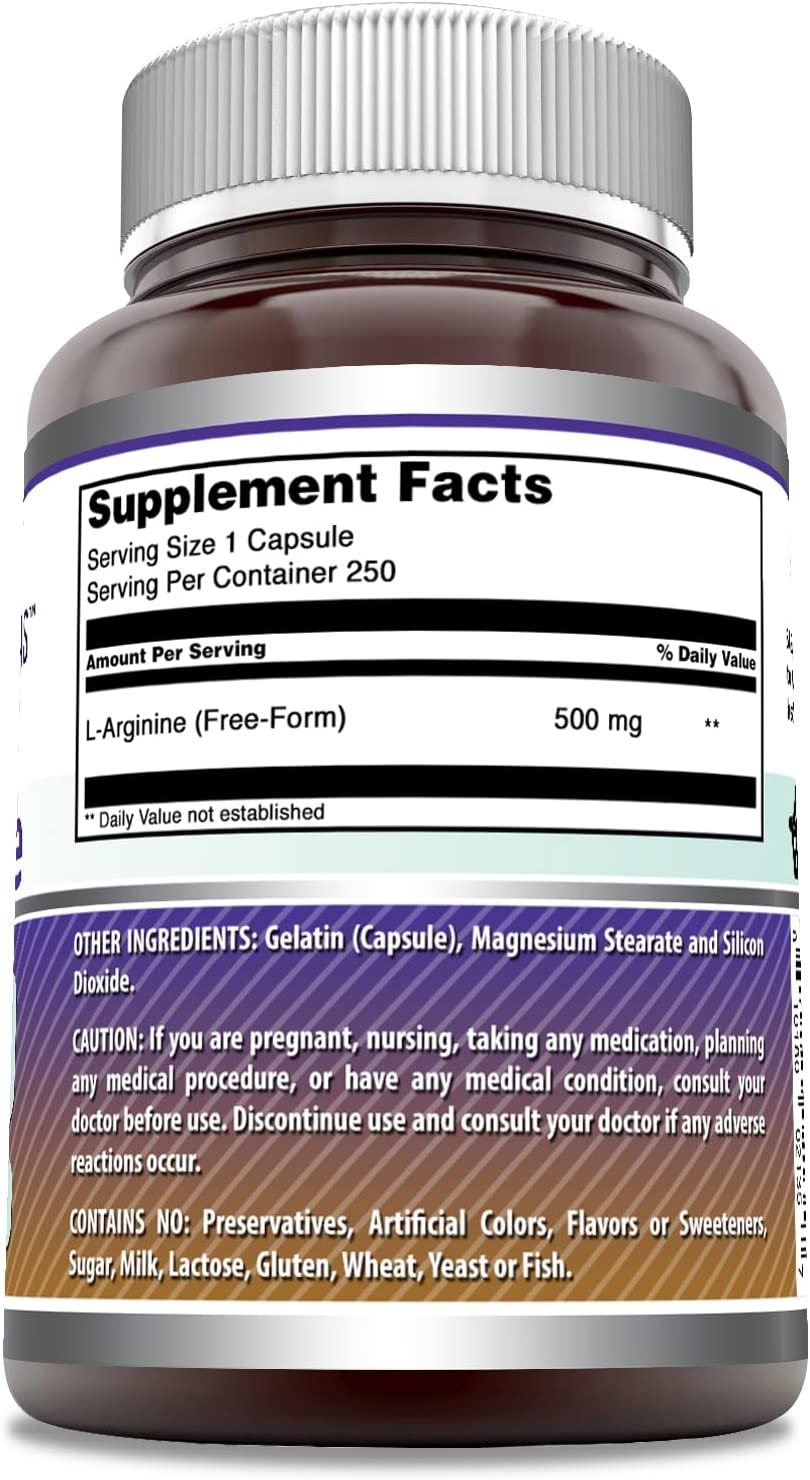
The Supplement Facts panel in the product photos shows a serving size of 1 capsule, 250 servings per container, and one active ingredient: “L-Arginine (Free-Form) 500 mg,” with the Daily Value marked as not established. Other ingredients are gelatin (the capsule), magnesium stearate and silicon dioxide. The suggested use reads: “As a dietary supplement, adults take one (1) capsule up to three times daily, preferably with a meal or as directed by a healthcare professional.” The label’s caution asks anyone pregnant, nursing, on any medication, planning a procedure or with a medical condition to consult a doctor first.
| This product | Doses in the trials above | NIH RDA / AI | Tolerable Upper Limit | |
|---|---|---|---|---|
| L-arginine, per day | 500 mg per capsule; 500 to 1,500 mg a day at 1 to 3 capsules | 4 to 24 g (2011 blood pressure analysis); 9 g goal (VINTAGE MI, 2006); US adult dietary average 4.40 g (NHANES III analysis, 2008) | None found in the sources we could read; the label states the Daily Value is not established | None set: a 2008 review could not derive one and instead proposed an Observed Safe Level of 20 g a day for healthy adults |
Put plainly, the label maximum of 1,500 mg is 37.5% of 4 g, the lowest dose in the 2011 analysis, and 6% of the 24 g top of its range. A 4 g day would take 8 capsules, so the bottle would last about 31 days; at the label maximum it lasts about 83.
The store listing differs from the label. It says each capsule uses “L-Arginine HCL, or hydrochloride,” and that “there is strong evidence that this type of L-arginine is more readily absorbed.” The photographed label says “Free-Form,” a different form, so trust the label; we found no trial comparing the two. The listing also calls arginine a “semi-essential amino acid” that “cannot be spontaneously produced by the body,” which contradicts itself, and we have not sourced how much the body makes. Its claims to “boost nitric oxide levels” and support immune, hormonal and libido function are manufacturer statements this article has not assessed.
Safety, and What We Could Not Verify
For healthy adults, the safety record at supplement doses is reassuring but imperfect. Shao and Hathcock (2008 risk assessment) found “the absence of a systematic pattern of adverse effects in humans” for oral arginine, which meant the usual NOAEL and LOAEL approach to a tolerable upper limit “could not be used.” They instead identified an Observed Safe Level of 20 g a day for normal healthy adults, adding that much higher levels “may be safe,” but that data above the OSL were “not sufficient for a confident conclusion of long-term safety.” No limit is not a clearance, and the review covers healthy adults, not the heart-attack patients VINTAGE MI tested.
The FDA’s dietary supplement Q&A (content current as of 27 August 2026) states: “Under DSHEA, FDA does not have the authority to approve dietary supplements before they are marketed.” We cannot confirm this capsule’s purity or potency.
What we could not verify: an authoritative side-effect or interaction list (the NIH Office of Dietary Supplements site refused our requests, and MedlinePlus no longer carries an arginine page); effects in pregnancy, breastfeeding or kidney disease; and any trial at 500 to 1,500 mg a day. Our own inference, not a sourced finding: if it can lower pressure by five or six mmHg in trials, anyone on blood pressure medication should tell their prescriber first.
Who Might Consider It, and Who Should Skip It
Who this is for: healthy adults, ideally with a clinician’s agreement, curious about arginine for blood pressure who understand the trials used 4 g or more, which would take 8 or more of these capsules, above the label’s own ceiling.
Who should skip it: most people. At the label dose of up to 1,500 mg, we found no trial showing a benefit, and food already supplies about 4.4 g. Skip it, or ask first, if you have had a heart attack (VINTAGE MI), have high or low blood pressure managed with medication, are pregnant or breastfeeding, are planning a medical procedure, or take any prescription drug, as the label itself cautions.
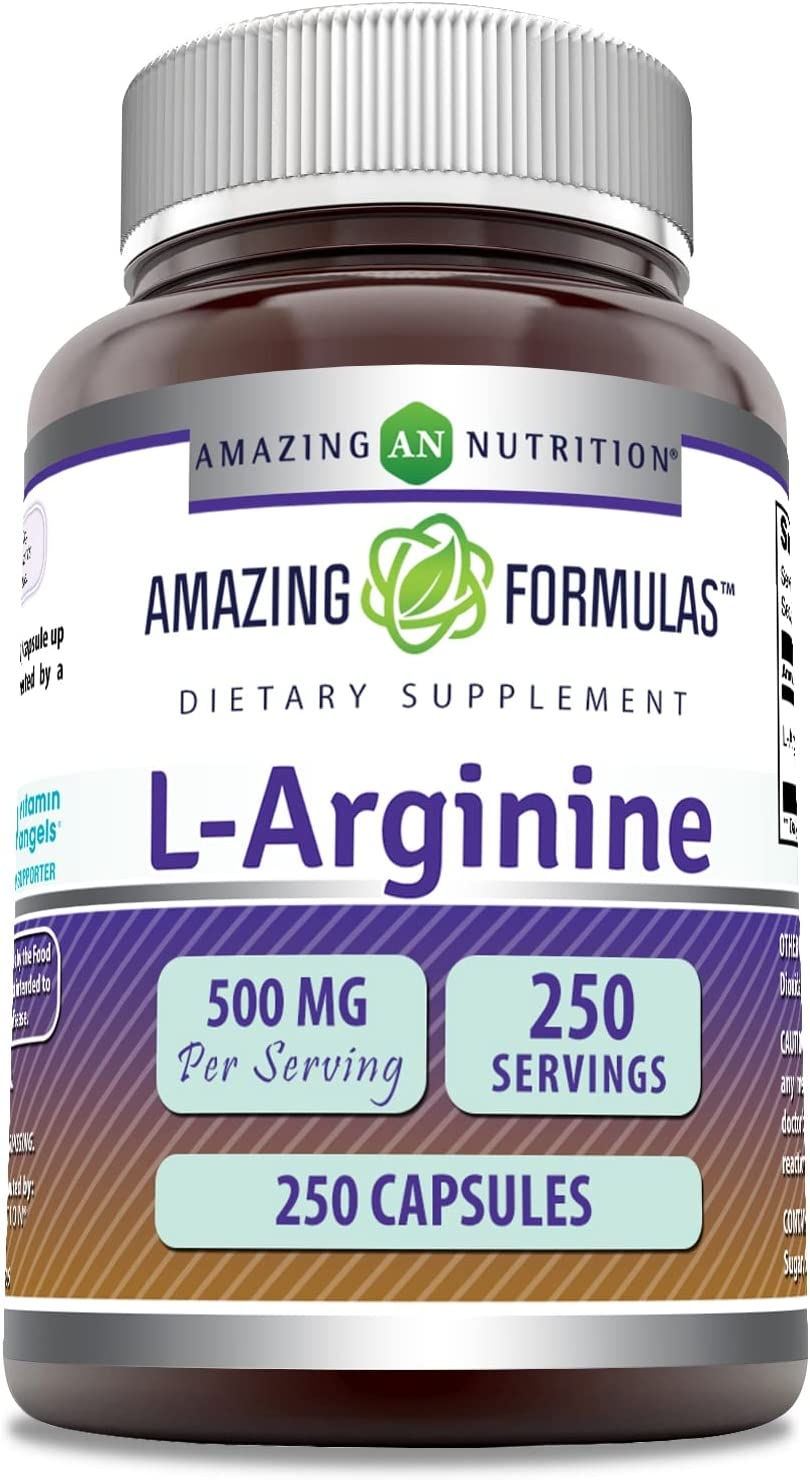
Amazing Formulas L-Arginine 500 mg, 250 Capsules
Single-ingredient free-form L-arginine, 500 mg per gelatin capsule, 250 capsules per bottle, with directions of one capsule up to three times daily with a meal. Browse more heart and cardiovascular supplements.
View Product DetailsFrequently Asked Questions
What is L-arginine?
L-arginine is an amino acid and a substrate of nitric oxide synthase, the enzyme that produces nitric oxide. US adults already take in about 4.40 g a day from food, according to a 2008 analysis of national survey data.
Does L-arginine lower blood pressure?
In pooled trials, yes, modestly. A 2011 meta-analysis of 11 trials found systolic pressure fell 5.39 mmHg, and a 2022 update of 22 trials found 6.40 mmHg. The doses were 4 g a day or more, far above this label.
How much L-arginine should you take for blood pressure?
No dose is established. The 2011 trials used 4 to 24 g a day, and a 2022 analysis found the effective dose was 4 g or more with no significant change above 9 g. Ask your clinician before taking any amount.
Is 500 mg of L-arginine enough to do anything?
We found no trial showing that. The lowest dose in the 2011 analysis was 4 g, eight times a single 500 mg capsule, and the label maximum of 1,500 mg is 37.5% of that. The label dose is unproven, not proven useless.
Is L-arginine safe after a heart attack?
The only trial we found says no. In the 2006 VINTAGE MI trial, 6 of the L-arginine patients (8.6%) died within six months against none on placebo, and enrolment was closed for safety. Its authors wrote that arginine should not be recommended after a heart attack.
What are the side effects of L-arginine?
A 2008 risk assessment found no systematic pattern of adverse effects and set an Observed Safe Level of 20 g a day for healthy adults. We could not retrieve an authoritative side-effect list, so ask a pharmacist if you take medicines.
Can you take L-arginine with blood pressure medication?
We found no authoritative interaction table. Because trials show arginine can lower pressure by roughly five to six mmHg, tell your prescriber before combining it with blood pressure drugs; the combined effect is not established in our sources.
Is free-form L-arginine different from L-arginine HCl?
They are different forms. This bottle’s label says free-form, while its store listing says hydrochloride and claims better absorption. We found no trial comparing them, so treat the absorption claim as a manufacturer statement and follow the label.
Sources
- Schulman et al. “L-arginine therapy in acute myocardial infarction: the Vascular Interaction With Age in Myocardial Infarction (VINTAGE MI) randomized clinical trial.” JAMA, 4 January 2006. Accessed 14 October 2026. PubMed record 16391217 (NLM)
- Dong et al. “Effect of oral L-arginine supplementation on blood pressure: a meta-analysis of randomized, double-blind, placebo-controlled trials.” American Heart Journal, December 2011. Accessed 14 October 2026. PubMed record 22137067 (NLM)
- “Effect of l-Arginine Supplementation on Blood Pressure in Adults: A Systematic Review and Dose-Response Meta-analysis of Randomized Clinical Trials.” Advances in Nutrition, 2022. Accessed 14 October 2026. PMC9340976
- Bai et al. “Increase in fasting vascular endothelial function after short-term oral L-arginine is effective when baseline flow-mediated dilation is low: a meta-analysis of randomized controlled trials.” American Journal of Clinical Nutrition, 2009. Accessed 14 October 2026. PubMed record 19056561 (NLM)
- Shao and Hathcock. “Risk assessment for the amino acids taurine, L-glutamine and L-arginine.” Regulatory Toxicology and Pharmacology, 2008. Accessed 14 October 2026. PubMed record 18325648 (NLM)
- King, Mainous and Geesey. “Variation in L-arginine intake follow demographics and lifestyle factors that may impact cardiovascular disease risk.” Nutrition Research, January 2008. Accessed 14 October 2026. PMC2245877
- U.S. Food and Drug Administration. “Questions and Answers on Dietary Supplements.” Content current as of 27 August 2026. Accessed 14 October 2026. fda.gov
This article is for educational purposes only and is not medical advice. It is not intended to diagnose, treat, cure, or prevent any disease. These statements have not been evaluated by the Food and Drug Administration. Talk to your doctor before starting any new supplement, especially if you have had a heart attack, are pregnant or breastfeeding, have a medical condition, or take any prescription medication.