
A typical pre-workout contains six or seven "performance" ingredients. According to the NIH, one of them has strong evidence, one has moderate evidence, and the rest range from conflicting to weak. That is not an argument against pre-workouts — it is an argument for knowing which parts of the scoop are doing the work. This guide grades every common ingredient against the NIH Office of Dietary Supplements fact sheet on exercise and athletic performance, and flags a timing conflict built into almost every product on the shelf.
Key takeaways
- Caffeine has the strongest evidence of any pre-workout ingredient: 2–6 mg/kg bodyweight, 15–60 minutes before exercise (210–420 mg for a 70 kg person).
- Beetroot nitrate is second: research uses ~500 ml of juice supplying 5–11 mmol nitrate, taken 2.5–3 hours before exercise.
- Those two timings conflict. Nitrate wants ~3 hours' lead; caffeine wants 15–60 minutes. One scoop cannot optimise both.
- Beta-alanine works by chronic loading — 4–6 g/day for 2–4 weeks to raise muscle carnosine 40–60%. It does almost nothing taken acutely before a session.
- NIH on L-arginine: a review of 54 studies found "little or no enhancement of athletic performance." On L-citrulline: research "does not provide strong support."
How the nitric oxide story actually works
Nitric oxide (NO) is a signalling molecule that relaxes the smooth muscle in blood vessel walls, widening them and improving blood flow. More blood flow to working muscle means better oxygen and nutrient delivery — hence the marketing interest.
There are two routes to producing it, and this is where most pre-workout labels get interesting:
- The arginine pathway. The enzyme nitric oxide synthase converts the amino acid L-arginine into NO. This is the pathway that "NO booster" supplements have targeted for decades with arginine and citrulline.
- The nitrate–nitrite–NO pathway. Dietary nitrate from vegetables — beetroot, rocket, spinach — is reduced to nitrite by bacteria on the tongue, then to nitric oxide in the body. This route does not require the enzyme at all and works especially well when oxygen is low, precisely the condition inside hard-working muscle.
Here is the irony worth noting: the pathway the supplement industry built its NO category on (arginine) is the one with weak evidence, while the pathway that comes from eating vegetables (nitrate) is the one that holds up. Most pre-workouts now include both, which is a reasonable hedge but tells you the ingredient list is assembled by marketing as much as by physiology.
Every ingredient, graded
All assessments below come from the NIH Office of Dietary Supplements fact sheet on dietary supplements for exercise and athletic performance.
| Ingredient | Evidence | Dose used in research | Timing |
|---|---|---|---|
| Caffeine | Strong — numerous trials, mostly consistent; endorsed by AND/ACSM | 2–6 mg/kg bodyweight | 15–60 min before |
| Nitrate (beetroot) | Moderate — improves exercise tolerance, economy and endurance in recreational athletes | ~500 ml juice; 5–11 mmol nitrate | 2.5–3 hours before |
| Beta-alanine | Conflicting — DoD review of 20 trials did not support use; ISSN found benefit for efforts >60 sec | 4–6 g/day, split into doses ≤2 g | Daily for 2–4 weeks, not acute |
| L-citrulline | Weak — "does not provide strong support" | 8 g citrulline malate | 1 hour before |
| L-arginine | Weak — 54-study review: "little or no enhancement" | 2–20 g/day | 1–28 days |
Adaptogens commonly added alongside — maca, Panax ginseng, rhodiola — are not covered as established performance aids. Rhodiola has some fatigue-related research behind it, but none of these belong in the same evidence tier as caffeine or nitrate.
Beetroot: dose and the 3-hour rule
Beetroot is the genuinely interesting ingredient here, and the NIH assessment is positive: citing the Academy of Nutrition and Dietetics position, the fact sheet notes beetroot can "enhance exercise tolerance and economy and improve endurance exercise performance in recreational athletes."
Two details from the research matter enormously in practice.
Dose. Studies use roughly 500 ml of beetroot juice — about two cups — supplying 5 to 11 mmol of nitrate. That is a substantial quantity of concentrated vegetable juice.
Timing. The nitrate must be converted through two steps before it becomes nitric oxide, so it is taken about 2.5 to 3 hours before exercise. Encouragingly, benefits persist for up to 24 hours after ingestion, which means consistency matters more than precision.
One harmless side effect worth expecting: beetroot can turn urine and stools pink or red. It is called beeturia, it is benign, and it alarms people who were not warned.
A practical note on the two-step conversion: the first step depends on bacteria living on your tongue. Antibacterial mouthwash can abolish the effect of dietary nitrate by killing them. If you are taking beetroot for performance, skip the antiseptic mouthwash.
Prof. Andrew Jones, the leading researcher on dietary nitrate and exercise, on dose and effect size.
Caffeine: the one that reliably works
If a pre-workout makes you feel dramatically different, caffeine is almost certainly why. The NIH describes "numerous clinical trials with mostly consistent results," and both the Academy of Nutrition and Dietetics and the American College of Sports Medicine endorse it.
| Parameter | Detail |
|---|---|
| Effective dose | 2–6 mg per kg bodyweight — 140–420 mg for a 70 kg person |
| Timing | 15–60 minutes before exercise |
| Peak blood level | Within 45 minutes |
| Half-life | 4–5 hours |
| Daily safety ceiling | 400–500 mg/day generally considered safe for adults |
Two practical consequences. First, check the caffeine content of your pre-workout against your bodyweight — many products sit below the studied range, particularly those using green tea extract rather than added caffeine. A 125 mg dose is real but modest: for a 70 kg person that is under 2 mg/kg, at the bottom edge of the effective band.
Second, that 4–5 hour half-life is why an evening session ruins sleep. Half the caffeine is still circulating five hours later, and sleep is a far bigger driver of training adaptation than any supplement in the tub.
The timing conflict nobody mentions
Put the two best-supported ingredients side by side and a structural problem appears:
- Nitrate needs 2.5–3 hours to convert.
- Caffeine peaks at 45 minutes and wants to be taken 15–60 minutes out.
Almost everyone takes their pre-workout 20–30 minutes before training. That timing is close to ideal for caffeine and roughly two hours too late for nitrate. You are paying for the beetroot and mistiming it.
There are two sensible fixes. Because nitrate's effects persist up to 24 hours, you can take a beetroot product daily, independent of training time, and treat it as a background intake rather than an acute pre-workout. Or you can split them: beetroot about three hours ahead, caffeine 30 minutes out. Either beats taking a combined scoop and assuming both halves are working.

Why beta-alanine is in the wrong product
Beta-alanine is the ingredient responsible for the tingling face and hands many people associate with "the pre-workout kicking in." That sensation is paraesthesia, a harmless nerve effect the NIH notes occurs at doses of 800 mg or more.
Here is the mismatch. Beta-alanine works by combining with histidine to form carnosine, which buffers acid buildup in muscle. Raising muscle carnosine requires 4–6 g daily, split into doses of 2 g or less, for at least two weeks — with effects increasing after four weeks, when muscle carnosine has risen 40–60%.
In other words, it is a chronic loading ingredient sold inside an acute product. A single scoop before training does essentially nothing for carnosine; it just makes your skin tingle, which many users understandably mistake for efficacy. Taken daily it does accumulate — but only if the daily dose reaches the effective range, which many blends do not.
The evidence is also genuinely mixed. A Department of Defense review of 20 human trials did not support beta-alanine for performance, while the International Society of Sports Nutrition found benefits for high-intensity efforts lasting more than 60 seconds. Both can be true if the benefit is real but small and specific to a narrow band of exercise.
A physiotherapist-led review of the beetroot performance literature.
How to choose and use one sensibly
- Check caffeine against your bodyweight. Target 2–6 mg/kg. Below that band, expect little; above it, expect jitters without extra benefit.
- Look for declared nitrate content on any beetroot product. Its absence is the norm, but its presence is a genuine quality signal.
- Beware proprietary blends. If ingredients are pooled into one total weight, you cannot check any dose against the research. That is usually the point.
- Judge beta-alanine on the daily total, not the tingle. Under about 4 g/day sustained, it is unlikely to do much.
- Time it deliberately — see §5.
- Do not train through the fundamentals. Sleep, total protein intake, progressive overload and consistency outrank every supplement here by a wide margin. Pre-workout is a small edge on top of a good programme, not a substitute for one.
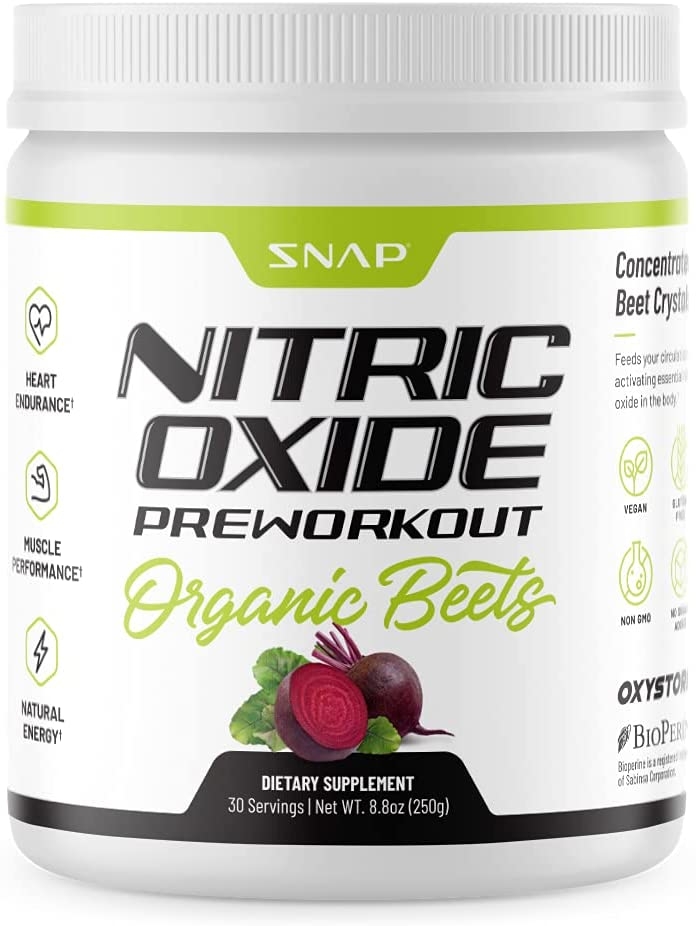
Snap Supplements Nitric Oxide Organic Beet Root Pre-Workout — Mixed Berry, 30 Servings
A multi-ingredient example of the category discussed above: organic beet root for dietary nitrate, plus beta-alanine, L-arginine HCl, L-citrulline malate, maca, Panax ginseng, rhodiola, B vitamins, and 125 mg of natural caffeine from organic green tea leaf extract. Use the evidence table in §2 to work out which parts of the blend are doing what, and note that 125 mg sits at the low end of the studied caffeine range for most adults.
Browse more in General Wellness and Vitamins & Minerals.
Frequently asked questions
Does beetroot powder actually improve performance?
Dietary nitrate has moderate evidence behind it — the NIH cites improvements in exercise tolerance, economy and endurance performance in recreational athletes. The important caveat is dose: research uses about 500 ml of beetroot juice supplying 5–11 mmol of nitrate. Most powders do not declare nitrate content, so it is often impossible to tell whether a scoop reaches the studied dose.
When should I take beetroot before exercise?
About 2.5 to 3 hours before, because dietary nitrate has to be converted first to nitrite and then to nitric oxide. Benefits persist for up to 24 hours after ingestion, so daily consistent intake works as well as precise timing.
How much caffeine should I take before a workout?
Research supports 2–6 mg per kilogram of bodyweight, taken 15 to 60 minutes before exercise — roughly 140–420 mg for a 70 kg person. Keep total daily caffeine from all sources below the generally accepted 400–500 mg ceiling, and remember the 4–5 hour half-life will affect sleep after evening sessions.
Why does pre-workout make my skin tingle?
That is paraesthesia caused by beta-alanine, which the NIH notes occurs at doses of 800 mg or more. It is harmless and unrelated to how well the product works — beta-alanine acts by raising muscle carnosine over weeks of daily use, not through any acute effect you can feel.
Do L-arginine and L-citrulline work?
The NIH assessment is weak for both. A review of 54 clinical studies concluded that supplemental arginine provided little or no enhancement of athletic performance and did not improve recovery from exhaustion. For citrulline, the fact sheet states the research does not provide strong support for enhancing exercise or athletic performance.
Is it safe to take pre-workout every day?
The main daily consideration is caffeine: keep the total from all sources under 400–500 mg, and be aware that tolerance builds. People with heart conditions, high blood pressure or anxiety disorders, and anyone pregnant, should speak to a doctor first. Beta-alanine and nitrate are generally taken daily by design.
Medical disclaimer. This article is for general education and is not medical advice. It is not a substitute for guidance from a qualified healthcare professional. Talk to your doctor before using stimulant-containing supplements, particularly if you have a heart condition, high blood pressure or an anxiety disorder, are pregnant or breastfeeding, or take prescription medication.
These statements have not been evaluated by the Food and Drug Administration. This product is not intended to diagnose, treat, cure, or prevent any disease.