
The International Society of Sports Nutrition calls creatine monohydrate “the most effective ergogenic nutritional supplement currently available to athletes” (position stand, 2017), yet the store listing for the tub reviewed here says it works by “giving the body the healthy fatty acids it needs” to strengthen the immune system, a claim that appears in neither of the Society’s two major reviews. Creatine is a compound the body makes from the amino acids arginine and glycine, found mostly in red meat and seafood, with about 95 percent of it stored in muscle (ISSN, 2017). This article separates what the trials support, what the safety record says, and what the listing adds.
Key Takeaways
- A pooled analysis of 22 trials with 721 older adults found creatine plus resistance training added 1.37 kg of lean tissue compared with placebo plus training (Chilibeck, Open Access J Sports Med, 2017).
- Daily intakes of 3 to 5 g work, and a loading phase “is not required” (ISSN, J Int Soc Sports Nutr, 2021); this tub’s serving is 5 g.
- In a review cited by the ISSN, serum creatinine did not rise in 12 studies, rose within the normal range in 8, and exceeded it in 2; in healthy people creatine can nudge a kidney blood test without harming the kidneys (ISSN, 2021), and MedlinePlus notes a high reading does not always mean a kidney problem (2023).
- The brain evidence is thin: a 2026 review found 6 studies with 1,542 older adults, only 2 of them supplement trials, and called for better trials (Marshall, Nutrition Reviews, 2026).
- Neither ISSN review mentions the immune system, so the listing’s claim that creatine “strengthens the immune system” has no support in the two reviews I read (2017, 2021).
In this article:
- What Creatine Is, and What You Already Make
- Does Creatine Build Muscle? Four Pooled Analyses
- How Much: Loading, 3 to 5 g, and Why More Is Not Better
- Kidneys, Hair, Water: The Safety Questions
- Beyond Muscle, and Who Paid for the Research
- Inside the Tub: Label Versus Listing
- Who Might Use It, and Who Should Skip It
- Frequently Asked Questions
What Creatine Is, and What You Already Make
According to the ISSN position stand (2017), the body needs to replace about 1 to 3 g of creatine a day, depending on muscle mass, and roughly half of that normally comes from food. A pound of uncooked beef or salmon supplies about 1 to 2 g. The rest is built in the liver and kidneys from arginine and glycine.
Muscle holds the stock. The same paper puts the average total creatine pool at about 120 mmol per kg of dry muscle, with an upper storage limit near 160. Vegetarians were reported to start lower, at 90 to 110, so they may gain more from a supplement. Our guide to L-arginine covers one of the two amino acids it is built from.
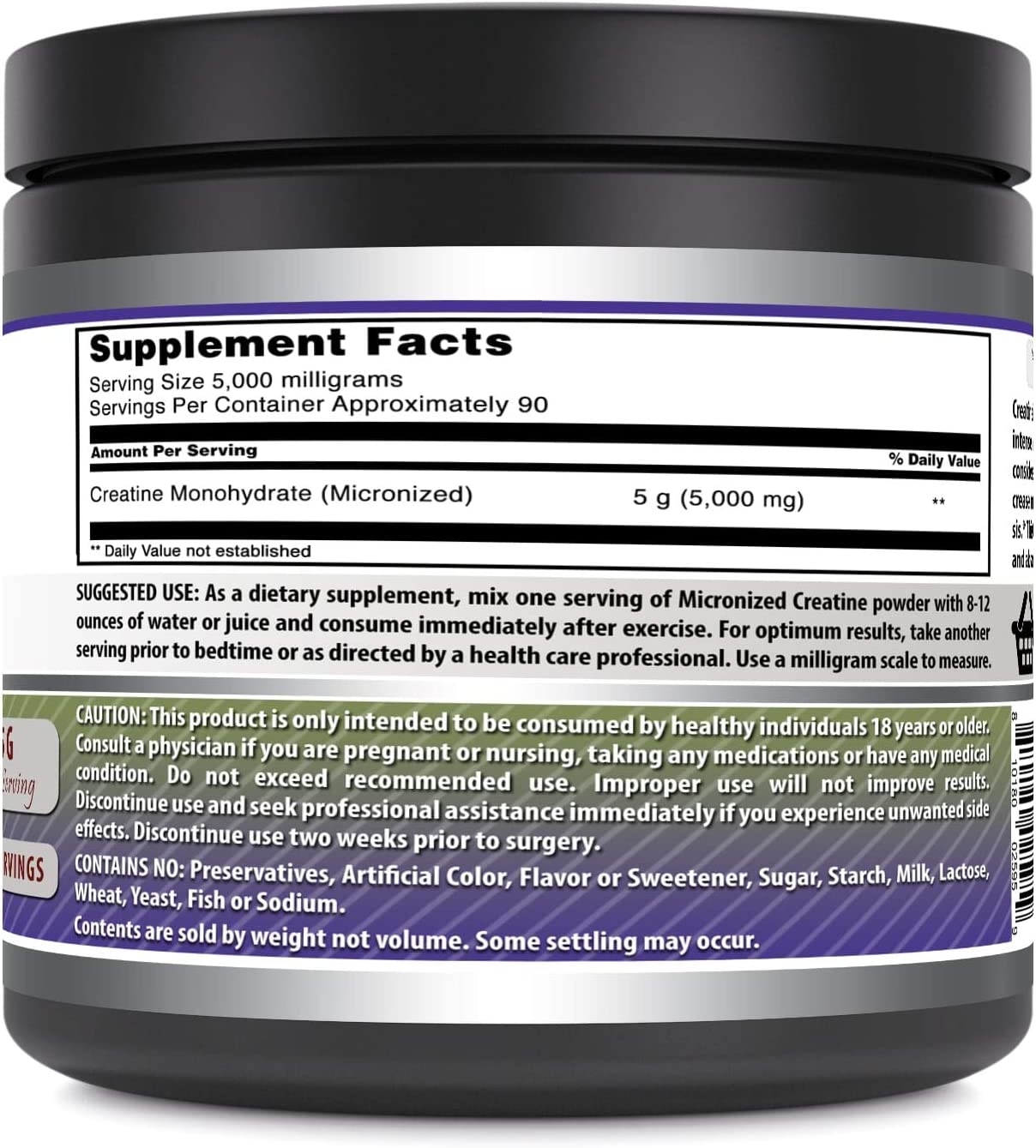
The product is Amazing Formulas Micronized Creatine Monohydrate Powder, 1 lb (454 g), listed at $37.00 and in stock on 25 October 2026. Its supplement facts panel shows one ingredient, creatine monohydrate (micronized), at 5 g (5,000 mg) per serving, about 90 servings per container.
Does Creatine Build Muscle? Four Pooled Analyses
A meta-analysis combines the results of several trials. I read the abstracts of four on creatine with resistance training in older adults, and all four favour creatine, though by modest amounts.
| Review (year) | What was pooled | Headline result | Caveat |
|---|---|---|---|
| Chilibeck, Open Access J Sports Med (2017) | 22 trials, 721 adults, mean age 57–70, 7–52 weeks | Lean tissue +1.37 kg (95% CI 0.97–1.76); chest press SMD 0.35; leg press SMD 0.24 | Compared with placebo plus the same training |
| Forbes, Nutrients (2021) | Updated analysis of the same question, by dosing strategy | Creatine increased lean mass and strength overall | With loading-phase studies excluded, no greater effect on chest or leg press strength |
| Liu, Eur Rev Aging Phys Act (2025) | 8 trials, 482 older adults | Lean mass SMD 0.27 (0.02–0.53); leg strength SMD 0.29 (0.00–0.57, p = 0.05) | No significant improvement in upper-body strength overall |
| Naddafha, J Int Soc Sports Nutr (2026) | 7 trials, 608 postmenopausal women, 12–104 weeks | Lean mass +0.37 kg (0.05–0.69); leg press +7.5 kg; bone density unchanged | Prediction interval for lean mass −0.10 to +0.84 kg; most trials rated “some concerns” of bias |
SMD, the standardized mean difference, puts different strength tests on one scale; values near 0.2 to 0.4 are conventionally read as small. These are real but modest gains, and every one was measured alongside training, not instead of it. The 2026 review found the benefit with 5 g or more a day combined with training, while trials at 3 g or less without training “showed no measurable effect.” Our guide to HMB covers another muscle supplement tested in older adults.
“Creatine monohydrate is the most effective ergogenic nutritional supplement currently available to athletes with the intent of increasing high-intensity exercise capacity and lean body mass during training.”
— Kreider et al., ISSN position stand, J Int Soc Sports Nutr (2017)How Much: Loading, 3 to 5 g, and Why More Is Not Better
The 2017 position stand describes the fastest route to full muscle stores as 5 g four times a day (about 0.3 g per kg of body weight) for 5 to 7 days, then 3 to 5 g a day to maintain them. That is the “loading phase.” The 2021 ISSN review concluded that smaller daily doses of 3 to 5 g (0.1 g per kg) are effective and “a creatine ‘loading’ phase is not required.”
Muscle can only hold so much, so doses beyond saturation do not add stores. The 2021 review warned that single servings above 10 g may cause gastrointestinal distress, such as diarrhea, and advised keeping loading doses to 10 g or less at a time.
Kidneys, Hair, Water: The Safety Questions
The 2021 ISSN review answered twelve common questions; the four readers ask about most are below.
| Question | Review’s conclusion | Detail worth knowing |
|---|---|---|
| Kidney damage? | Not at recommended doses in healthy individuals | Creatine and creatinine are both excreted; the scare traces to a 1998 case in a man who already had kidney disease |
| Hair loss? | “Majority of available evidence does not support a link” | One rugby study found DHT up 56% after a 25 g/day week; not replicated |
| Water retention? | “Does not always lead to water retention” | Early, short-term water shifts occur; 5–10 week studies found no rise in total body water |
| Dehydration or cramps? | Does not cause either | The 2017 paper noted users had less cramping and heat illness in a football study |
On hair, the 2021 review says the van der Merwe results “have not been replicated,” and that DHT stayed within normal limits. I found no trial that measured hair directly.
Long-term data in healthy people are reassuring. The 2017 paper reports football players taking 5 to 10 g a day for 21 months had no clinically significant differences in renal markers, liver enzymes or electrolytes against controls, and says up to 30 g a day for up to 5 years was well tolerated, though that figure comes from studies in patient populations, not healthy gym users. The 2026 review of postmenopausal women found adverse events “mild and similar to placebo.”
Creatine can change a kidney blood test. Muscle breaks down into creatinine, which kidneys clear, so blood creatinine is used as a kidney marker. The 2021 review warns that supplement users and heavy meat eaters should be read with caution, and MedlinePlus (December 2023) says high blood creatinine levels “don’t always mean you have a kidney problem,” listing a meat-heavy diet among the causes and asking patients to tell their provider about supplements. If you have kidney disease or an upcoming kidney test, ask a clinician before starting. The ISSN conclusions apply to healthy people.
Beyond Muscle, and Who Paid for the Research
Creatine is also studied for the brain. A 2026 systematic review in Nutrition Reviews (Marshall and colleagues) found six studies with 1,542 older adults, 55.7 percent of them women. Five of six reported a positive relationship with cognition, mainly memory and attention. But only two were double-blind supplement trials; four were cross-sectional surveys estimating intake from dietary recall, and quality was rated “good” for one, “fair” for two and “poor” for three. The authors wrote that “high-quality clinical trials are warranted.” A later letter in the same journal is titled as concerns about the review’s methodological rigor and interpretation, and the authors published a response; I have not read either in full.
Funding matters here too. The 2026 postmenopausal-women review discloses that one author chairs the Creatine for Health Scientific Advisory Board, which is supported by the creatine maker Alzchem, and states: “The ISSN receives funding on occasion from companies that manufacture, market, or sell creatine.” The 2017 position stand’s lead author disclosed industry grants and consulting, and the 2021 Forbes analysis lists advisory roles with a creatine manufacturer. Chilibeck’s 2017 meta-analysis reported no conflicts of interest.
That does not make the findings wrong; the direction is the same across reviews by different authors. It is a reason to trust the pooled numbers over adjectives like “most effective.”
Inside the Tub: Label Versus Listing
The label and the store listing make different claims. The label has the three starred claims “Supports ATP Production,” “Promotes Athletic Performance” and “Supports Lean Muscle Mass,” each carrying the FDA disclaimer. The listing goes further.
| Topic | Label photos | Store listing (manufacturer copy) | What the sources I read say |
|---|---|---|---|
| Immune system | Not mentioned | Says it “strengthens the immune system” by giving “healthy fatty acids” | Neither ISSN review mentions immunity; creatine is made from arginine and glycine, not fatty acids (ISSN, 2017) |
| Nitric oxide | Not mentioned | Says it helps release nitric oxide and bring more oxygen-rich blood to muscle | The term appears in neither ISSN review |
| Muscle and performance | “Promotes Athletic Performance”; “may help” increase muscle mass | Same, stated as a benefit | Supported as a modest gain alongside training (see pooled table) |
| Micronized | “mix easily in liquid and absorb faster in the body” | “Improved digestive comfort” | Micronization is not discussed in either ISSN review; the 2017 paper puts creatine absorption at nearly 100 percent |
| Quality | Made in USA and GMP badges | “No fillers” | No third-party certification seal is visible in the three photos |
Everything in the listing column is a manufacturer claim. The NCCIH (updated January 2019) notes that supplements you buy “may differ in important ways from products tested in studies,” and the FDA (content current as of 1 October 2024) says manufacturers “are responsible for evaluating the safety and labeling of their products before marketing.”
U.S. Food and Drug Administration, “Dietary Supplements Overview”: general background on supplement regulation from the agency itself; I have not checked every claim in it.
| This product | Typical research dose | Official intake guidance | Tolerable Upper Limit | |
|---|---|---|---|---|
| Creatine monohydrate | 5 g per serving; label suggests one after exercise and another before bed (up to 10 g/day) | 3–5 g/day maintenance; about 20 g/day (5 g four times) for 5–7 days if loading (ISSN, 2017, 2021) | None found; the label itself states Daily Value not established | None found; ISSN reports up to 30 g/day for up to 5 years was well tolerated, mainly in patient populations (2017); the label says not to exceed recommended use |
One serving sits at the top of the 3 to 5 g range; two a day would be 10 g, double the usual maintenance dose, which the 2017 paper associates with larger athletes. The label’s own spoon chart lists half a teaspoon as about 1,400 mg, one teaspoon as about 2,800 mg and one and a half as about 4,200 mg, with no 5,000 mg line, and tells you to “use a milligram scale to measure.” By my arithmetic a 5 g serving is roughly 1.8 teaspoons. At $37.00 for about 90 servings, one serving costs roughly 41 cents.
The label limits use to healthy people 18 or older and says to stop two weeks before surgery.
Who Might Use It, and Who Should Skip It
Who this is for: healthy adults doing regular resistance training who want a low-cost, well-studied add-on; older adults who are lifting and whose clinician agrees; and vegetarians or vegans, who the ISSN reports start with lower muscle creatine.
Who should skip it: most people who are not training, because every pooled gain above was measured alongside resistance exercise; anyone buying it for immune support, since nothing I read supports that; anyone with kidney disease or about to have a kidney blood test, until a clinician weighs in; anyone under 18, which the label excludes; and anyone pregnant or breastfeeding, taking medication or with a medical condition, unless a physician agrees, which is what the label asks. This tub itself was not tested in any trial; the trials used creatine monohydrate generally.
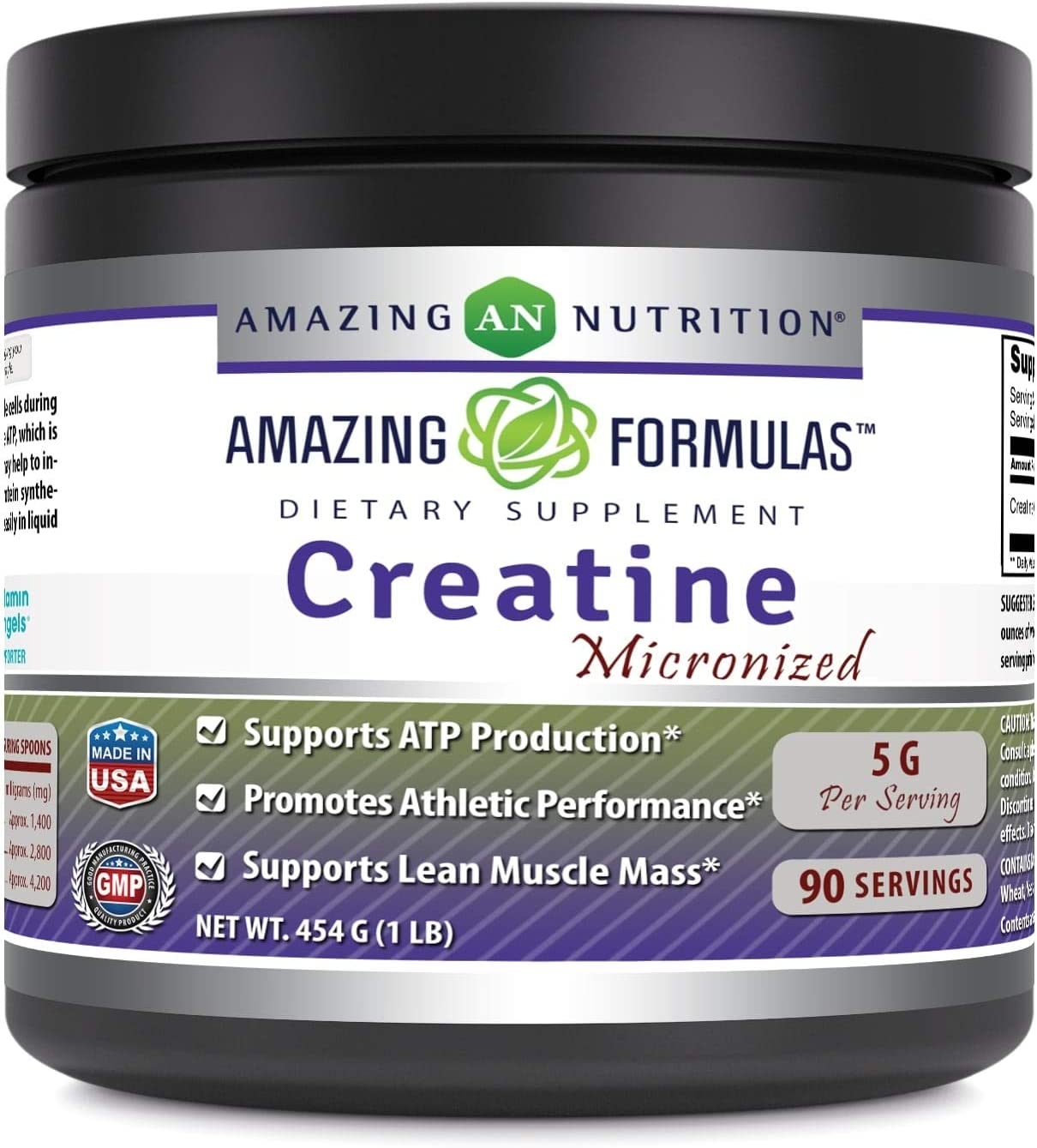
Amazing Formulas Micronized Creatine Monohydrate Powder – 1 lb
Unflavored micronized creatine monohydrate, 454 g, 5 g per serving, about 90 servings; the label gives no third-party testing seal. Browse more in our protein and sports powders.
View Product DetailsFrequently Asked Questions
What is creatine monohydrate?
Creatine monohydrate is the supplement form of creatine, a compound the body makes from arginine and glycine and gets from red meat and seafood. About 95 percent is stored in muscle (ISSN, 2017).
Does creatine build muscle?
With resistance training, pooled trials in older adults found greater lean tissue gains than training with placebo: 1.37 kg across 22 trials (2017) and 0.37 kg in postmenopausal women across 5 trials (2026). The 2021 ISSN review says creatine alone gives older adults only “some” benefit, with most coming alongside training, so expect modest gains.
How much creatine should I take a day?
The ISSN says 3 to 5 g a day, or 0.1 g per kg of body weight, is effective (2021). Larger athletes in heavy training may need 5 to 10 g (2017). This tub’s serving is 5 g; its label suggests a second serving at bedtime, which would be 10 g.
Do I need to load creatine?
No. A loading phase of about 20 g a day for 5 to 7 days raises muscle stores faster, but the 2021 ISSN review concluded loading “is not required” because daily 3 to 5 g reaches the same place over a few weeks. Single servings above 10 g may cause diarrhea.
Does creatine damage the kidneys?
In healthy people at recommended doses, the 2021 ISSN review found no kidney damage, and football players taking 5 to 10 g a day for 21 months had no clinically significant renal differences (2017). Creatine can raise blood creatinine, so tell your clinician; people with kidney disease should ask first.
Does creatine cause hair loss?
Probably not. The theory rests on one rugby study in which DHT rose 56 percent after a 25 g a day loading week (reported in the 2021 ISSN review). It has not been replicated, and the ISSN found most evidence does not support a link.
Does creatine cause bloating, cramps or dehydration?
The 2021 ISSN review found creatine does not cause dehydration or cramping and does not always cause water retention, though early short-term water shifts occur. Single servings above 10 g may cause diarrhea.
Does creatine boost the immune system or the brain?
The immune claim in this listing has no support in the two ISSN reviews I read. For the brain, a 2026 review of six studies in 1,542 older adults found mostly positive associations, but only two were supplement trials, and its authors called for higher-quality trials.
Sources
- Kreider RB, et al. International Society of Sports Nutrition position stand: safety and efficacy of creatine supplementation in exercise, sport, and medicine. Journal of the International Society of Sports Nutrition 2017;14:18. Accessed 25 October 2026. pmc.ncbi.nlm.nih.gov
- Antonio J, et al. Common questions and misconceptions about creatine supplementation: what does the scientific evidence really show? Journal of the International Society of Sports Nutrition 2021;18:13. Accessed 25 October 2026. pmc.ncbi.nlm.nih.gov
- Chilibeck PD, et al. Effect of creatine supplementation during resistance training on lean tissue mass and muscular strength in older adults: a meta-analysis. Open Access Journal of Sports Medicine 2017;8:213–226. Accessed 25 October 2026. pmc.ncbi.nlm.nih.gov
- Forbes SC, et al. Meta-analysis examining the importance of creatine ingestion strategies on lean tissue mass and strength in older adults. Nutrients 2021;13(6):1912. Accessed 25 October 2026. pmc.ncbi.nlm.nih.gov
- Liu S, et al. The impact of creatine supplementation associated with resistance training on muscular strength and lean tissue mass in the aged: a systematic review and meta-analysis. European Review of Aging and Physical Activity 2025;22(1):26. Abstract via NCBI PubMed record 41388441. Accessed 25 October 2026. ncbi.nlm.nih.gov
- Naddafha S, et al. Creatine monohydrate for lean mass, strength, and bone density in postmenopausal women: a systematic review and meta-analysis. Journal of the International Society of Sports Nutrition 2026;23(1):2668435. Accessed 25 October 2026. pmc.ncbi.nlm.nih.gov
- Marshall S, et al. Creatine and cognition in aging: a systematic review of evidence in older adults. Nutrition Reviews 2026;84(2):333–344. Accessed 25 October 2026. pmc.ncbi.nlm.nih.gov
- Quaresma MVLDS. Concerns regarding the methodological rigor and interpretation of “Creatine and cognition in aging.” Nutrition Reviews 2026;84(10):2215–2218. Record only, full text not read. Abstract via NCBI PubMed record 41405942. Accessed 25 October 2026. ncbi.nlm.nih.gov
- MedlinePlus. Creatinine tests. Last updated 5 December 2023. Accessed 25 October 2026. medlineplus.gov
- National Center for Complementary and Integrative Health. Using dietary supplements wisely. Last updated January 2019. Accessed 25 October 2026. nccih.nih.gov
- U.S. Food and Drug Administration. Dietary supplements. Content current as of 1 October 2024. Accessed 25 October 2026. fda.gov
This article is for educational purposes only and is not medical advice. It is not intended to diagnose, treat, cure, or prevent any disease. These statements have not been evaluated by the Food and Drug Administration; product statements come from its store listing and label photos. Talk to your doctor before using any supplement, especially if you have kidney disease or an upcoming kidney blood test, take prescription medicine, are facing surgery, are under 18, or are pregnant or breastfeeding.