
The best human result for oral glutamine in gut health, an 8-week trial in 106 completers with post-infectious irritable bowel syndrome (Gut, 2019), used 15 g a day; the capsule reviewed here holds 0.5 g, and the label allows at most two of them. L-glutamine is an amino acid the body uses to build proteins and to fuel immune and gut-lining cells, and it is sold as a capsule for “immune and gut health”. Meanwhile, the one large trial that gave glutamine to very sick patients in intensive care found more deaths on it, not fewer.
Key Takeaways
- In a 2019 Gut trial, 115 adults with post-infectious IBS-D and a leaky-gut marker took 5 g three times daily (15 g) or placebo for 8 weeks; among completers, 79.6% on glutamine met the symptom-improvement target against 5.8% on placebo. The authors called for larger trials.
- The same trial’s dose is 30 capsules of this product a day; the label directs 1 or 2 capsules (0.5–1 g), so a 100-capsule bottle would last about 3 days at the trial dose (our calculation).
- The REDOXS trial (NEJM, 2013) of 1,223 critically ill adults found 28-day mortality of 32.4% with glutamine against 27.2% without (adjusted OR 1.28, 95% CI 1.00–1.64, P = 0.05), and higher in-hospital and 6-month mortality.
- For athletes, a 2019 meta-analysis of 25 trials found no effect of glutamine on immune function, aerobic performance or body composition, and a 6-week trial in 31 young adults found no muscle benefit at 0.9 g per kg of lean mass a day.
- The FDA approved prescription L-glutamine powder in July 2017 only for sickle cell disease, at 5–15 g twice daily by body weight; this is a drug product tested in a 230-patient trial, not evidence for a 500 mg supplement.
In this article:
- What L-Glutamine Is, and Why a Shortage Argument Doesn’t Settle Anything
- Gut Health: One Promising Trial at 15 g, One Null Trial at 21 g
- The Warning: What Happened When ICU Patients Got Glutamine
- Muscle and Immunity: What Athletes’ Trials Found
- The FDA-Approved Version, and Why It Isn’t This Capsule
- Inside Life Extension L-Glutamine 500 mg: Label Versus Trials
- Who Might Consider It, and Who Should Skip It
- Frequently Asked Questions
What L-Glutamine Is, and Why a Shortage Argument Doesn’t Settle Anything
Glutamine is an amino acid, a unit of protein that cells also burn as fuel. Life Extension’s own product imagery says “can be found in the blood, as well as stored in the skeletal muscles and liver”, and that it is an energy source for gut-lining and immune cells. The sales leap is from “cells use it” to “a capsule helps”, and the research does not make that leap for you.
A 2008 review in the Journal of Nutrition by Gleeson (J Nutr, October 2008) makes the point for athletes. Plasma glutamine does fall after prolonged exercise, but feeding it back “does not prevent the postexercise changes in several aspects of immune function”, and the suggested reasons for taking supplements, including immune support, “have received little support from well-controlled scientific studies in healthy, well-nourished humans.”
The FDA (FDA consumer guidance, content current as of 21 October 2022) states that it is “not authorized to approve dietary supplements for safety and effectiveness before they are marketed.” Read everything below with that in mind. We have reviewed similar gut and recovery claims for probiotics and HMB.
Gut Health: One Promising Trial at 15 g, One Null Trial at 21 g
The gut claim rests on the idea that glutamine feeds the cells lining the intestine and can tighten a leaky barrier. Two trials test it, and they disagree.
| Study | People and dose | What it found |
|---|---|---|
| Zhou et al., Gut, 2019 | 115 adults with post-infectious IBS-D and raised gut permeability, randomised (59 glutamine, 56 placebo); 5 g three times daily for 8 weeks; 106 completers analysed | Primary endpoint (≥50-point fall in IBS-SS score) in 43 (79.6%) on glutamine vs 3 (5.8%) on placebo; IBS-SS 301 to 181; permeability normalised; no serious adverse events |
| Den Hond et al., JPEN, 1999 | 14 people with Crohn’s disease and raised permeability; 7 g three times daily for 4 weeks (7 per group) | Permeability did not change significantly after glutamine or placebo; no significant effect on disease activity index or C-reactive protein |
The Gut result is large, and the authors wrote that glutamine “dramatically and safely reduced all major IBS-related endpoints”. It is also one trial in a narrow group, people with diarrhoea-predominant IBS that began after a gut infection and who had a measured permeability problem. The analysis covered completers (54 of 59 and 52 of 56), and the conclusion itself asks that “large randomised clinical trials (RCTs) should now be done to validate these findings.” The authors state that none of them has any competing interests, and the trial was funded by the US National Institutes of Health (NCCIH and NIDDK) and the Department of Veterans Affairs (Gut, 2019).
“Oral glutamine supplements, in the dose administered, do not seem to restore impaired permeability in patients with Crohn’s disease.”
— Den Hond et al., JPEN Journal of Parenteral and Enteral Nutrition, January–February 1999, conclusion of the abstractThe Crohn’s trial is only 14 people, so it cannot rule out an effect, but it ran at 21 g a day. Neither trial used anything close to 500 mg.
NEJM Group, “Glutamine to Treat Sickle Cell Disease”. We could not read a transcript, so it is background for the sickle cell section below, not a source for any figure in this article.
The Warning: What Happened When ICU Patients Got Glutamine
Safety warning — serious illness: in the REDOXS trial, critically ill adults with multiple organ failure who received glutamine had higher mortality. Glutamine supplements are not a safe self-treatment for anyone who is seriously ill, on a ventilator or recovering from major illness. Ask the treating team before taking any amino acid supplement.
REDOXS is a large controlled test of the idea in the sickest patients. In REDOXS (Heyland et al., New England Journal of Medicine, 18 April 2013), 1,223 ventilated adults with multiorgan failure in 40 intensive care units received glutamine, antioxidants, both or placebo, started within 24 hours of admission and given intravenously and through the gut.
The authors reported a “trend toward increased mortality at 28 days” with glutamine, 32.4% versus 27.2% (adjusted odds ratio 1.28, 95% CI 1.00 to 1.64, P = 0.05), and in-hospital and 6-month mortality “significantly higher” among those given glutamine. They concluded that glutamine “was associated with an increase in mortality among critically ill patients with multiorgan failure.”
Two caveats keep this fair. The patients were far sicker than anyone buying a capsule, and the doses were high and partly intravenous; an erratum corrected a dosage error in the article text, so we do not quote the doses. The reading is narrow: glutamine is not harmless in every circumstance.
Muscle and Immunity: What Athletes’ Trials Found
Glutamine is a staple of sports shelves, so the muscle and immune claims have been tested more than most.
| Study | Design | What it found |
|---|---|---|
| Ramezani Ahmadi et al., Clinical Nutrition, 2019 | Systematic review of 47 studies; meta-analysis of 25 trials in athletes over 18, searched to January 2017 | No effect on the immune system, aerobic performance or body composition; a small pooled weight reduction (WMD −1.36, P = 0.02) |
| Candow et al., European Journal of Applied Physiology, December 2001 | 31 young adults, double-blind; 0.9 g per kg lean tissue mass per day for 6 weeks of resistance training | Strength, torque, lean mass and muscle protein breakdown did not differ significantly from placebo |
The meta-analysis conclusion is plain: “generally, glutamine supplementation has no effect on athletics immune system, aerobic performance, and body composition.” Candow’s group concluded that glutamine supplementation during resistance training “has no significant effect on muscle performance, body composition or muscle protein degradation in young healthy adults.” A product’s “supports healthy muscle mass” line therefore has little controlled evidence behind it in healthy trainees.
A pilot study in Nutrients (Nutrients, 27 September 2020) gave 14 healthy men single doses of 0.3, 0.6 or 0.9 g per kg of fat-free mass. Digestive symptoms were greater at the highest dose, though most were rated mild. That concerns large doses, not a 500 mg capsule.
The FDA-Approved Version, and Why It Isn’t This Capsule
One form of L-glutamine is an approved drug, much as NAC is an approved drug in another form. On 7 July 2017 the FDA (FDA news release, 7 July 2017) approved Endari (L-glutamine oral powder) for people aged five and older with sickle cell disease, to reduce severe complications. In the 48-week trial of 230 patients aged 5 to 58, those on Endari had a median of 3 sickle cell crises against 4 on placebo, 2 hospitalisations against 3, and 6.5 hospital days against 11; acute chest syndrome occurred in 8.6% against 23.1%.
| Body weight | Per dose | Per day |
|---|---|---|
| Under 30 kg (66 lb) | 5 g | 10 g |
| 30 to 65 kg (66–143 lb) | 10 g | 20 g |
| Over 65 kg (143 lb) | 15 g | 30 g |
The NEJM paper (Niihara et al., NEJM, 19 July 2018) used pharmaceutical-grade L-glutamine at 0.3 g per kg per dose, twice daily, and was funded by Emmaus Medical, the drug’s maker. FDA lists constipation, nausea, headache and abdominal pain among common side effects, and the label says safety “has not been established in patients with renal or hepatic impairment”. MedlinePlus (MedlinePlus drug information, last revised 15 September 2017) describes it as a powder taken twice daily on prescription.
The approval covers one disease, a prescribed 10 to 30 g a day, and a drug-quality powder. It does not show that 500 mg in a capsule does anything for immunity or digestion, and the supplement is no substitute for sickle cell treatment.
Inside Life Extension L-Glutamine 500 mg: Label Versus Trials
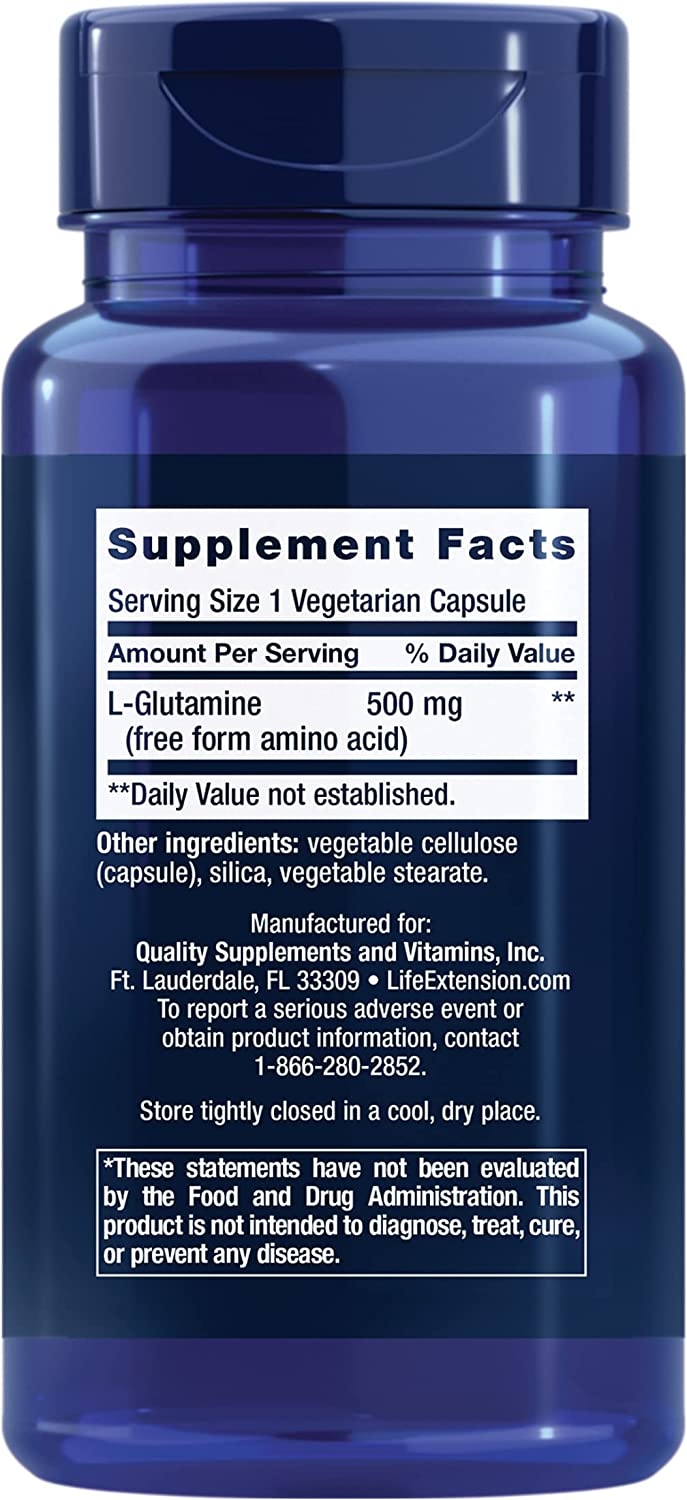
The product is Life Extension L-Glutamine 500 mg, 100 vegetarian capsules. The Supplement Facts photo shows a serving of one vegetarian capsule containing L-glutamine 500 mg (free form amino acid), Daily Value not established. Other ingredients are vegetable cellulose (capsule), silica and vegetable stearate. The directions read “Take one (1) capsule once or twice daily on an empty stomach, or as recommended by a healthcare practitioner”, so a bottle lasts 50 to 100 days (our calculation).
| This product (label directions) | 2019 Gut IBS-D trial | FDA-approved Endari | NIH RDA / AI | Tolerable Upper Limit | |
|---|---|---|---|---|---|
| L-glutamine per day | 0.5 g (1 capsule) to 1 g (2 capsules) | 15 g (5 g three times daily) | 10 g to 30 g (5–15 g twice daily by weight) | None established | None established; 14 g a day Observed Safe Level for healthy adults (2008 risk assessment) |
We found no NIH RDA, Adequate Intake or Upper Limit for glutamine; the 2020 Nutrients paper calls it a “conditionally essential” amino acid. “None established” is not the same as “safe at any dose”. A 2008 risk assessment by two scientists at the Council for Responsible Nutrition, a supplement-industry trade group (Regulatory Toxicology and Pharmacology, April 2008), found too few adverse effects in trials to set a formal UL, and instead named an Observed Safe Level of 14 g a day for healthy adults, adding that data above it were “not sufficient for a confident conclusion of long-term safety.” The 15 g IBS-D trial dose and the upper Endari doses sit above that level, which is one more reason to take any high-dose plan to a clinician rather than copy it. The doses studied for gut symptoms and sickle cell disease are 10 to 30 times the product’s maximum label dose of 1 g (our calculation), and the one result that is dramatic, the IBS-D trial, is the one most unlike a person taking a capsule.
| Claim | Where it appears | What we checked |
|---|---|---|
| “Immune & Gut Health”, “supports intestinal barrier integrity” | Store listing title and short description | Manufacturer wording. The one gut-barrier trial we found in IBS-D used 15 g a day; a 14-person Crohn’s trial at 21 g a day found no permeability change |
| “Supports healthy muscle mass” | Store listing bullet | Manufacturer wording. A 25-trial meta-analysis found no effect on body composition in athletes |
| “For Mood, Muscle and Immune Support” | Front of the bottle | The bottle says mood; the store title says gut. We did not review mood trials and take no position on that claim |
| Dose, directions, caution | Label photos | One 500 mg capsule once or twice daily; the label cautions people with “significant kidney or liver disease” to consult a practitioner, and advises a physician if pregnant, lactating or under treatment |
The listing’s directions match the label. We did not verify potency, purity or contaminant testing, and the photos show a “Non-GMO” mark but no testing laboratory or results. Under DSHEA these statements have not been evaluated by the FDA, and the label says the product is not intended to diagnose, treat, cure or prevent any disease.
Who Might Consider It, and Who Should Skip It
Who this is for: a healthy adult who has talked to a clinician about a specific goal and wants a low, label-dose amino acid capsule, understanding that the trials behind the headline results used 15 g a day or more and that benefit at 0.5–1 g is unproven. People with post-infectious IBS-D who are interested in the Gut trial should discuss it with a gastroenterologist rather than copying its dose.
Who should skip it: most people. Skip it, or ask first, if you have kidney or liver disease (the label’s own caution, and the FDA label for the prescription version says safety has not been established), if you are seriously ill or in hospital (REDOXS), if you are pregnant or breastfeeding, or if you have sickle cell disease and are considering this instead of prescribed treatment. If you are buying it for athletic performance or immunity, the pooled evidence says it is unlikely to help.
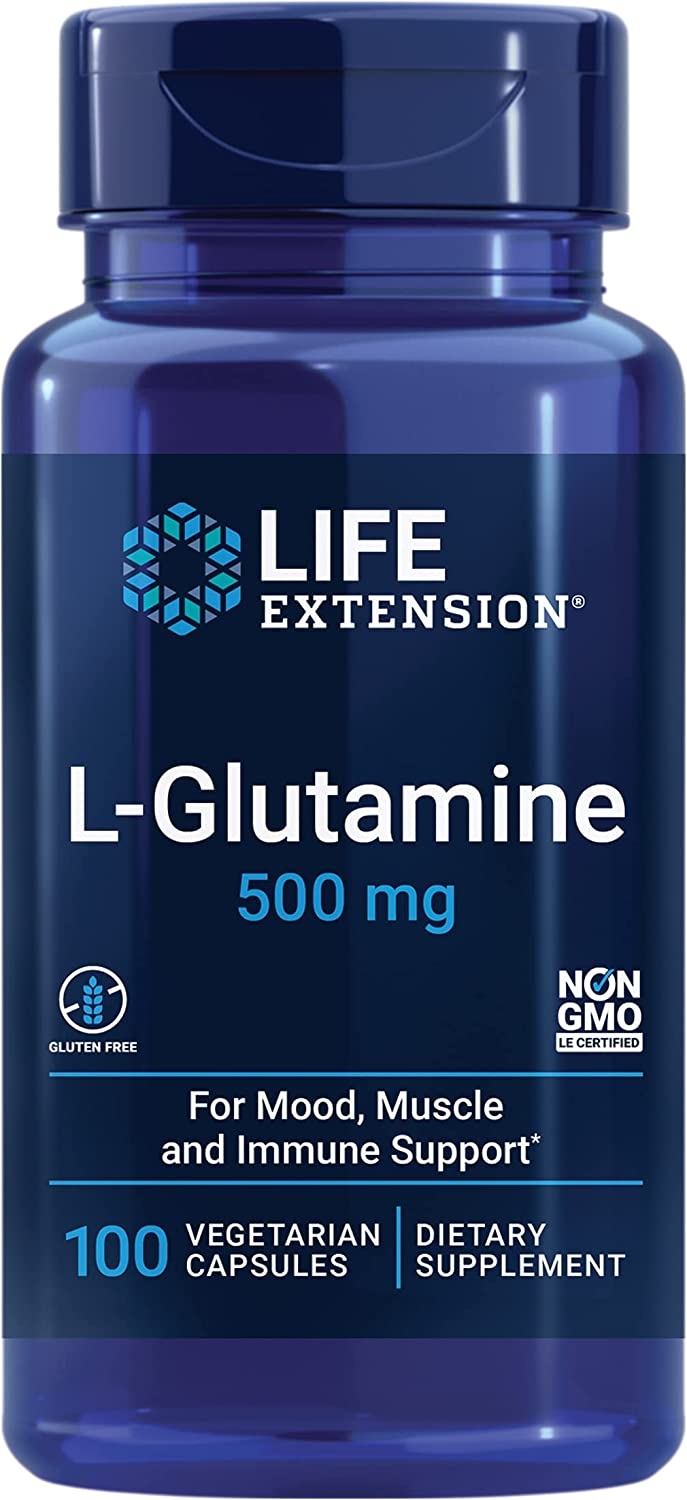
Life Extension L-Glutamine 500 mg, 100 Vegetarian Capsules
500 mg of free-form L-glutamine per capsule; label directions are one capsule once or twice daily; vegetarian capsule. Browse more supplements.
View Product DetailsFrequently Asked Questions
What does L-glutamine do for the body?
L-glutamine is an amino acid the body uses to build protein and as fuel for gut-lining and immune cells. A 2020 paper calls it conditionally essential, and we found no NIH recommended intake. The trials reviewed here do not show that extra from a capsule helps healthy people.
Does L-glutamine help gut health or leaky gut?
One 2019 trial (115 adults, 15 g daily for 8 weeks) found large benefit in post-infectious IBS-D with raised permeability, and a 14-person Crohn’s trial at 21 g daily found no permeability change. Evidence for general gut health is thin, and neither used a 500 mg dose.
Is 500 mg of glutamine enough to work?
Unknown. The doses in the trials we reviewed ran from 5 to 30 g a day, which is 10 to 60 times a 500 mg capsule. No trial we reviewed tested 500 mg, so any benefit at that dose is unproven rather than disproven.
Does glutamine build muscle or help recovery?
Not reliably. A 2019 meta-analysis of 25 athlete trials found no effect on aerobic performance, immune function or body composition, and a 2001 trial of 31 young adults found no muscle benefit after 6 weeks. Gleeson’s 2008 review said the support for these uses was limited.
Is L-glutamine safe to take every day?
Short studies in healthy adults report no ill effect from acute 20–30 g intakes (J Nutr, 2008), but a 2008 risk assessment judged long-term safety data sufficient only up to 14 g a day. Safety in kidney or liver disease is unestablished, and critically ill patients had higher mortality on glutamine in REDOXS (2013).
What are the side effects of glutamine?
For the prescription powder, the FDA lists constipation, nausea, headache and abdominal pain. In healthy men, a pilot study (Nutrients, 2020) found more digestive symptoms at 0.9 g per kg of fat-free mass than at lower doses, mostly mild. Capsule-sized doses are less studied.
Is L-glutamine FDA approved?
Only as a prescription drug. The FDA approved Endari (L-glutamine oral powder) on 7 July 2017 for sickle cell disease in people aged five and older, at 5 to 15 g twice daily. Dietary supplement glutamine is not approved for any use, and the FDA does not pre-approve supplements.
Should I take glutamine with a medical condition or medication?
Ask your doctor or pharmacist first, especially with kidney or liver disease, during pregnancy or breastfeeding, or after a serious illness. The bottle itself says to consult a physician if you are treated for a medical condition. Do not substitute it for prescribed sickle cell treatment.
Sources
- Zhou Q, Verne ML, Fields JZ et al. “Randomised placebo-controlled trial of dietary glutamine supplements for postinfectious irritable bowel syndrome.” Gut, June 2019. Accessed 19 October 2026. PubMed Central
- Heyland D, Muscedere J, Wischmeyer PE et al. “A randomized trial of glutamine and antioxidants in critically ill patients.” New England Journal of Medicine, 18 April 2013. Accessed 19 October 2026. PubMed record 23594003 (NLM)
- Niihara Y, Miller ST, Kanter J et al. “A Phase 3 Trial of l-Glutamine in Sickle Cell Disease.” New England Journal of Medicine, 19 July 2018. Accessed 19 October 2026. PubMed record 30021096 (NLM)
- US Food and Drug Administration. “FDA approves new treatment for sickle cell disease.” News release, 7 July 2017. Accessed 19 October 2026. fda.gov
- US Food and Drug Administration. “Endari (L-glutamine oral powder) prescribing information.” Label revised July 2017. Accessed 19 October 2026. accessdata.fda.gov
- MedlinePlus (National Library of Medicine). “L-glutamine.” Last revised 15 September 2017. Accessed 19 October 2026. medlineplus.gov
- Gleeson M. “Dosing and efficacy of glutamine supplementation in human exercise and sport training.” Journal of Nutrition, October 2008. Accessed 19 October 2026. PubMed record 18806122 (NLM)
- Candow DG, Chilibeck PD, Burke DG et al. “Effect of glutamine supplementation combined with resistance training in young adults.” European Journal of Applied Physiology, December 2001. Accessed 19 October 2026. PubMed record 11822473 (NLM)
- Ramezani Ahmadi A, Rayyani E, Bahreini M et al. “The effect of glutamine supplementation on athletic performance, body composition, and immune function: a systematic review and a meta-analysis of clinical trials.” Clinical Nutrition, June 2019. Accessed 19 October 2026. PubMed record 29784526 (NLM)
- Den Hond E, Hiele M, Peeters M et al. “Effect of long-term oral glutamine supplements on small intestinal permeability in patients with Crohn’s disease.” JPEN Journal of Parenteral and Enteral Nutrition, January–February 1999. Accessed 19 October 2026. PubMed record 9888411 (NLM)
- “Gastrointestinal Tolerance of Low, Medium and High Dose Acute Oral l-Glutamine Supplementation in Healthy Adults: A Pilot Study.” Nutrients, 27 September 2020. Accessed 19 October 2026. PubMed Central
- US Food and Drug Administration. “Information for Consumers on Using Dietary Supplements.” Content current as of 21 October 2022. Accessed 19 October 2026. fda.gov
- Shao A, Hathcock JN (Council for Responsible Nutrition). “Risk assessment for the amino acids taurine, L-glutamine and L-arginine.” Regulatory Toxicology and Pharmacology, April 2008. Accessed 19 October 2026. PubMed record 18325648 (NLM)
This article is for educational purposes only and is not medical advice. It is not intended to diagnose, treat, cure, or prevent any disease. These statements have not been evaluated by the Food and Drug Administration. Talk to your doctor or pharmacist before starting any new supplement, especially if you take prescription medication, have kidney or liver disease, are pregnant or breastfeeding, or are being treated for a medical condition.