
NAC — the same compound hospitals give by IV to stop a Tylenol overdose from destroying the liver — is, by the FDA's own reading of the law, not a legal dietary supplement at all, because it was approved as a drug in 1963 before it ever reached supplement shelves. The FDA never formally resolved that objection; in 2022 it simply stopped enforcing it, which is exactly where NAC supplements like this one still sit today.
NAC, short for N-acetylcysteine, is a modified amino acid the body converts into glutathione, one of its main antioxidants. At a much higher dose, it is also an FDA-approved prescription drug — the tension between those two facts is why NAC has spent years in regulatory limbo.
Key Takeaways
- NAC was approved by the FDA as a new drug in 1963, decades before it was sold as a supplement — the history the agency later cited to exclude it from the legal definition of "dietary supplement" (FDA guidance, 2022).
- The FDA confirmed NAC's exclusion in response to two citizen petitions — a conclusion that met "significant pushback, including litigation," which is what produced the 2022 enforcement-discretion policy (FDA guidance, 2022; Covington & Burling, 2025).
- A 2022 review of 19,580 patients found NAC prevented or reduced liver damage from acetaminophen overdose when started within 8 hours (Frontiers in Pharmacology, 2022).
- The FDA reversed course in 2022, issuing "enforcement discretion" that keeps NAC legally on shelves while a permanent rule stays pending — still unresolved as of the latest tracking (Covington & Burling, 2025).
- A 2023 meta-analysis of 2,137 COPD patients found NAC did not reduce flare-ups or improve lung function versus placebo (Therapeutic Advances in Respiratory Disease, 2023).
In this article:
- What Is NAC, and Why Is It Both a Drug and a Supplement?
- The FDA Tried to Ban NAC Supplements. Here's Why — and What Changed.
- What NAC Is Proven to Do: The Tylenol Overdose Antidote
- The Weaker Claims: Detox, Lungs, and "Boosting Glutathione"
- Safety, Side Effects, and Who Should Be Careful
- Inside Amazing Formulas NAC 600mg: What's Actually in the Capsule
- How to Use NAC Sensibly
- Frequently Asked Questions
What Is NAC, and Why Is It Both a Drug and a Supplement?
Cysteine is an amino acid the body needs to build glutathione, the molecule most responsible for mopping up free radicals inside cells. Plain cysteine is unstable and hard to absorb, so chemists modified it into N-acetylcysteine — stable enough to manufacture and dose predictably. The body converts NAC back into cysteine, and cysteine into glutathione.
That chemistry served two industries at two different times. In the 1960s, doctors wanted a drug to thin airway mucus in chronic bronchitis patients — NAC's free sulfhydryl group breaks the disulfide bonds that make mucus viscous. The FDA approved it as a new drug on September 14, 1963, sold as an inhaled mucolytic. Decades later, physicians realized the same effect could rescue a liver from acetaminophen poisoning, making NAC the standard overdose antidote, covered below.
More recently, the same compound has been sold over the counter as an antioxidant supplement for liver, immune, and respiratory support — the product this article is built around. U.S. law doesn't allow a substance to be both an approved drug first and a supplement second, which produced the regulatory fight covered next.
The FDA Tried to Ban NAC Supplements. Here's Why — and What Changed.
The FD&C Act excludes an article from the legal definition of "dietary supplement" if it was already approved as a new drug first (21 U.S.C. 321(ff)(3)(B)). The FDA's 2022 guidance states it plainly: NAC "was approved as a new drug... on September 14, 1963," and it is "not aware of any evidence that NAC was marketed as a dietary supplement or as a food prior to" that date — on paper, making every NAC capsule on a supplement shelf technically unlawful.
The agency confirmed that exclusion in response to two citizen petitions, in an industry where NAC was already common in antioxidant and liver-support supplements. That conclusion, as a 2025 review of the federal rulemaking agenda put it, "was met with significant pushback, including litigation, which led FDA to issue an enforcement discretion policy allowing for the continued sale of NAC-containing dietary supplements" (Covington & Burling, September 2025).
| Date | What happened |
|---|---|
| Sept 14, 1963 | FDA approves NAC as a new drug (inhaled mucolytic) |
| Apr 22, 2022 | Draft guidance: FDA will exercise "enforcement discretion," letting NAC supplements stay on shelves |
| Aug 2, 2022 | FDA finalizes the enforcement-discretion guidance |
| Sept 2025 | Regulatory agenda still lists a proposed NAC rule (RIN 0910-AI91), targeted for Jan 2026 |
The FDA's answer was not a resolution — it was a pause. The agency stated its intent "to exercise enforcement discretion with respect to the sale and distribution of certain products that contain... NAC... labeled as dietary supplements": it still maintains NAC is technically excluded, but won't act against compliant products while it weighs formal rulemaking.
"FDA is not aware of any evidence that NAC was marketed as a dietary supplement or as a food prior to September 14, 1963."
— U.S. Food and Drug Administration, Policy Regarding N-acetyl-L-cysteine: Guidance for Industry, 2022That policy is still the operative rule. A September 2025 review of the federal government's regulatory agenda by law firm Covington & Burling found a proposed rule that would formally settle NAC's status was targeted for January 2026, after slipping from an earlier May 2025 date. We could not confirm whether that rule was actually issued by publication — NAC's legal status remains enforcement discretion, not settled law.
What NAC Is Proven to Do: The Tylenol Overdose Antidote
The strongest evidence for NAC has nothing to do with why it's sold as a supplement. Acetaminophen (Tylenol) overdose produces a toxic metabolite, NAPQI, which depletes the liver's glutathione and destroys liver cells once that reserve runs out. NAC restores glutathione and neutralizes NAPQI directly — the same chemistry marketed in the capsule, delivered at emergency-medicine doses under supervision.
A 2022 review pooled 34 studies covering 19,580 patients treated with NAC for acetaminophen-related liver injury. Roughly 2,376 still developed some hepatotoxicity, and mortality ranged widely (0% to 52%) depending on how late treatment started — but the review concluded NAC "administration was efficacious in terms of mortality" when started within 8 hours, and still had value up to 24. The FDA-approved injectable label confirms the same indication: "an antidote for acetaminophen overdose indicated to prevent or lessen hepatic injury."
Hospital dosing looks nothing like a supplement capsule: an IV loading dose of roughly 150 mg/kg followed by tapering infusions, or an oral protocol of 140 mg/kg then 70 mg/kg every 4 hours for 72 hours — a total of 300 mg/kg by IV over 21 hours on the FDA-approved injectable label, or about 1,330 mg/kg orally across the full 72 hours. For a 70 kg adult that is on the order of 20 to 40 grams in the first day alone, fifteen to thirty times this product's entire daily dose, given under hospital monitoring, not at home.
Nebraska Regional Poison Center on recognizing and responding to acetaminophen overdose. If you suspect an overdose, call Poison Control (1-800-222-1222) or emergency services immediately — do not attempt to treat it with an over-the-counter NAC supplement.
The Weaker Claims: Detox, Lungs, and "Boosting Glutathione"
The mechanism behind NAC's antioxidant marketing is real: a 2021 review confirms NAC's "primary role... as an antioxidant stems from its ability to increase the intracellular concentration of glutathione." What is not established is that raising glutathione with a 600 mg capsule produces a noticeable "detox" effect in someone whose liver and kidneys already function normally. "Detox" is a marketing word, not a measured clinical outcome.
The respiratory claim has the most direct evidence against it. This product's own label promises it "supports lung health & respiratory function," extending NAC's original use as a mucolytic drug. But a 2023 meta-analysis pooling 9 randomized trials and 2,137 COPD patients found no statistically significant difference in exacerbation rates (odds ratio 1.12, 95% CI 0.92–1.36), FEV1, FVC, or quality-of-life scores. The authors' conclusion: "NAC could not reduce the risk of acute exacerbation and ameliorate the decline in lung volume in COPD patients." Trials in that pool used doses from 600 mg once daily up to 1,800 mg twice daily — the same range as this product's suggested use, so it isn't a dosing artifact.
Not on this label, but worth knowing: research on NAC as a psychiatric adjunct is emerging but thin — some cognitive benefit in schizophrenia, none clear for depression. As the review puts it, "recommendations... in most psychiatric disorders are still limited."
Safety, Side Effects, and Who Should Be Careful
Oral NAC is generally well tolerated, but not free of side effects: nausea and vomiting in up to 23% of patients, plus occasional itching or flushing from its sulfurous smell. Intravenous NAC, used in hospital overdose treatment rather than an oral supplement, carries a far more serious risk — anaphylactoid reactions in up to 8.2% of patients, with the FDA-approved injectable label warning that "serious anaphylactoid reactions, including death in a patient with asthma, have been reported." That risk belongs to the IV drug, not the capsule, but it's why anyone with asthma should mention NAC use to a clinician regardless of form.
Genuine safety warning: NAC "potentiates the effects of nitroglycerin," per the 2021 review — combining the two can cause additive drops in blood pressure. Anyone on nitrates for heart disease should not start NAC without a doctor's input. Taking NAC alongside activated charcoal may also reduce how much NAC the body absorbs, though that evidence is "still controversial."
There is no NIH-established Tolerable Upper Limit for NAC — it isn't a vitamin or mineral and has no Office of Dietary Supplements fact sheet at all. That isn't a clean bill of safety at any dose: the 2021 review notes "the toxicity of NAC overdose has not yet been defined... for healthy people," and documents one accidental 100-gram overdose causing serious complications. Pregnant or breastfeeding people, and anyone on blood thinners, nitrates, or with asthma, should talk to a doctor first.
Inside Amazing Formulas NAC 600mg: What's Actually in the Capsule
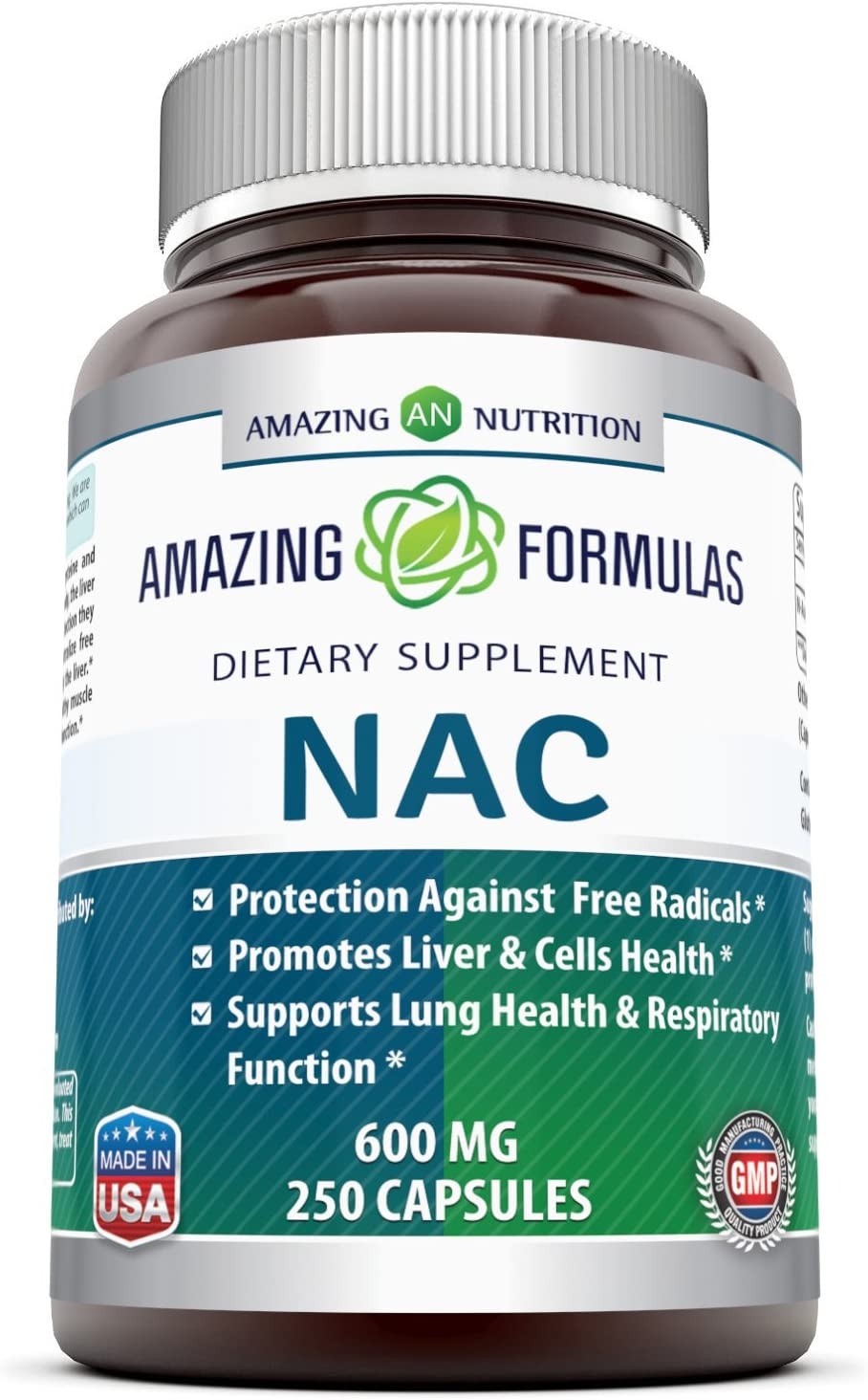
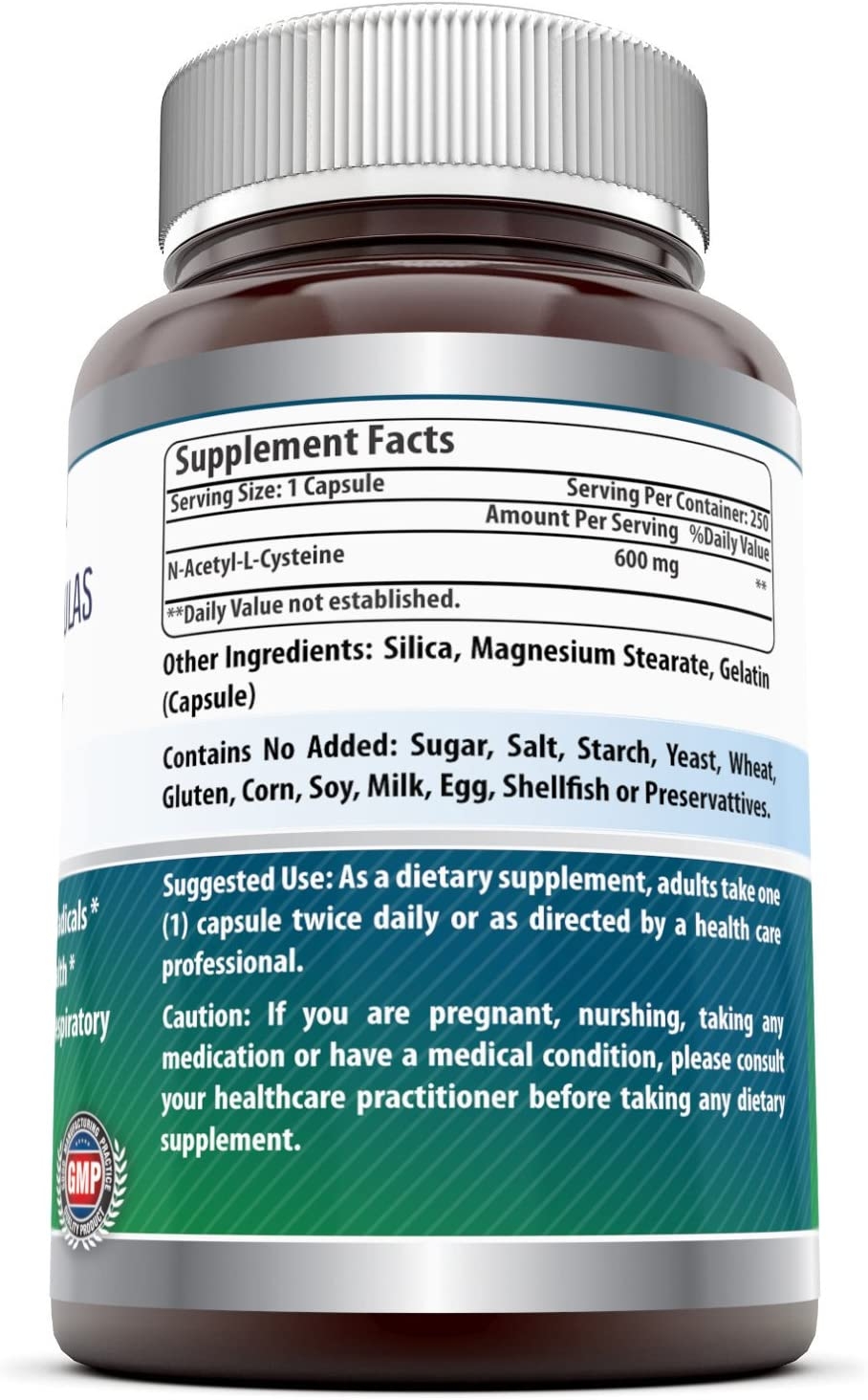
The Supplement Facts panel is short and single-ingredient: 600 mg of N-Acetyl-L-Cysteine per capsule, no daily value established because none exists for this compound. The label's suggested use is one capsule twice daily — 1,200 mg/day, comfortably inside the 600–3,600 mg/day trial range cited above, but nowhere close to the multi-gram, weight-based doses used for an actual overdose. Other ingredients are silica, magnesium stearate, and a gelatin capsule — not vegan, despite that not being stated on the front label. It's made in the USA in a GMP-certified facility, with no added sugar, salt, starch, yeast, wheat, gluten, corn, soy, milk, egg, shellfish, or preservatives.
| This product | Typical dose in clinical trials | Hospital antidote dose | Tolerable Upper Limit | |
|---|---|---|---|---|
| N-Acetylcysteine | 1,200 mg/day (2 × 600 mg capsules) | 600–3,600 mg/day, respiratory and psychiatric trials | Weight-based: ~140 mg/kg oral loading, then 70 mg/kg every 4 hours for 72 hours, hospital-administered only | None established — no NIH reference intake exists for NAC |
Amazing Formulas NAC 600mg — 250 Capsules
A roughly four-month supply at the labeled dose. The antioxidant mechanism is real, but the two most-marketed benefits on this label — lung support and liver "detox" — aren't well supported by the trial evidence above. It sits in our wider supplements range.
View this productHow to Use NAC Sensibly
The trial evidence suggests little basis for exceeding a standard 600–1,200 mg/day dose without a doctor's input; higher psychiatric-trial doses were used under research supervision, not as a self-directed starting point. Take it with food if the smell or nausea bothers you. NAC is not a substitute for emergency care after a real overdose, which requires immediate, medically supervised treatment.
Who this is for: People who want a well-studied antioxidant with genuine, if narrow, clinical backing, or exploring NAC as a psychiatrist-supervised cognitive adjunct in schizophrenia.
Who should skip it: Anyone expecting improved lung function or COPD symptoms; anyone with asthma, nitrates, or blood thinners without a doctor's sign-off; strict vegans (this capsule is gelatin); and most people chasing a "liver detox" the evidence doesn't support.
Frequently Asked Questions
What does NAC actually do in the body?
NAC converts into glutathione, one of the body's main antioxidants. That mechanism is well established; what it translates to at a 600–1,200 mg daily supplement dose in an otherwise healthy person is far less clear than the marketing suggests.
Is NAC the same thing doctors give for a Tylenol overdose?
Yes, chemically. Hospitals use it as the standard antidote for acetaminophen overdose, at weight-based doses far higher than a supplement capsule, under medical supervision — not something to self-administer at home in place of emergency care.
Why did the FDA try to ban NAC supplements?
Because NAC was approved as a prescription drug in 1963, U.S. law technically excludes it from the definition of a dietary supplement. The FDA confirmed that exclusion in response to two citizen petitions, then reversed course in 2022 by choosing not to enforce it while it weighs a permanent rule.
Is it legal to buy NAC supplements right now?
Yes, as of the most recent confirmed reporting — the FDA's 2022 enforcement-discretion policy is still the operative rule. A proposed rule targeted for January 2026 would formally settle the question, but wasn't confirmed as finalized when this article was written.
Does NAC actually help with liver 'detox'?
NAC raises glutathione, which the liver uses in detoxification, and has strong evidence for reversing acetaminophen-related liver injury specifically. There's no comparable trial evidence that a standard dose produces a noticeable 'detox' benefit in someone with normal liver function.
Does NAC help with COPD or chronic bronchitis?
A 2023 meta-analysis (9 trials, 2,137 patients) found no significant benefit for exacerbations, lung function, or quality of life versus placebo. Six earlier meta-analyses had concluded the opposite, which is likely why the claim persists on labels.
What are the side effects of NAC supplements?
Oral NAC most commonly causes nausea or an upset stomach, in up to 23% of users. More serious allergic-type reactions are tied to intravenous NAC in hospitals, not oral capsules, but anyone with asthma should still mention NAC use to their doctor.
Is Amazing Formulas NAC vegan?
No. Its Supplement Facts panel lists gelatin as the capsule material, derived from animal collagen. Vegans or vegetarians would need a product that specifically states a vegetable-based capsule.
Sources
- U.S. Food and Drug Administration. "Policy Regarding N-acetyl-L-cysteine: Guidance for Industry." Issued August 2022. Accessed 31 August 2026.
- Federal Register (via GovInfo). "Policy Regarding N-Acetyl-L-Cysteine; Draft Guidance for Industry; Availability." Published 22 April 2022. Accessed 31 August 2026.
- Federal Register (via GovInfo). "Policy Regarding N-Acetyl-L-Cysteine; Guidance for Industry; Availability." Published 2 August 2022. Accessed 31 August 2026.
- Covington & Burling LLP. "Implications of the Trump Administration's First Unified Agenda for Food and Dietary Supplement Companies." Published 5 September 2025. Accessed 31 August 2026.
- Licata, A. et al. "N-Acetylcysteine for Preventing Acetaminophen-Induced Liver Injury: A Comprehensive Review." Frontiers in Pharmacology. Published 10 August 2022. Accessed 31 August 2026.
- "The Efficacy of N-Acetylcysteine in Chronic Obstructive Pulmonary Disease Patients: A Meta-Analysis." Therapeutic Advances in Respiratory Disease. Published 17 March 2023. Accessed 31 August 2026.
- "N-Acetylcysteine (NAC): Impacts on Human Health." Antioxidants (Basel). Published 16 June 2021. Accessed 31 August 2026.
- DailyMed, U.S. National Library of Medicine. "Acetylcysteine Injection" (Fresenius Kabi USA, LLC label). Accessed 31 August 2026.
This article is for educational purposes only and is not medical advice. It is not intended to diagnose, treat, cure, or prevent any disease. These statements have not been evaluated by the Food and Drug Administration. Talk to your doctor before starting NAC or any new supplement, especially if you have asthma, take nitrate medication or blood thinners, are pregnant or breastfeeding, or have a diagnosed liver or kidney condition. If you suspect an acetaminophen overdose, contact Poison Control (1-800-222-1222) or emergency services immediately — do not attempt to treat it with an over-the-counter supplement.