
Milk thistle (Silybum marianum) is a spiny, purple-flowered plant whose seeds contain silymarin, a mixture of plant compounds sold as a “liver detox” and “liver support” supplement — yet the two largest NIH-funded human trials ever run on it, one in 154 people with hepatitis C and another in 78 people with fatty liver disease, both found it worked no better than a placebo. Milk thistle is still one of the top-selling herbal supplements in the country, and the National Center for Complementary and Integrative Health (NCCIH) still says there isn’t enough high-quality evidence to draw firm conclusions about it for any liver condition.
Key Takeaways
- Two placebo-controlled, NIH-funded trials — 154 people with chronic hepatitis C (JAMA, 2012) and 78 people with non-alcoholic fatty liver disease (PLoS One, 2019) — found silymarin performed no better than placebo at doses up to 2,100 mg a day.
- NCCIH (updated February 2025) states that results from milk thistle trials for liver disease “have been conflicting or too limited to allow conclusions to be reached.”
- Milk thistle has been used for liver and biliary complaints for over 2,000 years, according to the National Cancer Institute’s PDQ summary (updated 2022) — one of the oldest continuously used botanicals still sold today.
- This product is raw, milled seed powder with no silymarin content declared on the label, while the clinical trials used standardized extracts delivering 1,260–2,100 mg of silymarin a day.
- NCCIH (2025) warns that people allergic to ragweed, daisies, marigolds, or chrysanthemums can react to milk thistle, and that some milk thistle products on the market don’t contain the amount of silymarin stated on the label.
In this article:
- What Is Milk Thistle, and What’s Actually in the Bottle?
- Does Milk Thistle Protect the Liver? What Two NIH-Funded Trials Found
- Cirrhosis, Alcohol-Related Liver Disease, and Diabetes: What the Evidence Adds Up To
- Who Actually Needs Liver Support, and What Milk Thistle Won’t Fix
- Safety, Allergies, and Drug Interactions to Know
- Inside BareOrganics Milk Thistle Seed Powder: What’s Actually in the Jar
- Frequently Asked Questions
What Is Milk Thistle, and What’s Actually in the Bottle?
Milk thistle is a tall, thistle-like plant native to the Mediterranean, identifiable by its purple flower heads and the milky-white leaf veins that give it its name. Its seeds (technically fruits) are the part used medicinally. Per the National Cancer Institute’s PDQ physician summary (updated 2022), the plant has been used therapeutically for more than 2,000 years, starting with the Greek physician Dioscorides in the first century A.D. and continuing through medieval herbalists who used it as an antidote to liver toxins.

The active ingredient is silymarin, not a single chemical but a complex mixture of flavonolignans — mainly silybin A and B, isosilybin A and B, silychristin, and silydianin (PDQ, 2022). In laboratory studies, silymarin appears to stabilize liver cell membranes, boost the body’s own glutathione detoxification pathway, and act as an antioxidant. Those are cell-culture and animal findings, though — not proof that a capsule changes the course of human liver disease, which is what the clinical trials below were designed to test.
Does Milk Thistle Protect the Liver? What Two NIH-Funded Trials Found
The honest answer, according to the two largest and best-designed trials on record, is no — not at the doses and in the populations tested so far.
| Hepatitis C trial (Fried et al., JAMA, 2012) | Fatty liver disease trial (Navarro et al., PLoS One, 2019) | |
|---|---|---|
| Patients randomized | 154 | 78 |
| Silymarin dose tested | 420 mg or 700 mg, three times daily | 420 mg or 700 mg, three times daily |
| Duration | 24 weeks | 48 weeks |
| Primary outcome met | 3.8% (placebo) vs. 4.0% (420 mg) vs. 3.8% (700 mg) | 12% (placebo) vs. 19% (420 mg) vs. 15% (700 mg) |
| Statistical result | No significant difference (P ≥ .99) | No significant difference (P = .79) |
The hepatitis C trial, funded by the NIH and published in JAMA in 2012, enrolled 154 people with chronic hepatitis C who had already failed interferon-based therapy (Fried et al., 2012). Researchers measured whether silymarin could lower liver enzyme (ALT) levels to a healthy range. It could not, at either dose tested, with no meaningful difference from placebo in ALT levels, hepatitis C viral load, or quality of life.
The second trial, funded by NCCIH and published in PLoS One in 2019, tested silymarin in 78 people with non-alcoholic fatty liver disease (Navarro et al., 2019). Over 48 weeks, researchers looked for at least a 2-point improvement on a standardized liver biopsy scoring system. Slightly more people on silymarin hit that mark than on placebo, but the gap was small enough to easily be chance (P = .79 is a coin-flip result, not a signal). The authors’ own conclusion: silymarin was “safe and well tolerated” but its effect on fatty liver disease “remains inconclusive.”
“Silymarin did not significantly improve serum ALT levels compared with placebo when administered to patients with chronic HCV infection previously unsuccessfully treated with IFN-based therapy.”
— Fried MW, et al., JAMA, 2012NCCIH’s own summary of the wider research (updated February 2025) doesn’t soften this: results from trials of milk thistle for liver diseases have been “conflicting or too limited to allow conclusions to be reached,” and the two studies it funded itself — one on hepatitis C, one on non-alcoholic steatohepatitis — “did not show benefits from supplementation with the milk thistle extract silymarin.” Its bottom-line verdict, in the agency’s own words, is that “there isn’t enough high-quality evidence to allow definite conclusions to be reached about the effects of milk thistle on health conditions in people.”
Cirrhosis, Alcohol-Related Liver Disease, and Diabetes: What the Evidence Adds Up To
Milk thistle’s reputation as a liver herb predates modern trial design by centuries, and some of the oldest research reflects that. A large observational study of 2,637 people with chronic liver disease, cited in the PDQ summary, reported that 560 mg of silymarin a day was associated with reduced liver enzymes and less liver enlargement — but observational studies without a placebo group can’t rule out patients simply improving on their own.
For alcohol-related liver disease, NCCIH (2025) groups it with the other liver conditions whose trial results have been “conflicting or too limited to allow conclusions to be reached.” For cirrhosis, older and smaller randomized trials have yielded conflicting results on liver function and survival (PDQ, 2022), none large or consistent enough to change clinical guidelines.
The one area with slightly more encouraging, if still preliminary, data is blood sugar control: NCCIH notes small studies suggest milk thistle extracts may help manage type 2 diabetes, though most were conducted in the Middle East in smaller populations, and it’s unclear how well the results generalize elsewhere.
Who Actually Needs Liver Support, and What Milk Thistle Won’t Fix
Liver disease is common enough that the appeal of a low-risk herbal supplement is understandable. Non-alcoholic fatty liver disease, now often called MASLD, affects a large share of American adults and is closely linked to obesity, type 2 diabetes, and metabolic syndrome. Chronic hepatitis B and C, alcohol-related liver disease, and drug-induced liver injury round out the major categories clinicians actually treat.
Mayo Clinic on what actually moves the needle for fatty liver disease — weight loss, diet, and managing metabolic risk factors, not a supplement bottle.
What actually changes outcomes for these conditions has nothing to do with silymarin: antiviral medication for hepatitis B and C, complete abstinence from alcohol for alcohol-related liver disease, and sustained weight loss plus blood sugar control for fatty liver disease. Milk thistle has been tested as an add-on in exactly these populations, and in the two best-designed trials, it added nothing measurable on top of standard care — so the honest expectation is curiosity at best, never a substitute for a prescribed antiviral, an alcohol treatment program, or a physician-supervised weight-management plan.
Safety, Allergies, and Drug Interactions to Know
The safety data is genuinely reassuring, which is one reason milk thistle stays popular even where efficacy data is weak. NCCIH (2025) describes the most common side effects as digestive symptoms — bloating, nausea, and gas — and the JAMA and PLoS One trials above found silymarin, even at 2,100 mg a day for close to a year, as well tolerated as placebo.
| Group | Why |
|---|---|
| Ragweed, daisy, marigold, or chrysanthemum allergy | Milk thistle is in the same plant family (Asteraceae) and can trigger cross-reactive allergic reactions, per NCCIH. |
| Pregnant or breastfeeding | NCCIH states little is known about safety in pregnancy or lactation; there isn’t enough data to call it low-risk. |
| Taking prescription medication | NCCIH advises telling your health care provider before combining any herbal product with medicine, since some herbs interact with drugs in harmful ways. |
| Anyone relying on it for a diagnosed liver disease | The largest trials found no measurable benefit over placebo — it isn’t a substitute for antiviral therapy, alcohol treatment, or a medically supervised weight-loss plan. |
Quality control is the real risk with this supplement class. NCCIH (2025) reports some milk thistle products on the market contain amounts of silymarin substantially different from what’s stated on the label, or are contaminated with pesticides, microorganisms, or mycotoxins. As a dietary supplement rather than a drug, it isn’t tested or approved by the FDA for effectiveness before reaching store shelves (FDA, Dietary Supplements).
Inside BareOrganics Milk Thistle Seed Powder: What’s Actually in the Jar
BareOrganics Milk Thistle Seed Powder ($24.99) is USDA Certified Organic, vegan, non-GMO, and gluten-free milled milk thistle seed, sold as an 8 oz container, with label directions to mix one scoop into juice, yogurt, or a smoothie. That’s a meaningfully different product from what either clinical trial actually tested.
| This product | Doses used in older trials | Dose used in NIH-funded trials | Tolerable Upper Limit | |
|---|---|---|---|---|
| Milk thistle (silymarin) | Not stated on label — raw milled seed powder, 1 scoop per serving | 120–560 mg a day across older trials (PDQ, 2022) | 420–700 mg standardized extract, three times daily (1,260–2,100 mg/day) | None established |
No Tolerable Upper Limit has been set for silymarin, which sounds reassuring, but it mainly reflects that milk thistle has never gone through the kind of nutrient-risk review the NIH runs for vitamins and minerals — not that every dose in every population has been proven safe. What we do know is that the trial doses above, at up to 2,100 mg of standardized silymarin extract a day for nearly a year, produced side effects no worse than placebo.
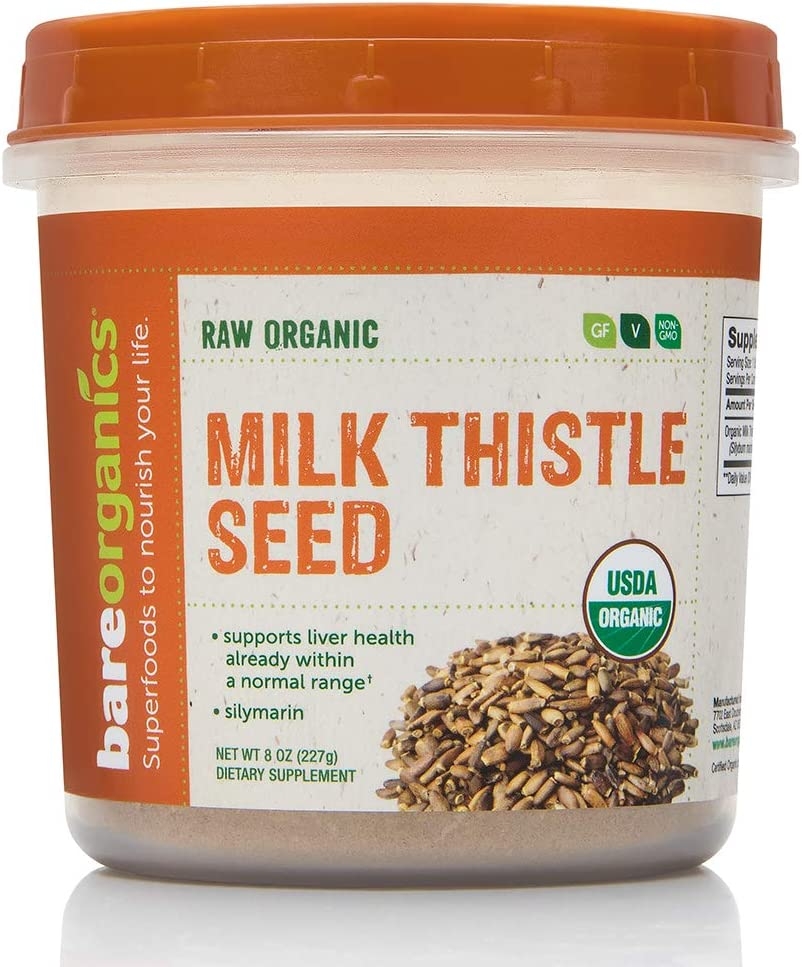
That distinction is the honest catch here. Whole seed powder has never been standardized for silymarin the way the JAMA and PLoS One trial extracts were, and this label doesn’t state a silymarin amount per scoop — only that the seeds are “naturally rich in silymarin.” Because silymarin is concentrated through processing, a scoop of raw milled seed almost certainly delivers far less of it than a capsule of standardized extract, and the amount will vary batch to batch. If the appeal is the studied compound itself, a labeled, standardized extract is the more comparable product; if the appeal is a whole-food-style powder, this is a reasonable, low-risk way to try it — just not one that can be expected to replicate results from trials it was never dosed to match.
Who this is for: People who want a low-risk, low-cost way to try a traditional botanical out of curiosity, or as a personal add-on alongside — never instead of — medical care for a real liver condition, and who don’t have a ragweed or daisy-family allergy.
Who should skip it: Most people looking for an actual liver treatment. That includes anyone hoping to substitute this for antiviral hepatitis therapy, anyone using it in place of alcohol treatment or a weight-loss plan for fatty liver disease, anyone with a ragweed/Asteraceae allergy, and anyone pregnant or breastfeeding, since safety data there is lacking.
BareOrganics Milk Thistle Seed Powder — 8 oz
USDA Certified Organic, vegan, non-GMO milled milk thistle seed powder, mixed into juice, yogurt, or a smoothie by the scoop. As covered above, the label doesn’t declare a silymarin amount, so it isn’t directly comparable to the standardized extracts used in clinical trials — but the underlying botanical has a strong safety record even at much higher doses than a scoop of powder would deliver.
View Product DetailsReaders managing an actual digestive or metabolic condition should also look at the broader evidence on digestive health support, since diet and gut health interact closely with liver health.
Frequently Asked Questions
Does milk thistle actually help the liver?
The evidence is weaker than its reputation suggests. The two largest NIH-funded trials — 154 people with hepatitis C and 78 people with fatty liver disease — both found silymarin performed no better than placebo. NCCIH says there isn’t enough high-quality evidence for firm conclusions either way.
How much milk thistle is safe to take?
Clinical trials have used standardized extracts up to 700 mg three times daily (2,100 mg/day) for nearly a year with no more side effects than placebo. Those were supervised trials of a prescription-grade European product, not label directions for a retail supplement. No Tolerable Upper Limit has been established, but that reflects a lack of formal review rather than proof of safety at every dose.
Can milk thistle cure hepatitis or fatty liver disease?
No. The best-designed trials found no meaningful benefit over placebo for either condition. Antiviral medication remains the standard treatment for hepatitis C, and weight loss and metabolic management remain the standard approach for fatty liver disease.
Is milk thistle safe to take with other medications?
NCCIH advises telling your health care provider before combining milk thistle with any prescription medication, since some herbs and drugs interact in harmful ways. This is especially relevant if you take medication metabolized by the liver.
Who shouldn’t take milk thistle?
People allergic to ragweed, daisies, marigolds, or chrysanthemums, since milk thistle is in the same plant family and can cross-react. Pregnant or breastfeeding people should also avoid it, since NCCIH says safety data there is lacking.
What’s the difference between milk thistle powder and milk thistle extract?
Extracts are processed to concentrate and standardize the amount of silymarin per dose, which is what clinical trials use. Raw seed powder, like the product reviewed here, is unprocessed and doesn’t declare a silymarin content, so the actual dose delivered is unknown and likely much lower.
How long does it take for milk thistle to work?
There isn’t a reliable answer, because the trials that tested it for close to a year (48 weeks) still couldn’t show a clear benefit over placebo for fatty liver disease. Any timeline claim beyond that isn’t backed by the clinical data.
Is BareOrganics Milk Thistle Seed Powder a standardized extract?
No. It’s milled whole seed powder with no silymarin content stated on the label, which is different from the standardized extracts used in the clinical trials cited throughout this article.
Sources
- National Center for Complementary and Integrative Health. “Milk Thistle.” Updated February 2025. Accessed 29 August 2026.
- National Cancer Institute. “Milk Thistle (PDQ®) – Health Professional Version.” Updated 17 February 2022. Accessed 29 August 2026.
- Fried MW, et al. “Effect of Silymarin (Milk Thistle) on Liver Disease in Patients With Chronic Hepatitis C Unsuccessfully Treated With Interferon Therapy: A Randomized Controlled Trial.” JAMA, 2012. Accessed 29 August 2026.
- Navarro VJ, et al. “Silymarin in Non-Cirrhotics With Non-Alcoholic Steatohepatitis: A Randomized, Double-Blind, Placebo Controlled Trial.” PLoS One, 2019. Accessed 29 August 2026.
- U.S. Food and Drug Administration. “Dietary Supplements.” Accessed 29 August 2026.
- U.S. Food and Drug Administration. “Questions and Answers on Dietary Supplements.” Accessed 29 August 2026.
- Wikipedia. “Silybum marianum.” Accessed 29 August 2026.
This article is for educational purposes only and is not medical advice. It is not intended to diagnose, treat, cure, or prevent any disease. These statements have not been evaluated by the Food and Drug Administration. This product is not intended to diagnose, treat, cure, or prevent any disease. Talk to your doctor before starting any new supplement, especially if you are pregnant, breastfeeding, have a diagnosed liver condition, take prescription medication, or have a ragweed or Asteraceae plant allergy.