
Alpha-lipoic acid is a sulfur-containing compound every cell already makes and binds to protein as a cofactor for the mitochondrial enzymes that turn food into energy — and per the Linus Pauling Institute at Oregon State University, there is no evidence the free-form alpha-lipoic acid in a supplement capsule can ever be built into that same protein-bound pool. Yet it's sold as a "cellular energy" antioxidant for anyone, at a dose the strongest trial evidence actually supports for only one diagnosed condition — and even there, this bottle's own label falls short of the dose that worked.
Key Takeaways
- A 2023 meta-analysis of 10 trials and 1,242 patients found oral alpha-lipoic acid significantly improved nerve symptom and impairment scores in diagnosed diabetic neuropathy — but every positive trial used 600–1,800 mg a day (Hsieh et al., Nutrients, 2023).
- This product's label tops out at 480 mg a day (two 240 mg capsules) — below the 600 mg/day floor every positive trial in that meta-analysis used.
- NCCIH's own 2023 review states a 2019 analysis of 10 studies and 553 participants found alpha-lipoic acid "no better than placebo" for blood sugar, cholesterol, or triglycerides — the general metabolic "energy" claim this product is marketed on.
- No NIH Recommended Dietary Allowance, Adequate Intake, or Tolerable Upper Intake Level exists for alpha-lipoic acid; it isn't classified as an essential nutrient, and the product's own label confirms "Daily Value not established."
- About 60 cases worldwide of a rare insulin autoimmune reaction have been linked to alpha-lipoic acid, some after only days to a couple of weeks of use at ordinary supplement doses (Journal of Postgraduate Medicine, 2025).
In this article:
- What Alpha-Lipoic Acid Actually Is
- Does It Help Diabetic Nerve Pain? What the Trials Found
- What It Doesn't Do: Blood Sugar, Cholesterol, and "Energy"
- The "R-Form" Bioavailability Claim: Real Science, Manufacturer Math
- The Safety Catch: A Rare Insulin Reaction, and Why This Isn't a Kids' Bottle
- Inside Life Extension Super R-Lipoic Acid: What's Actually in the Capsule
- How to Use It Sensibly, If You Decide To
- Frequently Asked Questions
What Alpha-Lipoic Acid Actually Is
Alpha-lipoic acid (ALA) is an organosulfur compound made inside human mitochondria and bound to specific enzyme complexes that help convert food into usable energy. According to the Linus Pauling Institute's Micronutrient Information Center (Oregon State University, reviewed 2019), only the "R" form is made this way, and it functions strictly as a protein-bound cofactor — not a free-floating antioxidant in the blood. Every capsule sold as a supplement, including this one, contains free (unbound) lipoic acid instead. The Institute states plainly that "there is no evidence in humans that exogenous lipoic acid can be activated… and incorporated into lipoic acid-dependent enzymes" the way the body's own supply is — a capsule doesn't top up the cofactor your cells run on; it introduces a separate pool the body uses briefly as a circulating antioxidant and clears within hours.
Unlike biotin or vitamin D, ALA has no NIH Office of Dietary Supplements fact sheet, no Recommended Dietary Allowance, and no Tolerable Upper Intake Level, because it isn't classified as an essential nutrient — the body makes what it needs. Supplemental ALA is instead studied the way a drug candidate would be, for a specific effect in a specific population, most often people with a diagnosed metabolic or mitochondrial condition, not as a general "energy" nutrient for everyone.
| This product | Typical shelf dose | Dose shown effective in trials (diabetic neuropathy) | NIH RDA / AI / Tolerable Upper Limit | |
|---|---|---|---|---|
| Alpha-lipoic acid | 240–480 mg/day (1–2 capsules, R-form) | 100–600 mg/day | 600–1,800 mg/day (racemic); no added benefit above 600 mg/day in dose-ranging trials | None established — ALA is not classified as an essential nutrient, so the NIH has not set a reference intake or upper limit |
Does It Help Diabetic Nerve Pain? What the Trials Found
The strongest, most consistent evidence for alpha-lipoic acid is specific: painful diabetic peripheral neuropathy, the burning, tingling, or numbness in the feet and hands of people with diabetes. A 2023 systematic review and meta-analysis in Nutrients pooled 10 randomized controlled trials totaling 1,242 patients and found oral ALA produced significantly better Total Symptom Score outcomes than placebo (mean difference −1.69) and better Neuropathy Impairment Score outcomes (mean difference −1.16), across trials dosed at 600 mg, 1,200 mg, or 1,800 mg per day (Hsieh et al., Nutrients, 2023).
An earlier dose-ranging trial in 72 people with type 2 diabetes, cited by the Linus Pauling Institute, tested those same three doses and found insulin sensitivity improved about 25% after four weeks — with no meaningful difference between the 600, 1,200, and 1,800 mg groups, suggesting 600 mg/day is close to the effective ceiling, not a floor to build on. A separate 12-month, 85-patient trial combining 570 mg ALA with other antioxidants found sustained improvement in nerve conduction, vibration sense, and pain (about 16% reduction) versus a placebo group that got worse (Didangelos et al., Nutrients, 2020).
"Some studies suggest that chromium, cinnamon, or berberine might help with blood sugar control and that alpha-lipoic acid might be helpful for reducing pain associated with diabetic neuropathy (nerve problems). But most of these studies have limitations in size and differ from each other in participant characteristics, supplement formulations and dosing, length of study, and results, leading to no clear conclusions."
— National Center for Complementary and Integrative Health, Diabetes and Dietary Supplements: What You Need To Know, updated November 2023NutritionFacts.org's Dr. Michael Greger reviews a small trial in which diet and daily walking, not a supplement, resolved diabetic nerve pain in most participants within days — a reminder that alpha-lipoic acid isn't the only lever for this condition.
What It Doesn't Do: Blood Sugar, Cholesterol, and "Energy"
This product's marketing frames alpha-lipoic acid as general "cellular energy support," not as a diabetic-neuropathy treatment — and that's the claim the evidence doesn't back. NCCIH's 2023 review states a 2019 analysis of 10 studies and 553 participants with type 2 diabetes found ALA "no better than placebo at reducing levels of blood sugar, cholesterol, or triglycerides." The same review found no benefit for diabetic macular edema or kidney dysfunction, summarized below.
| Claim | Evidence pooled | NCCIH's verdict |
|---|---|---|
| Diabetic nerve pain / symptoms | 8–10 studies, 1,242–2,062 participants across three reviews (2022 ×2; 2023 meta-analysis) | Inconsistent to positive; strongest data of any use, at 600 mg/day+ |
| Blood sugar, cholesterol, triglycerides | 10 studies, 553 participants (2019 review) | No better than placebo |
| Diabetic kidney dysfunction | 12 studies, 653 participants (2022 review) | No benefit found |
| Diabetic macular edema (eye) | 1 study, 467 participants (2011; 600 mg/day for 2 years) | No statistically significant difference vs placebo |
| General safety across conditions | 71 studies, 4,749 participants (2020 review) | Generally safe at conventional doses |
Why the gap matters: "Cellular energy support" is broad enough to imply a benefit for anyone. The actual evidence is narrow: real signal in diagnosed diabetic neuropathy at 600 mg/day and up, and a flat "no better than placebo" result everywhere else NCCIH has reviewed it, including the metabolic markers "energy" implicitly promises to move.
The "R-Form" Bioavailability Claim: Real Science, Manufacturer Math
The product's own marketing claims its stabilized R-lipoic acid delivers "up to 30 times the bioavailable amounts" of conventional R-lipoic acid. The underlying chemistry is real but far more modest than that figure suggests. Most inexpensive supplements use a 50:50 racemic mix of the R- and S-enantiomers, and according to the Linus Pauling Institute, independent human pharmacokinetic studies found peak plasma concentrations of the R-enantiomer run about 40–50% higher than the S-enantiomer after an oral racemic dose — not 30-fold. Roughly 30–40% of an oral racemic dose is absorbed at all, and taking it with food cuts peak concentration by about 30%, which is why labels direct an empty-stomach dose.
Pure R-lipoic acid is chemically unstable at room temperature, which is the real problem a "stabilized" salt form (the sodium R-lipoate used here) solves — a legitimate formulation improvement. But the independent, published head-to-head trial that would support "30 times more bioavailable" doesn't exist. That figure comes from the manufacturer's own materials, not the peer-reviewed literature the rest of this article draws on.
The Safety Catch: A Rare Insulin Reaction, and Why This Isn't a Kids' Bottle
Alpha-lipoic acid is generally well tolerated. The NIH's LiverTox database (updated May 2023) rates it "unlikely" to cause clinically apparent liver injury at conventional 100–600 mg doses, with no published reports of enzyme elevations tied to normal use. Common side effects, per NCCIH, are headache, heartburn, nausea, and vomiting.
Two genuine risks are worth knowing anyway. Because ALA contains a sulfhydryl group, it has been identified, since cases were first reported in Japan in 2006, as a trigger for a rare autoimmune reaction called insulin autoimmune syndrome (Hirata disease) in people with a genetic susceptibility. That susceptibility tracks with specific HLA-DRB1 immune-system variants — DRB1*04:06 in East Asian populations, DRB1*04:03 in Caucasian ones — and cases have now been reported across ethnic groups, including a series from India. A 2025 case report in the Journal of Postgraduate Medicine describes two patients who developed spontaneous hypoglycemia after short courses at ordinary supplement doses — one after two weeks at 300 mg twice a day, the other after just five days at 300 mg a day — and notes that about 60 cases of the syndrome linked to alpha-lipoic acid have been reported worldwide. In both patients, symptoms began roughly a week or two after they had already stopped taking it.
Genuine safety warning: The NIH's LiverTox database records that single large overdoses of alpha-lipoic acid have caused confusion, stupor, seizures, lactic acidosis, rhabdomyolysis, coma, and multi-organ failure "that can be fatal" (updated May 2023). Deaths have been documented after 6 grams — about 25 of this product's capsules, or just 10 of the higher-strength 600 mg tablets some brands sell — in both an adult and a 14-year-old child. But there is no established safe threshold below that: the toxic range is poorly defined, some patients have survived 6 g and even 18 g, and serious symptoms have been reported after as little as roughly 1.8 g in adolescents and about 30 mg/kg in one teenage girl who developed seizures (Memorial Sloan Kettering). Children are at risk from far smaller amounts than an adult would be, so store the bottle out of reach of children, in its original container.
Anyone on insulin or a blood-sugar-lowering medication should talk to a doctor first, since ALA can independently lower blood glucose and the combined effect isn't predictable. Memorial Sloan Kettering Cancer Center also cautions that ALA's antioxidant activity "may antagonize the effects of chemotherapy and radiation therapy" — clear it with an oncology team first, even though supervised trials have separately tested ALA to reduce chemotherapy-induced nerve damage. Safety data in pregnancy and breastfeeding is insufficient, so both groups should avoid it absent medical advice.
Inside Life Extension Super R-Lipoic Acid: What's Actually in the Capsule
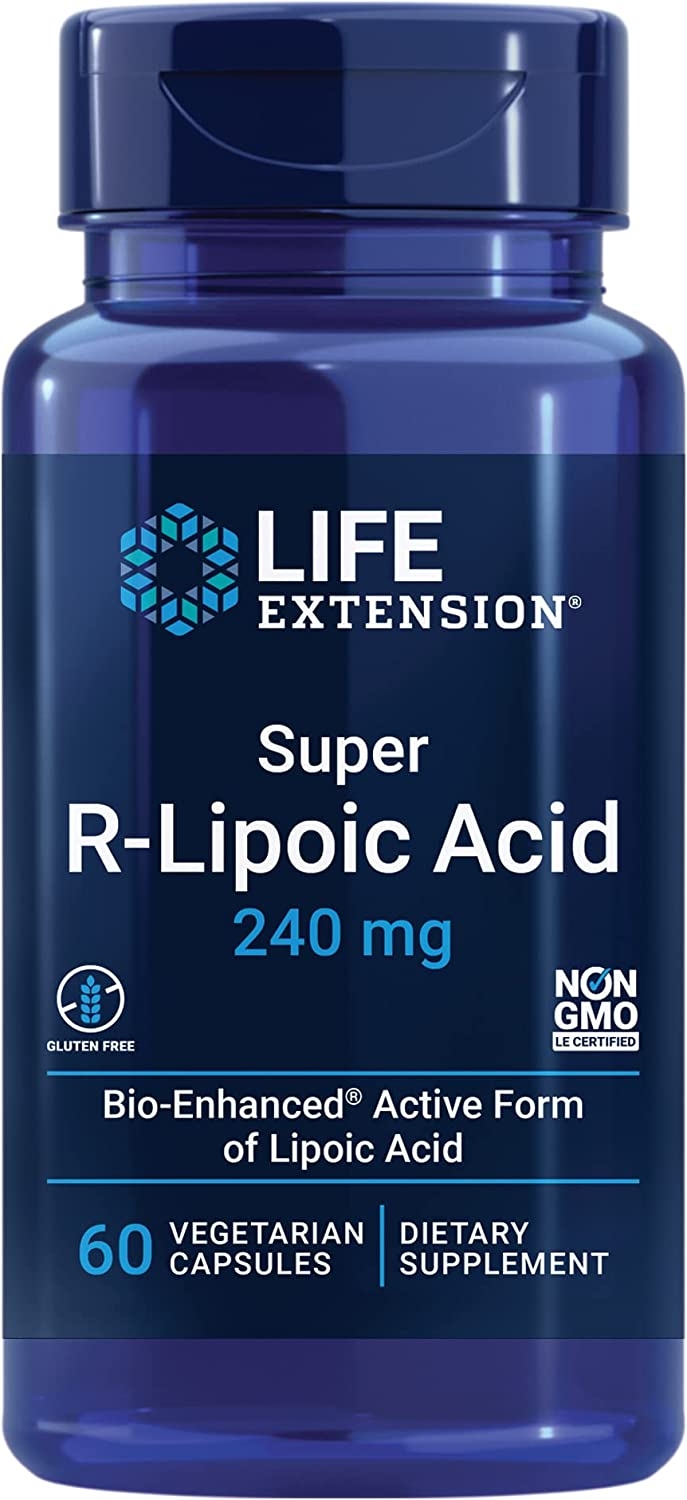
This is a 60-capsule bottle priced at $34.95, roughly a one-to-two-month supply. Each vegetarian capsule provides 283 mg of "Bio-Enhanced Stabilized Na-RALA" (sodium R-lipoate), supplying 240 mg of R-lipoic acid plus 28 mg of sodium. The label states "Daily Value not established." The capsule is gluten-free and non-GMO, with vegetable cellulose, vegetable stearate, and silica the only other listed ingredients.
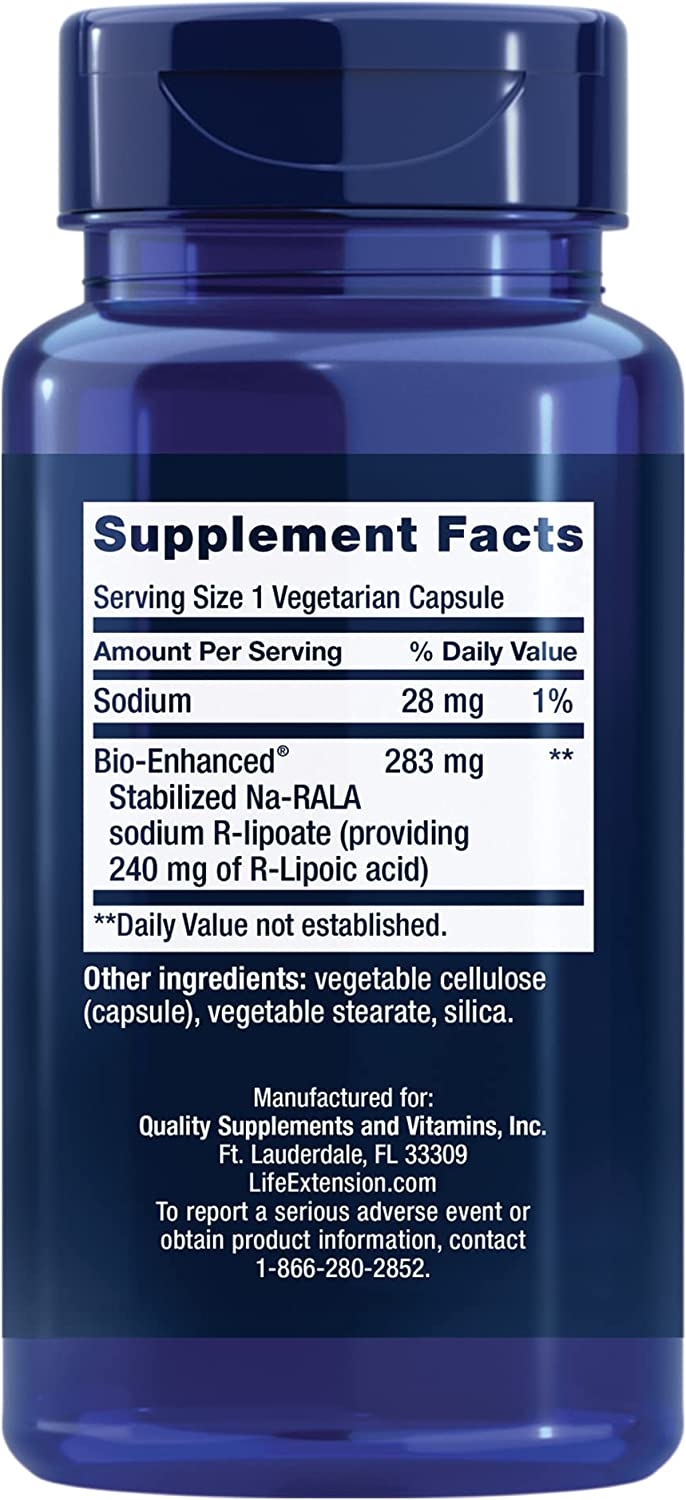
Framed honestly: at the labeled one-capsule dose, this supplies 240 mg of R-lipoic acid a day; at two capsules, 480 mg. Even granting the real (not 30×) bioavailability edge of the R-form, that's below the 600 mg/day floor every positive diabetic-neuropathy trial in the 2023 meta-analysis used — and dose-ranging research found no extra benefit above 600 mg. This product isn't mislabeled; it's simply dosed below the range where the strongest clinical evidence for this ingredient exists.
Who this is for: Adults who want a well-tolerated antioxidant, are content with the labeled 240–480 mg/day, and understand that the "cellular energy" evidence is thin. This product is a general-purpose dietary supplement; it is not a treatment for any medical condition, and nothing here is a protocol to follow on your own.
Who should skip it: Most healthy adults hoping for a metabolic or energy boost, since NCCIH found no benefit over placebo for blood sugar, cholesterol, or triglycerides; anyone on diabetes medication or in active cancer treatment without medical sign-off; and pregnant or breastfeeding women, given insufficient safety data.
Life Extension Super R-Lipoic Acid 240 mg — 60 Vegetarian Capsules
240 mg of stabilized R-lipoic acid per capsule, gluten-free and non-GMO. As covered above, the labeled 1–2 capsule dose sits below the 600 mg/day used in the trials with the clearest benefit, so this is best understood as a general antioxidant supplement rather than a way to reproduce those trials at home.
View Product DetailsHow to Use It Sensibly, If You Decide To
- Take it on an empty stomach, ideally 30 minutes before a meal — food cuts peak absorption by roughly 30%.
- If you have diagnosed diabetic neuropathy and want the evidence-backed 600 mg/day dose, discuss it with your doctor first, including diabetes-medication interactions.
- If you're taking it as a general antioxidant, know NCCIH found no measurable benefit for blood sugar, cholesterol, or triglycerides at any studied dose.
- Watch for low-blood-sugar symptoms — sweating, palpitations, confusion — and see a doctor if they occur.
- Keep the bottle out of reach of children; serious poisonings have been reported in children and adolescents at doses well below the amounts that have proved fatal in adults.
- Our Vitamins & Minerals category carries other evidence-reviewed antioxidants like CoQ10 or NAC.
Frequently Asked Questions
Does alpha-lipoic acid actually help with nerve pain?
For diagnosed diabetic peripheral neuropathy, a 2023 meta-analysis of 10 trials and 1,242 patients found real, statistically significant improvement in symptom and impairment scores — but only at 600 mg/day or higher, above what most single-ingredient capsules provide per serving.
Is alpha-lipoic acid good for general energy or metabolism?
The evidence doesn't support that broader claim. NCCIH's 2023 review cites a 10-study, 553-participant analysis finding it no better than placebo for blood sugar, cholesterol, or triglycerides in type 2 diabetes, undercutting the cellular-energy framing used to market it to healthy adults.
What's the difference between R-lipoic acid and regular alpha-lipoic acid?
Most standard supplements use a 50:50 racemic mix of the R- and S-forms; R-lipoic acid is the form the body makes and absorbs somewhat better, with peak plasma concentrations roughly 40–50% higher than the S-form — a real but modest edge, not the 30-fold difference some marketing claims.
Is there a recommended dose or upper limit for alpha-lipoic acid?
No. The NIH has not set a Recommended Dietary Allowance, Adequate Intake, or Tolerable Upper Intake Level, because ALA isn't classified as an essential nutrient. This product's own label states that its Daily Value is not established.
Can alpha-lipoic acid cause low blood sugar?
Yes, two ways: it can independently lower blood glucose, which matters if you take insulin or another diabetes medication, and in rare cases it has triggered an autoimmune reaction causing spontaneous hypoglycemia, with about 60 such cases reported worldwide to date.
Is alpha-lipoic acid safe for the liver?
At conventional 100–600 mg doses, yes. The NIH's LiverTox database rates it an unlikely cause of clinically apparent liver injury, with no published reports of enzyme elevations tied to normal use. Severe multi-gram overdoses affect the kidneys, heart, and nerves far more than the liver.
Can I take alpha-lipoic acid during chemotherapy?
Only with your oncology team's guidance. Memorial Sloan Kettering Cancer Center cautions its antioxidant activity may antagonize chemotherapy and radiation therapy, even though separate supervised trials have tested it to reduce chemotherapy-induced nerve damage.
How many capsules would match the dose used in the diabetic neuropathy trials?
The trials showing benefit used 600–1,800 mg daily. This product provides 240 mg per capsule, so matching even the lowest effective trial dose means exceeding this bottle's labeled 1–2 capsule (240–480 mg) directions — a change to make only with a doctor's guidance.
Sources
- National Center for Complementary and Integrative Health. "Diabetes and Dietary Supplements: What You Need To Know." Updated November 2023. Accessed 2 September 2026.
- Delage, B. "Lipoic Acid." Linus Pauling Institute Micronutrient Information Center, Oregon State University. Reviewed January 2019. Accessed 2 September 2026.
- Hsieh, R-Y., Huang, I-C., Chen, C., Sung, J-Y. "Effects of Oral Alpha-Lipoic Acid Treatment on Diabetic Polyneuropathy: A Meta-Analysis and Systematic Review." Nutrients, 2023. Accessed 2 September 2026.
- Didangelos, T., et al. "Efficacy and Safety of the Combination of Superoxide Dismutase, Alpha Lipoic Acid, Vitamin B12, and Carnitine for 12 Months in Patients with Diabetic Neuropathy." Nutrients, 2020. Accessed 2 September 2026.
- LiverTox: Clinical and Research Information on Drug-Induced Liver Injury. "Alpha Lipoic Acid." NIH National Institute of Diabetes and Digestive and Kidney Diseases. Updated May 2023. Accessed 2 September 2026.
- "Autoimmune Hypoglycemia Due to Alpha-Lipoic Acid: Report of Two Cases." Journal of Postgraduate Medicine, 2025. Accessed 2 September 2026.
- Memorial Sloan Kettering Cancer Center. "Alpha-Lipoic Acid." Accessed 2 September 2026.
- MedlinePlus. "Dietary Supplements." Updated 20 November 2025. Accessed 2 September 2026.
- U.S. Food and Drug Administration. "Dietary Supplements." Accessed 2 September 2026.
This article is for educational purposes only and is not medical advice. It is not intended to diagnose, treat, cure, or prevent any disease. These statements have not been evaluated by the Food and Drug Administration. Talk to your doctor before starting alpha-lipoic acid or any new supplement, especially if you have diabetes or take insulin or another blood-sugar-lowering medication, are undergoing cancer treatment, are pregnant or breastfeeding, or have a history of autoimmune disease.