
The NIH Office of Dietary Supplements says the body makes enough carnitine to meet the needs of healthy people and requires only about 15 mg a day (fact sheet updated 17 April 2023), yet this capsule supplies 500 mg of its acetylated form, and up to 2,000 mg a day on the label directions. Acetyl-L-carnitine (ALCAR) is a carnitine compound, derived from an amino acid, that cells use to turn fat into energy. The stake is a result worth knowing before you buy: in a 409-patient cancer trial, 3,000 mg a day made nerve damage worse, and the American Society of Clinical Oncology now says to discourage it for that use.
Key Takeaways
- NIH puts carnitine need at about 15 mg a day, met by diet plus the body’s own synthesis; an omnivore diet gives 24 to 145 mg (NIH ODS, updated 2023).
- A 2003 Cochrane review found ALCAR helped Alzheimer’s patients on clinician impression at 12 and 24 weeks but not at 52 weeks, with no objective cognitive benefit (Cochrane, 2003).
- A 2018 meta-analysis of 12 trials (791 people) found lower depressive symptoms (SMD −1.10), but trials disagreed widely (I² = 86%) (Psychosom Med, 2018).
- In the 409-woman SWOG S0715 trial, 3,000 mg a day worsened chemotherapy nerve damage: grade 3–4 neurotoxicity in 8 patients versus 1 on placebo (J Clin Oncol, 2013).
- Carnitine has no established upper limit, but about 3 g a day can cause nausea, cramps, diarrhea and a fishy body odor (NIH ODS, 2023).
In this article:
- What Acetyl-L-Carnitine Is and Who Actually Lacks Carnitine
- Memory and Dementia: Early Optimism, Then Cochrane
- Mood: Big Numbers and Big Caveats
- The Cancer-Trial Warning
- Heart, Gut Bacteria and TMAO
- Dose, Side Effects and Interactions
- Inside Life Extension Acetyl-L-Carnitine 500 mg
- Who Might Consider It, and Who Should Skip It
- Frequently Asked Questions
What Acetyl-L-Carnitine Is and Who Actually Lacks Carnitine
The NIH Office of Dietary Supplements fact sheet (updated 17 April 2023) describes carnitine as the generic term for several compounds, including L-carnitine and acetyl-L-carnitine. The body makes it from the amino acids lysine and methionine, and food adds more, especially animal foods. Its job is to help carry long-chain fatty acids into mitochondria, where they are oxidized to make ATP.
Healthy people do not run short. NIH states that the body’s own synthesis is sufficient to meet their needs, and calls carnitine only “conditionally essential,” for example in premature birth or kidney dysfunction. True deficiency is a rare genetic transporter disorder, usually appearing in infancy or early childhood, or a secondary deficiency that doctors treat with carefully dosed carnitine, not shelf supplements.
| Measure | Amount | Source |
|---|---|---|
| Daily need, from diet plus synthesis | About 15 mg a day | NIH ODS, updated 2023 |
| Typical omnivore diet (165 lb adult) | 24 to 145 mg a day | NIH ODS, updated 2023 |
| Absorption: dietary carnitine / supplemental L-carnitine | 63% to 75% / 14% to 18% | NIH ODS, updated 2023 |
| Absorption of acetyl-L-carnitine | “Has not been well studied” | NIH ODS, updated 2023 |
A vegan diet provides only about 1.2 mg a day, yet NIH says synthesis covers the gap, so plant-based eating alone is no reason to supplement. The store listing says ALCAR “uniquely crosses the blood-brain barrier”; that is a manufacturer statement the NIH sheet does not address.
Memory and Dementia: Early Optimism, Then Cochrane
ALCAR’s brain reputation rests on a plausible idea: carnitine may support acetylcholine, the messenger that degenerating memory neurons use. A 2003 meta-analysis pooled 21 trials in 1,204 adults with mild cognitive impairment or mild Alzheimer’s disease taking 1.5 to 3.0 g a day for 3 to 12 months, and found better clinical and psychometric scores than with placebo (NIH ODS, updated 2023).
The same year’s Cochrane review (Hudson and Tabet, 2003) of double-blind trials in Alzheimer’s disease was far less enthusiastic. It found benefit on the clinician’s global impression at 12 and 24 weeks (odds ratios 2.33 and 3.91) but not at 52 weeks, and none for cognition, dementia severity or function. Its authors warned the significant result “may be due to chance.”
“At present there is no evidence to recommend its routine use in clinical practice.”
— Hudson and Tabet, “Acetyl-L-carnitine for dementia,” Cochrane Database of Systematic Reviews (2003), reviewers’ conclusionsNIH adds that the reviewers found more recent studies less positive than earlier ones, and that ALCAR’s effects in dementia “remain unclear.” These were people with diagnosed dementia, and the NIH sheet describes no trial showing memory gains in healthy people. For how a large trial can overturn a promising signal, see ginkgo biloba and a 3,069-person NIH trial.
Mood: Big Numbers and Big Caveats
A 2018 meta-analysis in Psychosomatic Medicine (Veronese et al.; searches ran to December 2016) pooled 12 randomized trials with 791 participants. Across nine trials (231 treated, 216 on placebo), ALCAR reduced depressive symptoms, with a standardized mean difference of −1.10 (95% CI −1.65 to −0.56). In three trials against established antidepressants (162 people per group), the effect was similar (SMD 0.06) with fewer adverse effects.
Those numbers are large, which is a reason to slow down. The heterogeneity statistic (I² = 86%) shows the trials disagreed widely, and they were small: 231 treated people across nine trials is about 26 per trial. The authors say “large scale trials” are required to confirm or refute the findings. Depression is a medical condition; anyone with persistent low mood should see a clinician rather than self-treat with a supplement.
| Outcome | Evidence | Finding |
|---|---|---|
| Mild cognitive impairment / mild Alzheimer’s | 2003 meta-analysis, 21 trials, 1,204 adults, 1.5–3 g a day | Better clinical and psychometric scores than placebo (NIH ODS) |
| Alzheimer’s disease | Cochrane 2003, double-blind trials | Global-impression benefit at 12 and 24 weeks, none at 52; no objective benefit |
| Depressive symptoms | Meta-analysis 2018, 12 trials, 791 people | SMD −1.10 versus placebo, I² = 86%; similar to antidepressants in 3 trials |
| Preventing chemotherapy nerve damage | SWOG S0715, 409 women, 3,000 mg a day, 24 weeks | Worse neuropathy with ALCAR at 24 weeks (P = .01) |
The Cancer-Trial Warning
Researchers tested whether ALCAR could prevent the nerve damage caused by taxane chemotherapy. The result, reported in the Journal of Clinical Oncology (Hershman and colleagues, 2013), was the opposite of what was hoped. SWOG S0715 was a 24-week double-blind trial of 3,000 mg a day of ALCAR against placebo in women receiving adjuvant taxane chemotherapy for breast cancer. Of 409 evaluable patients (208 on ALCAR, 201 on placebo), week-12 scores did not differ significantly, but at week 24 neuropathy scores were 1.8 points worse with ALCAR (95% CI −3.2 to −0.4; P = .01). A drop of more than five points occurred in 38% of the ALCAR group versus 28% on placebo, and grade 3–4 neurotoxicity in eight patients versus one.
“This is the first study to our knowledge showing that a nutritional supplement increased CIPN.”
— Hershman et al., Journal of Clinical Oncology (2013), abstract; CIPN is chemotherapy-induced peripheral neuropathyThe harm lingered: a two-year follow-up (Journal of the National Cancer Institute, 2018) found significantly worse neurotoxicity scores with ALCAR overall (−1.39 points; 95% CI −2.48 to −0.30; P = .01), and at 104 weeks 39.5% of the ALCAR group and 34.4% of the placebo group reported a five-point decrease.
Safety warning: if you are having, or have had, chemotherapy, especially a taxane such as paclitaxel or docetaxel, do not take acetyl-L-carnitine without asking your oncology team. ASCO’s 2020 guideline update (Loprinzi and colleagues) states that “the use of acetyl-l-carnitine for the prevention of CIPN in patients with cancer should be discouraged.”
The trial tested 3,000 mg a day and does not show harm in healthy people taking less, but a compound sold for the nerves is not automatically good for them. For another antioxidant tested in diabetic nerve pain, see alpha-lipoic acid.
Heart, Gut Bacteria and TMAO
The listing touts “cardiovascular support.” NIH reports mixed heart evidence, mostly for L-carnitine rather than the acetyl form: a meta-analysis of 13 trials in 3,629 adults after a heart attack found lower all-cause mortality but no effect on heart failure or reinfarction. The counterweight is a 2013 study of 2,595 adults having cardiac evaluation, which found that gut bacteria turn L-carnitine into trimethylamine-N-oxide (TMAO), a substance associated with higher cardiovascular risk, more so in meat eaters. NIH says the implications “are not well understood and require more research.” No trial has shown a daily ALCAR capsule raises or lowers heart-attack risk.
NutritionFacts.org on the carnitine–TMAO link, cited as background; our figures come from the sources listed below.
Dose, Side Effects and Interactions
NIH reports that carnitine has no established tolerable upper intake level, but doses of about 3 g a day of carnitine supplements can cause nausea, vomiting, abdominal cramps, diarrhea and a fishy body odor, plus muscle weakness in people with uremia and seizures in people with seizure disorders (NIH ODS, updated 2023). The trials above used 1 to 3 g a day, overlapping or exceeding the 1,000 to 2,000 mg this bottle’s directions give.
The sheet lists medicines that interact with carnitine: pivalate-conjugated antibiotics such as pivampicillin can deplete it, and the anticonvulsants valproic acid, phenobarbital, phenytoin and carbamazepine lower blood carnitine. Valproic acid may also cause liver toxicity and raise ammonia levels. NIH gives these as examples. The sheet offers no safety guidance for ALCAR in pregnancy or breastfeeding.
Inside Life Extension Acetyl-L-Carnitine 500 mg
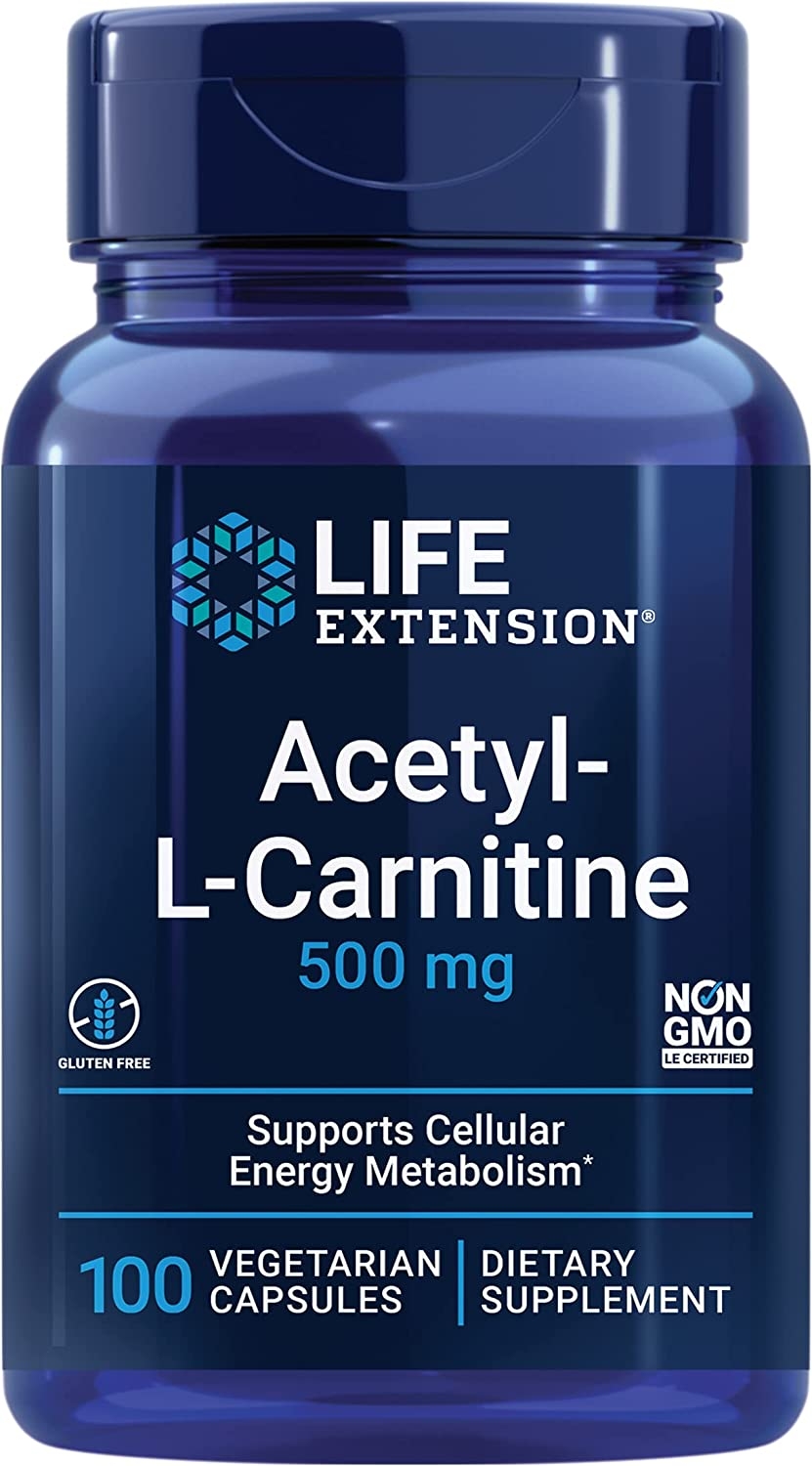
The product is Life Extension Acetyl-L-Carnitine 500 mg, 100 vegetarian capsules. The store listing states 500 mg per capsule. The directions read: “Take one (1) capsule two to four times daily on an empty stomach with water or juice,” which is 1,000 to 2,000 mg a day.
| This product | Typical shelf dose | NIH RDA / AI | Tolerable Upper Limit | |
|---|---|---|---|---|
| Acetyl-L-carnitine, per day | 500 mg per capsule; 1,000–2,000 mg on the listing’s directions | Carnitine supplements range from about 3 to 5,000 mg (NIH ODS); dementia trials used 1.5–3 g; SWOG S0715 used 3 g | None established; need is about 15 mg a day from diet plus synthesis | None established; about 3 g a day can cause GI upset and fishy odor |
No RDA exists, so these multiples are our arithmetic against NIH’s 15 mg figure for total carnitine need: one capsule is about 33 times that figure, four capsules about 133 times. Four capsules a day is two-thirds of the cancer-trial dose and inside the dementia trials’ 1.5 to 3.0 g range; those trials tested other makers’ ALCAR, so they say nothing specific about this brand.
Listing versus evidence: the store description says ALCAR provides “neuroprotective benefits,” “energy to the heart muscle” and “antioxidant protection.” Those are manufacturer statements; NIH calls the dementia results unclear and heart evidence mixed. One arithmetic note: at the directed two to four capsules a day, 100 capsules last 25 to 50 days, so the listing’s “up to 3-month supply” holds only at one capsule a day.
Who Might Consider It, and Who Should Skip It
Who this is for: adults who have talked with their doctor and want to try ALCAR for a specific reason, such as older adults curious about the mood findings, or people whose clinician has diagnosed a carnitine shortfall. The evidence is modest, so treat it as a time-limited trial, not a proven fix.
Who should skip it: most healthy adults, whose bodies make enough carnitine and who have no trial evidence of memory benefit; anyone having or recovering from taxane chemotherapy; people with seizure disorders or kidney disease; anyone on valproic acid, phenytoin, phenobarbital, carbamazepine or a pivalate antibiotic without clinician advice; and anyone pregnant or breastfeeding. Persistent low mood or memory loss needs a clinician first.
Life Extension Acetyl-L-Carnitine 500 mg, 100 Vegetarian Capsules
500 mg of acetyl-L-carnitine per capsule, 100 vegetarian capsules, with listing directions of one capsule two to four times daily on an empty stomach. Browse more in our supplements range.
View Product DetailsFrequently Asked Questions
What is acetyl-L-carnitine used for?
Acetyl-L-carnitine is a carnitine compound that helps move fatty acids into mitochondria for energy. Supplements are marketed for memory, mood and nerve health, but NIH calls the dementia evidence unclear and the mood findings come from small trials. Evidence for each use is limited.
Does acetyl-L-carnitine improve memory?
Not reliably. A 2003 Cochrane review found a clinician-rated benefit at 12 and 24 weeks in Alzheimer’s disease but none at 52 weeks and no objective cognitive benefit. The NIH sheet describes no trial showing memory gains in healthy adults.
Is acetyl-L-carnitine good for depression?
A 2018 meta-analysis of 12 trials (791 people) found lower depressive symptoms than placebo, but results varied widely and the authors want larger trials. Depression needs clinical assessment, so see a doctor rather than self-treating with a supplement. It is not a replacement for prescribed treatment.
How much acetyl-L-carnitine should you take a day?
No official dose exists. This bottle’s listing directs one 500 mg capsule two to four times daily, so 1,000 to 2,000 mg. Dementia trials used 1 to 3 g a day, and NIH says about 3 g can cause nausea and diarrhea. Ask a clinician first.
What are the side effects of acetyl-L-carnitine?
NIH lists nausea, vomiting, abdominal cramps, diarrhea and a fishy body odor at about 3 g a day of carnitine. It can also cause seizures in people with seizure disorders and muscle weakness in people with uremia. Tell a clinician if symptoms persist.
Who should not take acetyl-L-carnitine?
People in or recovering from taxane chemotherapy, those with seizure disorders or kidney disease, and anyone on valproic acid, phenytoin, phenobarbital, carbamazepine or pivalate antibiotics should ask a clinician first, as should pregnant or breastfeeding readers. This is not a complete list.
Is acetyl-L-carnitine the same as L-carnitine?
No, though both are carnitine compounds. NIH says supplemental L-carnitine is only 14% to 18% absorbed, while acetyl-L-carnitine absorption has not been well studied. Most heart and athletic evidence NIH reviews is for L-carnitine, and brain-health products mostly use the acetyl form.
Does carnitine raise TMAO and heart risk?
Gut bacteria convert L-carnitine to TMAO, which a 2013 study of 2,595 adults linked with cardiovascular risk, more so in meat eaters. NIH says the implications are not well understood and need more research. No trial has shown a daily ALCAR capsule changes heart-attack rates.
Sources
- NIH Office of Dietary Supplements. “Carnitine: Fact Sheet for Health Professionals.” Updated 17 April 2023. Accessed 10 October 2026 (archived copy, as the live page blocks automated access). web.archive.org snapshot of ods.od.nih.gov
- Hudson S, Tabet N. “Acetyl-L-carnitine for dementia.” Cochrane Database of Systematic Reviews, 2003 (CD003158). Accessed 10 October 2026. NCBI abstract record, PMID 12804452
- Veronese N, Stubbs B, Solmi M, et al. “Acetyl-L-carnitine supplementation and the treatment of depressive symptoms: a systematic review and meta-analysis.” Psychosomatic Medicine, February/March 2018. Accessed 10 October 2026. NCBI abstract record, PMID 29076953
- Hershman DL, Unger JM, Crew KD, et al. “Randomized double-blind placebo-controlled trial of acetyl-L-carnitine for the prevention of taxane-induced neuropathy in women undergoing adjuvant breast cancer therapy.” Journal of Clinical Oncology, 10 July 2013. Accessed 10 October 2026. NCBI abstract record, PMID 23733756
- Hershman DL, Unger JM, Crew KD, et al. “Two-year trends of taxane-induced neuropathy in women enrolled in a randomized trial of acetyl-L-carnitine (SWOG S0715).” Journal of the National Cancer Institute, 1 June 2018. Accessed 10 October 2026. NCBI abstract record, PMID 29361042
- Loprinzi CL, Lacchetti C, Bleeker J, et al. “Prevention and management of chemotherapy-induced peripheral neuropathy in survivors of adult cancers: ASCO guideline update.” Journal of Clinical Oncology, 1 October 2020. Accessed 10 October 2026. NCBI abstract record, PMID 32663120
- U.S. Food and Drug Administration. “Dietary Supplements.” Current page. Accessed 10 October 2026. fda.gov
This article is for educational purposes only and is not medical advice. It is not intended to diagnose, treat, cure, or prevent any disease. These statements have not been evaluated by the Food and Drug Administration. Dietary supplements are not approved by the FDA before they are sold. Talk to your doctor before starting any new supplement, especially if you are having cancer treatment, have a seizure disorder or kidney disease, are pregnant or breastfeeding, or take any prescription medication.