
The largest clinical trial ever run on ginkgo biloba — 3,069 adults followed for a median of six years — found slightly more cases of dementia in the group taking it than in the group taking a placebo. The difference wasn't statistically significant, but it is the opposite of what "brain support" marketing implies. That NIH-funded trial, called GEM, used the same 240 mg daily dose found in many ginkgo supplements on the market today. Here's what the evidence actually supports, what it doesn't, and what to know before combining ginkgo with any medication.
Key Takeaways
- The GEM study followed 3,069 people aged 75+ for a median of 6.1 years: 277 taking ginkgo developed dementia versus 246 on placebo (p=0.21) — no protective effect, and numerically worse.
- Clinical research on ginkgo almost always uses 240 mg/day of a standardized extract (24% flavone glycosides, 6% terpene lactones) — the same total daily dose as two 120 mg capsules of the featured product.
- Taking ginkgo alongside warfarin was associated with a 38% higher risk of a bleeding event (hazard ratio 1.38) in a retrospective analysis of a large U.S. Veterans Administration population.
- NCCIH states there is "no conclusive evidence that ginkgo is helpful for any health condition," including tinnitus and blood pressure, where it has been specifically tested.
- Ginkgo has no FDA-approved use, carries a genuine seizure-threshold warning, and is regulated as an unreviewed dietary supplement, not a drug.
In this article:
- What is ginkgo biloba, and why is it sold as a memory supplement?
- The largest ginkgo trial ever run: what the GEM study found
- What about existing memory loss, tinnitus, or blood pressure?
- How ginkgo is supposed to work in the brain
- The safety side: bleeding, seizures, and drug interactions
- Reading the label: dose, standardization, and "certified extract"
- Should you take a ginkgo supplement?
- FAQ
What Is Ginkgo Biloba, and Why Is It Sold as a Memory Supplement?
Ginkgo biloba is the sole surviving species of a plant family that predates most modern trees; extracts made from its fan-shaped leaves have been used in traditional Chinese medicine for centuries. Modern supplements don't use raw leaf — they use a concentrated, standardized leaf extract, because unprocessed ginkgo leaf and seeds contain compounds (ginkgolic acids) that are toxic in quantity. The extract format researchers actually study is standardized to roughly 24% flavone glycosides and 6% terpene lactones, with ginkgolic acid capped at a low fraction of a percent.
The pitch is straightforward: ginkgo is thought to improve blood flow and protect brain cells from oxidative stress, so it's marketed for memory, focus, and "healthy circulation." That mechanism is plausible on paper — the question this article works through is whether it holds up in the trials big enough to actually measure a dementia outcome, not just a mood or a test score.
The Largest Ginkgo Trial Ever Run: What the GEM Study Found
The Ginkgo Evaluation of Memory (GEM) study, funded by the National Institutes of Health and conducted at U.S. academic medical centers, is the largest trial ever conducted to test whether ginkgo biloba prevents dementia. It randomized 3,069 adults aged 75 and older — with normal cognition or mild cognitive impairment at enrollment — to either 240 mg/day of ginkgo extract or a matching placebo, then tracked them for a median of 6.1 years, assessing participants every six months and referring suspected cases to an expert consensus panel for diagnosis.
| Group | Randomized | Daily dose | Median follow-up | Developed dementia | Rate |
|---|---|---|---|---|---|
| Ginkgo biloba | 1,545 | 240 mg | 6.1 years | 277 | ~17.9% |
| Placebo | 1,524 | — | 6.1 years | 246 | ~16.1% |
The result (p=0.21) was not statistically significant — meaning the small numerical gap could plausibly be chance. But it is worth sitting with what that means in plain terms: in the best-powered trial ever run on this question, taking ginkgo did not reduce dementia risk, and the raw numbers ran slightly in the wrong direction. A companion French trial, GuidAge, tested ginkgo in adults with memory complaints and likewise found no reduction in progression to Alzheimer's disease. Two large, independent trials, same conclusion.
Why this trial matters more than smaller studies: a lot of ginkgo research consists of short trials measuring a test score in healthy adults, which is easy to run but easy to over-interpret. GEM measured an actual clinical outcome — a diagnosis of dementia — in enough people, for long enough, to detect even a modest real effect if one existed. It didn't find one.
What About Existing Memory Loss, Tinnitus, or Blood Pressure?
Dementia prevention isn't the only claim attached to ginkgo. The evidence for the rest is thinner, not stronger.
| Claimed use | What the evidence shows |
|---|---|
| Preventing dementia in healthy or mildly impaired older adults | Not effective — GEM and GuidAge, the two largest trials, both found no reduction in incidence. |
| Treating symptoms of existing dementia or cognitive impairment | Evidence is inconsistent; some analyses suggest a possible modest effect only at doses above 200 mg/day for 5+ months, not reliably reproduced. |
| Tinnitus (ringing in the ears) | Not helpful, according to NCCIH. |
| High blood pressure or heart disease prevention | Not helpful, according to NCCIH. |
| General memory/focus in healthy adults | Research is low quality; no conclusive benefit demonstrated. |
"There's no conclusive evidence that ginkgo is helpful for any health condition."
National Center for Complementary and Integrative Health (NCCIH), National Institutes of HealthThat's a blunt statement from the federal agency whose job is specifically to evaluate complementary-health evidence without a commercial stake in the answer. It doesn't mean ginkgo does nothing biologically — the mechanism research below is real — it means the clinical trials large and rigorous enough to prove a benefit to people haven't found one.
How Ginkgo Is Supposed to Work in the Brain
The biological rationale for ginkgo isn't invented. Extracts have measurable effects in the lab: they act as free-radical scavengers that may protect neurons from oxidative damage, they show mild anticholinesterase activity (the same general pathway some Alzheimer's drugs target, though far weaker), and they act as a platelet-activating-factor antagonist and mild vasodilator — which is the proposed basis for the "healthy circulation" claim on supplement labels. Ginkgo also has monoamine-oxidase-inhibiting activity, which affects serotonin and dopamine signaling.
None of that is in dispute. What the mechanism research can't tell you is whether those effects translate into a meaningful clinical benefit at supplement doses in real people over years — and that's exactly the question the GEM and GuidAge trials were designed to answer.
NutritionFacts.org walks through how the dementia-prevention research on ginkgo actually reads, including the GEM trial discussed above.
The Safety Side: Bleeding, Seizures, and Drug Interactions
Ginkgo's safety profile is where the honest caution belongs, regardless of whether you find the efficacy evidence convincing.
Bleeding risk. Ginkgo's platelet-activating-factor antagonism is a real pharmacological effect, and it shows up as a real interaction risk. A retrospective analysis of warfarin patients in a large U.S. Veterans Administration database (Stoddard et al., 2015) found that concurrent ginkgo use raised the hazard of a bleeding adverse event by 38% (hazard ratio 1.38, 95% CI 1.20–1.58, p<0.001). That is observational rather than randomized evidence, and controlled studies have not consistently shown ginkgo to alter warfarin pharmacokinetics — the literature is genuinely mixed. The clinical guidance is not: avoid ginkgo alongside anticoagulants (warfarin), antiplatelet drugs (aspirin, clopidogrel), and regular NSAID use, and stop it ahead of any planned surgery — StatPearls cites a recommendation to discontinue at least 36 hours beforehand, and your surgical team should be told you take it whatever the timing. Watch for unusual bruising, nosebleeds, bleeding gums, or blood in urine or stool, and stop and call a doctor if they occur.
Seizure threshold. Ginkgo is contraindicated in people with epilepsy or a seizure disorder — compounds in the plant can lower the seizure threshold.
Other interactions. Because ginkgo affects serotonin and dopamine pathways, combining it with antidepressants carries a theoretical serotonin syndrome risk. It can also raise blood glucose, so people with diabetes should monitor levels more closely if they use it. Ginkgo is not recommended during pregnancy or breastfeeding: there are no safety data in these groups, and NCCIH warns it might cause early labor or extra bleeding during delivery if used near term.
None of this makes ginkgo unusually dangerous compared to other herbal supplements — but "herbal" and "harmless" aren't the same claim, and a supplement that measurably affects clotting is exactly the kind of thing to mention to a surgeon, anesthesiologist, or prescribing physician before combining it with anything else.
Reading the Label: Dose, Standardization, and "Certified Extract"
Not all ginkgo products are equivalent, and the label is where that becomes checkable. The featured product here is Life Extension's Ginkgo Biloba Certified Extract — 120 mg per vegetarian capsule, standardized to 24% flavone glycosides and 6% total terpene lactones, with ginkgolic acid capped below 1 part per million.
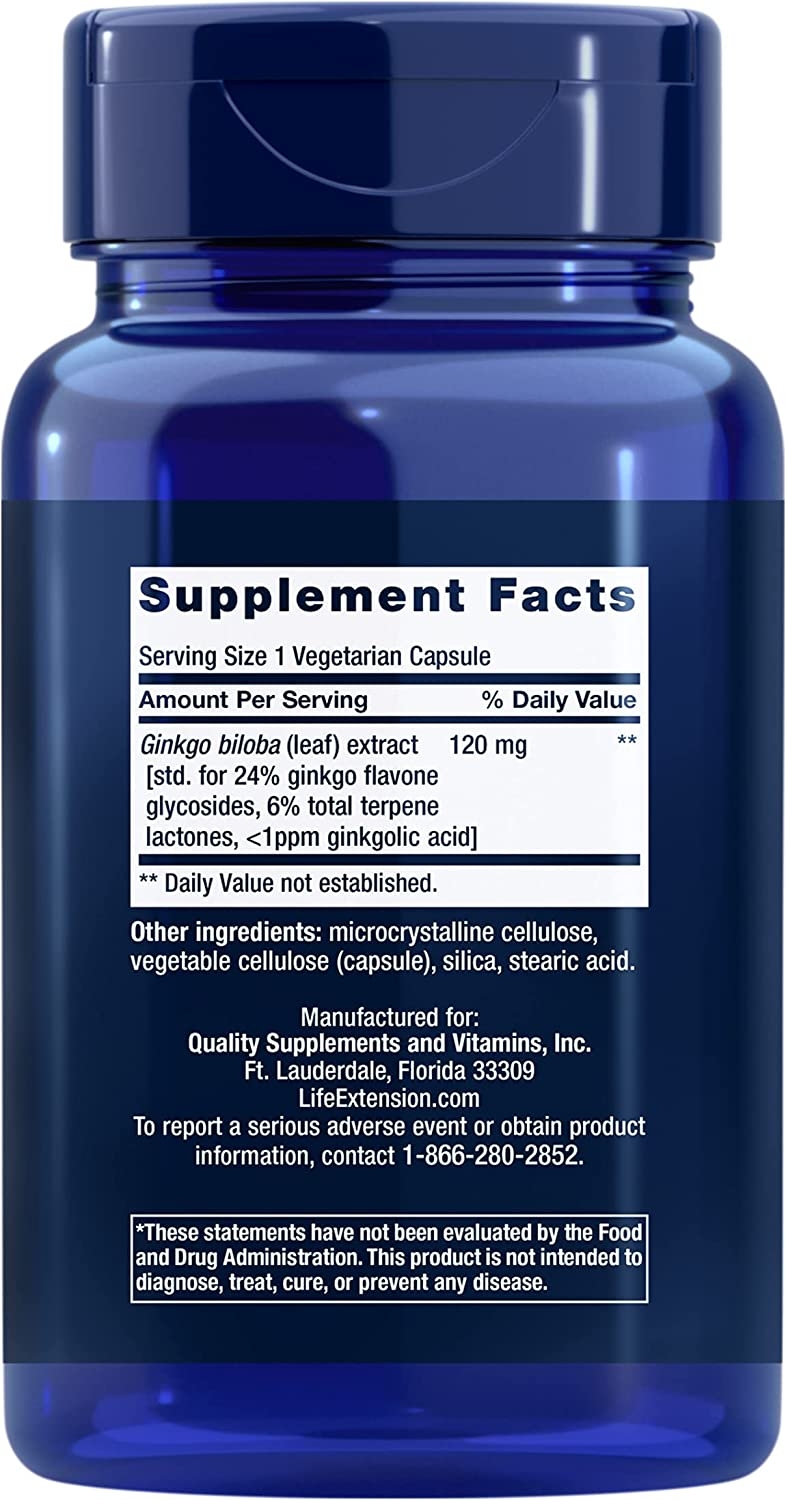
That standardization ratio — 24% flavone glycosides, 6% terpene lactones — matters more than it might look. It's the same general standardization used in the extract formulations tested in GEM and most other ginkgo trials, which is what makes a study's dosing translatable to a bottle on a shelf in the first place. A ginkgo product that doesn't disclose its standardization percentage is harder to connect to any specific trial's results, because "ginkgo leaf extract" alone says nothing about potency.
On dose: the label directs one capsule twice daily — 240 mg/day total — which lines up with the dose used in GEM and is also the maximum daily dose generally recommended for this extract — 240 mg/day is a ceiling to stay at, not a floor to build on. There's no established Tolerable Upper Intake Level for ginkgo the way there is for, say, vitamin A or zinc, because it isn't a nutrient with a required intake — the relevant caution is the drug-interaction profile above, not a dose-toxicity curve.
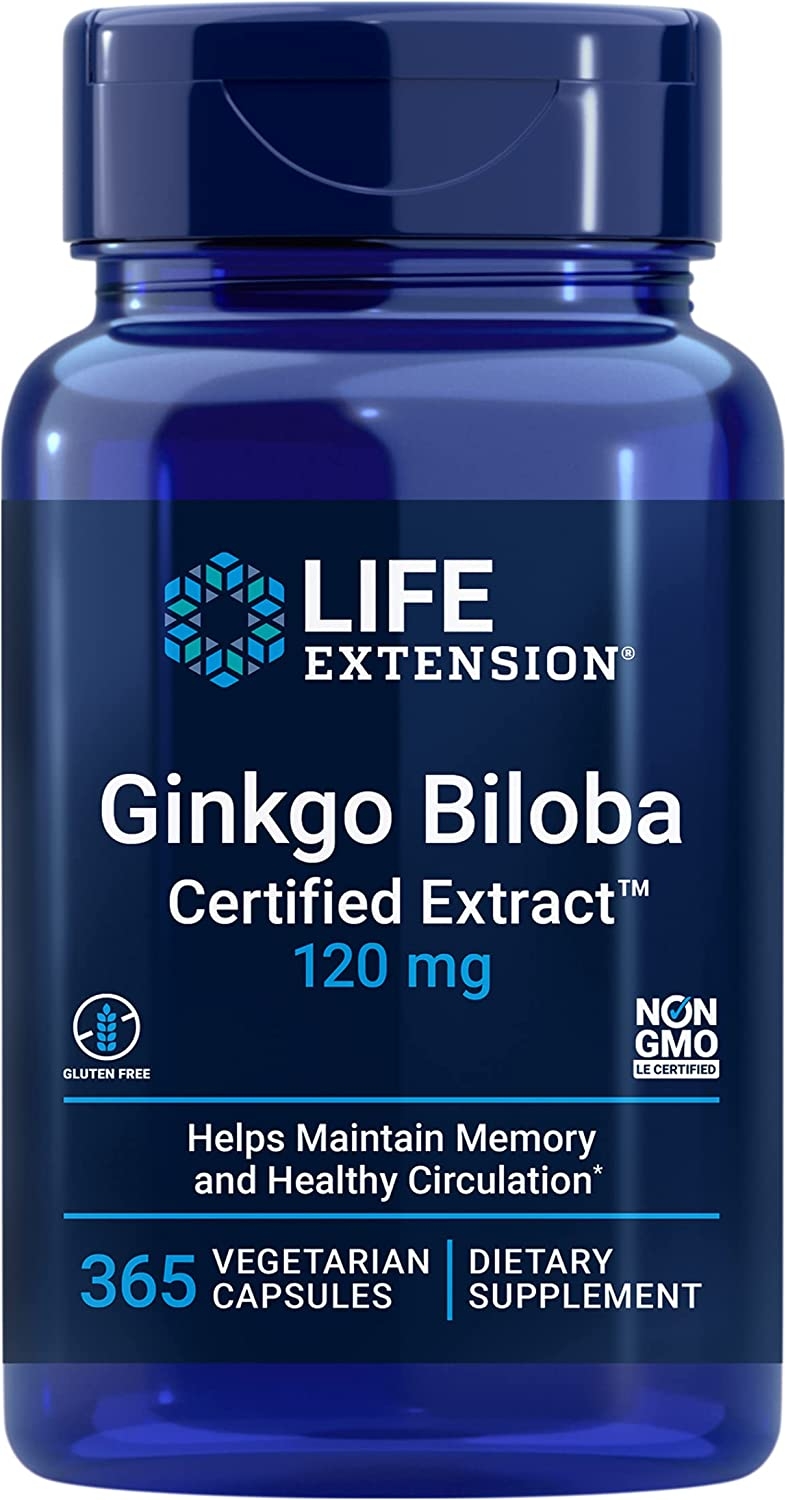
Life Extension Ginkgo Biloba Certified Extract, 120 mg — 365 Vegetarian Capsules
A single-ingredient, standardized ginkgo extract (24% flavone glycosides, 6% terpene lactones) at the same 120 mg-per-capsule strength used in most clinical research — gluten-free, non-GMO, and vegetarian. At the labeled dose of one capsule twice daily, a 365-capsule bottle lasts roughly six months, not a year.
View ProductShould You Take a Ginkgo Supplement?
If your goal is specifically to prevent dementia, the largest trial available says a standardized ginkgo extract doesn't do that — that's not a marketing framing problem, it's the finding. If you're taking it because you like how it makes you feel, or your clinician has suggested trying it for another reason, the safety profile is manageable for most healthy adults at standard doses, provided you aren't on a blood thinner, don't have a seizure disorder, and check with a physician if you're on other medications, pregnant, or breastfeeding. What ginkgo is not is a substitute for evaluating unexplained memory changes with a doctor — persistent memory problems deserve a clinical work-up, not a supplement trial-and-error approach.
Frequently Asked Questions
Does ginkgo biloba actually improve memory?
In the largest and longest trial ever conducted (GEM, N=3,069, median follow-up 6.1 years), ginkgo did not reduce the rate of dementia compared to placebo. Evidence for smaller memory or focus benefits in healthy adults is inconsistent and generally low quality.
Is ginkgo biloba safe to take with blood thinners?
No — concurrent ginkgo and warfarin use was associated with a 38% higher bleeding-event risk in a large retrospective Veterans Administration cohort, and it should also be avoided with aspirin, other antiplatelet drugs, and regular NSAID use without medical guidance.
What dose of ginkgo was used in the biggest dementia-prevention trial?
240 mg per day of standardized extract (120 mg twice daily), the same total daily dose as two capsules of the 120 mg product featured above.
Can ginkgo biloba cause seizures?
Ginkgo is contraindicated in people with epilepsy or a seizure disorder, since compounds in the extract can lower the seizure threshold.
Is ginkgo biloba FDA-approved?
No. It has no FDA-approved indication and is regulated as a dietary supplement, meaning it isn't reviewed for safety or effectiveness before it reaches shelves the way a drug is.
Should people with diabetes be cautious with ginkgo?
Yes — ginkgo can raise blood glucose, so people managing diabetes should monitor levels more closely and discuss it with their clinician before starting it.
Sources
- NCCIH — Ginkgo: Usefulness and Safety
- NCCIH — The Ginkgo Evaluation of Memory (GEM) Study
- ClinicalTrials.gov — NCT00010803, Ginkgo Biloba Prevention Trial in Older Individuals
- NCBI Bookshelf (StatPearls) — Ginkgo Biloba
- PMC — Impact of Ginkgo biloba Drug Interactions on Bleeding Risk and Coagulation Profiles
- Stoddard et al. — Ginkgo and Warfarin Interaction in a Large Veterans Administration Population (AMIA Annu Symp Proc, 2015)
- DeKosky et al. — Ginkgo biloba for Prevention of Dementia: a Randomized Controlled Trial (JAMA, 2008)
- FDA — Dietary Supplements
- Cleveland Clinic — Ginkgo Capsules and Tablets
This article is for educational purposes only and is not medical advice. Consult a qualified healthcare provider before starting any new supplement, especially if you take prescription medication, have a seizure disorder or bleeding condition, are scheduled for surgery, or are pregnant or breastfeeding. These statements have not been evaluated by the Food and Drug Administration. This product is not intended to diagnose, treat, cure, or prevent any disease.