
The Recommended Dietary Allowance for vitamin B12 is 2.4 micrograms a day — yet a single lozenge in this category can pack 5,000 micrograms, more than 2,000 times that amount. That is not a dosing error. It is a direct response to how badly the body absorbs vitamin B12 once it's taken by mouth in supplement form, and understanding that mechanism is the key to knowing whether a B12 supplement will actually do anything for you — or whether the "energy boost" on the label only applies to people who were deficient to begin with.
Key takeaways
- The adult RDA for vitamin B12 is just 2.4 mcg/day, but oral absorption drops sharply at higher doses — to roughly 1.3% at 1,000 mcg — which is why supplement doses run so high (NIH).
- NIH's own review states that vitamin B12 supplementation "appears to have no beneficial effect on performance in the absence of a nutritional deficit" — the energy claim only holds if you're actually low.
- In the EPIC-Oxford cohort study of 689 British men, 52% of vegans and 7% of vegetarians were classified as B12 deficient, versus fewer than 1% of meat-eaters.
- Among 614 patients with type 2 diabetes, metformin and a proton pump inhibitor (PPI) taken together were linked to 34.2% B12 deficiency, versus 22.2% on neither drug — measured against a liberal <300 pg/mL cut-off.
- A 2025 meta-analysis found sublingual lozenges were not statistically more effective than swallowed tablets — both worked comparably to B12 injections.
- What vitamin B12 actually does
- Why supplement doses are so much higher than the RDA
- Does it actually boost energy?
- Who is actually at risk of deficiency
- Sublingual vs. oral vs. injections: what the evidence shows
- Metformin, acid reducers, and a hidden interaction
- Signs of deficiency, and one real safety caveat
- The NatureBell lozenges: what they get right
- FAQ
What vitamin B12 actually does
Vitamin B12, or cobalamin, is a water-soluble vitamin the body cannot make on its own. According to the NIH Office of Dietary Supplements, it is required for red blood cell formation, DNA synthesis, and the normal function of the nervous system, where it plays a role in maintaining the myelin sheath that insulates nerve fibers. It also works alongside folate to break down homocysteine, an amino acid linked to cardiovascular risk when levels run high.
Because B12 is found almost exclusively in animal foods — meat, fish, eggs, and dairy — it occupies a specific niche among nutrients: most omnivores get enough from diet alone, while people who eat little or no animal food, or who cannot absorb it properly regardless of diet, are the ones actually at risk. The rest of this article separates those two groups, because the evidence supports supplementation very differently depending on which one you're in.
Why supplement doses are so much higher than the RDA
The adult RDA for vitamin B12 is 2.4 mcg/day, rising to 2.6 mcg in pregnancy and 2.8 mcg during breastfeeding. A typical over-the-counter B12 product, including the lozenge featured in this article, delivers 5,000 mcg per dose — a gap that looks alarming until you understand how B12 absorption actually works.
At normal dietary intakes, B12 is absorbed through an active, receptor-mediated pathway that depends on a stomach protein called intrinsic factor. That pathway has a ceiling: it can only process 1–2 mcg at a time. Once an oral dose exceeds that, the excess is absorbed by simple passive diffusion across the gut lining — a far less efficient route. NIH's fact sheet states this plainly: absorption is only about 2% at a 500 mcg dose and 1.3% at 1,000 mcg. NIH does not publish a specific figure for 5,000 mcg doses, but the trend is consistent — the higher the oral dose, the smaller the fraction that actually gets absorbed.
| Oral dose | Approximate % absorbed |
|---|---|
| 500 mcg | ~2% |
| 1,000 mcg | ~1.3% |
Source: NIH Office of Dietary Supplements, Vitamin B12 Fact Sheet for Health Professionals.
This is why manufacturers dose B12 supplements in the thousands of micrograms: even a small percentage of a very large number still clears the 2.4 mcg daily requirement several times over. It is a legitimate engineering response to a real absorption problem — not evidence that more is inherently better. NIH did not set a Tolerable Upper Intake Level for B12, but that reflects the vitamin's low potential for toxicity rather than any finding that larger doses achieve more (more on that below).
Does it actually boost energy?
This is the claim printed on nearly every B12 product, and it is also the one place where marketing copy and NIH's own evidence review diverge most sharply.
In plain terms: if your B12 status is already normal, taking more will not give you more energy, sharper focus, or better exercise performance. B12 is genuinely essential to the energy-producing reactions in every cell, which is exactly why fatigue is one of the first symptoms when someone is truly deficient — correcting a real deficiency can produce a dramatic improvement. But that improvement comes from fixing a shortfall, not from any additional benefit above a normal baseline. Someone with adequate B12 status who feels tired for other reasons — poor sleep, iron deficiency, thyroid dysfunction, or simply overwork — will not feel better from a B12 lozenge, because there was nothing to correct.
Who is actually at risk of deficiency
Because B12 comes almost entirely from animal foods, diet pattern is one of the strongest predictors of status. The EPIC-Oxford cohort study — a cross-sectional analysis of 689 British men (226 omnivores, 231 vegetarians, 232 vegans) — found a stark gradient. This particular analysis included men only, so read the percentages as a clear directional signal rather than as population-wide rates:
| Diet group | Deficient (<118 pmol/L) | Depleted (118–149 pmol/L) | Combined low status |
|---|---|---|---|
| Vegan | 52% | 21% | 73% |
| Vegetarian | 7% | 17% | 24% |
| Meat-eater | <1% | 1% | ~2% |
Source: Gilsing et al., European Journal of Clinical Nutrition, 2010 — EPIC-Oxford cohort, 689 British men. “Deficient” and “depleted” are the study's own serum cut-offs.
Diet is not the only route to deficiency, though. The National Institute on Aging sets the same 2.4 mcg daily target for adults over 51 as for everyone else, while noting that some people over 50 have trouble absorbing the B12 naturally present in food. The NIH Office of Dietary Supplements puts numbers on one reason why: atrophic gastritis, which lowers both stomach acid and intrinsic factor production, affects about 2% of the general population but 8% to 9% of adults aged 65 and over — meaning an older adult can eat plenty of meat and still absorb too little. MedlinePlus also identifies pernicious anemia, in which the body destroys the stomach cells that make intrinsic factor, and surgery removing parts of the stomach or small intestine — including some weight-loss surgeries — as causes that have nothing to do with diet at all.
"5 vitamins you may need more of." — Cleveland Clinic, an academic medical center, covering vitamin B12 alongside other commonly under-consumed nutrients.
Sublingual vs. oral vs. injections: what the evidence shows
Lozenge and sublingual B12 products are often marketed on the idea that dissolving under the tongue lets the vitamin bypass digestion and absorb more efficiently. It's a plausible-sounding mechanism, but a 2025 systematic review and meta-analysis in Frontiers in Pharmacology, pooling 16 studies and 6,098 participants, found no statistically significant difference between the three routes in raising serum cobalamin or lowering homocysteine (p = 0.270 and p = 0.485, respectively). Pooled results showed roughly a 307% average rise in cobalamin with injections, 285% with oral tablets, and 199% with sublingual lozenges — numerically lower for sublingual, though not a statistically reliable difference given the size and variability of the underlying studies.
The product description for the lozenge featured below also states that methylcobalamin (the "active coenzyme form" used here) is "preferred over cyanocobalamin for people with MTHFR gene variants." That is a claim rooted in functional-medicine practice rather than an NIH-documented consensus; MTHFR variants affect folate metabolism most directly, and mainstream sources do not establish methylcobalamin as necessary for people with these variants. Methylcobalamin is a legitimate, naturally occurring form of B12 that the body uses directly — that part is accurate — but the MTHFR-specific superiority claim should be read as a manufacturer position, not a settled medical recommendation.
Metformin, acid reducers, and a hidden interaction
One of the more clinically important — and least publicized — B12 risk factors has nothing to do with diet or age. Metformin, the first-line medication for type 2 diabetes, is well documented to lower B12 absorption over long-term use. Separately, proton pump inhibitors (PPIs) and H2-receptor antagonists reduce the stomach acid needed to release B12 from food proteins. A retrospective chart review published in Diabetes Care in 2012 looked at what happens when both are used together. Its population was narrow — 614 patients with type 2 diabetes at a single US veterans' medical centre, 96% of them male, with anyone over 60 excluded — and it defined deficiency generously, as a serum B12 below 300 pg/mL, well above the 200–250 pg/mL NIH describes as subnormal. That liberal threshold is why even the control group looks so affected; the gap between groups is the meaningful part, not the absolute rates:
| Group | Patients | B12 deficient | Rate |
|---|---|---|---|
| Neither drug (control) | 216 | 48 | 22.2% |
| Metformin alone | 146 | 32 | 21.9% |
| PPI alone | 129 | 33 | 25.6% |
| Metformin + PPI together | 123 | 42 | 34.2% (p = 0.0096 vs. control) |
Source: Long et al., Diabetes Care, 2012;35(12):e84. Deficiency defined as serum B12 <300 pg/mL; patients over age 60 were excluded.
Neither medication alone produced a statistically significant increase in deficiency compared with the control group (p = 0.95 and p = 0.48) — but the combination did (p = 0.0096). A single retrospective review of one mostly male clinic population is not the last word, and NIH lists gastric acid inhibitors and metformin as B12-lowering independently of it. Still, if you take metformin and also use an acid-reducing medication long-term, that combination is a reasonable basis to ask a doctor about checking your B12 level, independent of diet or age.
Signs of deficiency, and one real safety caveat
Early B12 deficiency can look like ordinary tiredness, but MedlinePlus lists more specific signs as it progresses: a swollen or red tongue and bleeding gums, and — once a low level has persisted long enough to damage nerves — numbness and tingling of the hands and feet, loss of balance, problems concentrating, irritability, and, in severe cases, confusion or a change in mental status. Left uncorrected, the neurological damage from B12 deficiency can become permanent, which is why identifying and treating a real deficiency matters more than simply "trying a supplement and seeing how you feel."
The NatureBell lozenges: what they get right
Against that evidence, here's how one specific product on our shelves holds up.
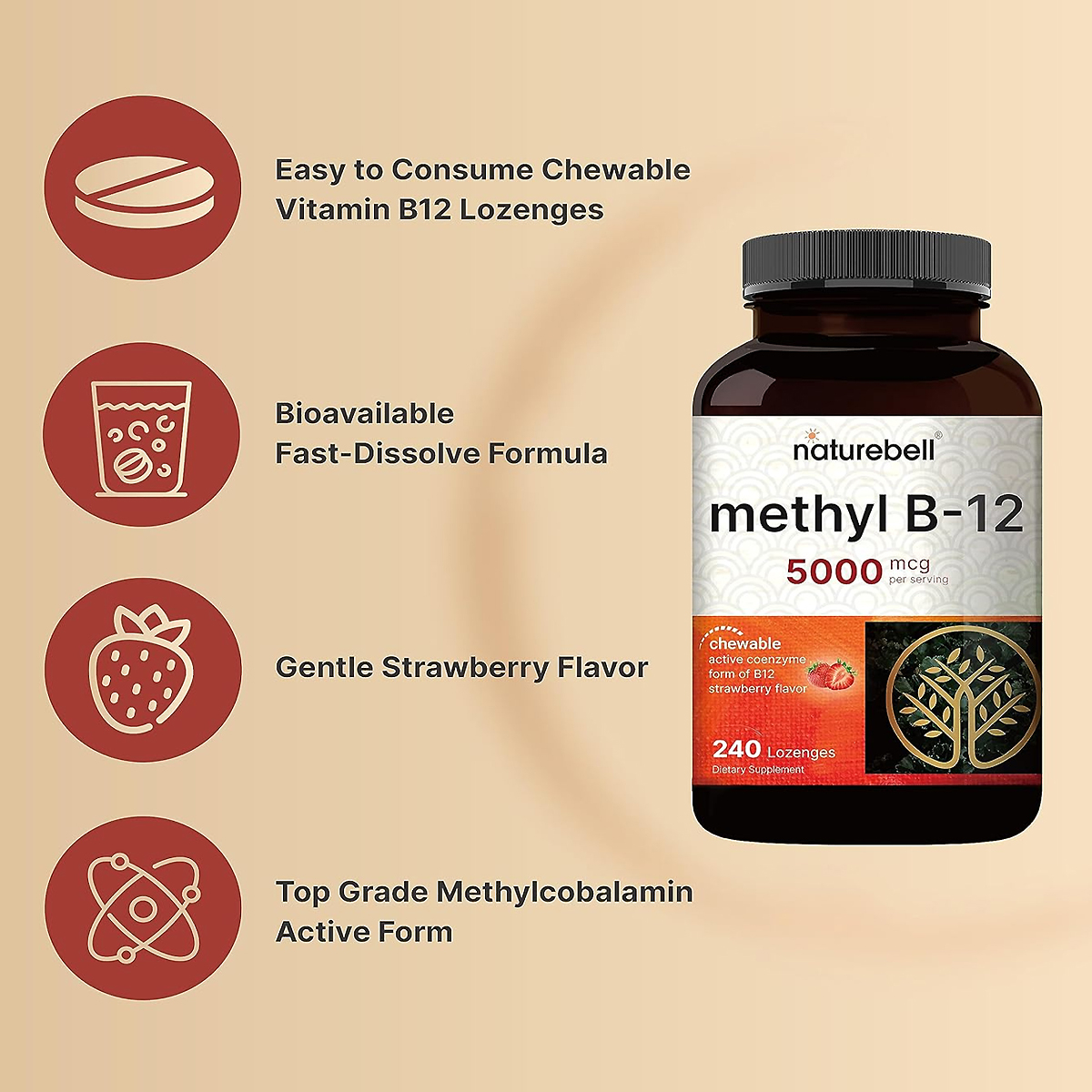
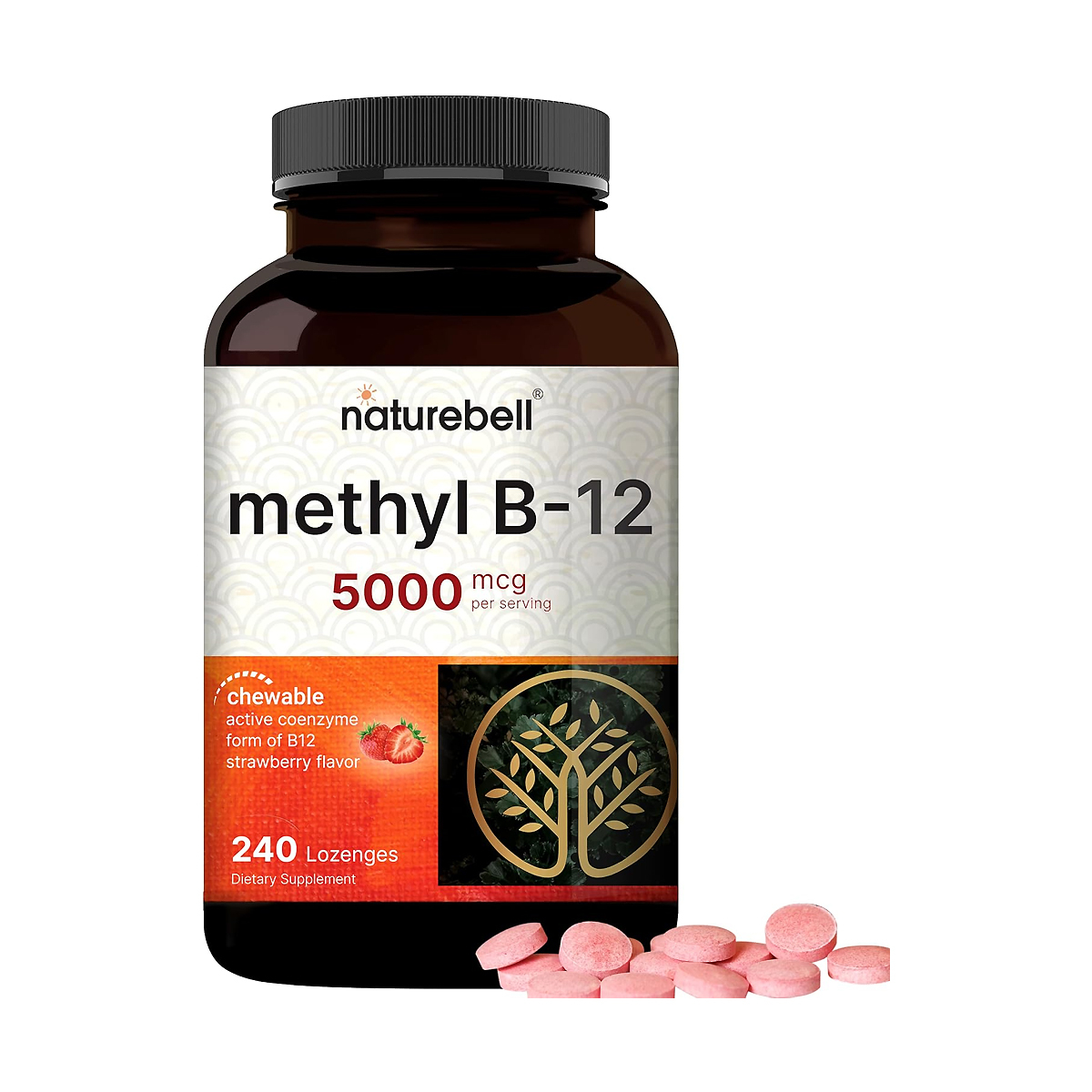
NatureBell Ultra Strength Methyl B12 — 240 Vegan Lozenges
Each strawberry-flavored lozenge delivers 5,000 mcg of methylcobalamin, with no gluten, dairy, soy, or common allergens. The label directs one lozenge daily; the listing describes both letting it dissolve under the tongue and chewing it, and on the evidence above that distinction makes little practical difference. As covered above, that dose is dramatically higher than the 2.4 mcg RDA because oral absorption is inefficient — not because the lozenge form itself absorbs better than a standard tablet, and there is no established upper safety limit for B12 to worry about at this dose. It's a reasonable, well-tolerated option for vegans, vegetarians, and anyone whose doctor has confirmed a genuine B12 shortfall.
Browse the full range in our Vitamins category.
Frequently asked questions
How much vitamin B12 do I actually need per day?
The RDA for adults is 2.4 mcg/day, rising to 2.6 mcg during pregnancy and 2.8 mcg while breastfeeding. This is easily met by a diet that includes meat, fish, eggs, or dairy; it is much harder to meet on a vegan diet without fortified foods or a supplement.
Will a B12 supplement give me more energy if I'm not deficient?
No. NIH's own review states that B12 supplementation has no measurable benefit on energy or performance in people who are not actually deficient. If your levels are normal, additional B12 will not create extra energy above your baseline.
Is a sublingual lozenge better absorbed than a regular tablet?
Current evidence doesn't support that. A 2025 meta-analysis found no statistically significant difference between sublingual and oral B12 in raising blood cobalamin levels, and both performed comparably to injections.
Who is actually at risk of vitamin B12 deficiency?
Vegans and vegetarians, older adults with reduced stomach acid, people with pernicious anemia or a history of gastric/bariatric surgery, and people taking metformin combined with a long-term acid-reducing medication (PPI or H2-blocker).
Is there a safe upper limit for vitamin B12?
NIH has not established a Tolerable Upper Intake Level for B12 because of its low toxicity potential. The main caution isn't the B12 itself — it's that folic acid in a combined supplement can mask the anemia symptoms of a B12 deficiency while nerve damage continues, so unexplained fatigue is worth a blood test rather than guesswork.
Can I get enough B12 from food if I eat a vegetarian (not vegan) diet?
It's possible through eggs and dairy, but the EPIC-Oxford analysis of 689 British men still found 7% of vegetarians were B12 deficient and another 17% had depleted status — meaningfully higher than the under-1% deficiency rate in meat-eaters. That sample was men only, but it is reason enough for vegetarians to consider periodic testing.
- NIH Office of Dietary Supplements — Vitamin B12, Fact Sheet for Health Professionals
- NIH Office of Dietary Supplements — Folate, Fact Sheet for Health Professionals
- National Institute on Aging — Vitamins and Minerals for Older Adults
- MedlinePlus Medical Encyclopedia — Vitamin B12 Deficiency Anemia
- Long AN et al. — Vitamin B12 Deficiency Associated With Concomitant Metformin and Proton Pump Inhibitor Use. Diabetes Care 2012;35(12):e84
- Mazur M et al. — Efficacy of Sublingual and Oral Vitamin B12 Versus Intramuscular Administration: A Systematic Review and Meta-Analysis. Frontiers in Pharmacology 2025
- Gilsing AMJ et al. — Serum Concentrations of Vitamin B12 and Folate in British Male Omnivores, Vegetarians, and Vegans (EPIC-Oxford). Eur J Clin Nutr 2010;64(9):933–9
This article is for educational purposes only and is not a substitute for professional medical advice, diagnosis, or treatment. Always consult a qualified healthcare provider before starting any supplement, especially if you are pregnant or breastfeeding, take metformin or long-term acid-reducing medication, or suspect a nutrient deficiency. These statements have not been evaluated by the Food and Drug Administration. This product is not intended to diagnose, treat, cure, or prevent any disease.