
The United States' tolerable upper limit for vitamin B6 is 100 mg a day; the European Food Safety Authority puts the same limit at 12 mg — an eightfold gap, drawn from overlapping evidence on the same nerve-damage cases. Vitamin B6 (pyridoxine) is a water-soluble vitamin the body cannot store, used as a coenzyme in more than 100 enzymes of amino acid metabolism. This capsule delivers 250 mg of it — 2.5 times the U.S. ceiling, and above the 200 mg/day no-observed-adverse-effect level that ceiling was calculated from. The condition at stake, sensory peripheral neuropathy, can take months to appear and does not always fully reverse.
Key Takeaways
- NIH's Tolerable Upper Intake Level for adult vitamin B6 is 100 mg/day; EFSA, Europe's food safety agency, set its limit at just 12 mg/day in 2023 — an eightfold difference from an overlapping evidence base.
- This product delivers 250 mg of pyridoxine per capsule, once daily as directed — 2.5× the NIH upper limit, and above the 200 mg/day no-observed-adverse-effect level the U.S. limit is built on (National Academies, 1998).
- The first published human case series of B6 nerve damage, in 1983, described seven patients with severe sensory neuropathy after 2,000–6,000 mg/day for 2 to 40 months; four could no longer walk.
- Nerve damage isn't only a megadose risk: B6 deficiency — most common with kidney failure, liver disease, or heavy alcohol use — can itself cause peripheral neuropathy (MedlinePlus, reviewed 2025).
- Most adults already meet the 1.3 mg/day RDA from food; the same report puts median U.S. intake from food at roughly 2 mg/day for men and 1.4 mg/day for women (National Academies, 1998).
- Zinc for Immune Health: What the 40 mg NIH Upper Limit Actually Means — another essential nutrient where chronic high doses near the upper limit induce peripheral neuropathy
In this article:
- What Is Vitamin B6, and Who Actually Falls Short?
- Does Vitamin B6 Live Up to the Energy and Mood Claims on the Bottle?
- The Upper Limit Problem: What 100 mg — or 12 mg — a Day Actually Means
- Who Is Genuinely at Risk of B6 Deficiency?
- Inside Life Extension Vitamin B6 250 mg: What's Actually in the Capsule
- How to Use High-Dose B6 Sensibly
- Frequently Asked Questions
What Is Vitamin B6, and Who Actually Falls Short?
Vitamin B6 is a water-soluble vitamin the body cannot store in any meaningful amount — leftover intake leaves through the urine, which is why it must be replenished through food or supplements on an ongoing basis, per the MedlinePlus Medical Encyclopedia. In its active form, pyridoxal 5'-phosphate, it is a coenzyme for more than 100 enzymes of amino acid metabolism (National Academies, 1998), and separately for the enzymes that build haem and release glucose from stored glycogen — which is why MedlinePlus lists making hemoglobin, breaking down protein and keeping blood sugar in normal ranges among its jobs. It's naturally present in tuna, salmon, poultry, beef and pork, bananas, legumes, nuts, and fortified whole-grain cereals.
True dietary deficiency is uncommon in the United States. MedlinePlus notes it mainly shows up with kidney failure, liver disease, or heavy alcohol use — conditions that interfere with how the body processes the vitamin, not simply eating too little of it. The National Academies' Dietary Reference Intakes report puts the adult RDA at just 1.3 mg/day for men and women aged 19–50, rising slightly with age, and puts median U.S. intake from food at around 2 mg/day for men and 1.4 mg/day for women — above the RDA before any supplement is opened.
| Life stage | RDA (mg/day) |
|---|---|
| Children, 1–3 years | 0.5 |
| Children, 4–8 years | 0.6 |
| Children, 9–13 years | 1.0 |
| Adolescents, 14–18 years | 1.2–1.3 |
| Adults, 19–50 years | 1.3 |
| Men, 51+ years | 1.7 |
| Women, 51+ years | 1.5 |
| Pregnancy | 1.9 |
| Lactation | 2.0 |
A healthy adult needs roughly one and a third milligrams a day. The capsule in this article contains 250 mg — not a multiple of a marginal shortfall, but a dose built for something else entirely.
Does Vitamin B6 Live Up to the Energy and Mood Claims on the Bottle?
B6 is real and necessary — it's a genuine cofactor for neurotransmitter synthesis, including serotonin and dopamine, and for the enzyme that converts stored glycogen into usable glucose during exercise. That's why "energy" and "mood support" appear on B-vitamin labels. What it doesn't mean is that more B6 produces more energy or a better mood once the body already has enough. B6 isn't stored, and its enzymes aren't rate-limited by extra circulating pyridoxine — the surplus is excreted. The StatPearls clinical reference notes that at oral doses around 100 mg, the majority of pyridoxine, pyridoxal and pyridoxamine is excreted unchanged in the urine (StatPearls, updated 2023) — which is the physiological reason megadosing a water-soluble vitamin doesn't scale the way marketing implies.
“Large doses of vitamin B6 can cause difficulty coordinating movement, numbness, and sensory changes.”
MedlinePlus Medical Encyclopedia, National Library of Medicine — reviewed 21 January 2025That's the trade the marketing leaves out. There's no controlled evidence that healthy, non-deficient adults get more energy or a better mood from 250 mg of B6 than from meeting the 1.3 mg RDA through diet. What the extra 248.7 mg buys isn't more benefit — it's proximity to a dose range where a well-documented harm becomes possible.
The Upper Limit Problem: What 100 mg — or 12 mg — a Day Actually Means
The U.S. Tolerable Upper Intake Level (UL) of 100 mg/day isn't an arbitrary round number. The National Academies' Food and Nutrition Board built it from two clinical studies: Bernstein and Lobitz (1988) treated 70 patients with diabetic neuropathy or carpal tunnel syndrome with 100–150 mg/day and detected no sensory neuropathy; Del Tredici and colleagues (1985) treated 24 carpal tunnel patients with 100–300 mg/day for four months, also with none detected. The midpoint of that second range — the average of 100 and 300 mg/day — is the No-Observed-Adverse-Effect Level (NOAEL) of 200 mg/day. A standard uncertainty factor of 2 brings the UL down to 100 mg/day — a deliberate safety margin, not the point where harm was actually seen.
| Dose range | What the evidence shows |
|---|---|
| 40–500 mg/day | No neuropathy detected across several published studies totaling hundreds of patients (National Academies, 1998) |
| 200 mg/day | NOAEL used to derive the U.S. Tolerable Upper Intake Level |
| 100 mg/day | U.S. Tolerable Upper Intake Level (NOAEL ÷ uncertainty factor of 2) |
| 50–300 mg/day, duration not reported | 40% of women (23 of 58) in one premenstrual-syndrome case report developed sensory-neuropathy-type symptoms — a report the National Academies itself flags as methodologically flawed, including for the missing treatment duration |
| 2,000–6,000 mg/day, 2–40 months | First human case series (1983): 7 patients, severe sensory neuropathy, 4 unable to walk |
Europe reached a very different number from overlapping literature. In a 2023 scientific opinion, EFSA's nutrition panel concluded it couldn't identify a clear lowest-observed-effect level from human data at all — only a "reference point" of 50 mg/day drawn from a case-control study, vigilance data, and case reports. It applied a larger uncertainty factor of 4, cross-checked against a dog toxicity study, and landed on 12 mg/day. It isn't new data contradicting the U.S. figure; it's a more conservative judgment about the same uncertain evidence. The U.S. number also dates to an unrevisited 1998 report; the EFSA opinion is from 2023. B6 isn't the only nutrient sold well past a documented ceiling — iodine has its own NIH upper limit built the same way, for a different specific harm.
| Authority | Upper Limit | Year set |
|---|---|---|
| U.S. National Academies (Food and Nutrition Board) | 100 mg/day | 1998 |
| European Food Safety Authority (EFSA) | 12 mg/day | 2023 |
Genuine safety warning: Peripheral neuropathy from high-dose B6 typically presents as numbness or a burning, tingling "stocking-glove" sensation in the feet and hands, sometimes with unsteady gait, per the StatPearls clinical reference. It can take weeks to months to appear, and doesn't always fully resolve after stopping. If you notice numbness, tingling, or coordination changes in your hands or feet while taking this or any B6-containing supplement, stop and contact your doctor — and check other supplements you take, since B6 is a common hidden ingredient and doses stack. New Zealand's medicines regulator makes the same point to prescribers: B6 is routinely present in multivitamin, zinc and magnesium preparations bought for other reasons, and patients often do not know they are taking it (Medsafe Prescriber Update, June 2025).
One line in that same StatPearls reference names this product's exact daily dose: patients “typically experience symptoms of peripheral neuropathy, dermatoses, photosensitivity, dizziness, and nausea with long-term intake of dosages above 250 mg/day” (StatPearls, updated 2023). This capsule delivers 250 mg — at, not above, that threshold — leaving no margin between the labelled serving and the point where a clinical reference expects symptoms with long-term use.
Mayo Clinic clinicians on how peripheral neuropathy presents and is managed. It covers the condition generally rather than the B6-induced form — included because that condition is the exact harm the B6 upper limit exists to prevent.
Who Is Genuinely at Risk of B6 Deficiency?
Documented risk factors are specific, not general: kidney failure or dialysis, which alters B6 metabolism and clearance; chronic liver disease; long-term heavy alcohol use, which impairs the enzyme that activates B6; certain malabsorption conditions; and medications that interfere with B6, notably some anticonvulsants and isoniazid (used to treat tuberculosis). Older adults also have a modestly higher RDA (1.5–1.7 mg/day) than younger adults, a real if small age-related increase documented in the National Academies report.
Outside those groups, a diagnosed deficiency in a person eating an ordinary mixed diet is genuinely uncommon in the U.S. — MedlinePlus says so directly. That doesn't mean supplementation is never reasonable; it means the honest starting point for most healthy adults is "I probably don't need this to avoid deficiency," and the decision to take it should rest on a specific reason, not a general assumption that more B vitamins means more energy.
Inside Life Extension Vitamin B6 250 mg: What's Actually in the Capsule
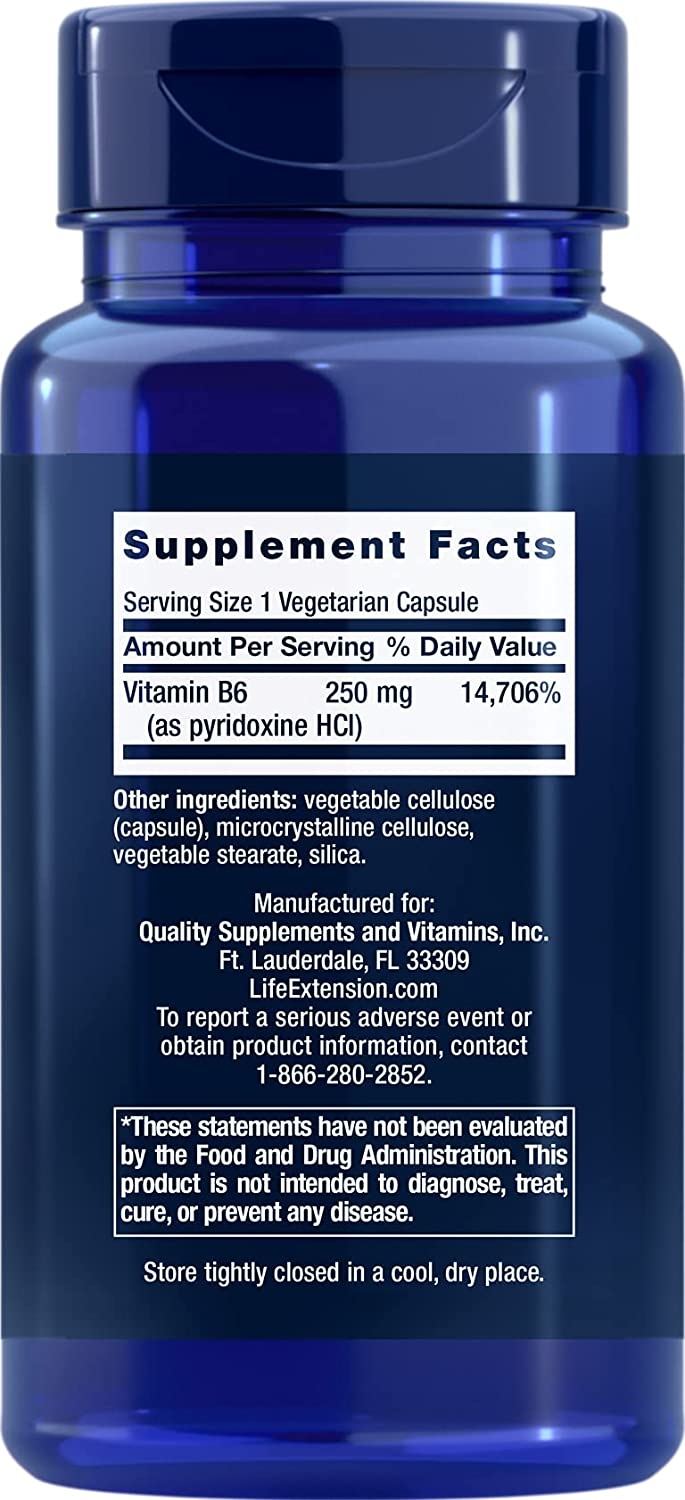
This is one of several standalone B vitamins in Champ Vita's individual vitamins category: a single-active-ingredient, gluten-free, vegetarian-capsule product with 250 mg of pyridoxine HCl per capsule, one directed daily with food, in a 100-count bottle — a 100-day supply at the labeled serving. The label puts that serving at 14,706% of the Daily Value. There's no proprietary blend to decode and no ambiguity about the dose. The question isn't whether the product is what it says it is — it is — but whether a healthy adult without a diagnosed deficiency has a good reason to take 190 times the RDA every day, indefinitely.
| This product | Range studied in humans | NIH RDA (adults 19–50) | NIH Tolerable Upper Limit | |
|---|---|---|---|---|
| Vitamin B6 (pyridoxine) | 250 mg per capsule, 1/day | 40–6,000 mg/day across published studies and case reports | 1.3 mg/day | 100 mg/day (EFSA: 12 mg/day) |
At the labeled one-capsule dose, this product supplies 2.5 times the U.S. upper limit and roughly 21 times the EFSA limit, every day, with no built-in cycling or lower-dose option on the label. It sits well below the 2,000–6,000 mg/day range behind the severe 1983 case series, but above the 200 mg/day NOAEL that anchors the U.S. limit — and inside the lower end of the range where milder case reports exist.
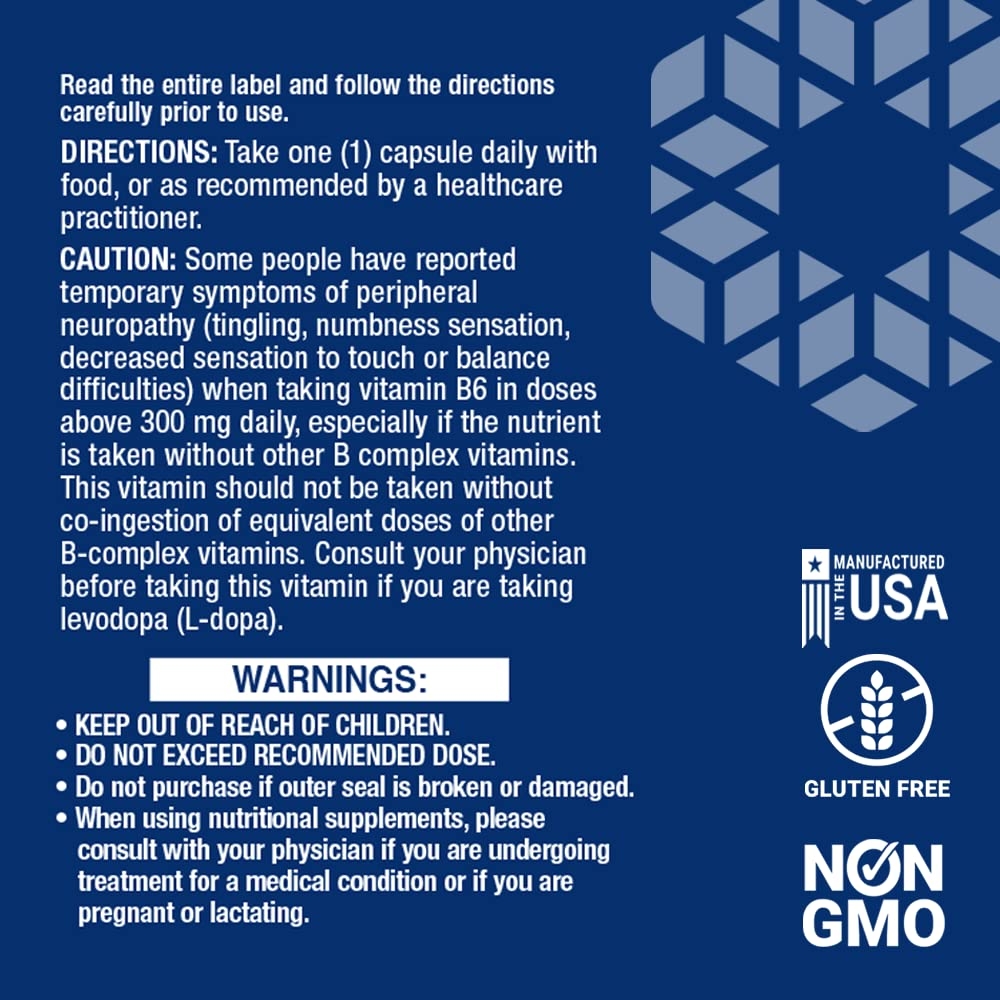
The bottle's caution panel carries two instructions a reader working from the front label would miss. First, a co-ingestion requirement: the label states this vitamin “should not be taken without co-ingestion of equivalent doses of other B-complex vitamins,” and warns that reported neuropathy symptoms are likelier “especially if the nutrient is taken without other B complex vitamins.” Second, a drug interaction: it directs anyone taking levodopa (L-dopa) to consult a physician first — and StatPearls lists L-dopa among the drugs that form complexes with vitamin B6.
Who this is for: Adults with a specific, clinician-identified reason for high-dose B6 — managing elevated homocysteine alongside folate and B12, or a documented deficiency from kidney disease, liver disease, or malabsorption — ideally with periodic blood work and a defined stopping point.
Who should skip it: Most healthy adults already meeting the 1.3–1.7 mg/day RDA from food. Anyone taking a multivitamin, B-complex, or energy supplement with added B6 should total their intake first. Pregnant or breastfeeding people, anyone on anticonvulsant medication, anyone taking levodopa (L-dopa) — a warning the label itself carries — and anyone with existing numbness or tingling in their hands or feet should talk to a doctor before starting it.
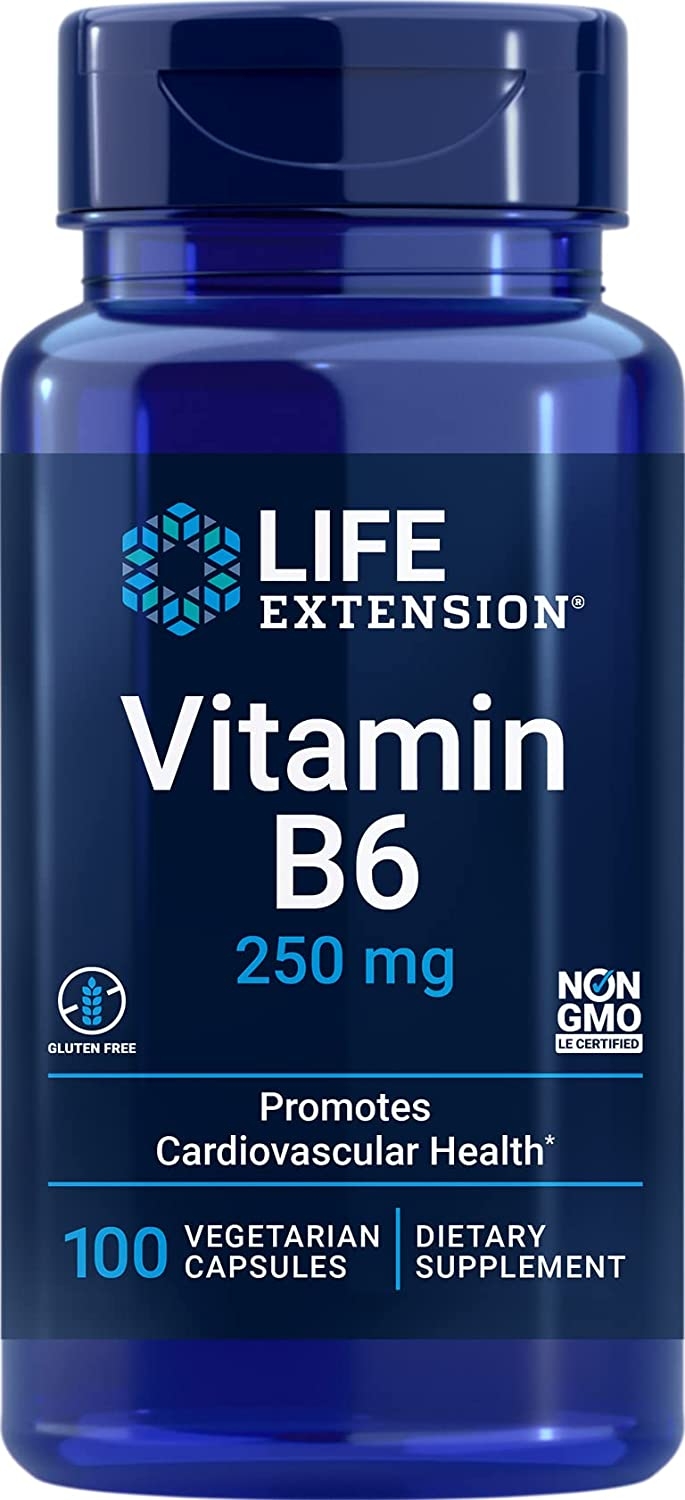
Life Extension Vitamin B6 250 mg — 100 Vegetarian Capsules
250 mg of pyridoxine HCl per capsule, gluten-free and vegetarian, one capsule daily with food as directed — a 100-day supply. A clean, single-active-ingredient product with an accurate label; the case for taking it daily, long-term, without a specific clinical reason is the part worth questioning, not the manufacturing. Read the caution panel before you start: the label requires co-ingestion with other B-complex vitamins and flags an interaction with levodopa.
View Product DetailsHow to Use High-Dose B6 Sensibly
If a clinician recommended this dose — commonly alongside folate and B12 for elevated homocysteine, or a documented deficiency — take it with food, as directed, and mention it at every visit rather than treating it as an indefinite habit. If you're taking it on your own initiative, first total the B6 you already get from any multivitamin or B-complex, and treat 100 mg/day as a hard ceiling rather than a starting point — this product's 250 mg dose exceeds that ceiling in a single capsule. Follow the label's own caution panel too: it requires co-ingestion of equivalent doses of other B-complex vitamins, and tells anyone on levodopa to check with a physician first. Watch for new numbness, tingling, or coordination changes in your hands or feet, and stop and see a doctor if any appear.
Frequently Asked Questions
Is 250 mg of vitamin B6 too much to take every day?
It exceeds the NIH's Tolerable Upper Intake Level of 100 mg/day by 2.5 times, and it's above the 200 mg/day dose shown to cause no harm in the controlled studies that limit is based on. It isn't the 2,000–6,000 mg/day range linked to severe nerve damage in the 1983 case series, but it calls for a specific reason and, ideally, medical guidance rather than indefinite unsupervised use.
What are the early signs of vitamin B6 toxicity?
Per the StatPearls clinical reference, early signs include numbness or a burning, tingling sensation typically starting in the feet and hands (a stocking-glove pattern), clumsiness or unsteady gait, and sometimes increased sensitivity to touch. These reflect sensory nerve involvement and are the reason peripheral neuropathy is the specific harm regulators watch for.
Can too little vitamin B6 also cause nerve problems?
Yes. MedlinePlus lists peripheral neuropathy as a symptom of vitamin B6 deficiency as well as of excess, alongside confusion, depression, irritability, and glossitis (mouth and tongue sores). True deficiency is uncommon in the U.S. and is concentrated in people with kidney failure, liver disease, or heavy alcohol use.
Why do the U.S. and European upper limits for vitamin B6 differ so much?
Not new contradicting data — different safety margins applied to the same uncertain evidence. The U.S. figure (100 mg/day, 1998) used a NOAEL of 200 mg/day from controlled studies with an uncertainty factor of 2; the EFSA figure (12 mg/day, 2023) could not establish a lowest-observed-effect level from human data at all, so it took a reference point of 50 mg/day and applied an uncertainty factor of 4.
Does vitamin B6 give you more energy?
B6 is required for enzymes involved in energy metabolism, but there's no controlled evidence that taking more than your body needs produces more usable energy in someone who isn't deficient. It's water-soluble and not stored, so surplus intake is largely excreted rather than banked for later use.
Who actually needs a high-dose B6 supplement like this one?
People with a specific, usually clinician-identified reason — documented deficiency from kidney disease, liver disease, or malabsorption, or as part of a homocysteine-lowering regimen alongside folate and B12 — generally under periodic monitoring. It is not intended as a general daily energy or mood supplement for healthy adults already meeting the 1.3–1.7 mg/day RDA through diet.
Can I take this alongside a multivitamin that already contains B6?
Total the B6 from every source first — multivitamins, B-complexes, and energy drinks or powders commonly include it — because adding this product's 250 mg on top pushes total intake further above the 100 mg/day upper limit without adding established benefit. Note the label separately requires co-ingestion of equivalent doses of other B-complex vitamins, so raise the combination with a pharmacist or doctor rather than deciding alone.
Is vitamin B6 nerve damage permanent?
Not always. In the 1983 case series, symptoms improved in all seven patients after stopping high-dose pyridoxine. StatPearls puts the general prognosis as favourable, with neurologic dysfunction usually resolving within six months of stopping — but adds plainly that some patients do not recover, and that massive exposures can cause long-term disability.
Sources
- Institute of Medicine (National Academies). "Vitamin B6." Dietary Reference Intakes for Thiamin, Riboflavin, Niacin, Vitamin B6, Folate, Vitamin B12, Pantothenic Acid, Biotin, and Choline. Published 1998. Accessed 26 August 2026.
- StatPearls (NCBI Bookshelf). "Vitamin B6 Toxicity." Updated 7 February 2023. Accessed 26 August 2026.
- EFSA Panel on Nutrition, Novel Foods and Food Allergens (NDA). "Scientific opinion on the tolerable upper intake level for vitamin B6." EFSA Journal 21(5):e08006. Published 17 May 2023. Accessed 26 August 2026.
- MedlinePlus Medical Encyclopedia. "Vitamin B6." National Library of Medicine. Reviewed 21 January 2025. Accessed 26 August 2026.
- Medsafe (NZ Medicines and Medical Devices Safety Authority). "Vitamin B6 (pyridoxine) and peripheral neuropathy." Prescriber Update 46(2):29–30. Published 5 June 2025. Accessed 26 August 2026.
- U.S. Food and Drug Administration. "Dietary Supplements." Updated 1 October 2024. Accessed 26 August 2026.
This article is for educational purposes only and is not medical advice. It is not intended to diagnose, treat, cure, or prevent any disease. Under the Dietary Supplement Health and Education Act (DSHEA), these statements have not been evaluated by the Food and Drug Administration; manufacturers, not the FDA, are responsible for evaluating a supplement's safety and labeling before it reaches the market. Talk to your doctor before starting any new supplement, especially if you are pregnant, breastfeeding, take anticonvulsant medication or levodopa (L-dopa), or have kidney disease, liver disease, or existing numbness, tingling, or coordination problems in your hands or feet.