
Almost every standalone over-the-counter potassium tablet in the United States stops at 99 mg — not because that's a healthy dose, but because a 1975 FDA policy requires any coated potassium tablet supplying 100 mg or more to carry a prescription-style warning about small-bowel injury and to be filed as a new drug. Potassium is a mineral and electrolyte that carries the electrical charge nerves and muscles run on, and the adult body needs 2,600 to 3,400 mg of it a day, per a 2019 National Academies report — meaning a 99 mg tablet supplies roughly 3 to 4% of a day's requirement, by regulatory design, not nutritional judgment.
Key Takeaways
- The National Academies of Sciences, Engineering, and Medicine set potassium's Adequate Intake at 3,400 mg/day for men and 2,600 mg/day for women in its 2019 revision — down from the old 2005 figure of 4,700 mg for both sexes.
- This Country Life tablet supplies 99 mg of potassium per serving, or about 3–4% of the current adult AI — a ceiling manufacturers adopted voluntarily to stay clear of a 1975 FDA drug-labelling rule, not a nutritional target (NIH ODS, 2019).
- NHANES 2013–2014 data show U.S. adults already get 3,016 mg/day (men) and 2,320 mg/day (women) from food alone, according to the NIH Office of Dietary Supplements — closer to target than the "widespread deficiency" framing on many product labels suggests.
- No Tolerable Upper Intake Level has been set for potassium in healthy adults, but the National Academies' 2019 report explicitly warns against high supplemental intake in people with compromised kidney function.
- A meta-analysis of 11 cohort studies in over 247,000 adults linked a 1,640 mg/day higher potassium intake to a 21% lower stroke risk — a dietary finding that has nothing to do with a 99 mg pill.
In this article:
- What Is Potassium, and How Much Do You Actually Need?
- Does the Average American Diet Actually Fall Short?
- The FDA Rule Behind Every 99 mg Tablet
- Who Is Actually at Risk From Too Much Potassium?
- Inside Country Life Potassium 99 mg: What's Actually in the Tablet
- Does a 99 mg Tablet Actually Move the Needle?
- How to Use Potassium Supplements Sensibly
- Frequently Asked Questions
What Is Potassium, and How Much Do You Actually Need?
Potassium is a mineral and electrolyte the body uses to run its electrical systems — it helps nerves fire, muscles contract (including the heart muscle), and it works opposite sodium to regulate fluid balance and blood pressure, according to the MedlinePlus Medical Encyclopedia. Most of the body's potassium sits inside cells, and the concentration gradient against the fluid outside the cell is what generates a nerve impulse or a heartbeat.
For decades, the reference number was 4,700 mg a day, set by the Institute of Medicine in 2005. That changed in March 2019, when the National Academies re-reviewed the evidence and replaced it with lower, sex-specific Adequate Intakes based on median intakes of healthy people in national surveys — a real revision, not a rounding change.
| Life stage | AI (mg/day) |
|---|---|
| Infants, 0–6 months | 400 |
| Infants, 7–12 months | 860 |
| Children, 1–3 years | 2,000 |
| Children, 4–8 years | 2,300 |
| Boys, 9–13 years | 2,500 |
| Girls, 9–13 years | 2,300 |
| Males, 14+ years | 3,000–3,400 |
| Females, 14+ years | 2,300–2,600 |
| Pregnancy | 2,600–2,900 |
| Lactation | 2,500–2,800 |
The number moved because there still isn't enough evidence for a formal Recommended Dietary Allowance for potassium, so the AI reflects what healthy people with normal blood pressure actually eat, not a disease-prevention target. It's worth knowing which figure a source quotes — this store's own listing for the product reviewed below still cites the retired 4,700 mg number.
Does the Average American Diet Actually Fall Short?
Partially, and less dramatically than "everyone is deficient" marketing implies. According to the NIH Office of Dietary Supplements, citing 2013–2014 NHANES data, the average American adult (20+) gets 3,016 mg/day from food if male, 2,320 mg/day if female — a real but modest shortfall against the 2019 AI, not the multi-thousand-milligram gap implied by comparisons to the old 4,700 mg benchmark.
| Group | Average intake from food (NHANES 2013–2014) | 2019 AI | Gap |
|---|---|---|---|
| Men, 20+ | 3,016 mg | 3,400 mg | ~384 mg short |
| Women, 20+ | 2,320 mg | 2,600 mg | ~280 mg short |
That gap is why the 2015–2020 Dietary Guidelines for Americans called potassium a "nutrient of public health concern," per the NIH ODS fact sheet. A 2022 USDA brief using NHANES 2017–2018 data found mean intake had drifted lower still, to 2,496 mg/day across everyone age 2+, with only about a quarter of women 20+ meeting the female AI on the day surveyed. Food closes the gap best: a medium baked potato provides about 610 mg, a cup of cooked lentils 731 mg, and a medium banana 422 mg.
The FDA Rule Behind Every 99 mg Tablet
This is the part almost no bottle explains. In 1975, the FDA published a policy — still in force as 21 CFR 201.306 — addressing coated potassium tablets after "several reports... concerning nonspecific small-bowel lesions consisting of stenosis, with or without ulceration," some causing "obstruction, hemorrhage, and perforation," with surgery frequently required and deaths recorded. The mechanism wasn't systemic toxicity — it was localized: a slowly-dissolving tablet sitting against one patch of intestinal wall, creating a "hot spot" of concentrated salt. The fix required any coated tablet supplying 100 mg or more per dose to carry a warning label and be handled as a new drug requiring FDA review — a bar an ordinary supplement isn't built to clear. The regulation is careful about the strength of its own evidence, adding in that same warning that "the incidence of these lesions is low, and a causal relationship in man has not been definitely established."
"Many dietary supplement manufacturers and distributors limit the amount of potassium in their products to 99 mg (which is only about 3% of the [Daily Value]) because of two concerns related to potassium-containing drugs. First, the FDA has ruled that some oral drug products that contain potassium chloride and provide more than 99 mg potassium are not safe because they have been associated with small-bowel lesions. Second, the FDA requires some potassium salts containing more than 99 mg potassium per tablet to be labeled with a warning about the reports of small-bowel lesions."
— NIH Office of Dietary Supplements, Potassium — Health Professional Fact SheetSo the number on this bottle isn't a nutrition recommendation — it's a regulatory ceiling manufacturers stay one milligram under to avoid the paperwork and warning label 100 mg triggers. Strictly speaking the FDA does not cap potassium in supplements at all — by act of Congress it may not limit the amount of any nutrient in a dietary supplement except for safety reasons, per the same ODS fact sheet, which records only that most potassium-only products contain up to 99 mg. That's unusual in the supplement aisle: most products reviewed here are sold at doses far above what the body needs. Potassium is the rare case where the shelf dose is capped far below it, for a reason unrelated to how much potassium is actually good for you.
Who Is Actually at Risk From Too Much Potassium?
The small-bowel injury above is separate from hyperkalemia — too much potassium in the blood. In healthy people with normal kidneys, the excess is simply excreted, and the National Academies found insufficient evidence for a Tolerable Upper Intake Level in the general population. But the same 2019 report was explicit that no UL "does not mean there is no risk," warning against high supplemental intake in "those with or at high risk for compromised kidney function." Per the NIH ODS fact sheet, hyperkalemia can occur even below the AI in people with chronic kidney disease or those taking:
| Drug class | Examples | Effect on potassium |
|---|---|---|
| ACE inhibitors | Benazepril (Lotensin) | Reduces urinary potassium excretion |
| ARBs | Losartan (Cozaar) | Reduces urinary potassium excretion |
| Potassium-sparing diuretics | Spironolactone (Aldactone), amiloride (Midamor) | Reduces urinary potassium excretion |
Loop and thiazide diuretics (furosemide/Lasix, chlorothiazide/Diuril) push potassium the other way, increasing loss — why people on these are sometimes advised to supplement under medical supervision instead.
Genuine safety warning: Severe hyperkalemia can cause muscle weakness, paralysis, heart palpitations, and life-threatening cardiac arrhythmias, per the NIH ODS fact sheet, and can be asymptomatic until it is serious. If you have chronic kidney disease, diabetes, heart failure, or take an ACE inhibitor, ARB, or potassium-sparing diuretic, talk to your doctor before any potassium supplement — including a 99 mg one — or a "salt substitute," many of which carry far more potassium per serving than any pill here.
Cleveland Clinic on what potassium actually does in the body, and why both too little and too much matter.
Inside Country Life Potassium 99 mg: What's Actually in the Tablet
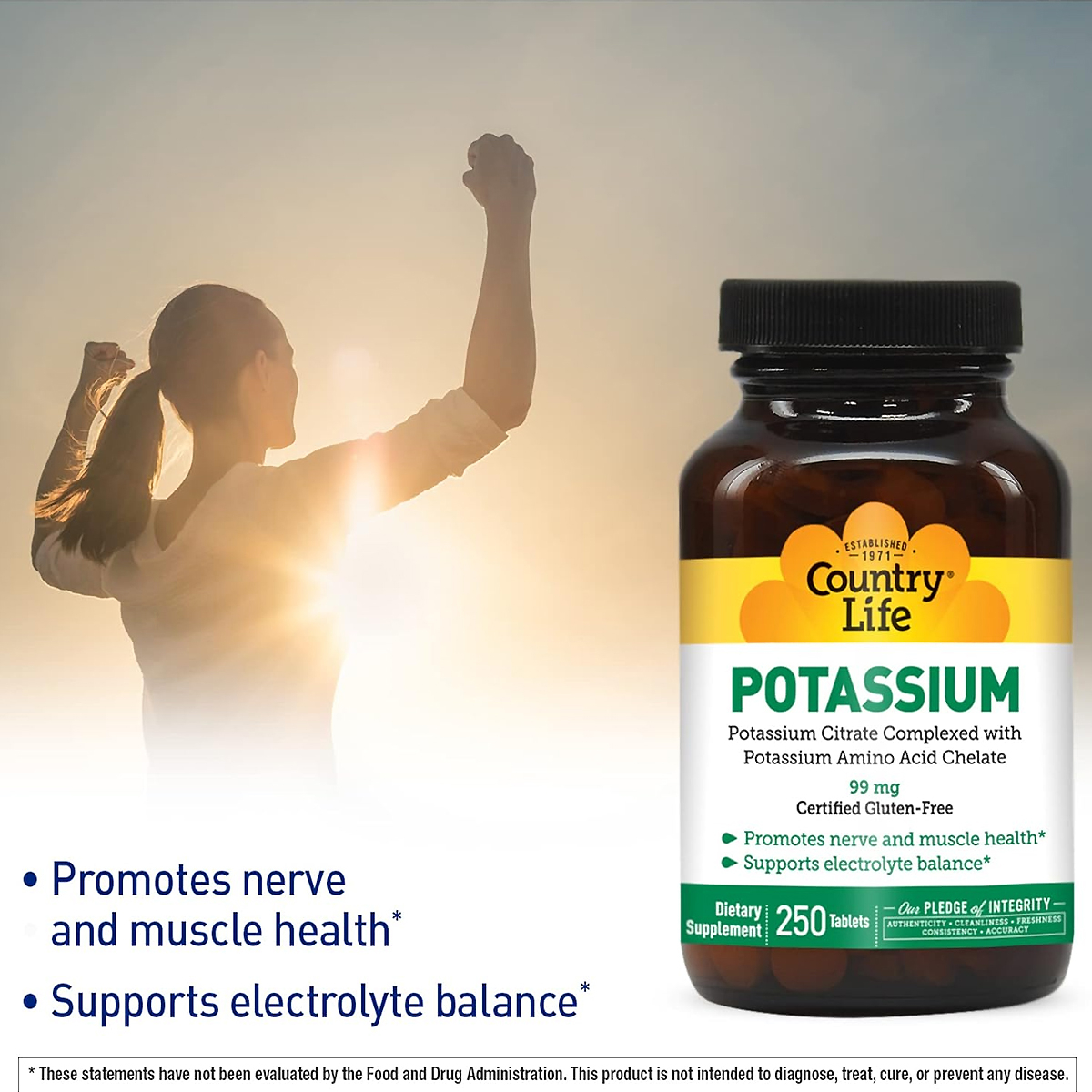
Country Life's Potassium 99 mg is a 250-tablet bottle, one tablet daily with food — one milligram under the 100 mg threshold that would trigger the drug-labelling requirement above. It's certified gluten-free, vegan (American Vegetarian Association), and kosher, with no yeast, wheat, corn, soy, milk, or added sugar.
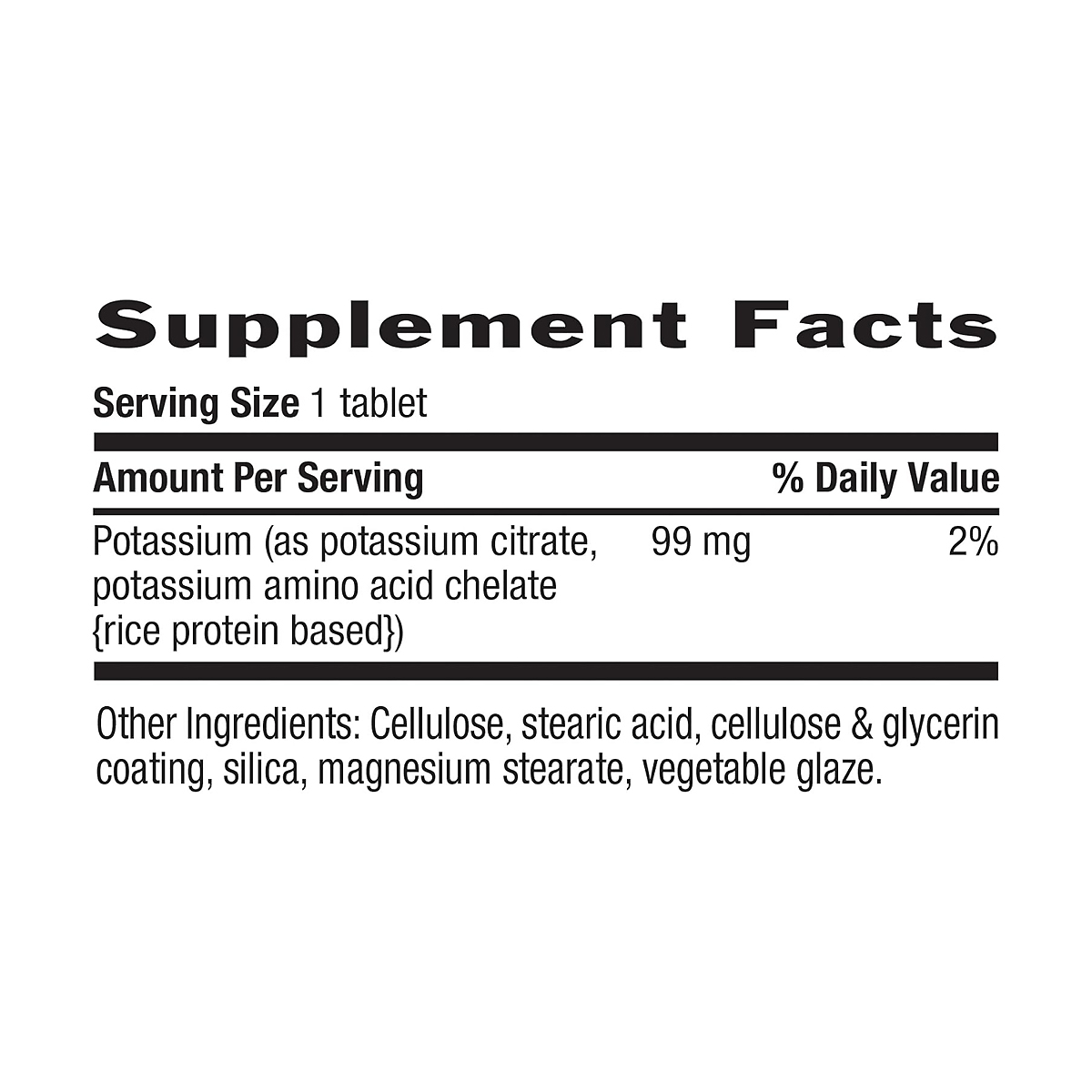
A correction, for accuracy: This store's own short description states the tablet provides "99 mg of potassium gluconate." Per the manufacturer's current Supplement Facts panel on Country Life's product page, the actual form is potassium citrate and potassium amino acid chelate — not gluconate. We've used the manufacturer's figure throughout. The listing also cites the retired 2005 AI of 4,700 mg, not the 2,600–3,400 mg range set in 2019.
Potassium citrate has its own evidence base: a 2015 Cochrane review cited by ODS found it reduced kidney stone recurrence in people with a history of calcium-containing stones — at trial doses of 1,173 to 2,346 mg per day, 12 to 24 times what one 99 mg tablet provides. None of that evidence transfers to this label's dose; it's mentioned only because the ingredient name matches.
| This product | Typical OTC shelf dose | 2019 NIH/NASEM AI | Tolerable Upper Limit | |
|---|---|---|---|---|
| Potassium | 99 mg (potassium citrate / potassium amino acid chelate) | 99 mg — virtually all standalone OTC potassium tablets are capped here | 3,400 mg (men) / 2,600 mg (women) | None established for healthy adults — but caution urged for anyone with reduced kidney function (NASEM, 2019) |
Does a 99 mg Tablet Actually Move the Needle?
Framed honestly: not by much, for most people. The NIH ODS fact sheet reports that among U.S. adults who use potassium-containing supplements, that use "does not significantly increase total potassium intakes," adding a mean of only 87 mg to daily totals — close to what you'd expect from a 99 mg tablet with imperfect absorption, and a fraction of the ~300–400 mg average shortfall documented above.
Absorption itself looks fine: a 2016 trial cited by ODS found the body absorbs about 94% of potassium from potassium gluconate supplements, similar to potatoes. A separate 2016 Nutrients review found urinary potassium rose with dose for both gluconate and potato sources, somewhat more with potato, with no blood pressure difference. Neither study used this product's citrate/chelate form, but the direction holds: a well-absorbed 99 mg dose still delivers only 99 mg.
How to Use Potassium Supplements Sensibly
- If your diet is genuinely short, prioritize food — potatoes, legumes, leafy greens, bananas, dairy, fish — over a 99 mg pill, which by regulatory design can't close a large gap alone.
- If you have chronic kidney disease, diabetes, heart failure, or take an ACE inhibitor, ARB, or potassium-sparing diuretic, talk to your doctor before any potassium supplement or "salt substitute" — the latter can carry 440 to 2,800 mg per teaspoon.
- Low magnesium status can itself drive potassium loss through the kidneys, and over half of people with significant hypokalemia may also have a magnesium deficit — see this store's evidence review of magnesium inadequacy.
- Unlike iodine, which carries an NIH-set upper limit covered in our iodine and thyroid health review, potassium has no UL for healthy adults — but "no UL" isn't "no risk" with reduced kidney function.
- This tablet sits in this store's supplements category alongside dozens of others — worth comparing against a multivitamin, which typically supplies only about 80 mg of potassium.
Who this is for: Adults with a doctor-confirmed, modest shortfall and normal kidney function, who understand a 99 mg tablet is a small top-up, not a fix, and take no medication affecting potassium excretion.
Who should skip it: Most healthy adults, for whom fruit or a potato closes the same gap more effectively; anyone with chronic kidney disease; anyone on an ACE inhibitor, ARB, or potassium-sparing diuretic without a doctor's involvement; and anyone already told to limit potassium.
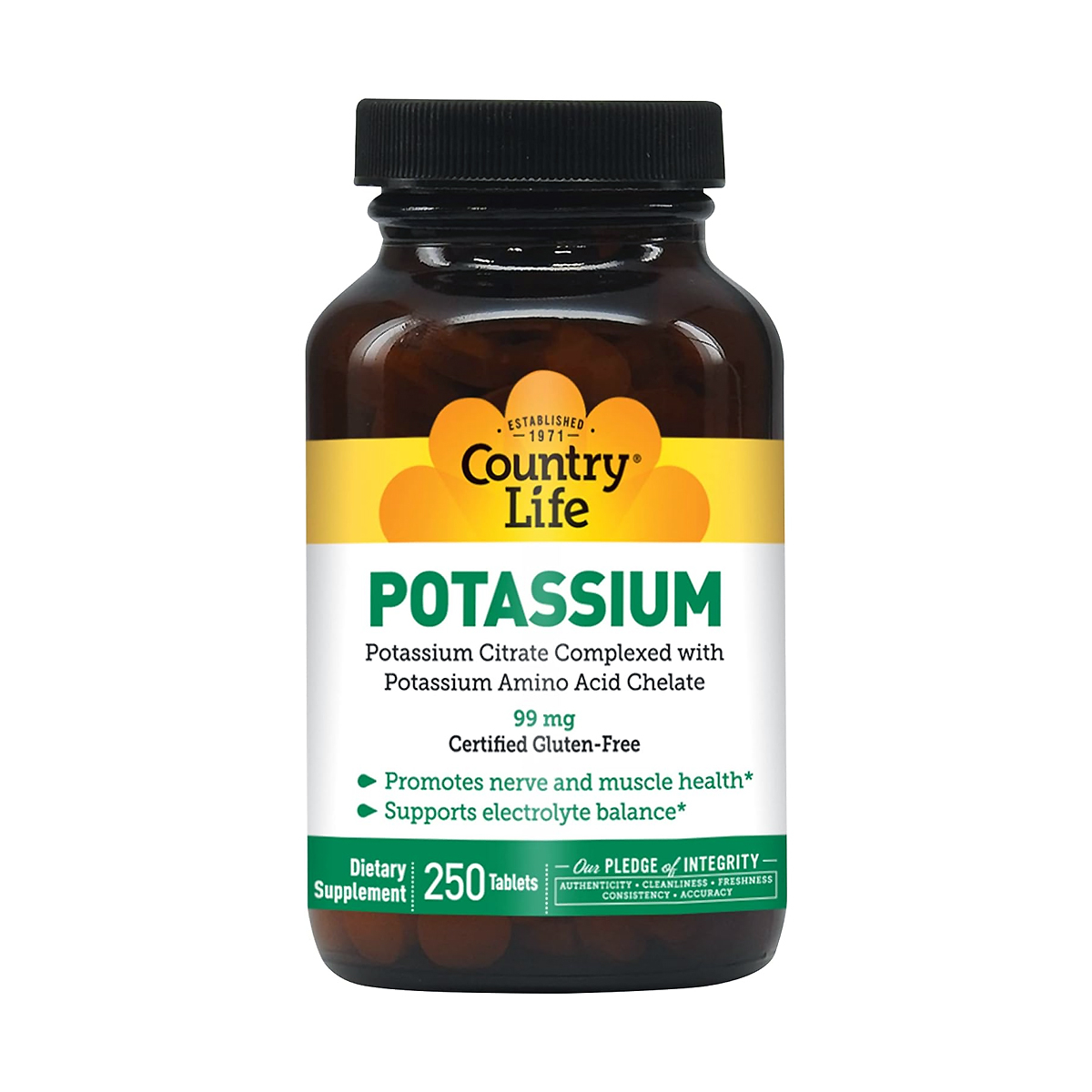
Country Life Potassium 99 mg — 250 Tablets
99 mg of elemental potassium per tablet, as potassium citrate and potassium amino acid chelate, one tablet daily with food. Certified gluten-free, vegan and kosher, with no soy, wheat, corn, or added sugar. As covered above, 99 mg is the ceiling nearly every standalone OTC potassium tablet observes, and it won't by itself close a large dietary shortfall.
View Product DetailsFrequently Asked Questions
How much potassium do I actually need per day?
The National Academies set the 2019 Adequate Intake at 3,400 mg/day for men and 2,600 mg/day for women, ages 19 and up. This replaced the older 2005 figure of 4,700 mg for both sexes, which some product labels still cite.
Why do potassium supplements only contain 99 mg when I need thousands of milligrams?
Because of a 1975 FDA policy (21 CFR 201.306) requiring any coated potassium tablet supplying 100 mg or more to carry a specific warning label about small-bowel injury risk. Manufacturers cap standalone tablets at 99 mg to avoid that requirement, not because 99 mg reflects a nutritional target.
Is it dangerous to take more than 99 mg of potassium in a supplement?
The risk the 1975 FDA rule addresses is localized intestinal injury from concentrated, slow-dissolving coated tablets, though the agency notes a causal link was never definitively established. Separately, anyone with reduced kidney function or taking an ACE inhibitor, ARB or potassium-sparing diuretic can develop hyperkalemia at modest intakes. Higher doses belong under medical supervision.
What foods have more potassium than a 99 mg supplement?
Many. A medium baked potato provides about 610 mg, a cup of cooked lentils about 731 mg, and a medium banana about 422 mg, according to the NIH Office of Dietary Supplements — each several times more than a standalone supplement tablet.
Who should avoid potassium supplements?
People with chronic kidney disease, and anyone taking an ACE inhibitor, ARB, or potassium-sparing diuretic, should consult a doctor first, since these conditions and medications can cause hyperkalemia even at intakes below the Adequate Intake.
Can too much potassium be dangerous?
Yes, in the form of hyperkalemia, which can cause muscle weakness, cardiac arrhythmias, and in severe cases can be life-threatening. This is rare in healthy people with normal kidney function but is a real risk for those with kidney disease or on interacting medications.
Does the form of potassium in a supplement matter?
Absorption research on potassium gluconate shows about 94% is absorbed, similar to potassium from food. This product uses potassium citrate and potassium amino acid chelate instead; both are considered well-absorbed forms, though less head-to-head absorption data exists for citrate specifically at supplement doses.
What are the signs of low potassium (hypokalemia)?
Mild hypokalemia can cause muscle weakness, fatigue, constipation, and general malaise. More severe cases can cause abnormal heart rhythms and, per the NIH ODS fact sheet, can be life-threatening due to effects on cardiac and muscle function.
Sources
- National Academies of Sciences, Engineering, and Medicine — Dietary Reference Intakes for Sodium and Potassium (Consensus Study Report Highlights). Published March 2019. Accessed 1 September 2026.
- NIH Office of Dietary Supplements — Potassium, Health Professional Fact Sheet (government-archived copy via regulations.gov). Snapshot dated 14 February 2019. Accessed 1 September 2026.
- Electronic Code of Federal Regulations — 21 CFR 201.306, Potassium Salt Preparations Intended for Oral Ingestion by Man. Source: 40 FR 13998, March 27, 1975. Accessed 1 September 2026.
- MedlinePlus Medical Encyclopedia — Potassium in Diet. Accessed 1 September 2026.
- Weaver CM. Potassium and Health. Advances in Nutrition, 2013;4(3):368S–377S. Accessed 1 September 2026.
- Stone MS, et al. Potassium Intake, Bioavailability, Hypertension, and Glucose Control. Nutrients, 2016;8(7):444. Accessed 1 September 2026.
- USDA Food Surveys Research Group — Potassium Intake of the U.S. Population, Dietary Data Brief (NHANES 2017–2018). Published September 2022. Accessed 1 September 2026.
- U.S. Food and Drug Administration — Dietary Supplements. Accessed 1 September 2026.
This article is for educational purposes only and is not medical advice. It is not intended to diagnose, treat, cure, or prevent any disease. These statements have not been evaluated by the Food and Drug Administration. Talk to your doctor before starting any new supplement, especially if you have kidney disease, diabetes, heart failure, are pregnant or breastfeeding, or take medication that affects potassium levels, including ACE inhibitors, ARBs, potassium-sparing diuretics, or NSAIDs.