
One capsule of a popular iodine supplement delivers 1,000 mcg of iodine — more than double the ceiling thyroid specialists recommend from supplements alone, and 91% of the entire daily safety limit the National Institutes of Health sets for iodine from every source combined. That is not a reason to panic. Iodine deficiency causes real, measurable harm, and most of the fear around this mineral is overblown. But it is a reason to know the actual numbers before adding a high-dose capsule to a diet that may already include iodized salt, dairy, bread, or seafood.
Key takeaways
- The NIH sets the adult Recommended Dietary Allowance (RDA) for iodine at 150 mcg/day. A single 1,000 mcg capsule provides more than six times that amount in one dose.
- The NIH Tolerable Upper Intake Level (UL) for adults is 1,100 mcg/day from all sources combined. One capsule alone uses 91% of it, before food.
- The American Thyroid Association advises against iodine or kelp supplements above 500 mcg/day. This product's single-capsule dose is double that specific ceiling.
- A peer-reviewed audit of 96 commercial kelp and seaweed products found that 54 of them — 56% — would exceed the 600 mcg European upper limit in a single portion or dose.
- Pregnant people need roughly 50% more iodine than non-pregnant adults, but a high-dose capsule is not automatically the right way to close that gap — see the pregnancy section below.
In this article
- What iodine actually does in the body
- How much iodine you need — and why shortfalls still happen
- This capsule's dose, measured against every safety ceiling
- Why kelp-derived iodine is harder to dose than it looks
- Who should be careful, or skip it entirely
- Iodine during pregnancy: a different calculation
- The product
- FAQ
What Iodine Actually Does in the Body
Iodine has exactly one job that matters at the population level: it is a raw material for thyroid hormone. The thyroid gland combines iodine with the amino acid tyrosine to build thyroxine (T4) and triiodothyronine (T3), according to the NIH Office of Dietary Supplements. Those two hormones set the pace for protein synthesis, enzyme activity, and metabolic rate in essentially every tissue, and they are non-negotiable for fetal and infant brain development.
This is why iodine deficiency and iodine excess can produce a similar-looking symptom in opposite directions: an enlarged thyroid gland, or goitre. The gland enlarges when it is straining to extract enough iodine from too little supply, and it can also enlarge under some patterns of chronic excess. The organ is the same; the cause is not.
Historically, iodine deficiency was one of the most common preventable causes of intellectual disability worldwide, which is precisely why iodized salt programmes exist. In the United States, iodine deficiency at the population level is now uncommon — a direct result of that public health measure — which is part of why the case for routine high-dose supplementation is weaker than manufacturer marketing often implies.
How Much Iodine You Need — and Why Shortfalls Still Happen
The RDA is not a target to maximise; it is the amount that meets the needs of nearly all healthy people in a given group. For iodine, that number is small.
| Life stage | RDA (mcg/day) | Tolerable Upper Intake Level (mcg/day) |
|---|---|---|
| Children, 1–3 years | 90 | 200 |
| Children, 4–8 years | 90 | 300 |
| Children, 9–13 years | 120 | 600 |
| Teens, 14–18 years | 150 | 900 |
| Adults, 19+ years | 150 | 1,100 |
| Pregnancy | 220 | 1,100 |
| Lactation | 290 | 1,100 |
Source: NIH Office of Dietary Supplements, Iodine Fact Sheet for Consumers. Most of that 150 mcg adult requirement is covered, in the typical American diet, by iodized salt, dairy products, eggs, and seafood — not by supplements. People who avoid all three (strict vegans who don't use iodized salt, for example) are the group most likely to run genuinely short, according to Cleveland Clinic, which also lists people living far from the coast in countries without salt iodization programmes as the highest-risk group globally.
Deficiency symptoms are mostly the symptoms of an underactive thyroid: fatigue, weight gain, and difficulty tolerating cold, per Cleveland Clinic. Severe, prolonged deficiency in pregnancy is far more serious — it is linked to miscarriage, stillbirth, and irreversible intellectual disability in the child, which is exactly why the pregnancy RDA is set higher than the adult one.
"Thyroid 101" — Cleveland Clinic explains how the thyroid gland uses iodine to build hormones that regulate metabolism, and what goes wrong when the supply runs short or long.
This Capsule's Dose, Measured Against Every Safety Ceiling
The product this article is about — Life Extension Sea-Iodine — provides 1,000 mcg of iodine per vegetarian capsule, sourced from organic sea algae, with a labelled direction of one capsule daily "or as recommended by a healthcare practitioner." The label makes no disease claims, and 1,000 mcg is well below the level associated with acute poisoning (gram-level doses can cause vomiting, a weak pulse, and in extreme cases coma, per NIH's consumer fact sheet). That is not the realistic risk here. The realistic risk is chronic thyroid dysfunction from a dose that is disproportionately large relative to actual need — and the numbers make that easy to see in one table.
| Reference point | Amount (mcg/day) | This capsule as % of it |
|---|---|---|
| Adult RDA (NIH) | 150 | 667% |
| American Thyroid Association's supplement-specific ceiling | 500 | 200% |
| Adult Tolerable Upper Intake Level, all sources combined (NIH) | 1,100 | 91% |
The middle row is the one worth pausing on. The American Thyroid Association issued a statement specifically advising against iodine or kelp supplements exceeding 500 mcg daily, separate from the broader NIH ceiling that covers total intake from food and supplements together. This product's single-capsule dose is double the ATA's supplement-specific guidance, while still sitting under NIH's all-sources UL — two authoritative bodies drawing the line in two different places, for two different reasons. NIH's number answers "how much can a person consume in total before risk rises." The ATA's number answers a narrower, more practical question: how much should come from a supplement bolus specifically, given that thyroid tissue responds differently to a large single dose than to the same amount spread across meals.
"[The American Thyroid Association advises] against the ingestion of iodine and kelp supplements containing in excess of 500 mcg iodine daily... ingestion of greater than 1,100 mcg of iodine per day is not recommended and may cause thyroid dysfunction."
— American Thyroid Association, public health statementRead this before adding it to an existing iodine intake. The 91% and 200% figures above assume this is the only iodine source in a given day. Iodized salt, dairy, eggs, bread made with dough conditioners, and seafood all add more. If a normal day already includes any of those in normal amounts, a full capsule on top can push total intake past the NIH UL — not by a small margin. This is exactly the kind of stacking effect that a "natural, salt-free" framing can make easy to overlook, because the product genuinely is salt-free; it just isn't the only iodine most people are getting.
Why Kelp-Derived Iodine Is Harder to Dose Than It Looks
Iodine from kelp and other seaweed carries a documented dosing problem that iodine from potassium iodide (a synthesised, standardised salt) does not: wildly inconsistent content. NIH's professional fact sheet notes that iodine levels in commercially available seaweed range from 16 to 2,984 mcg per gram — roughly a 180-fold spread depending on species, harvest location, and processing.
A 2021 peer-reviewed audit published in Food & Nutrition Research tested 96 commercially available kelp and seaweed products on the Norwegian market — whole foods, foods containing macroalgae, and dietary supplements — and found iodine content in the supplement category alone ranged from 5 to 5,600 mcg per daily dose. Across all 96 products, 54 of 96 (56%) would exceed the upper limit in a single portion or dose, and the researchers separately flagged inadequate or inaccurate species labelling on several products.
One caveat on that 56% figure, since it is easy to misread: the study measured against the Nordic Nutrition Recommendations' upper limit of 600 mcg/day, not the NIH's 1,100 mcg figure used elsewhere in this article. Europe and the United States set the ceiling in different places. Judged against the higher NIH limit, fewer of those 96 products would cross it — the finding is about how erratic the category is, not a direct read on the US limit.
To be clear about what that does and does not say: this is a category-wide finding about kelp and seaweed products broadly, not an independent lab assay of this specific SKU. This article has not tested this product's capsules against its 1,000 mcg label claim, and no such test is publicly available. Worth noting from that same audit, though: among the macroalgae supplements that declared an iodine content, every one but a single product contained less iodine than its label stated, several by a wide margin. That is not a reason to assume this particular bottle is inaccurate, and under-delivery is the safer direction to err in — but it does mean a kelp-sourced iodine number is better treated as an estimate to check against the rest of a day's intake than as a precise figure.
Who Should Be Careful, or Skip It Entirely
NIH is specific that the people most likely to react badly to iodine intakes considered safe for the general population are those with pre-existing autoimmune thyroid disease and those coming from a state of iodine deficiency. Excess iodine can trigger both hypothyroidism and hyperthyroidism depending on the underlying thyroid, sometimes in the same population at different times — a phenomenon thyroid specialists call the Jod-Basedow effect for the hyperthyroid direction.
Talk to a doctor before taking this if any of the following apply: a diagnosis of Hashimoto's thyroiditis, Graves' disease, or any other autoimmune thyroid condition; current use of thyroid hormone replacement (levothyroxine) or anti-thyroid medication; a known thyroid nodule or goitre; or a recent or upcoming radioactive iodine scan or treatment, which requires a low-iodine diet beforehand. In each of these cases, an extra 1,000 mcg/day is not a neutral addition — it can measurably change thyroid function or interfere with a planned medical procedure.
Iodine During Pregnancy: A Different Calculation
Pregnancy is the one life stage where the case for adequate iodine is strongest and best documented. The RDA rises to 220 mcg/day in pregnancy — roughly 50% above the non-pregnant adult figure — and to 290 mcg/day during lactation, nearly double it, reflecting the mineral's direct role in fetal brain and nervous system development. Cleveland Clinic lists miscarriage, stillbirth, birth defects, and cretinism among the documented consequences of severe deficiency in pregnancy.
That does not automatically make a 1,000 mcg capsule the right tool for closing the gap. The pregnancy RDA (220 mcg) is still far below this product's per-capsule dose, and most prenatal vitamins already include iodine in a dose closer to that RDA. Because thyroid demands and existing supplementation both shift during pregnancy, and because the fetal thyroid is especially sensitive to both too little and too much maternal iodine, this is squarely a "bring your labels to your OB-GYN" situation rather than a self-directed one.
The Product
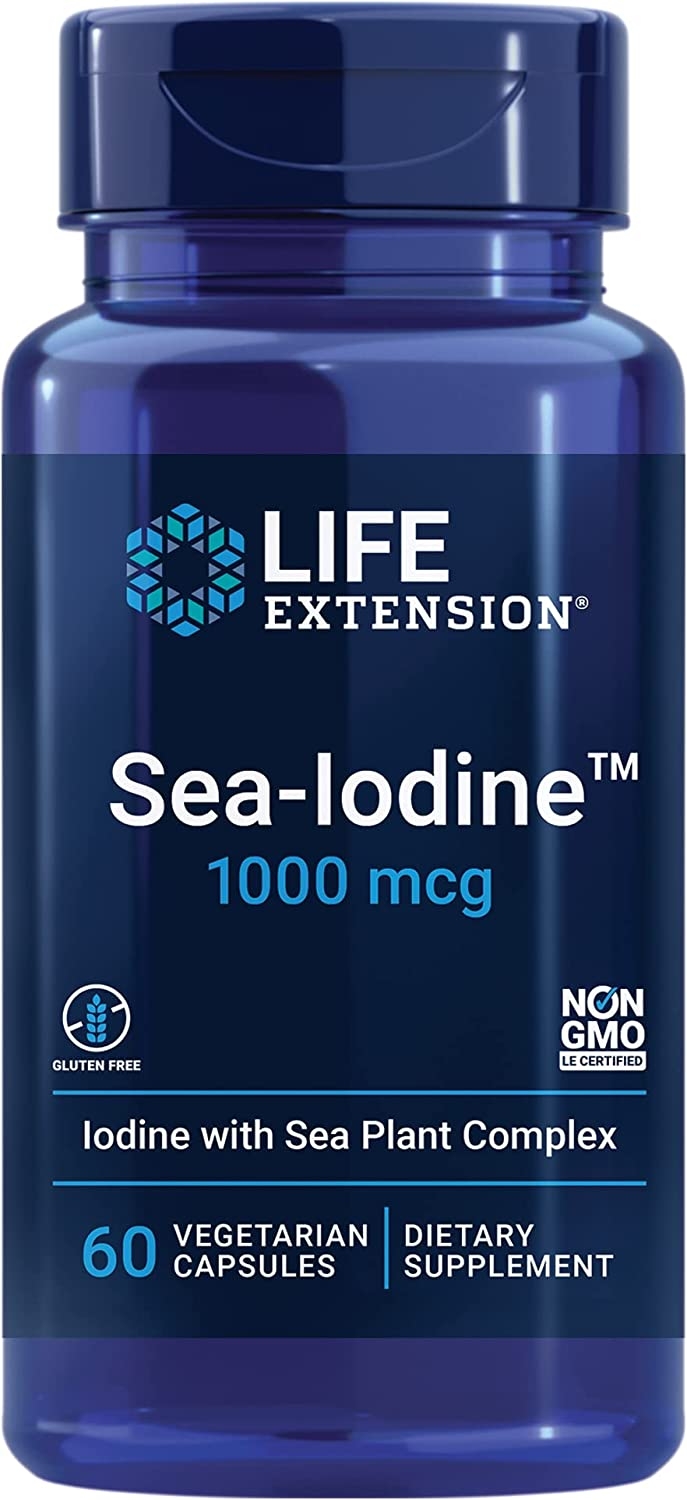
Life Extension Sea-Iodine provides 1,000 mcg of iodine per capsule from a blend of organic sea algae, aimed at people who want to avoid added dietary salt while still meeting iodine needs. It is gluten-free, non-GMO, and sold in a 60-capsule bottle — a two-month supply at the labelled one-capsule daily direction. Given everything above, it is best suited to someone who has already discussed their specific iodine status with a clinician, rather than as a default daily add-on for someone whose diet already includes iodized salt, dairy, or seafood.
View Life Extension Sea-IodineBrowse more options in the Supplements category at Champ Vita.
FAQ
How much iodine do I actually need per day?
The NIH RDA is 150 mcg/day for non-pregnant adults, 220 mcg/day during pregnancy, and 290 mcg/day during lactation. Most people in the US meet this through iodized salt, dairy, and seafood without needing a supplement.
Is 1,000 mcg of iodine in one capsule safe to take daily?
It is below the NIH's all-sources adult upper limit of 1,100 mcg/day, but it exceeds the American Thyroid Association's specific 500 mcg/day ceiling for iodine and kelp supplements. Whether it is appropriate depends heavily on how much iodine already comes from food and on thyroid health history — this is a "check with a doctor" dose, not an automatic one.
What happens if I get too much iodine?
Excess iodine can paradoxically cause both an enlarged thyroid and either hypothyroidism or hyperthyroidism, according to NIH. People with pre-existing autoimmune thyroid disease or iodine deficiency are more sensitive to these effects at intakes otherwise considered safe.
Can I get too much iodine from food alone, without supplements?
It is uncommon but possible with very high, sustained seaweed or kelp food intake — some seaweed species contain up to 2,984 mcg of iodine per gram, according to NIH. Supplements are still the more common route to excess because they deliver a concentrated, precise dose in one sitting.
Are kelp-based iodine supplements reliable in dose?
As a product category, no. A 2021 analysis of 96 commercial kelp and seaweed products found iodine in the supplement subgroup ranging from 5 to 5,600 mcg per daily dose, and 54 of the 96 products would exceed the 600 mcg European upper limit in a single portion. In that same analysis, every supplement declaring an iodine content but one contained less iodine than its label stated. Check any kelp-sourced iodine dose against total daily intake rather than assuming label accuracy.
Who should avoid iodine supplements like this one?
Anyone with Hashimoto's thyroiditis, Graves' disease, another autoimmune thyroid condition, a thyroid nodule, or a scheduled radioactive iodine procedure should talk to a doctor first, since an added 1,000 mcg/day can measurably shift thyroid function or interfere with a low-iodine diet required before treatment.
Sources
- NIH Office of Dietary Supplements — Iodine Fact Sheet for Health Professionals
- NIH Office of Dietary Supplements — Iodine Fact Sheet for Consumers
- Cleveland Clinic — Iodine Deficiency: Symptoms, Causes, Treatment & Prevention
- American Thyroid Association — Statement on the Potential Risks of Excess Iodine Ingestion and Exposure
- Food & Nutrition Research — Commercially Available Kelp and Seaweed Products: Valuable Iodine Source or Risk of Excess Intake?
- U.S. Food and Drug Administration — Dietary Supplements
- Cleveland Clinic — "Thyroid 101" (YouTube)
This article is for educational purposes and is not medical advice. It is not intended to diagnose, treat, cure, or prevent any disease. Talk to a doctor or pharmacist before starting any new supplement, especially if you have a thyroid condition, are pregnant or breastfeeding, or take thyroid medication. These statements have not been evaluated by the Food and Drug Administration. This product is not intended to diagnose, treat, cure, or prevent any disease. Dietary supplements are not reviewed or approved by the FDA for safety or effectiveness before they go to market, per FDA guidance on dietary supplements.