
Iron is the only nutrient on this shelf that comes with a federally mandated overdose warning printed directly on the label — and a standard 65 mg tablet already exceeds the National Academies' own upper intake limit for adults. Iron is a mineral the body uses to build hemoglobin, the protein in red blood cells that carries oxygen from the lungs to every tissue, and iron-deficiency anemia affects one in six pregnant women in the US (Office on Women's Health, updated 2025). That combination — a genuinely common deficiency, sold in doses that outrun the safety ceiling, on a label the FDA required by law — is worth reading past the front of the bottle.
Key Takeaways
- The adult Tolerable Upper Intake Level for iron is 45 mg/day, based on gastrointestinal distress as the limiting side effect (National Academies, Dietary Reference Intakes, 2001).
- A standard 65 mg ferrous sulfate tablet — the dose in this product and in the most common over-the-counter iron supplement sold in the US — already exceeds that limit by roughly 1.4 times.
- Premenopausal women need 18 mg/day and pregnant women need 27 mg/day, versus 8 mg/day for men and postmenopausal women (National Academies, 2001).
- Federal law has required a fatal-poisoning warning statement on iron-containing supplements and drugs since a 1997 FDA final rule, after accidental childhood overdoses caused deaths (FDA, 2003).
- Up to 5% of menstruating women develop iron-deficiency anemia from heavy periods, and iron-deficiency anemia affects roughly 1 in 6 pregnant women (Office on Women's Health, updated 2025).
In this article:
- What Iron Does — and Who Actually Runs Low
- Does Taking an Iron Supplement Actually Work?
- The Safety Catch: Why Federal Law Puts a Warning Label on This Bottle
- Who Genuinely Benefits From an Iron Supplement
- Inside Amazing Formulas Iron (Ferrous Sulfate): What's Actually on the Label
- How to Take Iron Without the Side Effects
- Frequently Asked Questions
- Sources
What Iron Does — and Who Actually Runs Low
Iron's main job is building hemoglobin, the oxygen-carrying protein in red blood cells, and myoglobin, which stores oxygen inside muscle tissue. Without enough of it, the body cannot make healthy red blood cells, and the result is iron-deficiency anemia: fatigue, weakness, dizziness, headaches, pale skin, shortness of breath on exertion, and brittle nails (Office on Women's Health, updated 2025). Yet most people in the United States get enough iron from food, according to the Office on Women's Health (updated 2025) — which makes who needs a supplement a narrower question than the shelf space suggests.
Requirements vary sharply by group, which is the first thing most multivitamin marketing glosses over. The National Academies' 2001 Dietary Reference Intake report sets these daily allowances:
| Group | RDA (mg/day) |
|---|---|
| Adult men (all ages) | 8 |
| Postmenopausal women | 8 |
| Premenopausal women (19–50) | 18 |
| Pregnant women | 27 |
| Breastfeeding women | 9 |
That 27 mg figure for pregnancy is more than three times the men's RDA, which is why prenatal supplementation guidance exists in the first place. According to the Office on Women's Health (updated 2025), up to 5% of menstruating women develop iron-deficiency anemia from heavy periods, and iron-deficiency anemia affects roughly one in six pregnant women. Vegetarians and vegans are also flagged as a higher-need group, because the non-heme iron in plant foods is absorbed far less efficiently than the heme iron in meat, fish and poultry (National Academies, 2001). Frequent blood donors and endurance athletes round out the at-risk list, both from ongoing iron loss the diet may not replace fast enough.
Does Taking an Iron Supplement Actually Work?
For a genuine, lab-confirmed iron deficiency, oral ferrous sulfate is the first-line treatment recommended by clinicians, and it reliably raises hemoglobin over several weeks (MedlinePlus, revised 2025). This is one of the more solidly evidence-backed corners of the supplement aisle: correcting a real deficiency with the mineral that's missing is not a stretch of the evidence the way many "energy" or "immunity" claims are.
The nuance marketing leaves out: iron supplementation helps when iron is actually low. If your fatigue has another cause — poor sleep, thyroid dysfunction, depression, or simply a demanding week — taking iron you don't need does not produce more energy, and pushes you closer to the doses discussed in the next section. A blood test (ferritin and a complete blood count) is the only reliable way to know whether you're actually iron-deficient before starting a supplement at this dose.
That distinction matters because iron is not like water-soluble vitamins the body simply excretes when it has enough. Iron balance is controlled almost entirely by how much the gut absorbs, not by how much leaves the body, so chronic over-supplementation in someone who isn't deficient can accumulate over time.
The Safety Catch: Why Federal Law Puts a Warning Label on This Bottle
This is the section that separates iron from almost everything else in our supplements range. Following a string of accidental childhood poisoning deaths in the 1990s — iron tablets can look like candy to a toddler, and a handful of adult-strength tablets can be fatal to a small child — the FDA issued a 1997 final rule requiring a specific warning statement on all iron-containing dietary supplements and drugs sold as solid oral dosage forms (FDA, 2003). The rule originally paired that warning with a unit-dose (blister-pack) packaging requirement for any product supplying 30 mg or more of iron per dosage unit.
“Accidental overdose of iron-containing products is a leading cause of fatal poisoning in children under 6. Keep this product out of reach of children. In case of accidental overdose, call a doctor or poison control center immediately.”
— FDA-mandated warning statement, required on iron-containing supplements and drugs since 1997The unit-dose packaging half of the rule was struck down in 2003 after a federal court ruled, in Nutritional Health Alliance v. FDA, that the Food, Drug and Cosmetic Act does not give the agency authority to mandate packaging purely for poison prevention (Federal Register, 2003). The warning-label requirement itself was not part of that challenge and remains in force today — which is why a warning to this effect appears on the bottle of the product featured later in this article — in that label's own slightly condensed wording, alongside a separate “keep out of reach of children” storage line.
Real safety warning, not boilerplate: keep every iron-containing product away from children — this is the specific hazard the federal warning label exists to address. If you have hemochromatosis, thalassemia, or any condition your doctor already monitors for iron overload, do not take an iron supplement without medical supervision; hemochromatosis causes iron to build up in the body, and extremely high iron levels can lead to organ damage (MedlinePlus, updated 2024).
None of this means iron is unusually dangerous when it's actually needed and taken as directed by an adult. It means the margin between a therapeutic dose and the upper limit is narrower than for most vitamins, and the label reflects a documented, decades-old public-health problem rather than an abundance of caution.
Who Genuinely Benefits From an Iron Supplement
The evidence points most clearly toward a handful of groups: people with a lab-confirmed iron deficiency or iron-deficiency anemia; premenopausal women with heavy menstrual periods; pregnant women, whose requirement nearly doubles; vegetarians and vegans, because of lower non-heme iron absorption; frequent whole-blood donors, who lose roughly 200–250 mg of iron with every standard donation; and endurance athletes, particularly female runners, who lose additional iron through foot-strike hemolysis and heavier training-related blood loss.
Mayo Clinic Minute on why female athletes are at elevated risk of low iron — one of the groups the NIH data above singles out.
Outside those groups, the case weakens quickly. A healthy adult man eating a typical mixed diet is unlikely to be iron-deficient, and routine iron supplementation without a documented shortfall is not something the evidence supports as a general "energy" strategy.
Inside Amazing Formulas Iron (Ferrous Sulfate): What's Actually on the Label
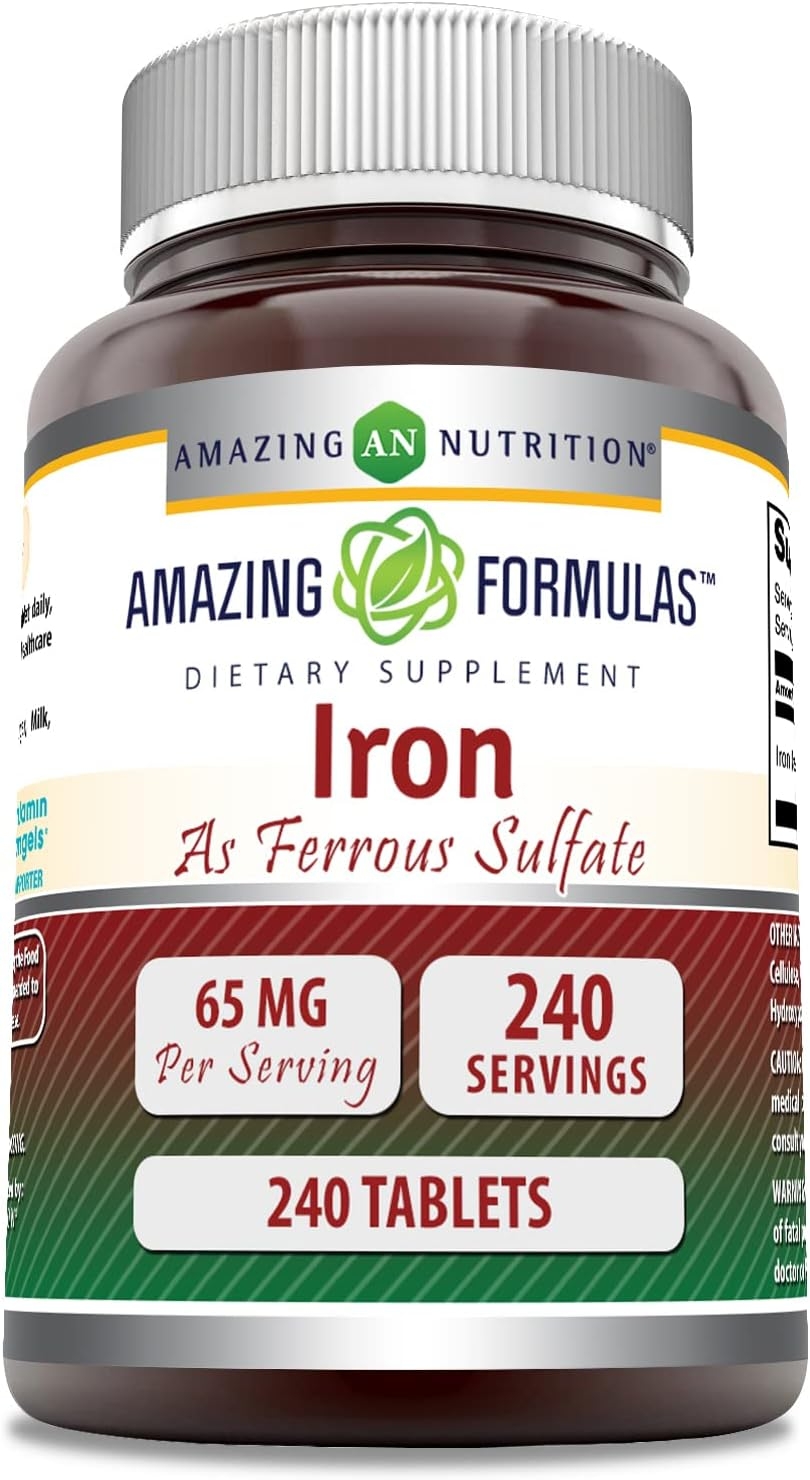
Each tablet of this product supplies 65 mg of elemental iron as ferrous sulfate — listed on the label as 361% of the FDA's daily value reference of 18 mg. That 65 mg figure is not an unusually aggressive dose by supplement-industry standards: it's the same elemental-iron amount delivered by the standard 325 mg ferrous sulfate tablet sold as a generic over-the-counter iron supplement in US pharmacies (DailyMed, FDA drug label database). It is, however, above the National Academies' adult Tolerable Upper Intake Level of 45 mg/day from every source combined.
| This product | Standard OTC ferrous sulfate | NIH RDA | Tolerable Upper Limit | |
|---|---|---|---|---|
| Elemental iron | 65 mg/tablet | 65 mg/tablet (325 mg ferrous sulfate) | 8–27 mg/day, by group | 45 mg/day (adults) |
Put in the prose: one tablet is roughly 8 times the RDA for an adult man, 3.6 times the RDA for a premenopausal woman, and about 1.4 times the adult upper limit — before counting any iron from food or a multivitamin taken the same day. That is exactly why the label carries the directions and warning it does, and exactly why the "consult your doctor" caution on the back of the bottle is not filler text.
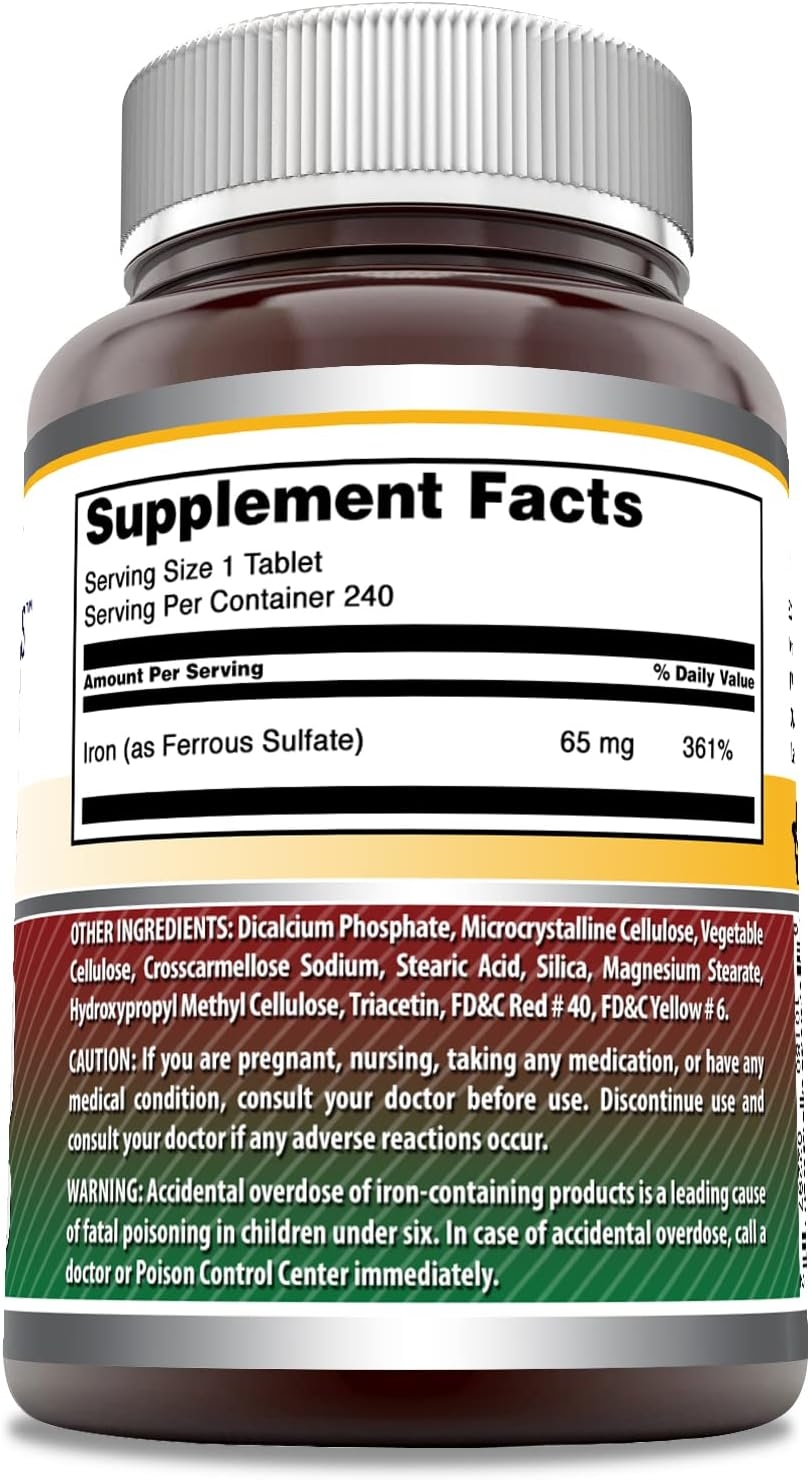
The "Other Ingredients" list is standard tableting material — dicalcium phosphate, microcrystalline cellulose, vegetable cellulose, croscarmellose sodium, stearic acid, silica, magnesium stearate, hydroxypropyl methyl cellulose and triacetin — plus two synthetic colorants (FD&C Red #40 and FD&C Yellow #6). The product contains no preservatives, artificial sweeteners, soy, gluten, dairy or fish, per the label. Directions state one tablet daily with a meal and plenty of fluids, or as directed by a healthcare professional — which, given the numbers above, is the more relevant option for anyone who is not a diagnosed anemia case following a clinician's dosing plan.
Who this is for: adults with a lab-confirmed iron deficiency or iron-deficiency anemia, under a doctor's guidance on dose and duration; and people in a documented higher-need group — heavy menstrual bleeding, pregnancy (with an obstetrician's sign-off, since prenatal formulas are usually dosed differently), or a vegetarian/vegan diet with confirmed low ferritin.
Who should skip it: most healthy adult men, most postmenopausal women, and anyone without a blood test showing low iron or ferritin. Anyone with hemochromatosis, thalassemia, or a family history of iron-overload disorders should not take this without medical supervision. If there's any chance a child could reach the bottle, that alone is a reason to store it somewhere else, not just a warning label to skim past.
Amazing Formulas Iron (Ferrous Sulfate) 65 mg, 240 Tablets
A 240-count bottle of standard-dose ferrous sulfate, priced for the long haul of a multi-month course. Best used the way its own label recommends — one tablet daily with food, or as your doctor directs — and best started after a blood test confirms you actually need it.
View Amazing Formulas Iron on Champ VitaHow to Take Iron Without the Side Effects
The most common reason people quit an iron supplement isn't the price — it's the stomach. Constipation, nausea, stomach pain and diarrhea are the most frequently reported side effects of oral ferrous sulfate (MedlinePlus, revised 2025). A few evidence-based adjustments make a real difference:
| Factor | Effect on non-heme iron absorption |
|---|---|
| Vitamin C (25–50 mg taken with the dose) | Increases absorption roughly 2- to 6-fold (National Academies, 2001) |
| Calcium (300–600 mg, e.g. a calcium supplement or a large dairy serving) | Reduces absorption by 50–60% (National Academies, 2001) |
| Tea and coffee (polyphenols/tannins) | Markedly inhibits absorption (National Academies, 2001) |
| Tetracycline-class antibiotics | Space 2 hours apart in either direction (MedlinePlus, 2025) |
The label's own suggested use — with a meal and plenty of fluids — is a compromise: food blunts some absorption compared with an empty stomach, but it substantially reduces the GI upset that causes most people to stop taking iron altogether. If side effects persist, that's a conversation for a doctor or pharmacist about switching forms or splitting the dose, not a reason to double up in the hope of catching up faster.
Frequently Asked Questions
How much iron do I actually need per day?
It depends heavily on who you are: 8 mg/day for adult men and postmenopausal women, 18 mg/day for premenopausal women, and 27 mg/day during pregnancy (National Academies, 2001). Most of that should come from food; supplements are for confirmed shortfalls, not a daily default.
Can too much iron actually be dangerous?
Yes. The adult Tolerable Upper Intake Level is 45 mg/day from all sources, set because of gastrointestinal distress at higher intakes (National Academies, 2001). In children, even a handful of adult-strength tablets can be fatal, which is why federal law requires the warning label discussed above.
Why does this bottle have an overdose warning printed on it?
Because federal law has required it since a 1997 FDA rule, issued after accidental childhood poisoning deaths from iron-containing products (FDA, 2003). The warning survived a 2003 court challenge that struck down a related packaging requirement, so it remains mandatory today.
Should I take iron with vitamin C?
It can help. Vitamin C significantly increases the absorption of non-heme iron — the kind in this supplement — by roughly two- to six-fold depending on the amount (National Academies, 2001). A small glass of orange juice or a vitamin C tablet alongside the dose is a reasonable, low-cost strategy.
Can I take iron and calcium (or a calcium-containing multivitamin) together?
Not ideally at the same time. Calcium can reduce iron absorption by 50 to 60 percent at typical supplemental doses (National Academies, 2001). Separating the two by a few hours preserves more of both nutrients.
How long does it take for iron supplements to raise low iron levels?
Hemoglobin typically begins rising within a few weeks of consistent daily use for a confirmed deficiency, though fully rebuilding iron stores (ferritin) can take several months (MedlinePlus, revised 2025). Follow-up blood work is how a clinician confirms it's working.
Does an iron supplement help if I'm tired but not actually anemic?
The evidence doesn't support that use. Iron supplementation helps when iron is measurably low; taking it without a documented deficiency has not been shown to relieve fatigue from other causes, and it adds unnecessary GI risk and, over time, iron-overload risk.
Who should not take an iron supplement?
Most healthy adult men and postmenopausal women don't need one. People with hemochromatosis, thalassemia, or other iron-overload conditions should avoid supplemental iron unless a doctor specifically directs otherwise, and anyone pregnant, nursing, or on medication should check with a clinician first, per the product's own label caution.
Sources
- Institute of Medicine (National Academies). "Iron." Dietary Reference Intakes for Vitamin A, Vitamin K, Arsenic, Boron, Chromium, Copper, Iodine, Iron, Manganese, Molybdenum, Nickel, Silicon, Vanadium, and Zinc. Published 2001. Accessed 6 September 2026. ncbi.nlm.nih.gov/books/NBK222309
- MedlinePlus (National Library of Medicine). "Iron." Updated 24 June 2024. Accessed 6 September 2026. medlineplus.gov/iron.html
- MedlinePlus (National Library of Medicine). "Iron Supplements (Oral Route)." Revised 15 April 2025. Accessed 6 September 2026. medlineplus.gov/druginfo/meds/a682778.html
- Office on Women's Health, U.S. Department of Health and Human Services. "Iron-deficiency anemia." Updated 24 October 2025. Accessed 6 September 2026. womenshealth.gov/a-z-topics/iron-deficiency-anemia
- U.S. Food and Drug Administration. "Small Entity Compliance Guide: Label Warning Statements for Iron-Containing Supplements and Drugs." 2003. Accessed 6 September 2026. fda.gov guidance document
- Federal Register. "Iron-Containing Supplements and Drugs; Label Warning Statements and Unit-Dose Packaging Requirements; Removal of Regulations for Unit-Dose Packaging Requirements." 17 October 2003. Accessed 6 September 2026. federalregister.gov, document 03-26188
- U.S. Food and Drug Administration. "FDA's Role in Dietary Supplement Regulation." Updated 1 October 2024. Accessed 6 September 2026. fda.gov/food/dietary-supplements
- DailyMed, National Library of Medicine. "Ferrous Sulfate Tablets, USP 325 mg." Accessed 6 September 2026. dailymed.nlm.nih.gov
This article is for educational purposes only and is not medical advice. It is not intended to diagnose, treat, cure or prevent any disease, and these statements have not been evaluated by the Food and Drug Administration. Talk to a doctor or pharmacist before starting an iron supplement, especially if you are pregnant, nursing, taking medication, or have a condition affecting iron levels.