
Calcium is the body's most abundant mineral — the structural material of bone and teeth, and the signal that drives muscle contraction, nerve firing and blood clotting. It is marketed almost entirely on the bone half of that job, but a 388,229-person NIH cohort study found that men taking more than 1,000 mg a day of supplemental calcium had a 20% higher risk of dying from cardiovascular disease than men taking none. The same study found no such risk from calcium eaten in food, and no risk at all in women. That distinction — supplement versus food, men versus women — is exactly the kind of detail a bottle label has no room for.
Key Takeaways
- Adults need 1,000–1,200 mg of calcium a day depending on age and sex, per the National Academies' 2011 Dietary Reference Intakes — the requirement rises for women at 51, not for men until 71.
- A 388,229-person NIH-AARP cohort study (Xiao et al., JAMA Internal Medicine, 2013) found men taking more than 1,000 mg/day of supplemental calcium had a 20% higher risk of cardiovascular death (RR 1.20) than men taking none — the link did not appear in women or with dietary calcium.
- This product delivers 1,000 mg of calcium and 500 mg of magnesium per two-tablet daily serving — the magnesium alone runs 43% above the NIH's 350 mg Tolerable Upper Intake Level for supplemental magnesium.
- A meta-analysis of 29 randomised trials, cited in a 2018 clinical review, found adequate calcium intake with or without vitamin D cut fractures of any type by 12% (RR 0.88) — and separately reported a 24% reduction in osteoporotic fractures among people with high supplement compliance.
- The Tolerable Upper Intake Level for calcium itself is 2,500 mg/day under age 51 and 2,000 mg/day at 51+ (National Academies, 2011) — a ceiling this product's calcium dose doesn't approach, even as its magnesium does.
In this article:
- What Is Calcium, and How Much Do You Actually Need?
- Does Calcium Supplementation Actually Protect Your Bones?
- The Heart-Risk Study Behind the Calcium Aisle
- Who Actually Needs a Calcium Supplement?
- Inside Country Life Target-Mins Calcium Magnesium: What's Actually in the Tablet
- How to Take Calcium (and Magnesium) Sensibly
- Frequently Asked Questions
What Is Calcium, and How Much Do You Actually Need?
Calcium is the most abundant mineral in the body. About 99% is stored in bone and teeth for structural rigidity; the remaining 1% circulates in blood and soft tissue, mediating muscle contractility, nervous excitability, blood clotting and hormone secretion, according to a 2016 review in Archives of Endocrinology and Metabolism.
How much a person needs changes substantially by age and sex. The National Academies (formerly the Institute of Medicine) set the current Recommended Dietary Allowances in its 2011 Dietary Reference Intakes for Calcium and Vitamin D:
| Life stage | RDA (mg/day) |
|---|---|
| Children & adolescents, 9–18 years | 1,300 |
| Adults, 19–50 years | 1,000 |
| Men, 51–70 years | 1,000 |
| Women, 51–70 years | 1,200 |
| Adults, >70 years (both sexes) | 1,200 |
| Pregnancy & lactation, 14–18 years | 1,300 |
| Pregnancy & lactation, 19–50 years | 1,000 |
Two things stand out. The requirement jumps for women specifically at 51 — roughly menopause, and the bone loss that follows — while men's requirement doesn't rise until 71. And at 1,000 mg per two-tablet serving, this product lands precisely at the RDA for most adults under 51 and for men 51–70, not above it, which matters for how the rest of this article should be read.
Most adults don't hit these numbers from diet alone, particularly with low dairy intake. MedlinePlus notes calcium absorbs best in doses of 500 mg or less at a time, and that calcium carbonate — one of the two main supplement forms, and the one in many antacids — needs food to absorb well, while calcium citrate works on an empty or full stomach and suits people with low stomach acid.
Mayo Clinic on how calcium needs change with age, and why more isn't automatically better.
Does Calcium Supplementation Actually Protect Your Bones?
Calcium's best-documented job is bone. NIAMS states plainly that osteoporosis is the major cause of fractures in postmenopausal women and older men, and recommends a diet rich in calcium and vitamin D — which helps the body absorb calcium — as one of the few modifiable risk factors.
The supplementation evidence is genuinely positive, with real limits. The Clinical Interventions in Aging review (2018) cites a meta-analysis of 29 randomised trials in men and women over 50, which found that adequate calcium intake — with or without vitamin D — reduces fractures of any type by 12% (RR 0.88, 95% CI 0.83–0.95). The same analysis separately reported a 24% reduction in osteoporotic fractures among people with a high compliance rate, and concluded that a minimum of 1,200 mg/day of calcium with 800 IU/day of vitamin D was the best treatment for osteoporosis. The headline fracture figure pools trials that did and did not include vitamin D, so it is not evidence that calcium alone performs as well.
Not every result agrees: one meta-analysis in the same review linked calcium supplementation to increased hip fracture risk, and another found no reduced fracture risk in community-dwelling older adults overall. Bone benefit depends on baseline intake, vitamin D status, and who's taking it.
The Heart-Risk Study Behind the Calcium Aisle
The NIH-AARP Diet and Health Study (Xiao et al., JAMA Internal Medicine, 2013) followed 388,229 men and women aged 50–71 for a mean of 12 years, tracking dietary and supplemental calcium against cardiovascular death in the National Death Index. In men, taking more than 1,000 mg/day of supplemental calcium — versus none — was associated with a 20% higher risk of cardiovascular death (RR 1.20, 95% CI 1.05–1.36), driven mainly by heart disease death (RR 1.19, 95% CI 1.03–1.37). In women, the same comparison showed no significant association with any cardiovascular outcome. And in both sexes, calcium from food showed no relationship to cardiovascular mortality — only the supplemental form was implicated, and only in men.
Genuine safety consideration: This is a large observational study, not a randomized trial — it shows an association, not proof that supplemental calcium causes heart disease in men. But it's a specific, dose-linked signal in nearly 400,000 people, applying directly to a dose — over 1,000 mg/day of supplemental calcium — that this product's label sits right at. If you're a man taking a calcium supplement, especially on top of a calcium-fortified diet or with existing cardiovascular risk factors, mention it to your doctor.
The picture is genuinely mixed elsewhere. The same review cites a Chinese cohort where modest dietary calcium (~600 mg/day) tracked with lower cardiovascular mortality, a European cohort where ~820 mg/day of dietary calcium tracked with 30% lower heart attack risk, and a cohort of over 34,000 postmenopausal women where both dietary and supplemental calcium tracked with lower ischemic heart disease mortality. These don't cancel out the NIH-AARP result — they describe different populations — but they're why this isn't settled science.
"Studies that have evaluated the influence of the consumption of foods rich in calcium have reported no increase in the cardiovascular risk... the use of calcium supplements should be reserved for patients who truly need supplementation and are unable to achieve the recommended daily nutritional intake of calcium."
— Lima et al., Archives of Endocrinology and Metabolism, 2016One nutrient covered elsewhere on this blog sits inside this exact debate: vitamin K helps direct circulating calcium toward bone and away from artery walls.
Who Actually Needs a Calcium Supplement?
A lot of adults already get enough calcium from food — dairy, fortified plant milks, leafy greens, canned fish with bones, and fortified orange juice add up quickly. A supplement makes the most sense for people whose diet genuinely falls short: those who avoid dairy without a fortified substitute, postmenopausal women (RDA rises to 1,200 mg), adults over 70, people with diagnosed osteoporosis or low bone density under a doctor's care, and anyone on long-term corticosteroid therapy, which increases calcium loss.
Pregnant women are a specific case with real evidence: a randomized trial cited in the same review found calcium above 1,000 mg/day significantly reduced preeclampsia risk, and the World Health Organization has recommended calcium supplementation in pregnancy on that basis where dietary intake is low.
There's a caution on the other side: the same review describes a 12-year study of 91,731 women that found high dietary calcium linked to fewer kidney stones, while high supplemental calcium was linked to more — the same food-versus-supplement split seen with cardiovascular risk. Anyone with a personal or family history of kidney stones should raise that with a doctor first.
| Age group | UL (mg/day, all sources) |
|---|---|
| Children, 1–8 years | 2,500 |
| Children & adolescents, 9–18 years | 3,000 |
| Adults, 19–50 years | 2,500 |
| Adults, 51+ years | 2,000 |
Most people reach these ceilings only by stacking a supplement on a high-calcium diet or antacid use — not from a single moderate-dose product like this one.
Inside Country Life Target-Mins Calcium Magnesium: What's Actually in the Tablet
This store's own listing describes the calcium and magnesium as "chelated" without saying which forms. The bottle's Supplement Facts panel is more specific, and the detail changes how the dose should be read.
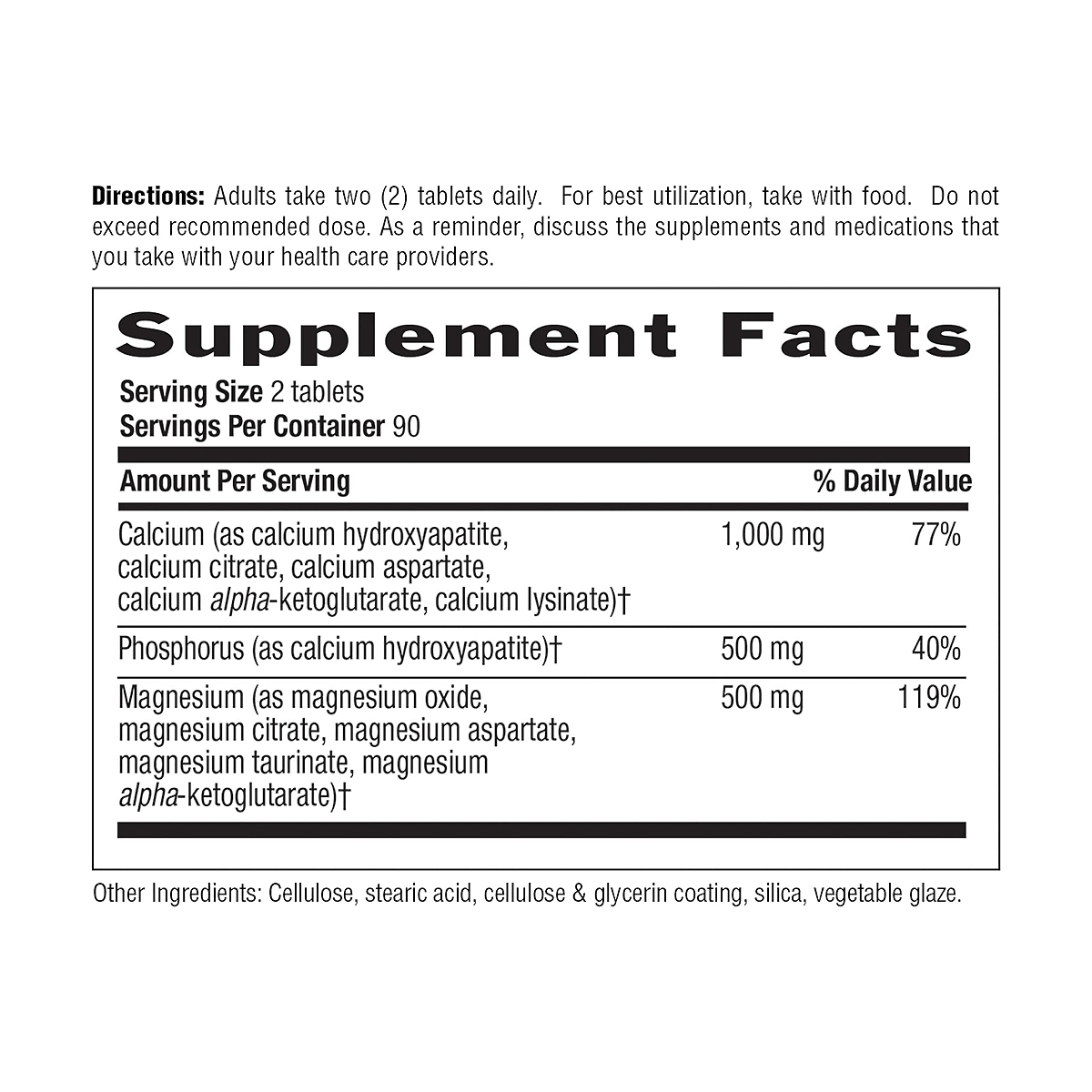
Per two-tablet serving: 1,000 mg calcium (77% of the FDA's current 1,300 mg Daily Value), as calcium hydroxyapatite, citrate, aspartate, alpha-ketoglutarate, and lysinate; 500 mg phosphorus (40% DV) from the hydroxyapatite; and 500 mg magnesium (119% DV), as magnesium oxide, citrate, aspartate, taurinate, and alpha-ketoglutarate. The label directs two tablets daily with food, not to exceed the recommended dose — 180 tablets is a 90-day supply, not the 30-day, six-tablet figure that appears elsewhere on this store's own page. We've used the label's figures throughout.
| This product (2 tablets) | Typical shelf dose | NIH RDA | NIH Tolerable Upper Limit | |
|---|---|---|---|---|
| Calcium | 1,000 mg | 500–1,200 mg | 1,000–1,200 mg (adult, by age/sex) | 2,000–2,500 mg (adult, by age) |
| Magnesium | 500 mg | 250–500 mg | 310–420 mg (adult, by sex) | 350 mg (supplemental sources only) |
Genuine safety consideration — the magnesium, not the calcium: The calcium dose here sits at the RDA, not above it. The magnesium doesn't: 500 mg is 43% above the National Academies' 350 mg Tolerable Upper Intake Level for magnesium. That UL applies specifically to supplemental magnesium — the 1997 National Academies report explains dietary magnesium has never been shown to cause adverse effects, while supplemental magnesium above this level can cause osmotic diarrhea, nausea, and cramping, the same cathartic effect that makes it a common laxative ingredient. That's not organ toxicity, and it isn't dangerous for most healthy adults, but it's a real, documented reason some people taking this product may get loose stools. Because the dose sits above the UL, clear it with a doctor or pharmacist before starting rather than self-managing — the same report singles out impaired kidney function as the condition that turns excess magnesium from a nuisance into a genuine risk, since the kidneys are what clear the surplus.
Readers who want magnesium on its own, at a lower dose, have that option in this store's mineral category.
Who this is for: Adults with a genuinely low-calcium diet who want both minerals in one product; postmenopausal women or adults over 70 whose RDA has risen to 1,200 mg; people who tolerate magnesium well.
Who should skip it: Men already close to or above 1,000 mg/day of supplemental calcium from other sources, given the cardiovascular signal above; anyone with a personal or family history of kidney stones or kidney disease; and most adults who already meet their calcium needs through diet and don't need any supplement, let alone one dosed above the magnesium UL.
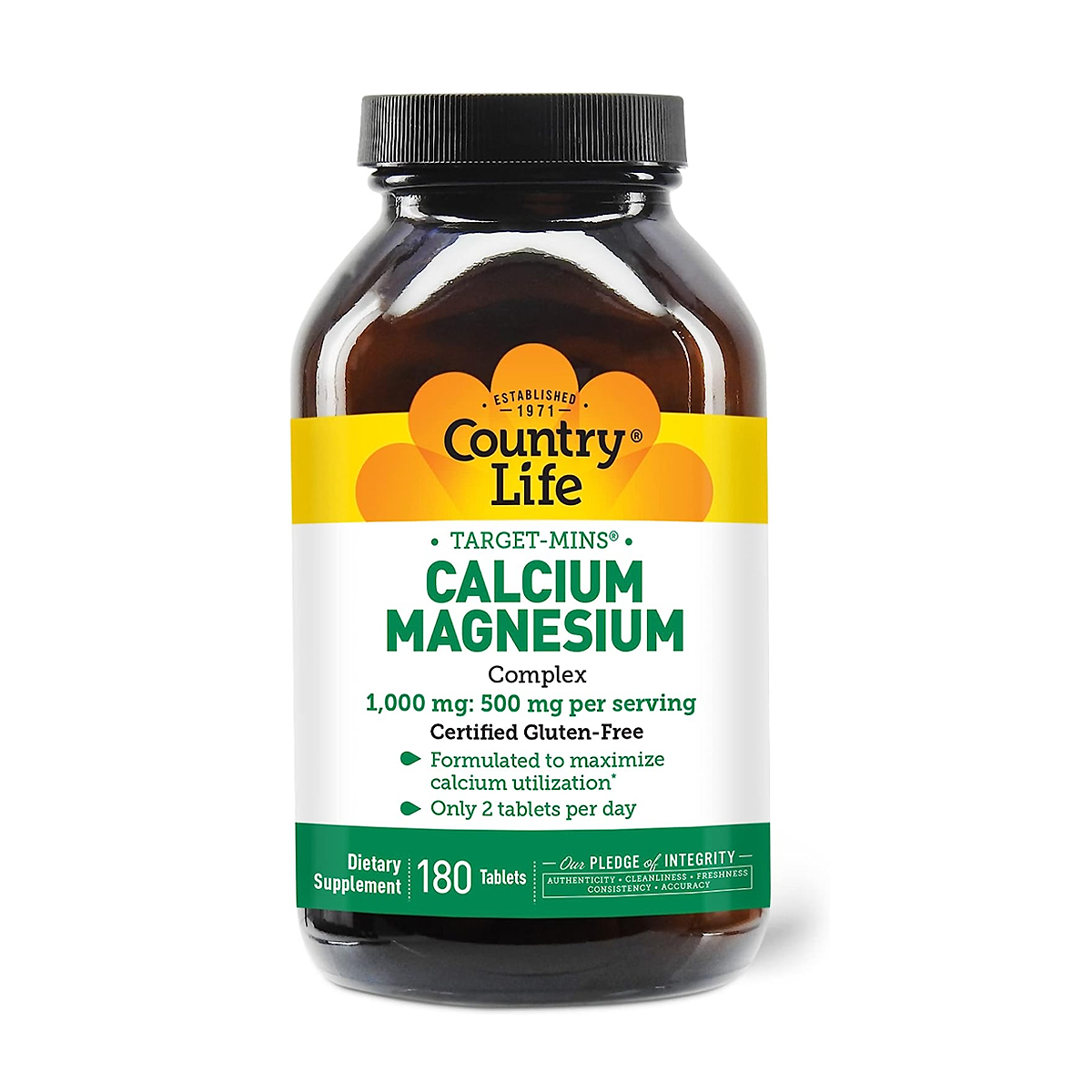
Country Life Target-Mins Calcium Magnesium Complex — 180 Tablets
1,000 mg calcium and 500 mg magnesium per 2-tablet daily serving, a 90-day supply. Vegan, certified gluten-free. As covered above, the magnesium dose runs above the supplemental UL — take with food, and check with a doctor if you have kidney disease or GI sensitivity to magnesium.
View Product DetailsHow to Take Calcium (and Magnesium) Sensibly
A few practical defaults follow from the evidence above:
- Split the two tablets — one with breakfast, one with dinner — since calcium absorbs best in doses of 500 mg or less.
- Take it with food, as the label directs.
- Don't take it within 1–2 hours of other medications; MedlinePlus notes calcium can reduce their effectiveness.
- If you're a man already getting substantial calcium elsewhere, factor that in — the cardiovascular signal above was specific to supplemental intake over 1,000 mg/day.
- Talk to your doctor first if you have kidney disease, a history of kidney stones, or are pregnant or breastfeeding — and stop if you get persistent diarrhea or nausea.
Frequently Asked Questions
How much calcium do adults actually need per day?
Most adults 19–50 need 1,000 mg/day. That rises to 1,200 mg/day for women 51 and older and all adults over 70; men 51–70 stay at 1,000 mg/day, per the National Academies' 2011 Dietary Reference Intakes.
Is it true that calcium supplements can be bad for your heart?
The evidence is mixed and depends on who's taking it. A 388,229-person NIH cohort study found a 20% higher cardiovascular death risk in men taking more than 1,000 mg/day of supplemental calcium, but no risk in women and none from calcium in food. Other cohort studies found dietary calcium linked to lower cardiovascular risk. The concern is specific to high-dose supplements in men, not calcium generally.
What's the difference between calcium carbonate and calcium citrate?
They are the two main supplement forms. Calcium carbonate is absorbed best when taken with food, and is the form in antacids such as Tums and Rolaids. Calcium citrate absorbs well on an empty or full stomach, and people with low stomach acid absorb it more easily than carbonate, per MedlinePlus.
Can I take too much calcium?
Yes. The Tolerable Upper Intake Level is 2,500 mg/day under 51 and 2,000 mg/day at 51+, counting food and supplements combined. This product's 1,000 mg dose sits well under that ceiling on its own.
Do calcium supplements cause kidney stones?
A 12-year study of over 91,000 women found high dietary calcium linked to fewer kidney stones, while high supplemental calcium was linked to more. Anyone with a history of kidney stones should discuss calcium supplementation with a doctor first.
Should I take calcium and magnesium together?
They're often paired because both support bone health, but check the magnesium dose. This product's 500 mg exceeds the NIH's 350 mg Tolerable Upper Intake Level for supplemental magnesium, which can cause diarrhea in some people even though it isn't organ-toxic.
Is it better to get calcium from food or supplements?
The evidence favors food where possible. A 2016 review in Archives of Endocrinology and Metabolism found dietary calcium showed no increase in cardiovascular risk, and recommended reserving supplements for people who can't meet their needs through diet alone.
What's the best time of day to take a calcium supplement?
With food, in doses of 500 mg or less if possible, since calcium absorbs better in smaller amounts. For a 1,000 mg daily dose like this product's, that means splitting the two tablets between two meals rather than taking both at once.
Sources
- National Academies (Institute of Medicine) — Dietary Reference Intakes for Calcium and Vitamin D. 2011. Accessed 3 September 2026.
- National Academies (Institute of Medicine) — Magnesium, in Dietary Reference Intakes for Calcium, Phosphorus, Magnesium, Vitamin D, and Fluoride. 1997. Accessed 3 September 2026.
- Xiao Q, Murphy RA, Houston DK, Harris TB, Chow WH, Park Y. "Dietary and supplemental calcium intakes in relation to mortality from cardiovascular diseases in the NIH-AARP Diet and Health Study." JAMA Internal Medicine, 2013. Accessed 3 September 2026.
- Li K, et al. "The Good, the Bad, and the Ugly of Calcium Supplementation: A Review of Calcium Intake on Human Health." Clinical Interventions in Aging, 2018. Accessed 3 September 2026.
- Lima GAC, et al. "Calcium Intake: Good for the Bones But Bad for the Heart? An Analysis of Clinical Studies." Archives of Endocrinology and Metabolism, 2016. Accessed 3 September 2026.
- MedlinePlus — Calcium. Updated 14 May 2024. Accessed 3 September 2026.
- MedlinePlus — Calcium Carbonate, Drug Information. Last revised 20 June 2024. Accessed 3 September 2026.
- NIAMS — Osteoporosis. Last reviewed December 2022. Accessed 3 September 2026.
- FDA — Dietary Supplements. Content current as of 1 October 2024. Accessed 3 September 2026.
This article is for educational purposes only and is not medical advice. It is not intended to diagnose, treat, cure, or prevent any disease. These statements have not been evaluated by the Food and Drug Administration. Talk to your doctor before starting any new supplement, especially if you are pregnant, breastfeeding, have kidney disease, have a history of kidney stones, or have cardiovascular risk factors.