
The federal government's own osteoporosis guidance for older adults never mentions vitamin K — only calcium and vitamin D. Yet a bottle on this store's shelf delivers 2,600 mcg of vitamin K per softgel, roughly 22 times the adult male Adequate Intake. That gap isn't a red flag by itself — a large 2024 meta-analysis of 17 randomized trials in 4,800 people found vitamin K does change bone chemistry in a measurable way. It just doesn't move bone density at most of the sites doctors actually scan, and the strongest evidence for "artery health" applies to one narrow marker, not arteries in general. Here's what the trial data actually supports, and what it doesn't.
Key takeaways
- The NIH Adequate Intake for vitamin K is 120 mcg/day for men and 90 mcg/day for women; this product's 2,600 mcg dose is about 22× and 29× those amounts.
- That 2,600 mcg is not one ingredient. The label breaks it out as 1,500 mcg K1, 1,000 mcg MK-4 and just 100 mcg MK-7 — so most of the headline number is K1, the form tied to clotting rather than to the bone and artery research.
- No Tolerable Upper Intake Level exists for vitamin K — the Food and Nutrition Board cites its "low potential for toxicity" — but that is a different statement from "more is better."
- A 2024 meta-analysis of 17 RCTs (4,800 participants) found vitamin K raised lumbar-spine bone density only marginally (p = 0.035), and the effect stopped being significant once one lower-quality study was removed; hip, femoral neck, and forearm density showed no significant change at all.
- A separate meta-analysis of 14 RCTs (1,533 participants) found vitamin K slowed coronary artery calcification specifically, but showed "no appreciable benefit" against vascular calcification measured more broadly.
- Vitamin K — including from supplements — antagonizes warfarin and similar anticoagulants; NIH and MedlinePlus both warn that a sudden change in intake, not the food itself, is what raises the risk of dangerous bleeding or clotting.
- What vitamin K is, and why this label lists three forms
- How much vitamin K you actually need — and what 2,600 mcg looks like next to it
- Does vitamin K build bone? What 17 trials in 4,800 people found
- Does vitamin K protect arteries? The calcification evidence
- The one interaction that matters: warfarin and other anticoagulants
- Reading the label: what "2,600 mcg" doesn't tell you
- Who might reasonably consider this, and who shouldn't
- FAQ
What vitamin K is, and why this label lists three forms
Vitamin K is a fat-soluble vitamin the body uses to activate proteins involved in blood clotting and in binding calcium into bone and out of soft tissue. According to the NIH Office of Dietary Supplements, it exists in two natural families: K1 (phylloquinone), the form in leafy greens, and K2 (menaquinones), made by gut bacteria and found in fermented foods and animal products. K2 itself splits into subtypes distinguished by a side-chain length — MK-4 and MK-7 are the two most studied. MK-4 clears the bloodstream within hours; MK-7 stays active for days, which is the pharmacological reason supplement makers favor it for a once-daily dose.
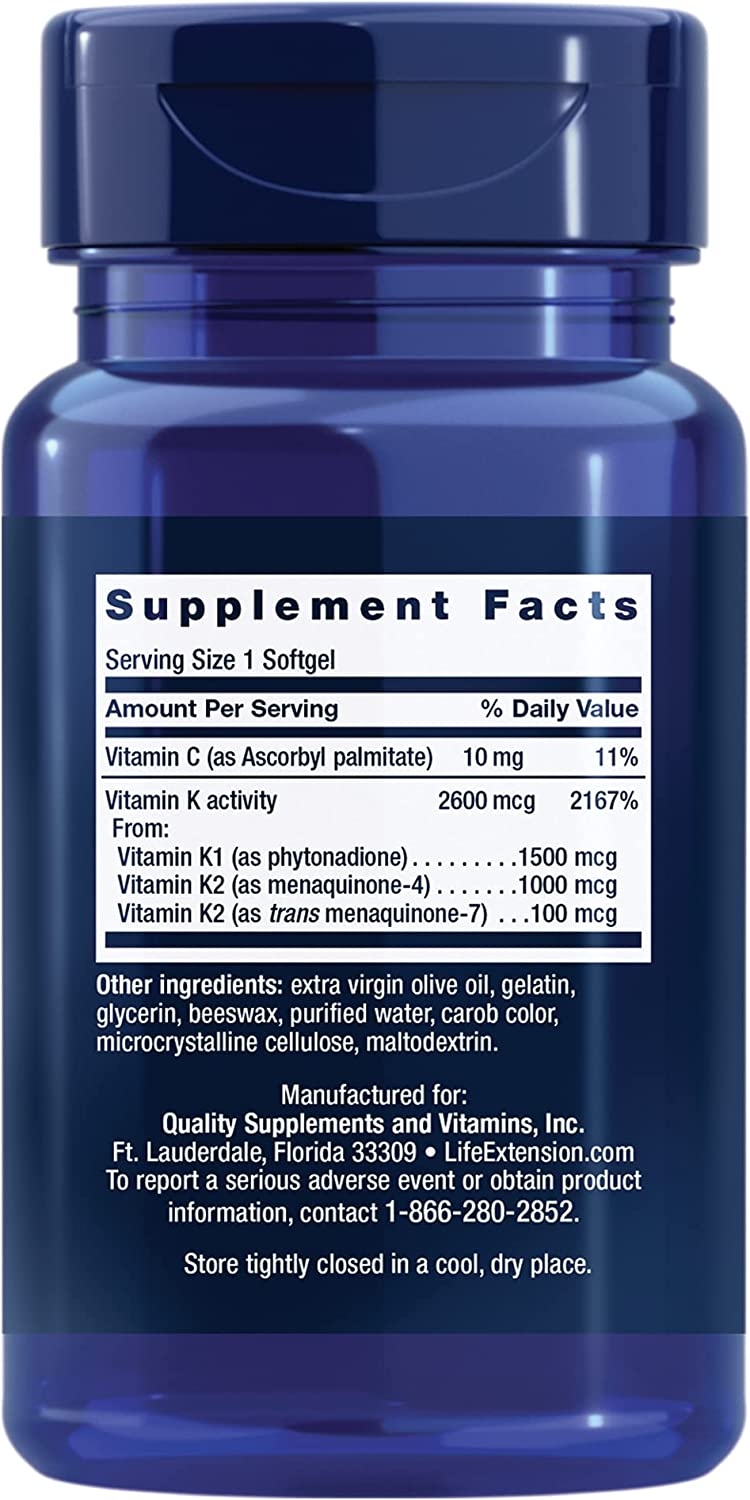
The product featured here combines all three — K1, MK-4, and MK-7 — in one softgel, on the logic that K1 covers clotting-related needs while the K2 forms carry the bone- and artery-focused research. Its Supplement Facts panel lists 1,500 mcg of K1 (as phytonadione), 1,000 mcg of MK-4, and 100 mcg of trans MK-7, adding to the 2,600 mcg of "vitamin K activity" on the front of the bottle, alongside 10 mg of vitamin C as ascorbyl palmitate. Whether that split is defensible is a separate question, covered below.
How much vitamin K you actually need — and what 2,600 mcg looks like next to it
The Food and Nutrition Board sets vitamin K intake as an Adequate Intake (AI), not a Recommended Dietary Allowance, because the data to set a precise RDA don't exist. Most people reach it through food without noticing:
| Group | Adequate Intake | This product's dose, as a multiple |
|---|---|---|
| Adult men, 19+ | 120 mcg/day | ~22× the AI |
| Adult women, 19+ | 90 mcg/day | ~29× the AI |
| Pregnant women | 90 mcg/day | ~29× the AI |
| Breastfeeding women | 90 mcg/day | ~29× the AI |
| 1 cup raw spinach (food source) | 145 mcg | — |
| 3 oz natto (highest known food source, as MK-7) | 850 mcg | — |
Two things are true at once here. First, there is no established Tolerable Upper Intake Level for vitamin K — the Food and Nutrition Board states plainly that it "did not establish ULs for vitamin K because of its low potential for toxicity," and that no adverse effects from food or supplement intake have been reported in humans or animals. Second, "no established upper limit" describes an absence of documented harm at high intakes in otherwise healthy people, not a finding that 2,600 mcg does anything more for you than a fraction of that amount. The clinical trials behind vitamin K's bone and artery research, covered next, mostly used doses far below what's in this bottle.
Does vitamin K build bone? What 17 trials in 4,800 people found
The National Institute of Arthritis and Musculoskeletal and Skin Diseases (NIAMS) lists a diet "rich in calcium and vitamin D" as one pillar of osteoporosis prevention, alongside weight-bearing exercise and avoiding smoking and excess alcohol. Vitamin K does not appear anywhere on that page. That's a meaningful omission from the federal government's own reference on the condition this product is partly marketed for — not proof vitamin K does nothing, but a sign the evidence hasn't reached the bar NIAMS uses for its core guidance.
The trial evidence explains why. A 2024 meta-analysis and systematic review pooled 17 randomized controlled trials — 4,800 participants total, vitamin K doses from 9.4 mcg/day to 100 mg/day, durations from two weeks to four years — to test what supplementation actually does to bone:
| Site / marker | Result | Statistical significance |
|---|---|---|
| Lumbar spine BMD | Weighted mean difference +0.01 g/cm² | p = 0.035 (not significant after removing one lower-quality trial) |
| Femoral neck BMD | No significant change | p = 0.245 |
| Total hip BMD | No significant change | p = 0.174 |
| Femoral Ward's triangle BMD | No significant change | p = 0.906 |
| Ultradistal radius BMD | No significant change | p = 0.720 |
| Carboxylated osteocalcin (bone protein activation) | Increased | p = 0.004 |
| Undercarboxylated osteocalcin | Decreased | p < 0.001 |
The pattern is consistent: vitamin K reliably activates osteocalcin, the bone protein it's a cofactor for, but that biochemical change didn't translate into measurably denser bone at the hip, femoral neck, or forearm — the sites most osteoporosis fracture risk is actually calculated from. The one site that moved, the lumbar spine, showed an effect so small it lost statistical significance when a single weaker study was excluded. The review's own authors summarized it plainly: the benefits of vitamin K supplementation on bone health "primarily involve enhancing the carboxylation of OC rather than altering the total amount of OC." K2 outperformed K1 in the pooled data, with the clearest (if still modest) signal in the female subgroup, where lumbar-spine BMD rose at p = 0.028.
"Bone Health: How to Feed Your Skeleton" — Cleveland Clinic registered dietitian Julia Zumpano on the nutrients that actually move the needle for bone density.
Does vitamin K protect arteries? The calcification evidence
The theory behind vitamin K and arteries is that K2 activates matrix Gla-protein (MGP), which helps keep calcium out of blood vessel walls. It's a plausible mechanism, and it has produced the most encouraging numbers in this article — with an important asterisk. A 2023 systematic review and meta-analysis pooled 14 randomized controlled trials, 1,533 participants analyzed, testing vitamin K against vascular calcification:
| Outcome | Trials | Result |
|---|---|---|
| Coronary artery calcification (CAC) progression | 4 studies | Slowed: mean difference −17.37 (95% CI −34.18 to −0.56), p = 0.04 |
| dp-ucMGP (inactive MGP, a biomarker of vitamin K status) | 7 studies | Reduced: mean difference −243.31 (95% CI −366.08 to −120.53), p = 0.0001 |
| Broader vascular calcification (non-CAC measures) | 8 studies | No appreciable benefit reported |
The honest summary: vitamin K reliably improves a lab marker of vitamin K status (dp-ucMGP), shows a modest signal for coronary calcification specifically, and shows no measurable benefit against vascular calcification measured other ways. The authors flagged substantial variability between studies (71% heterogeneity for the biomarker result) and inconsistent doses, formulations, and populations — the kind of noise that keeps a finding "promising" rather than "proven."
The one interaction that matters: warfarin and other anticoagulants
Reading the label: what "2,600 mcg" doesn't tell you
The store listing describes the formula only as "2,600 mcg of vitamin K, in both K1 and K2 forms." The Supplement Facts panel on the bottle is more specific, and the breakdown is the most useful thing on the label:
| Listed as | Amount | Share of the 2,600 mcg |
|---|---|---|
| Vitamin K1 (as phytonadione) | 1,500 mcg | 58% |
| Vitamin K2 (as menaquinone-4) | 1,000 mcg | 38% |
| Vitamin K2 (as trans menaquinone-7) | 100 mcg | 4% |
| Total "vitamin K activity" | 2,600 mcg | 2,167% of the Daily Value |
| Vitamin C (as ascorbyl palmitate) | 10 mg | — |
That split changes how the research above applies, and not in the direction the headline number suggests. Most of the 2,600 mcg — 1,500 mcg of it — is K1, the form most tied to clotting and the one that performed worse than K2 in the bone meta-analysis. MK-7, the form carrying most of the artery evidence, is the smallest component at 100 mcg. The artery trials in the 2023 review that used MK-7 mostly gave 180 to 400 mcg per day (180 mcg in postmenopausal women, 360 mcg in three of the diabetes and kidney trials, 400 mcg in chronic kidney disease). At 100 mcg, this softgel delivers less MK-7 than those trials used, not more.
The comparison runs the other way for MK-4. The bone trials that used K2 leaned heavily on 45 mg or 100 mg per day — that is 45,000 to 100,000 mcg, or roughly 45 to 100 times this product's 1,000 mcg of MK-4, and far beyond anything sold over the counter here. So "2,600 mcg" is 22 times the Adequate Intake, but it is not 22 times the dose used in the studies behind either claim. On the form that drove the artery findings it falls short of them; on the form that drove the Japanese bone trials it is a small fraction. A bigger total on the front of a bottle is not the same as a bigger dose of the thing that was actually tested.
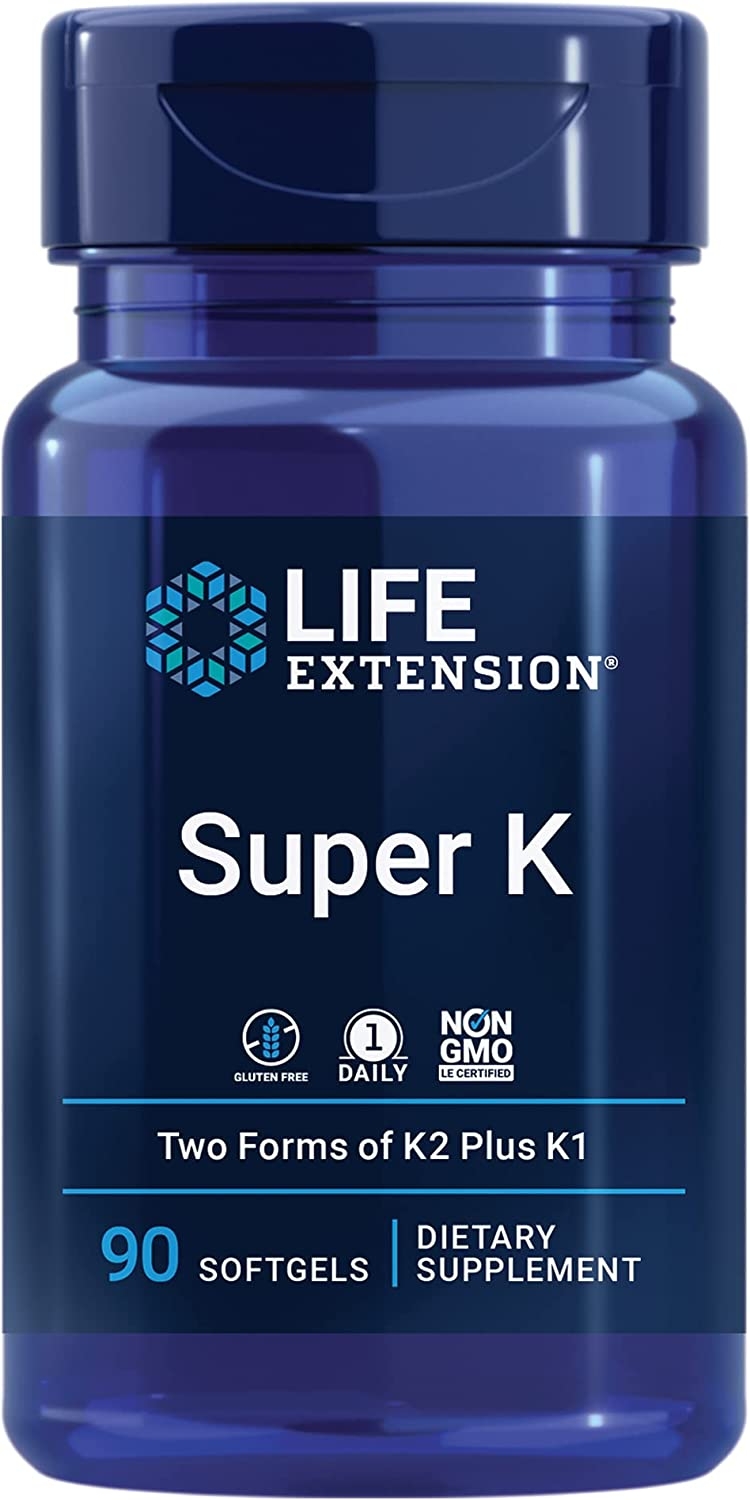
Life Extension Super K — 90 Softgels, Bone, Heart & Arterial Health Support
Each softgel provides 2,600 mcg of total vitamin K activity — 1,500 mcg K1 (phytonadione), 1,000 mcg MK-4 and 100 mcg MK-7 — plus 10 mg vitamin C as ascorbyl palmitate. Directions call for one softgel daily with food. Gluten-free and non-GMO, manufactured in the USA. Not a substitute for the calcium- and vitamin D-focused guidance NIAMS gives for bone health, and not appropriate alongside warfarin or similar anticoagulants without a physician's direct oversight.
Browse the full range in our Heart & Cardiovascular category.
Who might reasonably consider this, and who shouldn't
People with malabsorption conditions — cystic fibrosis, celiac disease, ulcerative colitis — or anyone post-bariatric surgery are the groups NIH specifically flags as being at higher risk of vitamin K deficiency, and are most likely to have a clinician-directed reason to supplement. Most otherwise healthy adults eating any regular amount of leafy greens meet the Adequate Intake from food alone, and the trial evidence above doesn't show this product's dose reliably outperforming the smaller amounts actually tested in research. Anyone with kidney or liver disease, or who is pregnant or breastfeeding, should check with a healthcare provider before adding a high-dose vitamin K supplement, given limited safety data at supplement-level doses in those groups.
Frequently asked questions
Does vitamin K actually strengthen bones?
The best current evidence — a 2024 meta-analysis of 17 randomized trials in 4,800 people — found vitamin K reliably activates a bone protein called osteocalcin, but that this didn't translate into a significant increase in bone density at the hip, femoral neck, or forearm. The one site that showed a small effect, the lumbar spine, lost statistical significance once a lower-quality study was removed from the analysis.
Does vitamin K prevent arterial calcification?
Partially, and inconsistently. A 2023 meta-analysis of 14 randomized trials found vitamin K slowed coronary artery calcification specifically and reliably improved a related blood biomarker, but found no appreciable benefit against vascular calcification measured more broadly. Several of the largest individual trials found no significant difference on calcification scans at all, even when blood markers improved.
Why does the product combine K1, MK-4, and MK-7 instead of just one form?
K1 is the form most tied to blood clotting, while the K2 subtypes MK-4 and MK-7 are the ones studied for bone and artery outcomes; MK-7 also stays active in the bloodstream far longer than MK-4. Combining them is a reasonable formulation choice. The label discloses the split: 1,500 mcg K1, 1,000 mcg MK-4 and 100 mcg MK-7. Worth noting that MK-7, the form behind most of the artery evidence, is the smallest part of the total, and at 100 mcg sits below the 180 to 400 mcg daily doses used in the MK-7 trials.
Is 2,600 mcg of vitamin K a lot?
Relative to the NIH's Adequate Intake, yes — about 22 times the amount set for adult men and 29 times the amount set for adult women. There's no established Tolerable Upper Intake Level for vitamin K, and NIH reports no documented toxicity from high intakes in healthy people. But the total is misleading on its own: 1,500 mcg of it is K1, while MK-7 — the form behind most of the artery evidence — is only 100 mcg, below the 180 to 400 mcg used in those trials. "No known upper limit" is not evidence that this particular mix outperforms what the research actually tested.
Can I take this if I'm on warfarin (Coumadin)?
Not without direct physician involvement. Vitamin K antagonizes warfarin and similar anticoagulants, and both the NIH and MedlinePlus warn that a change in intake — not the intake itself — is what raises the risk of dangerous bleeding or clotting. Starting or stopping a 2,600 mcg daily dose while on anticoagulant therapy needs to be managed with INR monitoring, not decided independently.
Who is most likely to actually benefit from a vitamin K supplement?
NIH identifies people with fat-malabsorption conditions — cystic fibrosis, celiac disease, ulcerative colitis — and those who've had bariatric surgery as the groups at meaningfully higher risk of vitamin K deficiency. Most otherwise healthy adults meet the Adequate Intake through diet, particularly leafy greens, without needing a supplement at all.
Sources
- NIH Office of Dietary Supplements — Vitamin K (Health Professional Fact Sheet)
- NIH Office of Dietary Supplements — Vitamin K (Consumer Fact Sheet)
- NIAMS — Osteoporosis
- PubMed Central — Effects of vitamin K supplementation on bone mineral density: a meta-analysis and systematic review of RCTs
- PubMed Central — Vitamin K supplementation and vascular calcification: a systematic review and meta-analysis of RCTs
- MedlinePlus — Warfarin (Coumadin) and diet
- U.S. Food and Drug Administration — Dietary Supplements
This article is educational and not a substitute for professional medical advice, diagnosis, or treatment. Consult a qualified healthcare provider before starting any supplement, especially if you are pregnant or breastfeeding, have kidney or liver disease, or take warfarin or another anticoagulant. These statements have not been evaluated by the Food and Drug Administration. This product is not intended to diagnose, treat, cure, or prevent any disease.