
Vitamin D (calciferol) is a fat-soluble vitamin the body needs to absorb calcium and build bone — and the NIH sets a Tolerable Upper Intake Level of 100 mcg (4,000 IU) of it a day for adults, the point past which the government's own nutrition scientists say the risk of harm starts to outweigh any benefit. A single softgel of one of this store's best-selling vitamin D3 products delivers 125 mcg (5,000 IU), 625% of the FDA Daily Value printed on its own label. That is not a labeling error or a fringe product; it is a widely sold, clearly labeled dose that sits a quarter above the ceiling the NIH itself set in 2010 — and the research on what that extra vitamin D actually buys you is far shakier than the marketing suggests.
Key Takeaways
- Adults need just 15–20 mcg (600–800 IU) of vitamin D a day, per the NIH Office of Dietary Supplements (updated 2025) — this product delivers 125 mcg (5,000 IU) per softgel, or 625% of the FDA Daily Value on its own label.
- The NIH's Tolerable Upper Intake Level for adults is 100 mcg (4,000 IU) a day; this product's single-softgel serving sits 25% above that limit (NIH ODS, 2025).
- A meta-analysis of 11 randomized controlled trials in 34,243 older adults found daily vitamin D supplementation gave no protection against fractures (cited in NIH ODS, 2025) — while a separate meta-analysis of 6 trials in 49,282 older adults found a modest benefit when vitamin D was combined with calcium.
- Large randomized trials found no reduction in cardiovascular disease risk from vitamin D supplementation, even in people who started with low blood levels (NIH ODS, 2025).
- Vitamin D deficiency clusters in specific groups — older adults, people with limited sun exposure, dark skin, obesity, or a fat-malabsorption condition — not the general population buying it off the shelf (NIH ODS, 2025).
In this article:
- What Is Vitamin D, and How Much Do You Actually Need?
- Does Vitamin D Actually Prevent Fractures, Heart Disease, or Depression?
- The NIH's Own Safety Limit — and Why This Product Sits Above It
- Who Is Actually at Risk of Vitamin D Inadequacy?
- Inside Sports Research Vitamin D3: What's Actually in the Softgel
- How to Use High-Dose Vitamin D Sensibly
- Frequently Asked Questions
What Is Vitamin D, and How Much Do You Actually Need?
Vitamin D (also called calciferol) is a fat-soluble vitamin the body needs for calcium absorption, bone mineralization, and roles in immune and neuromuscular function, according to the NIH Office of Dietary Supplements (ODS). Unusually, the body can make its own supply: UV light striking the skin triggers synthesis, which the liver and kidneys then convert into the active hormone form. It's also naturally present in fatty fish, egg yolks, and beef liver, and added to others, most notably fortified milk.
The amount the body actually needs is modest. The Food and Nutrition Board at the National Academies of Sciences, Engineering, and Medicine sets the Recommended Dietary Allowance (RDA) at 15 mcg (600 IU) a day for adults 19–70, rising to 20 mcg (800 IU) after 70, per NIH ODS (updated June 2025).
| Life stage | RDA (mcg/day) | RDA (IU/day) |
|---|---|---|
| Infants, 0–12 months | 10 mcg* | 400 IU* |
| Children & adolescents, 1–18 years | 15 mcg | 600 IU |
| Adults, 19–70 years | 15 mcg | 600 IU |
| Adults, 71+ years | 20 mcg | 800 IU |
| Pregnancy & lactation | 15 mcg | 600 IU |
*Adequate Intake, not RDA — there isn't enough data in infants to set a full RDA.
Vitamin D status is usually assessed by measuring serum 25-hydroxyvitamin D, or 25(OH)D. Per the Food and Nutrition Board's reference ranges (NIH ODS): below 30 nmol/L (12 ng/mL) is deficient; 30–50 nmol/L (12–20 ng/mL) is inadequate for most people; 50 nmol/L (20 ng/mL) or above is adequate; and above 125 nmol/L (50 ng/mL) is linked to potential adverse effects. The Endocrine Society does not recommend routine 25(OH)D testing in healthy adults with no specific risk factor.
Does Vitamin D Actually Prevent Fractures, Heart Disease, or Depression?
Vitamin D's role in bone health is genuine at physiological doses — it's required for calcium absorption, and severe deficiency causes rickets in children and osteomalacia in adults. What's far less settled is whether supplementing beyond an adequate intake changes outcomes in people who aren't deficient, and the trial evidence is genuinely mixed.
| Outcome | Trial evidence |
|---|---|
| Fractures (11 trials, vitamin D alone) | No fracture protection in 34,243 older adults, 9 months–5 years |
| Fractures (6 trials, vitamin D + calcium) | 6% fewer fractures, 16% fewer hip fractures in 49,282 older adults |
| Falls | USPSTF: no reduction in falls or fall injuries in adults 65+ |
| Cardiovascular disease | No reduction in CVD risk, even at low baseline 25(OH)D |
| Depression | No benefit for depressive symptoms in most trials |
That fracture comparison is worth sitting with: one meta-analysis of vitamin D taken alone found nothing, while another found a modest benefit — but only when vitamin D was paired with calcium, not from vitamin D by itself. Most positive trials in older adults combined the two nutrients, making it hard to credit vitamin D alone for the improvement. NIH ODS is candid that different doses, schedules, and populations across trials make isolating vitamin D's individual contribution genuinely difficult.
Mayo Clinic on how much vitamin D people actually need, and why more is not automatically better.
Large trials in cancer, multiple sclerosis, and type 2 diabetes tell a similar story: individual studies sometimes show a signal, but systematic reviews of the full trial record generally do not find that vitamin D supplements prevent these conditions in people who are not deficient. None of this means vitamin D is unimportant — it means the claim on many bottles, that more vitamin D straightforwardly protects against disease, outruns what the randomized evidence shows.
The NIH's Own Safety Limit — and Why This Product Sits Above It
Unlike biotin or B12, vitamin D has an established Tolerable Upper Intake Level (UL) — the Food and Nutrition Board set one in 2010 because, unlike those water-soluble vitamins, excess vitamin D is fat-soluble, accumulates in tissue, and has a documented toxicity syndrome. For everyone age 9 and up, the UL is 100 mcg (4,000 IU) a day, per NIH ODS.
| This product | Typical shelf dose | NIH RDA (adult) | Tolerable Upper Limit | |
|---|---|---|---|---|
| Vitamin D3 | 125 mcg (5,000 IU) per softgel | 25–125 mcg (1,000–5,000 IU), by product | 15–20 mcg (600–800 IU) | 100 mcg (4,000 IU) |
At one softgel a day as directed, this product delivers 6.3–8.3 times the adult RDA depending on age, and about 25% more than the NIH's own Tolerable Upper Intake Level — before counting any vitamin D from food, fortified milk, sun exposure, or another supplement in the same daily routine.
"While acknowledging that signs and symptoms of toxicity are unlikely at daily intakes below 250 mcg (10,000 IU), the FNB noted that even vitamin D intakes lower than the ULs might have adverse health effects over time."
— NIH Office of Dietary Supplements, Vitamin D Fact Sheet for Health Professionals, updated 2025That is a more nuanced warning than a simple toxicity threshold: the UL is not a bright line where safety ends and danger begins, but a level set with a margin of caution, and even intakes below it could carry effects that only show up with sustained use. True vitamin D toxicity (hypervitaminosis D) is uncommon and generally requires very high, sustained intakes, but when it happens the mechanism is hypercalcemia — too much calcium in the blood, causing nausea, vomiting, weakness, and frequent urination, and in severe cases, kidney stones or kidney damage.
Genuine safety warning: This product's labeled serving already sits above the NIH's Tolerable Upper Intake Level for adults. If you also take a calcium supplement, a multivitamin containing vitamin D, or a thiazide diuretic (a common blood-pressure medication), the combination raises your hypercalcemia risk — NIH ODS notes that thiazide diuretics reduce the kidneys' calcium excretion, and pairing them with vitamin D "might lead to hypercalcemia, especially among older adults and individuals with compromised renal function or hyperparathyroidism." Add up every source of vitamin D and calcium in your routine before starting a 5,000 IU product, and check with your doctor if you take a thiazide diuretic or have kidney disease, kidney stones, or a history of hypercalcemia.
Who Is Actually at Risk of Vitamin D Inadequacy?
Vitamin D inadequacy is real and reasonably common — unlike, say, biotin deficiency — but per NIH ODS it clusters in identifiable groups rather than being evenly spread across the population:
| Group | Why |
|---|---|
| Breastfed infants | Human milk alone generally doesn't supply enough; AAP recommends a supplement |
| Older adults | Skin's synthesis capacity declines with age; more time spent indoors |
| People with limited sun exposure | Homebound, skin-covering, or northern-latitude winters mean less UV synthesis |
| People with dark skin | Higher melanin reduces vitamin D synthesis from a given UV dose |
| Fat-malabsorption conditions | Crohn's, celiac disease, and cystic fibrosis reduce absorption of this fat-soluble vitamin |
| Obesity or gastric bypass history | Vitamin D is sequestered in fat tissue; bypass surgery also reduces absorption |
If you fall into one of these groups, a blood test and a conversation with your doctor is the right next step — not a self-selected megadose. For everyone else, routine sun exposure and an ordinary diet with fortified foods often already cover the RDA.
Inside Sports Research Vitamin D3: What's Actually in the Softgel
This is a 360-count bottle of softgels, each delivering 125 mcg (5,000 IU) of vitamin D3 (cholecalciferol) suspended in coconut MCT oil, taken one per day with food — a full 12-month supply at the labeled serving. The softgel shell is gelatin, vegetable glycerin, and purified water; there is no separate filler ingredient beyond the oil carrier. The product is IGEN non-GMO tested and labeled gluten-free.
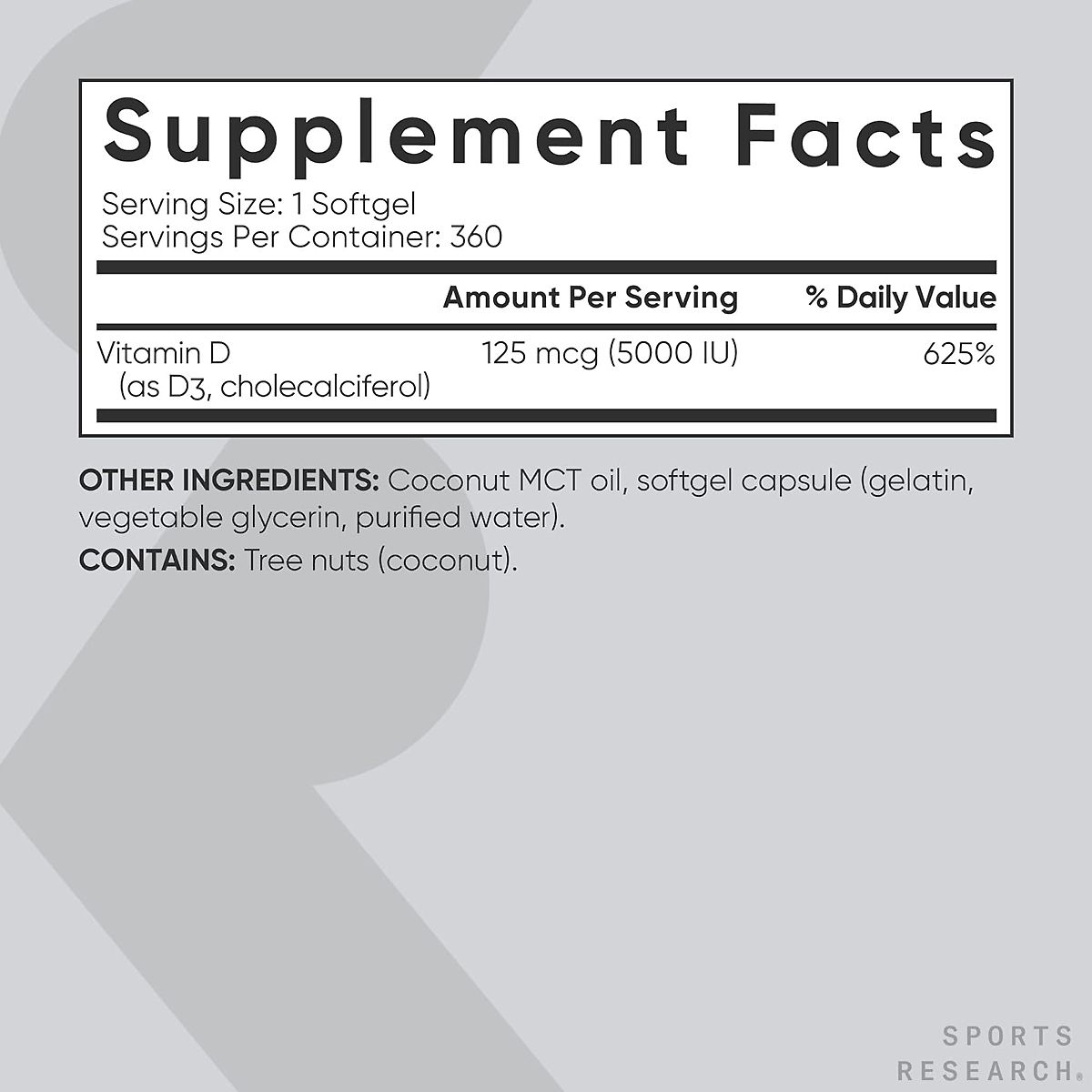
The coconut MCT oil carrier is a legitimate absorption choice, not filler: because vitamin D is fat-soluble, suspending it in a dietary fat can help it absorb even when a meal is light on fat. What that carrier doesn't change is the dose itself — 125 mcg is still 25% above the adult Tolerable Upper Intake Level regardless of how well it's absorbed.
Who this is for: Adults with a documented risk factor for inadequacy — limited sun exposure, darker skin, obesity, a malabsorption condition, or older age — especially with a blood test confirming a low 25(OH)D level and a clinician-recommended repletion dose in this range.
Who should skip it: Most people with some regular sun exposure and fortified foods in their diet likely already meet the 15–20 mcg (600–800 IU) RDA without a supplement this strong. Anyone taking a calcium supplement, a multivitamin with vitamin D, or a thiazide diuretic should total their intake first. It also contains coconut, which FDA labeling treats as a tree nut — skip it if you have a tree-nut allergy.
Framed honestly: this is a well-labeled product from an established manufacturer, and the 625% Daily Value figure is printed on the bottle itself, not hidden. What it is not is a dose most people need.
How to Use High-Dose Vitamin D Sensibly
None of the above means this product is dangerous when used as intended by someone who actually needs it. NIH ODS notes that toxicity symptoms are unlikely below 250 mcg (10,000 IU) a day, well above this product's 125 mcg serving. The realistic concern is cumulative: taking 25% above the UL every day, indefinitely, on top of whatever vitamin D you already get from food, fortification, and sun exposure.
- If you have no diagnosed risk factor, check what you're already getting from fortified milk, fatty fish, and sun exposure first — a lower-dose option from our vitamins category may fit routine maintenance better.
- If a clinician recommended a high-dose product like this one to correct a documented deficiency, follow their specific dosing and duration — repletion is often meant to be temporary, not permanent.
- Add up every source of vitamin D and calcium in your routine before starting this product, and tell your doctor if you take a thiazide diuretic or have kidney disease, kidney stones, or hypercalcemia.
- Stop and consult a doctor if you experience nausea, vomiting, weakness, or unusual thirst or urination.
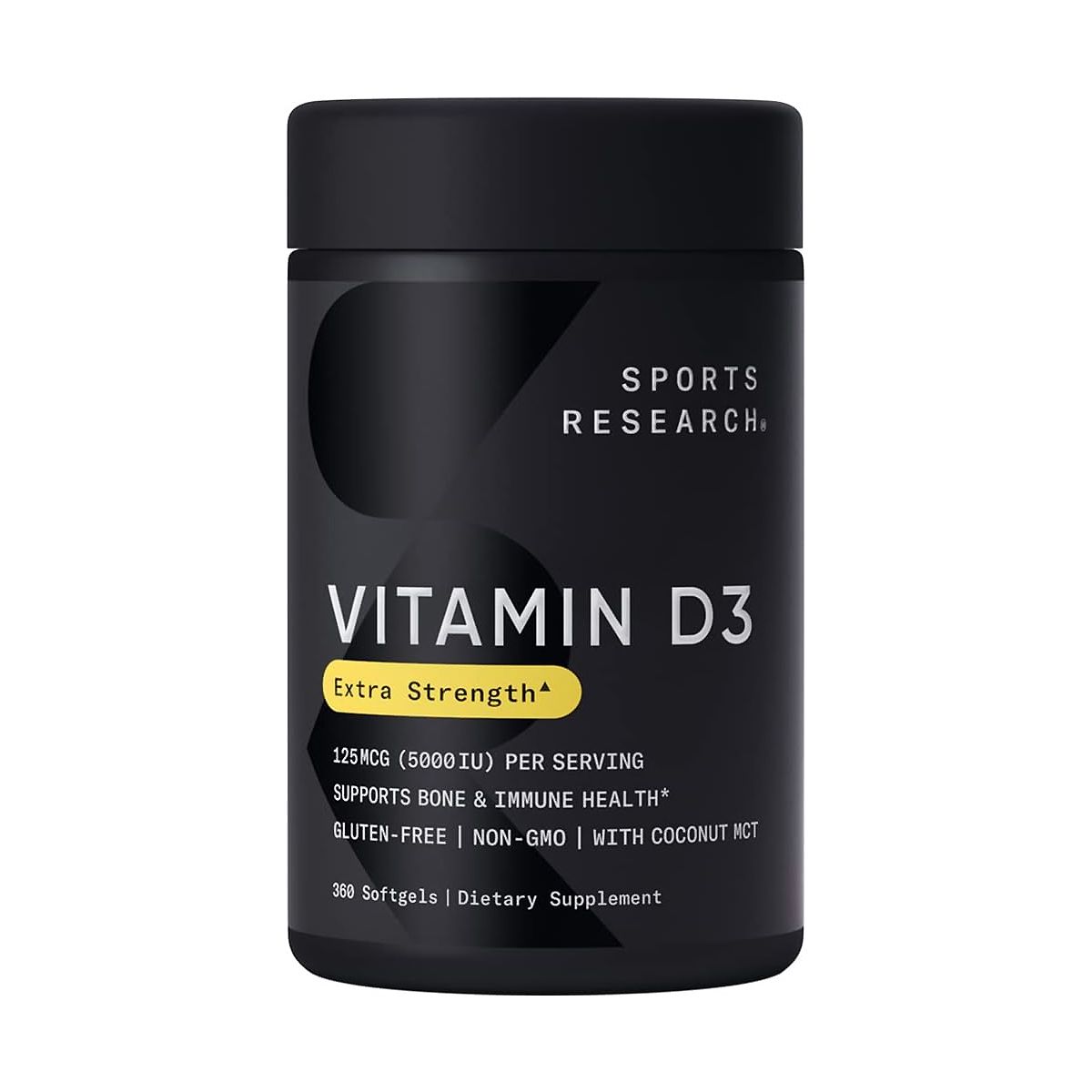
Sports Research High Potency Vitamin D3 — 360 Coconut MCT Softgels
125 mcg (5,000 IU) of vitamin D3 per softgel, suspended in coconut MCT oil for absorption, one softgel daily with food. A 12-month supply at the labeled serving; IGEN non-GMO tested and gluten-free. As covered above, this dose sits above the NIH's adult Upper Intake Level, so it suits someone correcting a documented deficiency more than routine daily use.
View Product DetailsFrequently Asked Questions
How much vitamin D do adults actually need per day?
The NIH sets the RDA at 15 mcg (600 IU) a day for adults 19–70, rising to 20 mcg (800 IU) after age 70. Most adults with regular sun exposure and fortified foods in their diet can meet this without a supplement.
What is vitamin D's Tolerable Upper Intake Level, and does this product exceed it?
The NIH's Tolerable Upper Intake Level for adults is 100 mcg (4,000 IU) a day. This product's labeled single-softgel serving is 125 mcg (5,000 IU), about 25% above that limit, before counting any other source of vitamin D in your diet.
Does vitamin D actually prevent fractures or heart disease?
The evidence is mixed. A meta-analysis of 11 trials in 34,243 older adults found vitamin D alone gave no fracture protection, while a separate meta-analysis of 6 trials in 49,282 older adults found a modest benefit when combined with calcium. Large trials found no reduction in cardiovascular disease risk.
Who is actually at risk of vitamin D inadequacy?
Breastfed infants, older adults, people with limited sun exposure or dark skin, and people with obesity or a fat-malabsorption condition such as Crohn's disease are the documented risk groups, per the NIH. The general population with regular sun exposure isn't automatically at risk.
Is 5,000 IU of vitamin D a day safe to take long-term?
Acute toxicity is unlikely below 250 mcg (10,000 IU) a day, but the NIH's Food and Nutrition Board notes that intakes above the 100 mcg (4,000 IU) Upper Intake Level may still carry adverse effects over time. This dose suits someone correcting a diagnosed deficiency under medical guidance more than indefinite daily use.
What's the difference between vitamin D2 and D3?
D2 (ergocalciferol) is typically plant- or fungus-derived, while D3 (cholecalciferol), the form in this product, is what the body makes from sunlight and is generally more effective at raising blood 25(OH)D levels. Both are well absorbed in the small intestine.
Can I get too much vitamin D from sunlight alone?
Almost certainly not. NIH ODS says experts do not believe excessive sun exposure causes vitamin D toxicity, because heat activation in the skin diverts the surplus into inactive, non-vitamin-D forms. Toxicity is almost always caused by supplements instead. One caveat: NIH notes that frequent tanning-bed use can push blood 25(OH)D well above 375 nmol/L (150 ng/mL).
Should I get a blood test before taking a high-dose vitamin D supplement?
The Endocrine Society doesn't recommend routine 25(OH)D testing for healthy adults with no specific risk factor. If you have a documented risk factor, or you're considering a dose that exceeds the Upper Intake Level like this one, a blood test and a talk with your doctor is a reasonable step first.
Sources
- NIH Office of Dietary Supplements — Vitamin D, Health Professional Fact Sheet. Updated 27 June 2025. Accessed 25 August 2026.
- NIH Office of Dietary Supplements — Vitamin D, Consumer Fact Sheet. Accessed 25 August 2026.
- MedlinePlus — Vitamin D. U.S. National Library of Medicine. Last updated 10 May 2024. Accessed 25 August 2026.
- FDA — Dietary Supplements. U.S. Food and Drug Administration. Content current as of 1 October 2024. Accessed 25 August 2026.
This article is for educational purposes only and is not medical advice. It is not intended to diagnose, treat, cure, or prevent any disease. These statements have not been evaluated by the Food and Drug Administration. Talk to your doctor before starting any new supplement, especially a high-dose vitamin D product, if you are pregnant, breastfeeding, take a thiazide diuretic or corticosteroid, or have kidney disease or a history of kidney stones or hypercalcemia.