
A supplement aisle staple long before "immune support" became its own category, elderberry now often ships inside a capsule that also delivers 625% of the daily value for vitamin D3 — a quarter more than the total daily intake health authorities consider safe from all sources combined. Elderberry (Sambucus nigra) is the dark purple fruit of the European elder tree, used in folk medicine for centuries and, since the 1990s, sold as a standardized extract for cold and flu season. The berry has a real, if modest, trial record; the vitamin D dose stacked next to it does not need one, because a supplement doesn't need proven benefit to clear a real safety ceiling — and a 2022 case report has separately linked years of elderberry use to a rare autoimmune liver injury.
Key Takeaways
- A 312-person randomized, placebo-controlled trial found elderberry cut cold duration by about two days — 4.75 days versus 6.88 for placebo, a 31% reduction (Tiralongo et al., Nutrients, 2016).
- A 2021 systematic review pooling 5 randomized trials (883 participants analysed) rated the evidence "low or very low" certainty, and found no evidence elderberry overstimulates the immune system (Wieland et al., BMC Complementary Medicine and Therapies, 2021).
- Raw or unripe elderberries contain cyanide-producing compounds that cause nausea, vomiting and severe diarrhea; cooking or processing into a standardized extract eliminates the risk (NCCIH, updated 2024).
- A documented case report links years of elderberry supplement use to autoimmune hepatitis in a woman with a pre-existing thyroid autoimmune condition, which resolved after she stopped the supplement and completed a four-week course of prednisone (Cureus case report, 2022).
- The featured product's 5,000 IU vitamin D3 dose sits 25% above the 4,000 IU adult upper limit recognized by Harvard's T.H. Chan School of Public Health — from one ingredient, in one capsule, before counting anything else in a person's diet (reviewed 2023).
In This Article
- What Is Elderberry, and Why Is It in Every Immune Supplement Now?
- Does Elderberry Actually Shorten a Cold or the Flu?
- The Toxicity Question: Raw Berries, Cyanide, and What "Extract" Fixes
- The Autoimmune Warning Rarely Printed on the Label
- Who Elderberry Actually Helps — and Who Should Skip It
- Inside Sports Research Elderberry Zinc & Vitamin C 5-in-1: What's Actually in the Capsule
- How to Use It Sensibly
- FAQ
What Is Elderberry, and Why Is It in Every Immune Supplement Now?
Sambucus nigra, the European black elder, produces small dark berries rich in anthocyanins — the same antioxidant pigment class that colors blueberries and blackberries. Elderberry syrup has a folk-medicine history stretching back to ancient Egypt and Greece, but its modern retail life began with a small Israeli trial in the 1990s and accelerated hard through the immune-support boom — US elderberry supplement sales nearly doubled between 2017 and 2018, before the pandemic added to them (Wieland et al., 2021). NCCIH notes elderberry is promoted today for "colds, flu, and other conditions," and, during the pandemic, for COVID-19 specifically — though, in NCCIH's words, "there is no good evidence to support its use" for that purpose (NCCIH, updated 2024).
That gap between marketing and evidence defines this category. Elderberry is not a vitamin or mineral with an established Recommended Dietary Allowance; it's an herbal extract, and the research behind it, while real, is thinner than most shoppers assume.
Does Elderberry Actually Shorten a Cold or the Flu?
The best single piece of evidence is a 2016 randomized, double-blind, placebo-controlled trial out of Griffith University, Australia. Researchers randomised 312 economy-class passengers on long-haul flights to a standardized elderberry extract or a placebo — long-haul air travel is a recognised risk window for respiratory infection, which makes it a useful natural experiment. Only 29 of the 312 actually developed a well-defined cold, and elderberry did not significantly reduce how many did. Those who caught one anyway recovered faster on elderberry: 4.75 illness days versus 6.88 on placebo (p = 0.05), and a symptom-severity score of 247 versus 583 (p = 0.02) (Tiralongo et al., Nutrients, 2016). Five participants reported adverse events, but researchers found no causal link to the extract.
| Study | Design | Participants | Result |
|---|---|---|---|
| Tiralongo et al., 2016 | Randomized, double-blind, placebo-controlled (air travelers) | 312 | Cold duration 4.75 vs. 6.88 days (p=0.05); symptom score 247 vs. 583 (p=0.02) |
| Wieland et al. systematic review, 2021 | 5 randomized trials, GRADE-assessed | 883 | Low/very-low certainty evidence of shorter, milder colds; 2 of the 3 influenza trials pooled (87 participants) showed illness ~2.7 days shorter, but with very high inconsistency (I² = 94%) |
A 2021 systematic review in BMC Complementary Medicine and Therapies pooled five randomized trials (883 participants analysed) on the prevention and treatment of viral respiratory illness — one cold-prevention trial, three influenza-treatment trials, and one pitting an echinacea-and-elderberry product against the antiviral oseltamivir. Its verdict was more cautious than most bottle marketing: elderberry did not significantly reduce how often people caught a cold, but among those who did, it may shorten duration and ease severity. Pooling two of the three influenza trials (87 participants) put illness roughly 2.7 days shorter on elderberry — though those two studies disagreed so sharply with each other (I² = 94%) that the authors called the estimate very uncertain. They rated certainty "low or very low" for every elderberry-versus-placebo treatment estimate — the standard caveat for small trials with inconsistent designs (Wieland et al., 2021).
NutritionFacts.org reviews the same trial evidence covered above, including where the studies fall short of proving elderberry works for everyone.
The review also addresses the pandemic-era fear that elderberry could worsen a COVID-19 "cytokine storm": it found no evidence elderberry overstimulates the immune system — though that rests on just three small studies in 51 people, measuring cytokines in the lab rather than any clinical outcome. The reassurance also sits alongside a narrower warning, covered next, for people whose immune systems already misfire against their own tissue.
"Some preliminary research suggests that elderberry may relieve symptoms of flu, colds, or other upper respiratory infections."
— NCCIH, Elderberry, updated 2024
The Toxicity Question: Raw Berries, Cyanide, and What "Extract" Fixes
The one elderberry safety fact every source agrees on has nothing to do with capsules. Raw or unripe elderberries, plus the plant's leaves, bark and stems, contain cyanogenic glycosides — compounds that release cyanide when metabolized. NCCIH is direct: "large quantities of the toxin may cause serious illness," with nausea, vomiting and severe diarrhea the typical presentation from raw fruit or unstrained, uncooked juice (NCCIH, updated 2024). Cooking destroys the toxin, which is why every traditional preparation — syrup, jam, wine — involves heat, and why commercial extracts start from processed, standardized fruit rather than raw berries.
Safety warning: Never eat raw or unripe elderberries, and never let children pick and eat them fresh from a garden or hedge — a common late-summer poison-control call. Commercial extract supplements, correctly manufactured, do not carry this specific risk; homemade syrup from foraged, uncooked berries does.
The Autoimmune Warning Rarely Printed on the Label
Separate from raw-berry toxicity is a subtler, newer safety signal: elderberry's effect on the immune system itself. Laboratory studies find elderberry extract stimulates monocytes to produce inflammatory cytokines, including IL-1β, TNF-α, IL-6 and IL-8 — plausibly part of how it helps fight a cold. It's also the mechanism a 2022 case report in Cureus points to in describing a 60-year-old woman with pre-existing Hashimoto's thyroiditis who developed autoimmune hepatitis after years of elderberry use — jaundice, severely elevated liver enzymes, and a biopsy showing the lymphocyte infiltrate characteristic of the condition. Her liver function normalized within four weeks of stopping the supplement and starting prednisone.
"Exposure to elderberry could be responsible for either the initiation or progression of autoimmune liver disease in the setting of genetic predisposition and molecular mimicry."
— Case report authors, Cureus, 2022
This is one case report, not a population-level finding, and the systematic review above found no broader signal of harm. But the mechanism is coherent enough that it changes the calculus for anyone with an existing autoimmune diagnosis — a group addressed directly next.
Who Elderberry Actually Helps — and Who Should Skip It
The strongest trial studied a specific, exposure-heavy scenario: air travelers on long-haul economy flights, reliably exposed to recirculated air and a higher-than-average chance of catching something. That's the closest real-world match to "this will probably help" — travel, a crowded conference, or a school term with young kids bringing colds home.
Who this is for: Adults without autoimmune disease who want a short-course immune supplement ahead of a specific high-exposure period — travel, conference season, a household with young kids in daycare — and who aren't already taking a separate vitamin D supplement.
Who should skip it: Anyone with lupus, rheumatoid arthritis, multiple sclerosis, Hashimoto's or another autoimmune condition, or on immunosuppressant therapy, given the cytokine-stimulation signal above. Pregnant or breastfeeding people, since NCCIH says safety data here simply doesn't exist. Anyone already taking a separate vitamin D product, given the dose math ahead. And, honestly, most healthy adults not heading into unusual exposure — a year-round immune stack isn't what the trial evidence supports.
Inside Sports Research Elderberry Zinc & Vitamin C 5-in-1: What's Actually in the Capsule
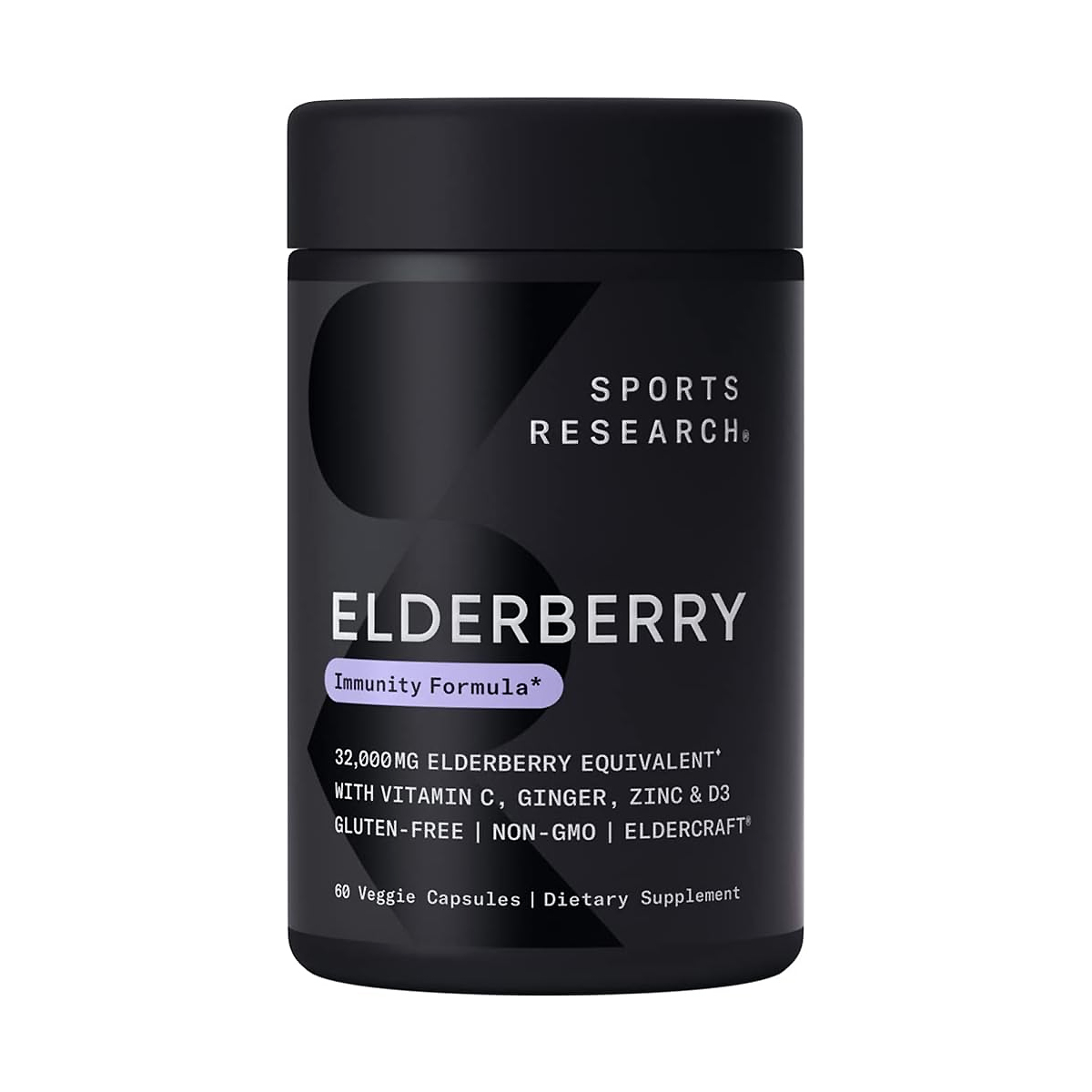
Sports Research's Elderberry Zinc & Vitamin C 5-in-1 ($25.47, 60 veggie capsules) packs five actives into a two-capsule daily serving: 500 mg of Organic European Black Elderberry Extract (a 64:1 concentrate, equivalent to 32,000 mg of fresh elderberries, branded ElderCraft®), 200 mg ginger extract, 400 mg vitamin C, 125 mcg (5,000 IU) vitamin D3, and 15 mg zinc as zinc picolinate. It is Non-GMO Project Verified, gluten-free and third-party tested.
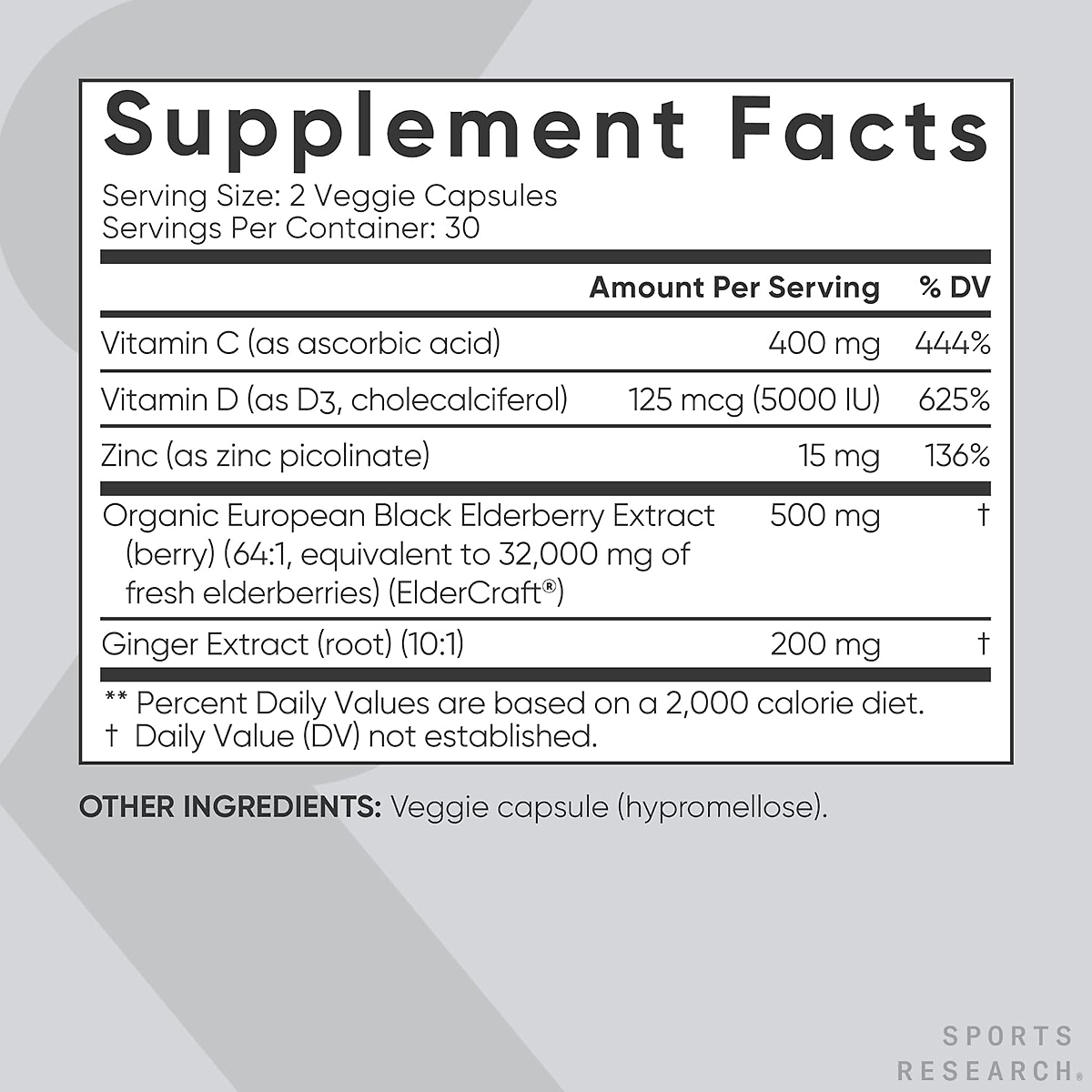
Three of the four measurable nutrients here have an established NIH-recognized reference range; the elderberry does not, because it's an herb rather than an essential nutrient.
| This product (2 capsules) | Adult RDA | Tolerable Upper Limit | |
|---|---|---|---|
| Black Elderberry Extract | 500 mg (≈32,000 mg fresh berries) | None established | None established — no standardized UL exists for elderberry extract; the toxicity data above concerns raw, unprocessed fruit, not this form |
| Vitamin C | 400 mg | 90 mg (men) / 75 mg (women) | 2,000 mg |
| Vitamin D3 | 125 mcg (5,000 IU) | 15–20 mcg (600–800 IU) | 100 mcg (4,000 IU) |
| Zinc | 15 mg | 11 mg (men) / 8 mg (women) | 40 mg |
The vitamin C and zinc doses are generous multiples of the RDA — roughly 4–5 times and 35–90% over it — but both land comfortably under their upper limits. The vitamin D3 dose does not: 5,000 IU is 25% above the 4,000 IU adult ceiling Harvard's Nutrition Source lists, before adding any vitamin D from sunlight, food or a separate multivitamin. Toxicity itself is uncommon below 10,000 IU/day per MedlinePlus, so one bottle isn't a medical emergency — but stacking it with another D-containing supplement is the realistic way people cross into symptomatic territory (constipation, fatigue, elevated blood calcium), and the label carries no warning against doing exactly that. Harvard's guidance on this is explicit: do not take daily vitamin D supplements above 4,000 IU "unless monitored under the supervision of your doctor" (Harvard T.H. Chan School of Public Health, reviewed 2023). This product clears that threshold on its own, at the labelled serving, which makes it one to raise with a clinician before starting rather than one to add to an existing routine unsupervised.
A second, plainer problem: the store's own product description tells shoppers "one capsule daily" is enough and calls the bottle "a 2-month supply." The manufacturer's actual Supplement Facts panel lists the serving size as two capsules, 30 servings per container — a one-month supply, not two. Taking one capsule a day, as the store copy suggests, delivers half the studied elderberry amount (250 mg instead of 500 mg) and half of everything else on the label. The label is the correct authority here, and we're flagging the mismatch rather than matching the article to the more flattering number.
Sports Research Elderberry Zinc & Vitamin C 5-in-1 (60 Capsules)
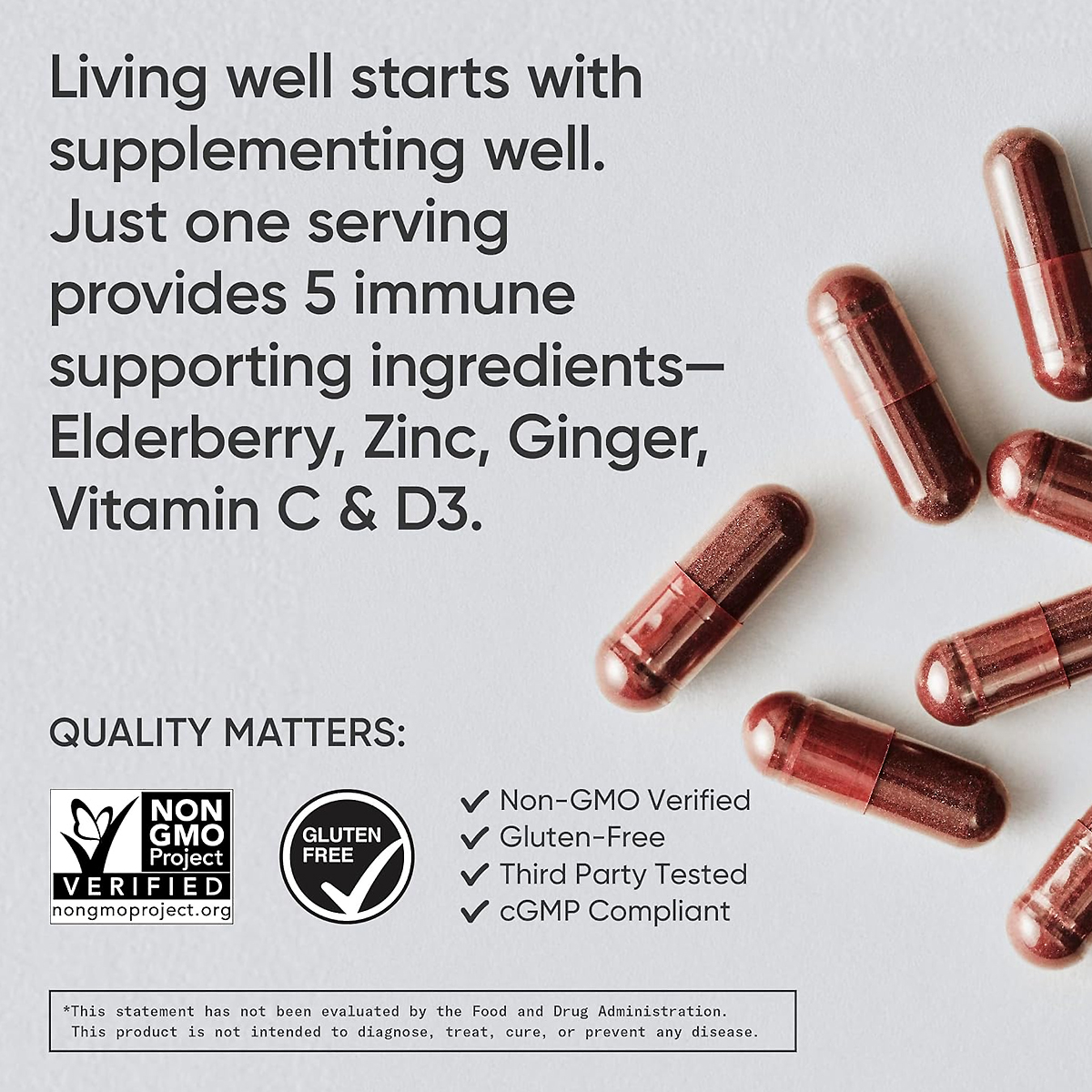
A concentrated ElderCraft® elderberry extract (500 mg per two-capsule serving, 64:1 ratio) paired with ginger, vitamin C, vitamin D3 and zinc. Non-GMO, gluten-free, third-party tested. Take the labeled two-capsule serving — not the store description's one-capsule suggestion — skip any separate vitamin D supplement while using it, and clear the 5,000 IU vitamin D3 dose with a clinician first, since it exceeds the 4,000 IU adult upper limit on its own.
View Product DetailsHow to Use It Sensibly
Take it as the label directs — two capsules daily with food, not the store listing's one-capsule suggestion — and treat it as a short-course tool for a specific high-exposure window, not a year-round supplement. Because the 5,000 IU vitamin D3 dose already exceeds the 4,000 IU adult upper limit on its own, don't add a separate vitamin D product on top of it, and tally your total if you also take a standalone zinc supplement. If you're pregnant, breastfeeding, have an autoimmune condition, or take prescription medication — especially immunosuppressants — talk to a clinician before starting. If a cold or flu doesn't improve within a week, or comes with a high fever or breathing trouble, see a healthcare provider rather than taking another dose. More options are browsable in our immune support collection.
FAQ
What is elderberry?
Elderberry is the dark purple fruit of the European elder tree (Sambucus nigra), traditionally cooked into syrup and now sold as a standardized extract. It's rich in anthocyanin antioxidants and has a modest, real trial record for shortening colds — though it's an herbal supplement, not an essential vitamin or mineral (NCCIH, 2024).
Does elderberry actually shorten a cold or the flu?
The best available trial (312 air travelers) found elderberry cut average cold duration from 6.88 to 4.75 days and roughly halved symptom severity scores. A 2021 review of five trials rated the overall evidence "low to very low" certainty — real, but not conclusive (Tiralongo et al., 2016; Wieland et al., 2021).
How much elderberry extract did the studies use?
The 2016 air-traveler trial used 600 mg of standardized extract daily before travel, rising to 900 mg during travel days. This product's labeled two-capsule serving provides 500 mg — the same order of magnitude, but below the 600 to 900 mg the trial actually used.
Can you eat elderberries raw?
No. Raw or unripe elderberries, plus the plant's leaves and stems, contain cyanide-producing compounds that cause nausea, vomiting and severe diarrhea. Cooking destroys the toxin, which is why every traditional preparation involves heat (NCCIH, 2024).
Does elderberry help against COVID-19?
No good evidence supports this. NCCIH states elderberry "has also been promoted for COVID-19, but there is no good evidence to support its use" for that purpose — distinct from its more modest cold-and-flu record (NCCIH, updated 2024).
Is elderberry safe if you have an autoimmune disease?
That's the biggest open question. Elderberry stimulates inflammatory cytokine production, and a 2022 case report links years of use to autoimmune hepatitis in a woman with pre-existing thyroid disease. It's not proof of broad harm, but the case authors argue it is reason enough to use elderberry judiciously in anyone with an autoimmune condition or a predisposition to one.
Does elderberry interact with medications?
NCCIH advises talking to a healthcare provider before combining elderberry with any medication, since "some herbs and medicines interact in harmful ways" — general guidance, since elderberry-specific interaction research is limited (NCCIH, 2024).
Does this product's serving size match its own directions?
No, and that's worth knowing before you buy. The manufacturer's Supplement Facts panel lists a two-capsule serving (30 servings per 60-capsule bottle), but the store's product description says to take one capsule daily and calls it a two-month supply. Follow the label's two-capsule serving, which is what the featured clinical trial's dosing actually resembles.
Sources
- National Center for Complementary and Integrative Health. "Elderberry." Updated 2024. Accessed 5 September 2026. nccih.nih.gov/health/elderberry
- Tiralongo E, Wee SS, Lea RA. "Elderberry Supplementation Reduces Cold Duration and Symptoms in Air-Travellers: A Randomized, Double-Blind Placebo-Controlled Clinical Trial." Nutrients. 2016;8(4):182. Published 24 March 2016. Accessed 5 September 2026. pmc.ncbi.nlm.nih.gov/articles/PMC4848651
- Wieland LS, et al. "Elderberry for prevention and treatment of viral respiratory illnesses: a systematic review." BMC Complementary Medicine and Therapies. 2021. Accessed 5 September 2026. pmc.ncbi.nlm.nih.gov/articles/PMC8026097
- Case report authors. "A Plausible Association Between the Use of Elderberry and Autoimmune Hepatitis." Cureus. Published April 2022. Accessed 5 September 2026. pmc.ncbi.nlm.nih.gov/articles/PMC9116981
- MedlinePlus (National Library of Medicine). "Hypervitaminosis D." Reviewed 19 October 2025. Accessed 5 September 2026. medlineplus.gov/ency/article/001594.htm
- MedlinePlus (National Library of Medicine). "Vitamin C and colds." Reviewed 14 January 2026. Accessed 5 September 2026. medlineplus.gov/ency/article/002145.htm
- Harvard T.H. Chan School of Public Health. "Vitamin C." The Nutrition Source. Reviewed March 2023. Accessed 5 September 2026. nutritionsource.hsph.harvard.edu/vitamin-c
- Harvard T.H. Chan School of Public Health. "Vitamin D." The Nutrition Source. Reviewed March 2023. Accessed 5 September 2026. nutritionsource.hsph.harvard.edu/vitamin-d
- Harvard T.H. Chan School of Public Health. "Zinc." The Nutrition Source. Updated September 2025 (page carries no published review date; date from page metadata). Accessed 5 September 2026. nutritionsource.hsph.harvard.edu/zinc
- U.S. Food and Drug Administration. "Dietary Supplements." Accessed 5 September 2026. fda.gov/food/dietary-supplements
This article is for educational purposes only and is not medical advice. These statements have not been evaluated by the Food and Drug Administration. This product is not intended to diagnose, treat, cure, or prevent any disease. Talk to a healthcare provider before starting any new supplement, especially if you are pregnant, breastfeeding, have an autoimmune condition, or take prescription medication.