
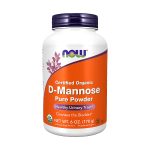
The front of this D-mannose tub says it "Cleanses the Bladder," yet the largest placebo-controlled trial of D-mannose to date (598 women, JAMA Internal Medicine, April 2024) found that 51.0% of women taking it still had a medically attended urinary tract infection within six months, against 55.7% on placebo. D-mannose is a simple sugar found in some fruits and vegetables and in normal human metabolism, sold on the theory that it stops the bacteria behind urinary tract infections (UTIs) from sticking to the bladder wall. The theory is plausible; what the trials show is a different matter.
Key Takeaways
- In the 598-woman MERIT trial, 2 g of D-mannose daily for 6 months gave 51.0% of women a medically attended UTI versus 55.7% on placebo (risk difference −5%, 95% CI −13% to 3%, P = .26) (JAMA Intern Med, 2024).
- A Cochrane review of 7 trials and 719 people (to February 2022) could not pool the data and rated the evidence very low certainty (Cochrane, 2022).
- A 2025 meta-analysis of 6 trials and 1,167 participants found a relative risk of 0.57 against control, but its 95% confidence interval (0.29 to 1.15) includes no effect (J Bras Nefrol, 2025).
- For an infection already under way, NIDDK says a clinician will likely prescribe antibiotics (NIDDK, reviewed April 2024).
- This product gives 2 g (2,000 mg) per level teaspoon; its label allows up to twice the daily dose tested in MERIT (product label).
In this article:
- What Is D-Mannose, and Why Would It Stop an Infection?
- The Largest Trial: 598 Women, a Placebo, No Clear Difference
- The Wider Evidence: Cochrane and a 2025 Meta-Analysis
- An Infection That Has Already Started Is a Different Question
- What Health Authorities List for Prevention
- Inside NOW Certified Organic D-Mannose Powder
- Who Might Consider It, and Who Should Skip It
- Frequently Asked Questions
What Is D-Mannose, and Why Would It Stop an Infection?
UTIs are common. According to the UK's NIHR Evidence service (February 2025), about 1 in 2 women will have a UTI in their lifetime and about 1 in 4 of those go on to have recurrent ones (2 in 6 months or 3 in a year). The NIH's National Institute of Diabetes and Digestive and Kidney Diseases (NIDDK, reviewed April 2024) says bladder infections are most often caused by bacteria.
The D-mannose idea follows from that. Cochrane (2022) describes it as a sugar that is part of normal human metabolism; the proposed mechanism is that it stops bacteria adhering to the cells lining the urinary tract, so urination flushes them out. Cochrane adds that the anti-adhesive effects have been "well-established," while small clinical trials have only recently appeared. In short: a documented mechanism, and a thin, mixed record in people. The same pattern runs through our elderberry guide, where a plausible mechanism also had to meet a trial result.
The Largest Trial: 598 Women, a Placebo, No Clear Difference
The trial that matters most is MERIT, run by the University of Oxford and published in JAMA Internal Medicine on 8 April 2024 (Hayward and colleagues). It was double-blind and enrolled women aged 18 or over with at least 2 UTIs in the previous 6 months or 3 in 12 months. Across 99 UK primary care centers, 598 women were randomized (mean age 58, range 18 to 93): 303 received 2 g of D-mannose powder daily and 295 a matched placebo powder.
The result, as published, is the unflattering fact at the center of this article. The primary outcome was the share of women who contacted a clinician for a clinically suspected UTI within 6 months. It was 150 of 294 (51.0%) on D-mannose and 161 of 289 (55.7%) on placebo, a risk difference of −5% (95% CI −13% to 3%; P = .26). No secondary outcome, including antibiotic use and UTI-related hospital admissions, differed significantly either. NIHR Evidence (February 2025) adds that the placebo was fructose and 64% of the women were postmenopausal.
"d-Mannose should not be recommended for prophylaxis in this patient group."
— Hayward et al., JAMA Internal Medicine, 8 April 2024 (MERIT randomized trial, 598 women)The Wider Evidence: Cochrane and a 2025 Meta-Analysis
| Source | What was included | Result |
|---|---|---|
| MERIT trial, JAMA Intern Med, April 2024 | One double-blind RCT, 598 women, 2 g daily vs placebo for 6 months | 51.0% vs 55.7% with a medically attended UTI; risk difference −5% (95% CI −13% to 3%); P = .26 |
| Cochrane review, 2022 (evidence to 22 February 2022) | 7 RCTs, 719 participants; follow-up 15 days to 6 months | No two studies comparable, so no meta-analysis; very low certainty; effects uncertain versus no treatment and versus antibiotics |
| Meta-analysis, J Bras Nefrol, 2025 (searched May 2024) | 6 RCTs, 1,167 participants; the largest enrolled 598 | RR 0.57 (95% CI 0.29 to 1.15) vs control; RR 0.39 (0.12 to 1.25) vs antibiotics; no improvement in a postmenopausal subgroup |
The Cochrane authors' conclusion (2022) is blunt: "There is currently little to no evidence to support or refute the use of D-mannose to prevent or treat UTIs in all populations." Reported side effects were few and none were serious, mostly diarrhea and vaginal burning.
The 2025 meta-analysis is more useful than its headline: its confidence intervals include both a large benefit and a small harm, as you would expect from few, small and different trials. Its authors note that the two studies with positive outcomes had younger participants and smaller samples, and that in MERIT's subgroup analysis premenopausal women on D-mannose had fewer recurrent UTIs, though no statistical test was conducted to confirm it. A younger-women effect is an open question, not a finding.
An Infection That Has Already Started Is a Different Question
The product page says the powder "aids in cleansing the urinary tract," and many shoppers will read that as a response to symptoms they already have. The evidence does not support that. Cochrane (2022) found little to no evidence either way for treating UTIs, and NIDDK (reviewed April 2024) says that if a bladder infection is caused by bacteria, the health care professional will likely prescribe antibiotics, while drinking more liquids helps flush bacteria out.
Do not wait out these symptoms. NIDDK (reviewed April and October 2024) says bladder infections can spread to the kidneys, and lists fever and chills, nausea or vomiting, and pain in the back, side or groin as signs of a kidney infection that need quick treatment. A supplement is not a substitute for being seen.
Mayo Clinic's short video on treating urinary tract infections, the standard-of-care context for everything in this article.
What Health Authorities List for Prevention
If D-mannose has not shown a reliable benefit, what do the authorities name? The sources reviewed list these.
| Option | Source | What the source says |
|---|---|---|
| Drinking liquids; fully emptying the bladder; loose cotton clothing | NIDDK, April 2024 | Drinking enough liquids can help prevent or relieve bladder infections; water is best. |
| Low-dose vaginal estrogen | NIDDK, April 2024 | For women in perimenopause or menopause with repeat infections, a clinician may prescribe it; it increases good bacteria. |
| Daily low-dose antibiotics, vaginal estrogen, methenamine hippurate | NICE guideline NG112 (updated December 2024), as summarized by NIHR Evidence, February 2025 | Options for recurrent UTI; long-term antibiotics can promote resistance. The guideline notes some women self-care with cranberry or D-mannose. |
| Cranberry products | NCCIH, updated November 2024 | May lower the risk of symptomatic recurrent UTIs in women by about 25%, but effectiveness is "still in question"; not recommended for existing UTIs. |
Cranberry is the closest comparison. NCCIH (November 2024) says cranberry products may reduce the risk of symptomatic, recurrent UTIs in women by 25 percent, but that findings are inconsistent. D-mannose has no equivalent wording and, after MERIT, a weaker position. The back label of this powder suggests mixing it with unsweetened cranberry juice, yet NIDDK says cranberry products do not treat an existing bladder infection. For another category sold on how it interacts with bacteria, see our probiotics guide.
Inside NOW Certified Organic D-Mannose Powder
The store listing does not name a brand or state a strength per serving; the bottle photographs do. The container is NOW Certified Organic D-Mannose Pure Powder, net weight 6 oz (170 g), with the front-label claims "Healthy Urinary Tract*" and "Cleanses the Bladder*." The Supplement Facts panel lists a serving of 1 level teaspoon (approximately 2 g), about 85 servings per container, 10 calories, 2 g total sugars and 2 g (2,000 mg) of organic D-mannose, with "Other ingredients: None."
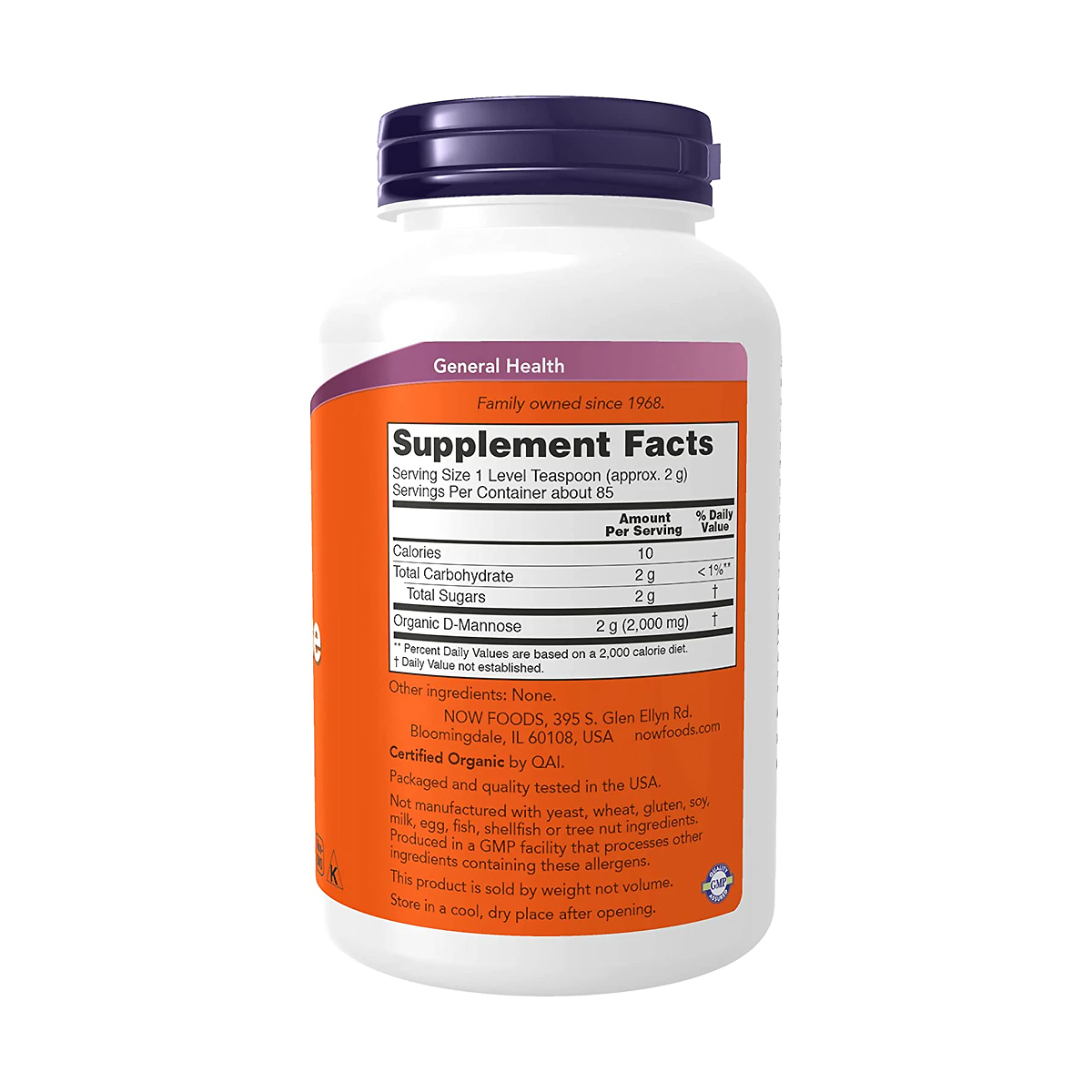
Per the label, the suggested usage is 1 level teaspoon 1 to 2 times daily with water or unsweetened juice, so a container lasts about 85 days at one serving a day or 42 at two. MERIT tested 2 g once daily, one serving. Two servings, 4 g, is double that, and the sources reviewed describe pilot doses only up to 2 to 3 g (Cochrane, 2022). The label also says to consult a physician if pregnant or nursing, taking medication, or having a medical condition.
| This product | Typical studied dose | NIH RDA / AI | Tolerable Upper Limit | |
|---|---|---|---|---|
| D-mannose | 2,000 mg per level teaspoon; 2,000–4,000 mg at the label's 1–2 servings a day | 2,000 mg daily for 6 months (MERIT, 2024); pilot doses 200 mg to 2–3 g (Cochrane, 2022) | None established in any source reviewed; D-mannose is a sugar, not a vitamin or mineral | None established in any source reviewed; Cochrane reported few, non-serious adverse events |
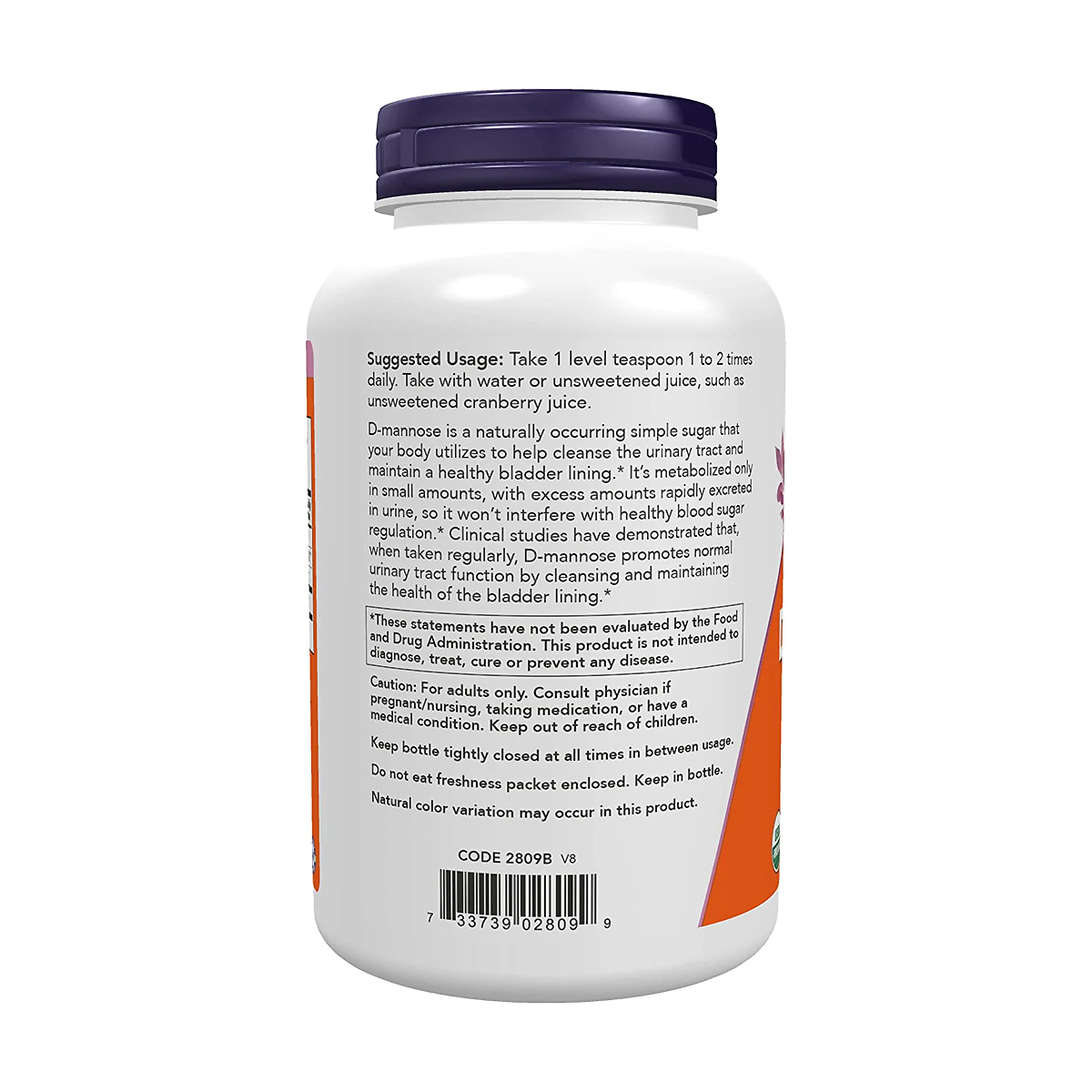
Where the label and listing outrun the evidence: the back label says clinical studies "have demonstrated" that regular D-mannose "promotes normal urinary tract function by cleansing and maintaining the health of the bladder lining." The store listing goes further, with headings reading "Clinically Proven" and "Clinically Tested," and says the powder is safe for long-term use. Those are manufacturer and store claims. After MERIT and the Cochrane review, "clinically proven" is not a fair description, and the longest placebo-controlled exposure in the sources reviewed is 6 months. The label also says D-mannose will not interfere with healthy blood sugar regulation; that is the manufacturer's statement, this article could not verify it, and anyone managing blood sugar should ask a clinician.
Who Might Consider It, and Who Should Skip It
Who this is for: women with recurrent UTIs who have already discussed the options in the table above with a clinician and still want to try a low-cost powder, understanding that the best trial found no significant benefit over placebo.
Who should skip it: most people. Anyone with current UTI symptoms, who should be seen rather than self-treating; anyone with fever, chills, vomiting or back, side or groin pain; anyone using it in place of prescribed prevention; and anyone pregnant, nursing, on medication or managing blood sugar who has not asked a clinician.
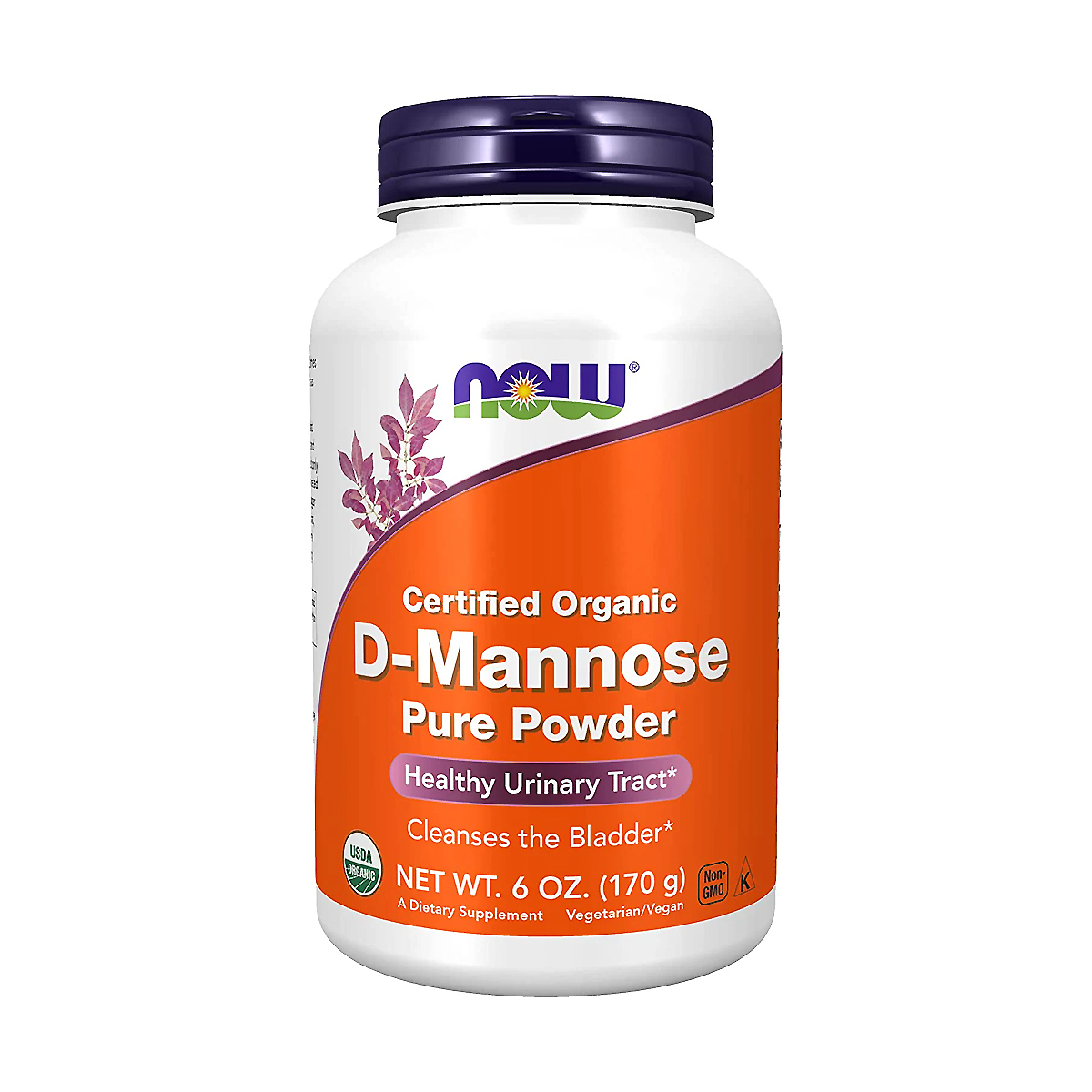
D-Mannose Urinary Tract Health Powder — 6 oz (170 g)
Single-ingredient organic D-mannose powder, 2 g per level teaspoon, about 85 servings. As covered above, the largest placebo-controlled trial did not show a significant reduction in UTIs, and it is not a treatment for an active infection. Also browse our supplements.
View Product DetailsFrequently Asked Questions
Does D-mannose prevent UTIs?
The best evidence says it does not reliably prevent them. In the 598-woman MERIT trial (2024), 51.0% of women taking 2 g daily had a medically attended UTI within six months versus 55.7% on placebo, a difference that was not statistically significant. A 2025 meta-analysis also found no significant reduction.
Does D-mannose treat a UTI that has already started?
There is little to no evidence that it does. Cochrane (2022) found the evidence for treating UTIs too sparse and low quality to judge. NIDDK says a bacterial bladder infection is usually treated with antibiotics prescribed by a health care professional, so symptoms should be assessed rather than self-treated.
How much D-mannose should I take for a UTI?
No dose has been proven to work. This product's label says 1 level teaspoon (2 g) 1 to 2 times daily. MERIT tested 2 g once daily and found no significant benefit; Cochrane describes pilot doses from 200 mg to 2 to 3 g. Ask a clinician first.
Is D-mannose safe, and what are the side effects?
In the trials Cochrane reviewed (2022), adverse events were few and none were serious, mostly diarrhea and vaginal burning. The label advises consulting a physician if you are pregnant or nursing, taking medication, or have a medical condition. Those trials ran 15 days to six months, so longer-term safety is less well documented.
Can I take D-mannose every day long term?
The label directs daily use, but the longest placebo-controlled follow-up in the sources reviewed is six months, so the listing's long-term safety claim goes beyond the trial evidence. If you have recurrent infections, a clinician can discuss prevention options with better support, such as those listed by NIDDK and NICE.
Is D-mannose better than cranberry for UTIs?
Neither is proven to treat an infection. NCCIH (November 2024) says cranberry products may lower the risk of symptomatic recurrent UTIs in women by about 25%, though effectiveness is still in question. D-mannose had no significant benefit in the largest placebo-controlled trial, so cranberry has the slightly stronger, though inconsistent, record.
Does D-mannose raise blood sugar?
The label lists 10 calories and 2 g of total sugars per 2 g serving, and the manufacturer says D-mannose will not interfere with healthy blood sugar regulation. This article could not verify that statement independently, so people managing diabetes or blood sugar should check with a clinician before using it daily.
When should I see a doctor about UTI symptoms?
Contact a health care professional if you have bladder infection symptoms such as burning on urination, frequent urges, lower abdominal pain, or cloudy, bloody or strong-smelling urine. NIDDK says fever, chills, nausea or vomiting, or back, side or groin pain can signal a kidney infection that needs quick treatment.
Sources
- University of Oxford, Nuffield Department of Primary Care Health Sciences. "MERIT: d-MannosE to prevent Recurrent urine InfecTions" (trial page; results published as Hayward G, et al., JAMA Intern Med, 8 April 2024;184(6):619-628; abstract read via Europe PMC). Accessed 1 October 2026. phc.ox.ac.uk
- NIHR Evidence. "D-mannose does not prevent urinary tract infections (UTIs)." Published 6 February 2025. Accessed 1 October 2026. evidence.nihr.ac.uk
- Cochrane. Cooper TE, et al. "D-mannose for preventing and treating urinary tract infections." Cochrane Database Syst Rev, 2022;(8):CD013608; evidence current to 22 February 2022. Accessed 1 October 2026. cochrane.org
- Vargas CEF, et al. "Efficacy of D-mannose as prophylaxis of recurrent urinary tract infection: a systematic review and meta-analysis of randomized controlled trials." J Bras Nefrol, 2025 (received 21 May 2025). Accessed 1 October 2026. doi.org/10.1590/2175-8239-jbn-2025-0169en
- National Institute of Diabetes and Digestive and Kidney Diseases. "Treatment for Bladder Infection in Adults." Last reviewed April 2024. Accessed 1 October 2026. niddk.nih.gov
- National Institute of Diabetes and Digestive and Kidney Diseases. "Symptoms & Causes of Bladder Infection in Adults." Last reviewed April 2024. Accessed 1 October 2026. niddk.nih.gov
- National Institute of Diabetes and Digestive and Kidney Diseases. "Eating, Diet, & Nutrition for Bladder Infection in Adults." Last reviewed April 2024. Accessed 1 October 2026. niddk.nih.gov
- National Institute of Diabetes and Digestive and Kidney Diseases. "Kidney Infection (Pyelonephritis)." Last reviewed October 2024. Accessed 1 October 2026. niddk.nih.gov
- National Center for Complementary and Integrative Health. "Cranberry." Last updated November 2024. Accessed 1 October 2026. nccih.nih.gov
- National Institute for Health and Care Excellence. "Urinary tract infection (recurrent): antimicrobial prescribing (NG112)." Last updated 12 December 2024. Accessed 1 October 2026. nice.org.uk
This article is for educational purposes only and is not medical advice. It is not intended to diagnose, treat, cure, or prevent any disease. These statements have not been evaluated by the Food and Drug Administration. Talk to your doctor before starting any new supplement, especially if you are pregnant, breastfeeding, over 65, take any medication, or have a medical condition.