
The 2023 international PCOS guideline states that “specific types, doses, or combinations of inositol cannot currently be recommended” for women with polycystic ovary syndrome, yet most myo-inositol trials used 2 to 4 grams a day, and the label on this jar directs 650 milligrams, up to three times a day. Inositol is a naturally occurring compound that cells use in their membranes and in hormone signalling, and the body makes about 4 g of it a day on its own, so the “Vitamin B8” name in the store listing misleads. The stake is whether a jar bought for PCOS, mood or pregnancy delivers the dose that was studied.
Key Takeaways
- A 2024 meta-analysis of 30 randomised trials in 2,230 women with PCOS called the evidence for inositol “limited and inconclusive” (Fitz et al., 2024).
- The 2023 international PCOS guideline says inositol “could be considered,” but no dose can be recommended, and calls it experimental for fertility (Teede et al., 2023).
- 6 of 8 myo-inositol plus folic acid trials used 4 g a day, the rest 2 g; this jar’s label allows 650 mg up to 3 times a day (Fitz et al., 2024; label).
- A 2014 meta-analysis of 11 trials (312 patients) found no significant effect of inositol on depressive, anxiety or obsessive-compulsive symptoms (Mukai et al., 2014).
- A 2022 meta-analysis of 7 pregnancy trials (1,321 women) found 4 g of myo-inositol cut gestational diabetes (RR 0.30), on low or very low quality evidence (Wei et al., 2022).
In this article:
- What Inositol Is, and Why “Vitamin B8” Misleads
- PCOS: What the 30 Trials Found
- Mood and Anxiety: A Small Literature and a 12 g Dose
- Pregnancy and Gestational Diabetes: A Strong Number on Weak Evidence
- Inside Horbaach Inositol Powder
- Safety, and What We Could Not Verify
- Who Might Consider It, and Who Should Skip It
- Frequently Asked Questions
What Inositol Is, and Why “Vitamin B8” Misleads
A 2024 meta-analysis in the Journal of Clinical Endocrinology & Metabolism (Fitz et al.) describes inositols as structural components of cell membranes that take part in hormone signalling. Of nine stereoisomers, myo-inositol (MI) is the most abundant in the body, and in humans “dietary intake and endogenous synthesis” both occur.
A 2023 narrative review in Current Issues in Molecular Biology (Concerto et al.) puts numbers on that: “The human body synthesizes inositol at a rate of approximately 4 g per day,” mostly in the kidney, and about 1 g a day comes from a normal, balanced diet.
This is why the store listing’s “Vitamin B8” name needs care. The Supplement Facts panel on the jar says “Inositol (aka Myoinositol)” and lists the Daily Value as not established. We found no RDA, Adequate Intake or deficiency syndrome in the reviews we read, so there is no intake gap for a jar to fill, and the case rests on trials, as it does for D-mannose, tested in a 598-woman placebo trial. (Inositol also appears as one ingredient in the capsule we examined in our biotin guide.)
PCOS: What the 30 Trials Found
The Office on Women’s Health (womenshealth.gov, updated 24 October 2025) says PCOS “affects 1 in 10 women of childbearing age” and that many affected women have insulin resistance, which inositol is proposed to improve. The 2024 review by Fitz and colleagues included 30 trials with 2,230 women; 19 were pooled.
| Comparison | Trials and participants | Inositol dose per day | Result |
|---|---|---|---|
| Myo-inositol + folic acid vs folic acid alone | 8 trials; 432 vs 457 women | 4 g (6 trials), 2 g (2 trials) | Fasting insulin −4.17 µU/mL and HOMA-IR −1.24 (2 trials); no difference in testosterone, BMI, clinical pregnancy (5 trials) or ovulation (2 trials) |
| Myo-inositol vs metformin | 10 trials; 353 vs 356 women | 1 to 4 g, most 4 g | No difference in cycle resumption, ovulation or pregnancy; metformin better for hirsutism and waist-hip ratio; fewer GI side effects with inositol (OR 0.09) |
| D-chiro-inositol vs placebo | 2 trials; 20 and 44 women | 0.6 to 1.2 g | Ovulation improved (OR 11.5, 2 trials); the review notes very small samples |
The only metabolic gains came from two small trials, and pregnancy and ovulation did not differ for myo-inositol, the form in this jar, against folic acid alone or against metformin. D-chiro-inositol is a different isomer tested in two small trials, so it tells us little about this product.
Only 16 of the 30 trials were at low risk of bias for randomisation and 11 for allocation concealment, and the authors graded certainty low to very low. A separate 26-trial meta-analysis that reported better cycle regularity included studies Fitz et al. excluded “due to uncertainty about research integrity.” The abstract’s conclusion: “The evidence supporting the use of inositol in the management of PCOS is limited and inconclusive.”
“Specific types, doses, or combinations of inositol cannot currently be recommended in adults and adolescents with PCOS, due to a lack of quality evidence.”
— Teede et al., 2023 International Evidence-based PCOS Guideline, recommendation 4.7.4, J Clin Endocrinol MetabThe same guideline (Teede et al., 2023) says inositol “could be considered” given limited harm, with limited clinical benefit for ovulation, hirsutism or weight, and that metformin “should be considered over inositol” for hirsutism and central adiposity. For PCOS with infertility, inositol “should be considered experimental therapy.” Fitz et al. add one opening: it “may be reasonable to consider the use of MI as an alternative to metformin in women who cannot tolerate metformin.”
Mayo Clinic, “Demystifying Polycystic Ovary Syndrome,” cited as background on PCOS, not as evidence about inositol.
Mood and Anxiety: A Small Literature and a 12 g Dose
Inositol’s psychiatric reputation rests on small early trials. The 2023 narrative review by Concerto and colleagues describes a 4-week trial of 12 g a day in depression that found a significant fall in Hamilton Depression Scale scores against placebo. The pooled picture is weaker: a 2014 meta-analysis in Human Psychopharmacology (Mukai et al.) searched to August 2013 for double-blind placebo-controlled trials.
| Condition group | Trials | Participants | Pooled result |
|---|---|---|---|
| Depression (bipolar, major depression, PMDD) | 7 | 242 | No significant effect on depressive symptoms; slightly more responders (p = 0.06) |
| Anxiety disorders (OCD, panic, PTSD) | 4 | 70 | No significant effect on anxiety or obsessive-compulsive symptoms |
| PMDD subgroup | 2 | not stated | Trend towards benefit (p = 0.07), not significant |
The authors wrote that “inositol may be beneficial for depressed patients, especially those with PMDD,” but that the main limitation was “a small number of studies.” Concerto et al. summarise the meta-analyses as showing no clear antidepressant effect.
The dose gap is the practical point. The label’s 1,950 mg ceiling is about one-sixth of the 12 g in the depression trial, and reaching 12 g would take more than 18 servings of this jar a day. We are not suggesting anyone do that; the label’s directions are far lower.
Pregnancy and Gestational Diabetes: A Strong Number on Weak Evidence
The NIDDK (last reviewed May 2017) defines gestational diabetes as “a type of diabetes that occurs only during pregnancy,” tested for at 24 to 28 weeks. Inositol’s best-known number comes from here. A 2022 meta-analysis in Nutrients (Wei, Yan and Yang) pooled 7 randomised trials with 1,321 participants. Across six trials (995 women), 4 g of myo-inositol a day cut gestational diabetes (RR 0.30, 95% CI 0.18 to 0.49), with substantial heterogeneity (I² = 52%). Two trials of a lower dose, 1.1 g myo-inositol plus 27.6 mg D-chiro-inositol, showed no difference.
The same review rated the evidence “low or very low” for every outcome: six of the seven studies were run in Italy, most lacked blinding, and the authors flagged a high risk of performance bias. It also notes a separate international multicentre trial (Godfrey et al., 2021) in which 4 g of myo-inositol combined with vitamins and probiotics “was not effective.” The review reported no side effects among its 1,321 women.
The 4 g signal is large enough to justify better trials, but it rests on mostly unblinded Italian trials, and the one international trial, of a combination product, found no benefit. It is also dose-specific: 4 g, started in early pregnancy, which does not transfer to a jar labelled for 650 mg servings. If you are pregnant or trying to conceive, ask your clinician first; the 2023 guideline states that for fertility use “side effects and safety are not known for inositol.”
Inside Horbaach Inositol Powder
The product is Horbaach Inositol Powder, 8 oz (227 g). The Supplement Facts photo shows one serving as approximately ¼ teaspoon (650 mg), about 349 servings per container, one ingredient (“Inositol (aka Myoinositol)”) and “Other Ingredients: None.” The directions: for adults, add approximately ¼ teaspoon (650 mg) one to three times daily to a beverage.
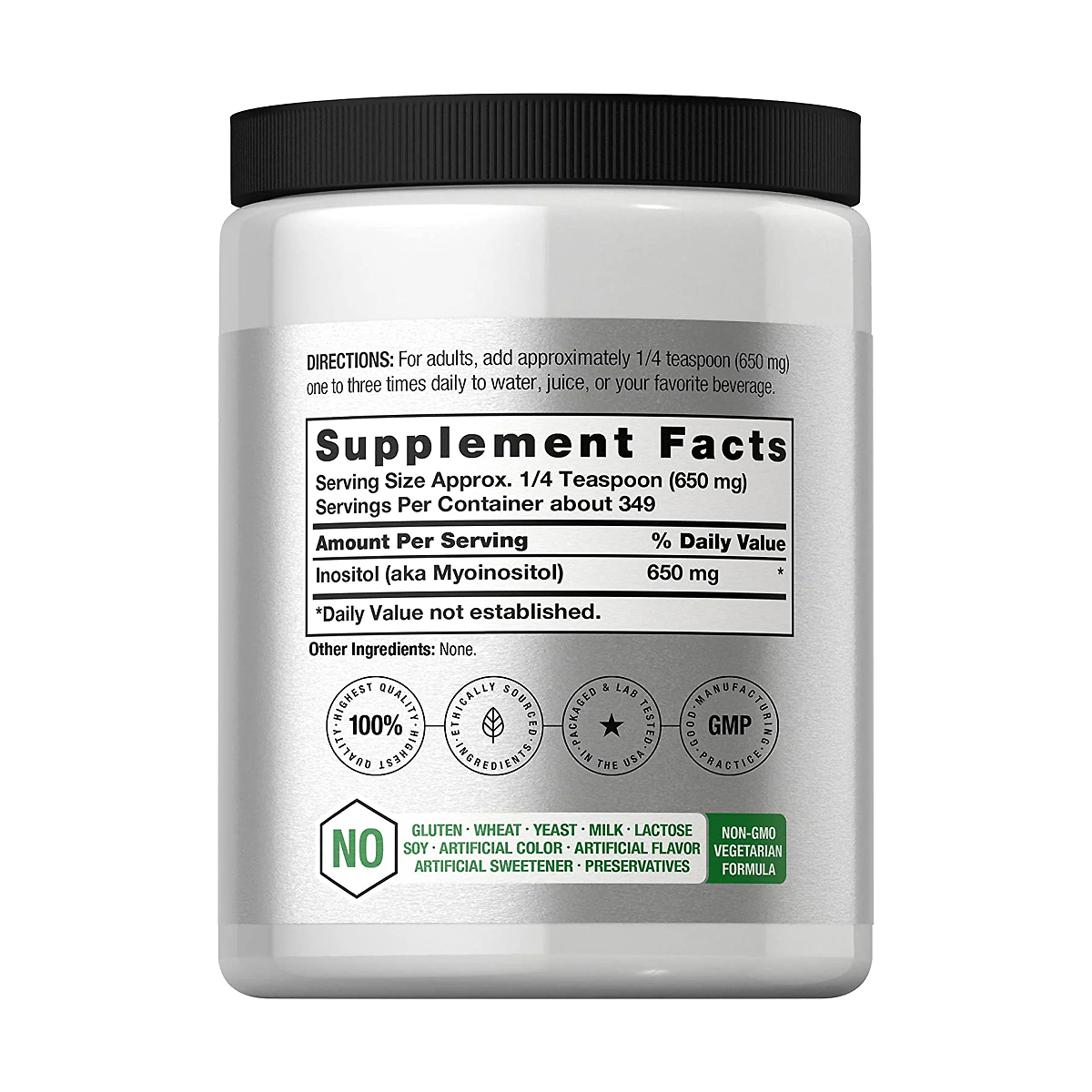
| This product | Doses used in the trials above | NIH RDA / AI | Tolerable Upper Limit | |
|---|---|---|---|---|
| Myo-inositol, per day | 650 mg per serving; 650 to 1,950 mg a day at 1 to 3 servings | 2 to 4 g (PCOS and gestational diabetes trials, 2022 and 2024 reviews); 12 g (depression trial, 2023 review) | None found in the sources we read; the label states the Daily Value is not established | None found in the sources we read, so none can be quoted; absence of a limit is not a safety clearance |
Put plainly, the label maximum of 1,950 mg is under half the 4 g used in most myo-inositol PCOS trials; a 4 g day would take six or more servings, twice the label’s ceiling. At 4 g the jar lasts about 57 days, at the label maximum about 116. Taking more than the label directs is a decision to make with your clinician, not from this arithmetic.
The store listing differs from the label in three ways. It says to mix “1 scoop” and take “1-2 servings daily,” while the label specifies a quarter teaspoon one to three times a day (we saw no scoop on the label, so follow the label). It says the powder “supports liver and nervous system function,” and its short description says inositol “has been studied” for mood, hormonal balance and insulin sensitivity. Those are manufacturer statements; the trials above are why “studied” is right and “works” would not be.
Safety, and What We Could Not Verify
Inositol looks well tolerated in these trials, but the record is thin. Fitz et al. found fewer gastrointestinal events with myo-inositol than metformin (OR 0.09, 6 trials), then caution that 23 of 29 trials did not report adverse events and that low-risk-of-bias studies showed no difference. Mukai et al. found gastrointestinal upset marginally more common than placebo (p = 0.06).
The FDA’s dietary supplement Q&A (content current as of 27 August 2026) states: “Under DSHEA, FDA does not have the authority to approve dietary supplements before they are marketed.” The 2023 guideline adds that quality control of inositol “can differ from those for pharmacological products.”
What we could not verify: an authoritative upper limit; safety over years; use in breastfeeding, kidney disease or children; and drug interactions. The psychiatric literature we read discusses inositol alongside lithium and valproate, so anyone taking those should ask their prescriber.
Who Might Consider It, and Who Should Skip It
Who this is for: women with PCOS whose own clinician has suggested trying myo-inositol, and who accept that the evidence is low certainty and the trials used higher doses than this label; and adults, with a clinician’s agreement, curious about a single-ingredient powder whose amount can be measured. It is a dietary supplement, not a replacement for any treatment you have been prescribed.
Who should skip it: most people. There is no deficiency to correct, PCOS pregnancy and ovulation outcomes did not change, and the mood and anxiety results were not significant. Skip it, or ask first, if you are pregnant or trying to conceive, breastfeeding, taking lithium or valproate, or treating depression or anxiety.
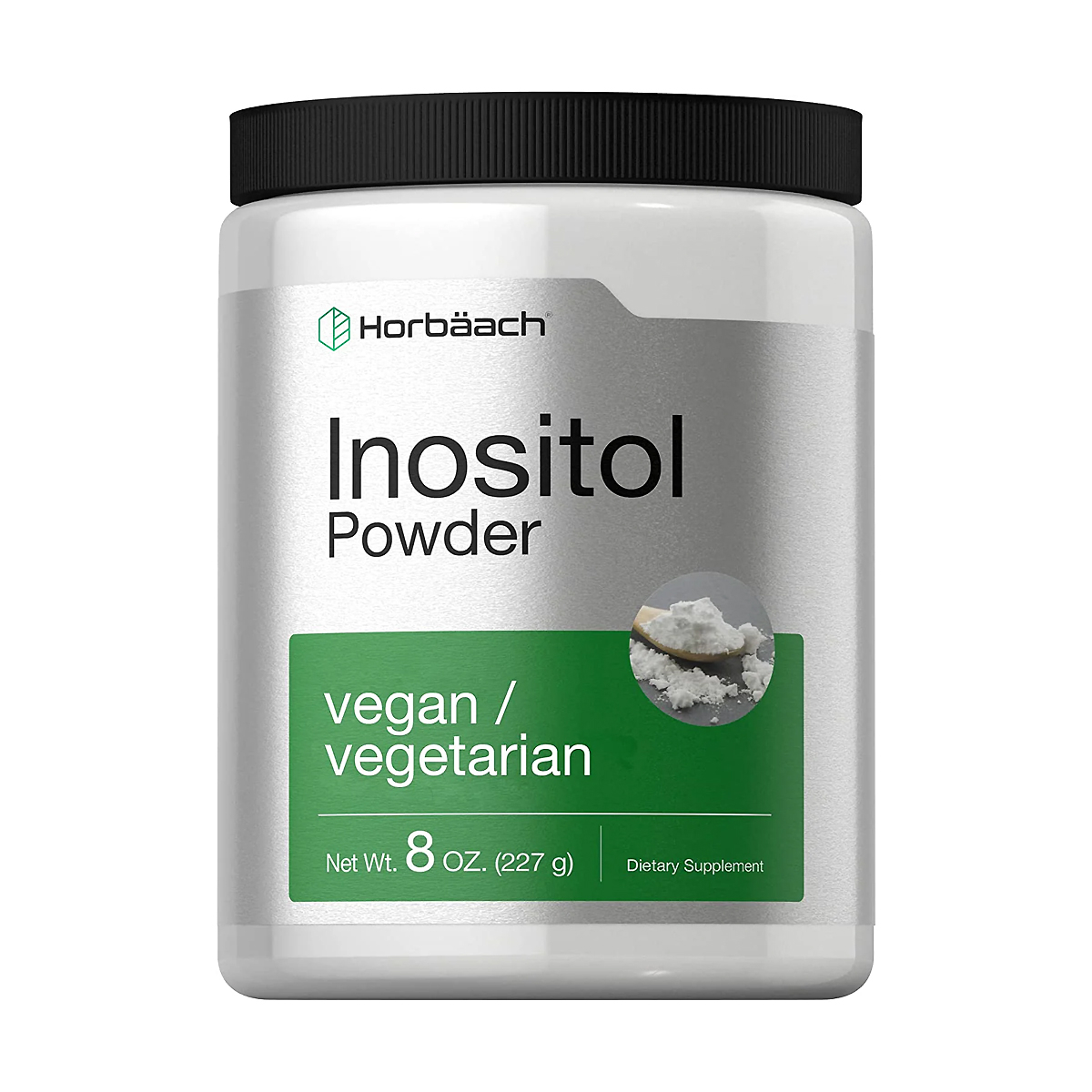
Horbaach Inositol Powder 8 oz, Vegan
Pure myo-inositol, 650 mg per approximate ¼ teaspoon, about 349 servings in an 8 oz (227 g) jar, with directions of one to three servings a day mixed into a drink. Browse our vitamins.
View Product DetailsFrequently Asked Questions
What is inositol?
Inositol is a naturally occurring compound that cells use in their membranes and in hormone signalling. Myo-inositol is its most abundant form in the body. The body makes about 4 g a day itself, and a normal diet supplies roughly 1 g more.
Is inositol really vitamin B8?
The name is common in marketing, but the jar’s Supplement Facts panel says “Inositol (aka Myoinositol)” with no Daily Value. We found no RDA or deficiency syndrome in the reviews we read, and the body makes it.
Does inositol help with PCOS?
The evidence is limited. A 2024 review of 30 trials found possible metabolic gains but no clear pregnancy or ovulation change for myo-inositol. The 2023 international guideline says inositol could be considered but no specific dose can be recommended.
How much inositol should you take for PCOS?
No dose is recommended; the 2023 guideline cites a lack of quality evidence. Trials of myo-inositol used 2 to 4 g a day, while this jar’s label allows 650 mg up to three times daily. Ask your clinician.
Does inositol work for anxiety or depression?
Not reliably. A 2014 meta-analysis of 11 placebo-controlled trials found no significant effect on depressive, anxiety or obsessive-compulsive symptoms. The best-known positive trial used 12 g a day, far above this label.
Can inositol prevent gestational diabetes?
Pooled data suggest 4 g of myo-inositol a day may lower the risk (RR 0.30 in a 2022 meta-analysis of six trials), but the authors rated the evidence low or very low quality. Use it in pregnancy only with clinician guidance.
Is inositol better than metformin for PCOS?
No. A 2024 review found metformin better for hirsutism and waist-hip ratio, with no difference in reproductive outcomes. Inositol caused fewer gastrointestinal side effects, so it may suit women who cannot tolerate metformin.
What are the side effects of inositol?
Trials report mild gastrointestinal upset at most; a 2014 meta-analysis found it marginally more common than placebo (p = 0.06). But 23 of 29 PCOS trials did not report adverse events, and we found no authoritative long-term or interaction data.
Sources
- Fitz et al. “Inositol for Polycystic Ovary Syndrome: A Systematic Review and Meta-analysis to Inform the 2023 Update of the International Evidence-based PCOS Guidelines.” Journal of Clinical Endocrinology & Metabolism, 2024. Accessed 13 October 2026. PMC11099481
- Teede et al. “Recommendations From the 2023 International Evidence-based Guideline for the Assessment and Management of Polycystic Ovary Syndrome.” Journal of Clinical Endocrinology & Metabolism, September 2023. Accessed 13 October 2026. PMC10505534
- Mukai et al. “A meta-analysis of inositol for depression and anxiety disorders.” Human Psychopharmacology, January 2014. Accessed 13 October 2026. PubMed 24424706
- Wei, Yan and Yang. “Inositol Nutritional Supplementation for the Prevention of Gestational Diabetes Mellitus: A Systematic Review and Meta-Analysis of Randomized Controlled Trials.” Nutrients, July 2022. Accessed 13 October 2026. PMC9318937
- Concerto et al. “Neurobiology and Applications of Inositol in Psychiatry: A Narrative Review.” Current Issues in Molecular Biology, February 2023. Accessed 13 October 2026. PMC9955821
- U.S. Office on Women’s Health. “Polycystic ovary syndrome.” Page last updated 24 October 2025. Accessed 13 October 2026. womenshealth.gov
- National Institute of Diabetes and Digestive and Kidney Diseases. “Gestational Diabetes.” Last reviewed May 2017. Accessed 13 October 2026. niddk.nih.gov
- U.S. Food and Drug Administration. “Questions and Answers on Dietary Supplements.” Content current as of 27 August 2026. Accessed 13 October 2026. fda.gov
This article is for educational purposes only and is not medical advice. It is not intended to diagnose, treat, cure, or prevent any disease. These statements have not been evaluated by the Food and Drug Administration. Talk to your doctor before starting any new supplement, especially if you are pregnant or breastfeeding, have a medical condition, or take any prescription medication.