
Biotin deficiency in a healthy person eating a normal diet has never been reported, according to the NIH — yet biotin is one of the best-selling "beauty vitamins" on the market, often sold at doses more than 150 times what the body actually needs. That gap between marketing and physiology is not just wasted money. High-dose biotin carries a documented FDA warning: it can distort certain blood tests badly enough to cause a missed heart attack diagnosis.
Key Takeaways
- Adults need just 30 mcg of biotin a day (NIH Adequate Intake), and most people already get 35–70 mcg from an ordinary diet — before any supplement.
- A peer-reviewed review found zero randomized controlled trials showing biotin helps hair or nail growth in healthy people; every one of the 18 published cases of improvement involved someone with a diagnosed underlying condition.
- This product delivers 5,000 mcg of biotin per daily serving — about 167 times the adult Adequate Intake.
- The FDA has received adverse event reports of biotin causing falsely low results on cardiac troponin tests, the blood test used to diagnose heart attacks. Separately, NIH notes that even a single 10 mg dose has interfered with thyroid function tests administered within 24 hours.
- No Tolerable Upper Intake Level exists for biotin because no direct toxicity has been documented — the real risk isn't the vitamin itself, it's what it does to your next blood test.
In this article:
- What Is Biotin, and Does Anyone Actually Lack It?
- Does Biotin Actually Grow Hair, Clear Skin, or Strengthen Nails?
- The FDA Warning Nobody Puts on the Bottle
- Who Is Actually at Risk of Biotin Deficiency?
- Inside Country Life Maxi Hair Plus: What's Actually in the Capsule
- How to Use High-Dose Biotin Sensibly
- Frequently Asked Questions
What Is Biotin, and Does Anyone Actually Lack It?
Biotin, also called vitamin B7, is a water-soluble B vitamin the body uses as a helper molecule for enzymes that break down fats, carbohydrates, and protein, according to the MedlinePlus Medical Encyclopedia. It's naturally present in eggs, organ meats, fish, nuts, seeds, and vegetables like sweet potatoes and broccoli, and the body also gets a contribution from bacteria living in the gut.
The amount you actually need is small. The Food and Nutrition Board has not been able to establish a full Recommended Dietary Allowance for biotin — there isn't enough data — so it instead set an Adequate Intake (AI), the level believed to cover nearly everyone's needs, according to the NIH Office of Dietary Supplements (ODS).
| Life stage | AI (mcg/day) |
|---|---|
| Infants, 0–6 months | 5 |
| Infants, 7–12 months | 6 |
| Children, 1–3 years | 8 |
| Children, 4–8 years | 12 |
| Children, 9–13 years | 20 |
| Adolescents, 14–18 years | 25 |
| Adults, 19+ years | 30 |
| Pregnancy | 30 |
| Lactation | 35 |
The most striking line in the ODS fact sheet isn't a number, though — it's a statement of fact: "severe biotin deficiency in healthy individuals eating a normal mixed diet has never been reported." ODS adds that average dietary biotin intake in Western populations already runs 35–70 mcg per day, which is above the 30 mcg AI before anyone opens a supplement bottle. Biotin deficiency is real, but it is a condition that shows up in specific, identifiable circumstances — not something the average person walking into a health store is at meaningful risk of.
Does Biotin Actually Grow Hair, Clear Skin, or Strengthen Nails?
This is the claim on almost every bottle of "hair, skin and nails" biotin, and it's worth separating what's proven from what's assumed. A 2017 peer-reviewed review in Skin Appendage Disorders, "A Review of the Use of Biotin for Hair Loss," searched the medical literature for evidence and found exactly 18 published cases in which biotin supplementation was reported to improve hair or nails.
"Biotin has no proven efficacy in hair and nail growth of healthy individuals... there is [a] lack of sufficient evidence for supplementation for hair and nail growth in individuals who do not present with low levels of biotin."
— Patel, Swink & Castelo-Soccio, Skin Appendage Disorders, 2017The key detail is what those 18 cases had in common: every single one involved a person with an underlying medical condition, not a healthy adult with ordinary hair thinning. The conditions included congenital biotin deficiency, biotinidase deficiency, uncombable hair syndrome, and brittle nail syndrome — genuine, diagnosable disorders where biotin metabolism itself is impaired. The reviewers found no randomized, controlled trials testing biotin supplementation in normal, healthy people. In other words, the strongest evidence for biotin's cosmetic benefits comes entirely from a population that isn't the one buying it off the shelf.
None of this means the ingredients in a hair-skin-nails formula are useless in a general sense — MSM, zinc, and B-complex vitamins all have their own, separate roles in skin and connective tissue health. It means the specific, headline claim — that extra biotin, on top of an already-adequate intake, will visibly change your hair or nails — isn't supported by controlled research in people who aren't deficient.
The FDA Warning Nobody Puts on the Bottle
The genuine safety issue with high-dose biotin isn't toxicity in the traditional sense — it's laboratory interference. Many common blood tests, including thyroid panels and cardiac troponin (the biomarker used to diagnose a heart attack), use a lab technique built around a protein called streptavidin that binds tightly to biotin. When a patient has taken a high-dose biotin supplement, the excess biotin in their blood sample can throw off the chemistry of the test itself, producing a result that has nothing to do with their actual health.
The FDA's current guidance on this, published directly on fda.gov, states plainly that "the FDA has continued to receive adverse events reports indicating biotin interference caused falsely low troponin results." A falsely low troponin reading is exactly backwards from what you'd want in an emergency room: it can make a real heart attack look like a normal test result.
Genuine safety warning: The NIH's Office of Dietary Supplements notes that even a single 10 mg dose of biotin has interfered with thyroid function tests administered within 24 hours of ingestion. If you take a high-dose biotin supplement — including this one, at 5,000 mcg (5 mg) daily — tell your doctor and the lab collecting your sample before any blood test, especially a cardiac troponin test or a thyroid panel. This matters most in an emergency, when clinicians may not know to ask.
A peer-reviewed case report published after the FDA's warning illustrates how this plays out in practice: a patient taking 5 mg of biotin daily — the same daily dose as this product — showed a suppressed thyroid-stimulating hormone (TSH) reading along with an abnormal parathyroid hormone and calcium panel. The values normalized only after the patient stopped taking biotin and was retested a month later. The authors note that a 5–20 mg daily biotin dose represents "a several hundred-fold increase" over the 30 mcg the body actually needs — and that the lab abnormalities it can cause are a testing artifact, not a real physiological change.
Who Is Actually at Risk of Biotin Deficiency?
Biotin deficiency is uncommon, but it isn't nonexistent — it clusters in a short list of identifiable groups, per the NIH ODS health professional fact sheet:
| Group | Why |
|---|---|
| Biotinidase deficiency | A rare inherited disorder that prevents the body from releasing free biotin from food, causing deficiency despite normal intake |
| Chronic alcohol use | Alcohol inhibits biotin absorption; roughly 15% of people with chronic alcoholism have low plasma biotin |
| Pregnant and breastfeeding women | At least a third of pregnant women develop marginal biotin deficiency despite normal intake; biotin levels in blood and breastmilk fall during lactation even when intake meets the AI |
| Long-term anticonvulsant use | Carbamazepine, primidone, phenytoin, and phenobarbital are linked to significantly lower serum biotin, through both faster biotin breakdown and reduced gut absorption |
If you fall into one of these groups, that's a conversation for your doctor, not a reason to self-prescribe a beauty-aisle megadose. For everyone else, the honest starting point is that a normal diet already covers what biotin actually does in the body.
Cleveland Clinic on who might actually benefit from a biotin supplement — and who almost certainly doesn't need one.
Inside Country Life Maxi Hair Plus: What's Actually in the Capsule
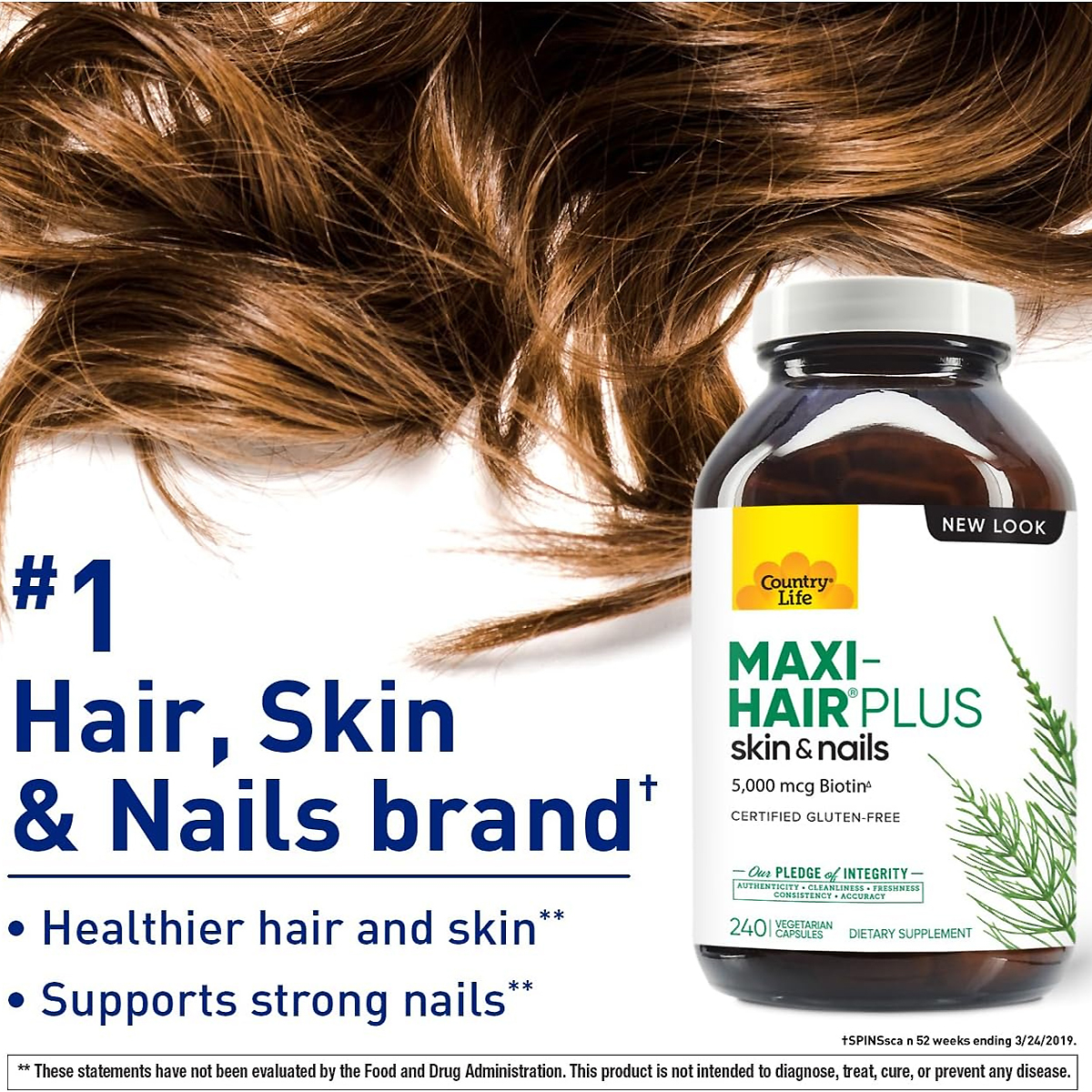
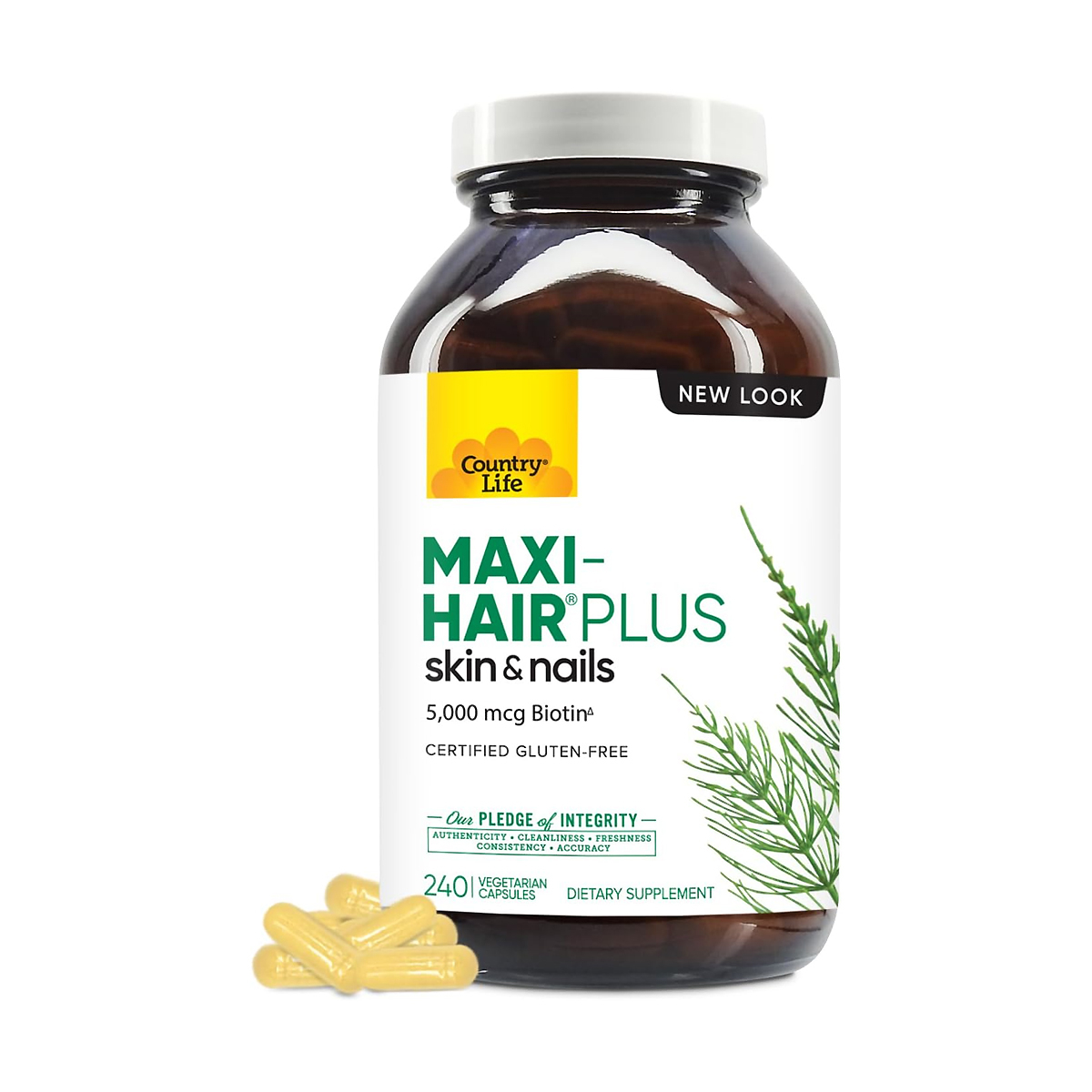
Country Life's Maxi Hair Plus is a 240-capsule bottle built around a 5,000 mcg biotin dose, delivered across a 4-capsule daily serving taken with food — a 60-day supply at that rate. Beyond biotin, the formula includes MSM, the amino acids L-methionine and L-cysteine, horsetail extract, inositol, and PABA, layered onto a B-complex and vitamins A, C, and E, plus calcium and zinc. It's certified gluten-free by GFCO.org and certified vegetarian by the American Vegetarian Association, with no wheat, soy, milk, artificial colors, flavors, sweeteners, or magnesium stearate.
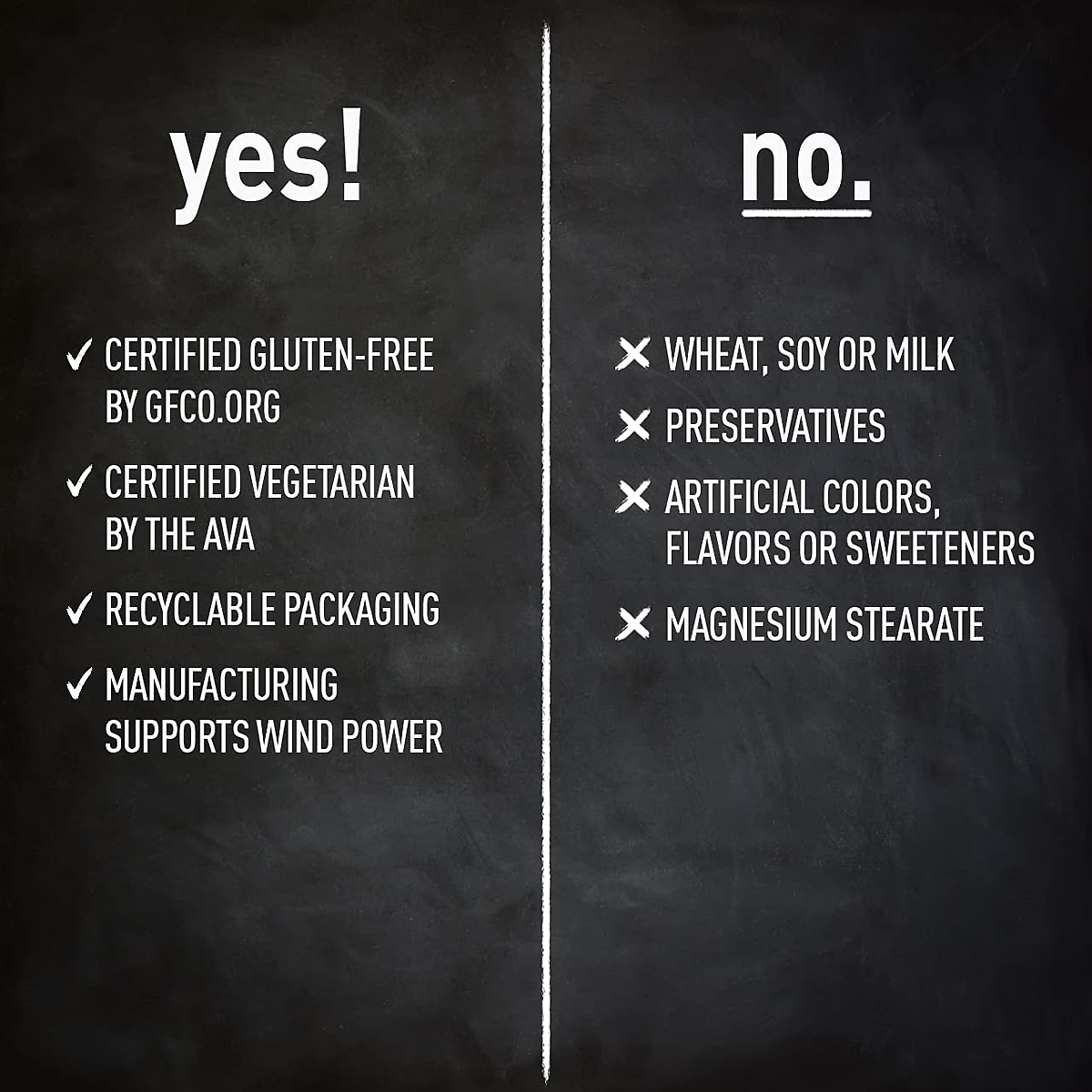
A correction, for accuracy: This store's own product description text states "5000mg of biotin" — that's a units typo. The bottle's printed label, and every independent retailer listing we checked for this product, agree on 5,000 mcg (5 mg) of biotin per daily serving, taken as 4 capsules — not 5,000 mg, and not the 3-capsules-daily figure that appears elsewhere on this store's listing. The 5,000 mcg / 4-capsule figures are what we've used throughout this article.
Framed honestly: this is a well-manufactured, clearly labeled supplement — certified gluten-free, certified vegetarian, free of the additives it says it's free of. What it is not is a product with controlled-trial evidence that its headline ingredient improves hair, skin, or nails in someone who isn't deficient. Both things can be true at once, and a shopper deserves to know both.
How to Use High-Dose Biotin Sensibly
None of the above means high-dose biotin is dangerous in the way a contaminated or adulterated supplement can be. ODS notes that no Tolerable Upper Intake Level has been set for biotin because "there is no evidence in humans that biotin is toxic at high intakes," with no adverse effects documented at doses as high as 10–50 mg daily, and up to 200 mg/day orally in patients with biotinidase deficiency. The realistic risk isn't organ toxicity — it's the lab-test interference covered above, plus the more mundane fact that a non-deficient person is paying for 167 times the biotin their body will use.
A few sensible defaults follow from the evidence:
- If you have no diagnosed deficiency risk factor, a normal diet likely already meets your biotin needs, and a lower-dose B-complex from our individual vitamins category covers the rest of this formula's B-vitamin content without the 5,000 mcg megadose.
- If you do take a high-dose biotin product like this one, tell any doctor or lab drawing your blood — every time, not just once.
- If you're pregnant, breastfeeding, on anticonvulsant medication, or managing a chronic condition, check with your doctor before adding any new supplement, biotin included.
- Stop and consult a doctor if you experience any adverse reaction, per the manufacturer's own label instructions.
Country Life Maxi Hair Plus Biotin — 240 Vegetarian Capsules
5,000 mcg biotin per 4-capsule daily serving, with MSM, L-methionine, L-cysteine, horsetail extract, and a B-complex. Certified gluten-free and vegetarian, a 60-day supply at the labeled serving. As covered above, tell your doctor and lab if you're having blood work done while taking it.
View Product DetailsFrequently Asked Questions
Does biotin actually make your hair grow?
Not in someone who already gets enough biotin from their diet. A 2017 peer-reviewed review found no randomized controlled trials showing benefit in healthy people; every documented case of improvement involved someone with a diagnosed condition affecting biotin metabolism, such as biotinidase deficiency or brittle nail syndrome.
How much biotin do I actually need per day?
The NIH sets the Adequate Intake at 30 mcg per day for adults, rising to 35 mcg during breastfeeding. Most people already get 35–70 mcg from an ordinary diet of eggs, meat, fish, nuts, and vegetables, without any supplement.
Can biotin supplements affect my blood test results?
Yes. The FDA has received reports of high-dose biotin causing falsely low cardiac troponin results, and it can also distort thyroid test results. The NIH notes that even a single 10 mg dose has interfered with thyroid function tests administered within 24 hours. Tell your doctor and testing lab if you're taking a biotin supplement.
Is 5,000 mcg of biotin daily safe to take?
No Tolerable Upper Intake Level has been set for biotin because no direct toxicity has been documented in humans, even at much higher doses. The realistic concern at 5,000 mcg isn't organ damage — it's the lab-test interference described above, which is why disclosure to your doctor matters more than the dose itself.
Who is actually at risk of a biotin deficiency?
People with biotinidase deficiency, chronic heavy alcohol use, pregnancy or breastfeeding, or long-term use of certain anticonvulsant medications (carbamazepine, primidone, phenytoin, phenobarbital) are the documented risk groups. Severe biotin deficiency in a healthy person eating a normal diet has never been reported.
What else is in Country Life Maxi Hair Plus besides biotin?
MSM, the amino acids L-methionine and L-cysteine, horsetail extract, inositol, PABA, a B-complex, vitamins A, C, and E, calcium, and zinc, in a certified gluten-free, certified vegetarian capsule. The label directs adults to take 4 capsules daily with food, a 60-day supply per 240-capsule bottle.
Sources
- NIH Office of Dietary Supplements — Biotin, Health Professional Fact Sheet
- NIH Office of Dietary Supplements — Biotin, Consumer Fact Sheet
- FDA — Biotin Interference with Troponin Lab Tests
- PMC — A Review of the Use of Biotin for Hair Loss (Skin Appendage Disorders, 2017)
- PMC — Clinically Significant Lab Errors due to Vitamin B7 (Biotin) Supplementation: A Case Report
- MedlinePlus Medical Encyclopedia — Pantothenic Acid and Biotin
This article is for educational purposes only and is not medical advice. It is not intended to diagnose, treat, cure, or prevent any disease. These statements have not been evaluated by the Food and Drug Administration. Talk to your doctor before starting any new supplement, especially if you are pregnant, breastfeeding, take anticonvulsant medication, or have any upcoming blood tests, and always tell your doctor and lab about any high-dose biotin supplement before testing.