
The highest daily dose of oral glutathione in the trials reviewed here was 1,000 mg; the serving on this bottle is 2,000 mg, and the store's own product name says 1,000 mg. Glutathione is a small molecule the body makes from three amino acids and uses as an antioxidant, and it is sold in capsules as the "master antioxidant." Oral glutathione can raise glutathione levels in the blood, but the evidence for skin lightening, liver "detox" and immune support is thinner than the marketing, and no trial reviewed here tested 2,000 mg a day.
Key Takeaways
- In a 6-month randomized trial of 54 adults, 1,000 mg/day of oral glutathione raised glutathione levels 30–35% in red cells, plasma and lymphocytes, and 250 mg/day raised blood levels 17% (Eur J Nutr, 2015); levels returned to baseline after a 1-month washout.
- A 2025 systematic review found oral glutathione at 250 mg twice daily, 250 mg once daily or 500 mg once daily reduced a skin melanin index versus placebo in five randomized trials, but called the results "unsustainable."
- The same review concluded intravenous glutathione "is contraindicated due to lack of efficacy and side effects"; a 2025 narrative review cites anaphylaxis and hepatotoxicity risks.
- The label lists 2,000 mg per 4-capsule serving (500 mg per capsule), 60 servings per bottle, at least double the highest daily dose in the trials reviewed here.
- The store's product name says 1,000 mg per serving and the short description says 2-capsule servings, but the description, the Supplement Facts panel and both front-of-bottle photos say 2,000 mg per 4 capsules (the fourth photo is a lab certificate); we use the label.
In this article:
What Is Glutathione, and Can a Capsule Raise It?
Glutathione (GSH) is described in a 2015 trial report as "the most abundant endogenous antioxidant" and "a critical regulator of oxidative stress and immune function." The body makes it, and the supplement question has always been whether swallowing it does anything, since it is a small protein-like molecule that digestion could break down. The trial's authors put it plainly: "While oral GSH has been shown to be bioavailable in laboratory animal models, its efficacy in humans has not been established." Their 2015 study set out to test it.
A 2026 crossover study in Antioxidants (Solnier and colleagues) adds a caution about formulations: in 14 healthy adults, a single 500 mg dose of standard glutathione produced about 2.5 times less exposure than a 300 mg dose of a proprietary micellar form (incremental exposure 517.8 versus 1,287.5 µg·mL·h). That study was of a novel formulation and is not about this product, but it shows that how glutathione is delivered may matter. Treat the size of that advantage with caution: several of the study's authors, including the owner of the Factors Group of companies, are named inventors on the pending patent for the micellar formulation it tested. This product is a plain reduced-form glutathione, not a liposomal or micellar one.
The label specifies the "reduced form," which is glutathione in its active, antioxidant state as opposed to its oxidized form (GSSG). The 2015 trial tracked the ratio of oxidized to reduced glutathione in blood as a marker of oxidative stress, and reported that the ratio decreased at both doses after 6 months. That is a genuine, measurable change in a laboratory marker, and it is the strongest human evidence for the "antioxidant" label. What it does not show is that the change translates into fewer illnesses, better skin or a healthier liver.
The Best Trial: Raising Blood Levels
The most useful human study is a 6-month, double-blind, placebo-controlled trial in the European Journal of Nutrition (Richie and colleagues, 2015) in 54 non-smoking adults, who took 250 or 1,000 mg of oral glutathione a day:
| Measure | 250 mg/day | 1,000 mg/day |
|---|---|---|
| Whole blood glutathione | +17% | Increased (dose- and time-dependent) |
| Red blood cells | +29% | +30–35% |
| Plasma and lymphocytes | Not reported | +30–35% |
| Cheek (buccal) cells | Not reported | +260% |
| Oxidative stress marker (oxidized-to-reduced ratio in blood) | Decreased | Decreased |
| Natural killer cell cytotoxicity | Not reported | More than doubled versus placebo at 3 months |
Two details matter. First, the increases were "dose and time dependent," and levels "returned to baseline after a 1-month washout period," meaning the effect lasts only as long as you keep taking it. Second, the authors concluded that daily consumption "was effective at increasing body compartment stores of GSH" — a statement about glutathione levels, not about health outcomes. The immune marker (natural killer cell activity) rose, but that is a lab measure, and the trial was not designed to show fewer infections or better skin.
"These findings show, for the first time, that daily consumption of GSH supplements was effective at increasing body compartment stores of GSH."
— Richie et al., European Journal of Nutrition, 2015 (randomized trial, 54 adults)Skin Lightening: Modest, Variable and Not Sustained
The other common reason to buy glutathione is skin brightening, and the store listing says it "supports skin whitening." A 2025 systematic review in the International Journal of Dermatology (Sarkar and colleagues) looked at glutathione as a skin-lightening agent and in melasma. For oral use it found five randomized controlled trials and one open-label study, at doses of 250 mg once daily, 250 mg twice daily and 500 mg once daily, which showed a significant reduction in the melanin index compared with placebo. It rated the risk of bias as high in about half of the studies and described oral and topical routes as moderately efficacious but "unsustainable." It also contrasted their side effects: minimal for topical glutathione, substantial for oral. A 2025 narrative review in Cureus was more reassuring on safety, finding that oral glutathione shows "significant but variable decreases in melanin levels with limited side effects."
| Route | Finding |
|---|---|
| Oral (250–500 mg/day) | Significant melanin-index reduction versus placebo in five RCTs; described as unsustainable, with substantial adverse effects compared with topical use (Sarkar et al.); significant but variable, limited side effects (Alzahrani et al.) |
| Topical | 0.5% more effective than 0.1% and placebo; combined topical plus oral was superior to either alone |
| Intravenous | One placebo-controlled study (6 of 16 versus 3 of 16 improved, p = 0.054); "contraindicated due to lack of efficacy and side effects"; anaphylaxis and hepatotoxicity concerns |
Note the dose again: every oral skin trial in that review used 250 to 500 mg a day. And the strongest warning is about the intravenous route, not capsules: the reviews call IV glutathione contraindicated and cite serious safety concerns. A capsule is not an injection, but readers weighing skin-lightening products should know that the injectable form is the one the reviewers warn against.
Genuine safety warning: do not use intravenous glutathione for cosmetic skin lightening. The 2025 International Journal of Dermatology review calls it "contraindicated due to lack of efficacy and side effects," and the 2025 Cureus review describes serious safety concerns including anaphylaxis (a severe allergic reaction) and hepatotoxicity (liver injury), made worse by the lack of standardized dosing. If you are considering any skin-lightening treatment, see a dermatologist first.
The American Academy of Dermatology on skin care that dermatologists actually use.
Liver, Immune and Detox Claims
The listing also says glutathione provides "complete liver health support, assisting in detoxification," bolsters the immune system, and "aids in recycling vitamins C & E." The sources reviewed here do not test those claims in people. The 2015 trial measured glutathione levels and one immune marker; it did not measure liver disease or infections. If you are looking at antioxidant supplements more broadly, our NAC article and alpha-lipoic acid article cover two other antioxidants with their own narrow evidence, and our vitamin C article covers immune claims.
The listing's customer testimonials, including one that says liver function tests improved, are anecdotes and not evidence, and we do not repeat them. Nothing here suggests glutathione treats a liver condition.
Inside NatureBell Glutathione
NatureBell Glutathione is a bottle of 240 vegetarian capsules. The Supplement Facts panel lists a serving of four capsules, with 60 servings per container, containing 2,000 mg of glutathione (reduced form) under the ingredient name GUTAXtra, with no established Daily Value; 2,000 mg across four capsules is 500 mg per capsule. Other ingredients are rice flour, magnesium stearate, silicon dioxide and the vegetable cellulose capsule. The front label reads "2,000 mg per serving." The store listing directs 4 capsules daily with water, preferably with meals, which makes the bottle a 60-day supply.
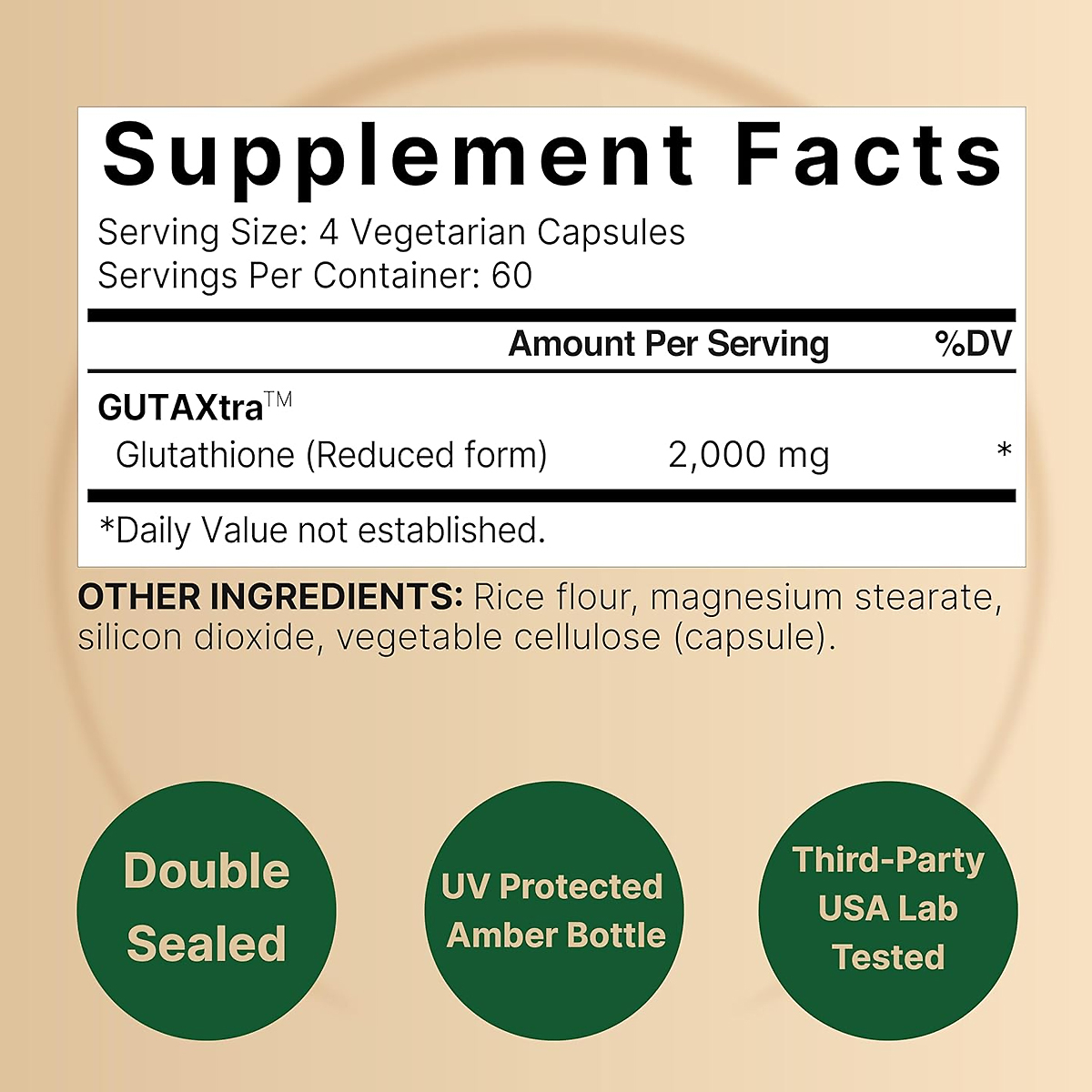
A correction, for accuracy: this store's product name says 1,000 mg per serving, and its short description describes 2-capsule daily servings and a 4-month supply. The label photographs, both the Supplement Facts panel and the front of the bottle, and the store's own longer description all say 2,000 mg per 4-capsule serving and a 60-day supply, which is what 240 capsules divided by 4 gives. We have used the label throughout. If your bottle differs, go by your bottle.
| This product | Typical trial dose | NIH RDA / AI | Tolerable Upper Limit | |
|---|---|---|---|---|
| Glutathione (reduced) | 2,000 mg per 4-capsule serving (500 mg per capsule) | 250 or 1,000 mg/day for 6 months (levels trial); 250–500 mg/day (skin trials) | None: the body makes it and it is not an essential nutrient | None established; long-term safety at 2,000 mg/day not covered in the sources reviewed |
At the label serving, this product supplies at least twice the highest daily dose in any trial discussed here, and four to eight times the doses used in the skin studies. That does not make it unsafe, and one 30-day study of a micellar formulation at 600 mg a day (Solnier et al., 2026, 14 adults) found no significant changes in liver or kidney safety markers, but it does mean the evidence does not cover this intake. The label states no upper limit and the sources reviewed set none.
What the listing claims versus what the evidence supports: the store description says the product "supports skin whitening," provides "complete liver health support," "aids in bolstering the immune system" and "supports nearly every cellular function." Those are manufacturer statements. The evidence supports raising blood glutathione at 250 to 1,000 mg a day and a modest, variable skin-melanin effect at 250 to 500 mg a day; the liver, immune and whole-body claims are not tested in the trials reviewed.
Who Might Consider It, and Who Should Skip It
Who this is for: healthy adults who have talked with a clinician, understand that the best evidence is for raising blood glutathione at half this dose, and are not counting on it for skin, liver or immune results.
Who should skip it: anyone with a liver condition, pregnant or breastfeeding, or taking medication without medical clearance; anyone interested in intravenous glutathione for skin lightening, where reviewers cite anaphylaxis and hepatotoxicity concerns; and, frankly, most people, who will get little from a dose that has not been tested.
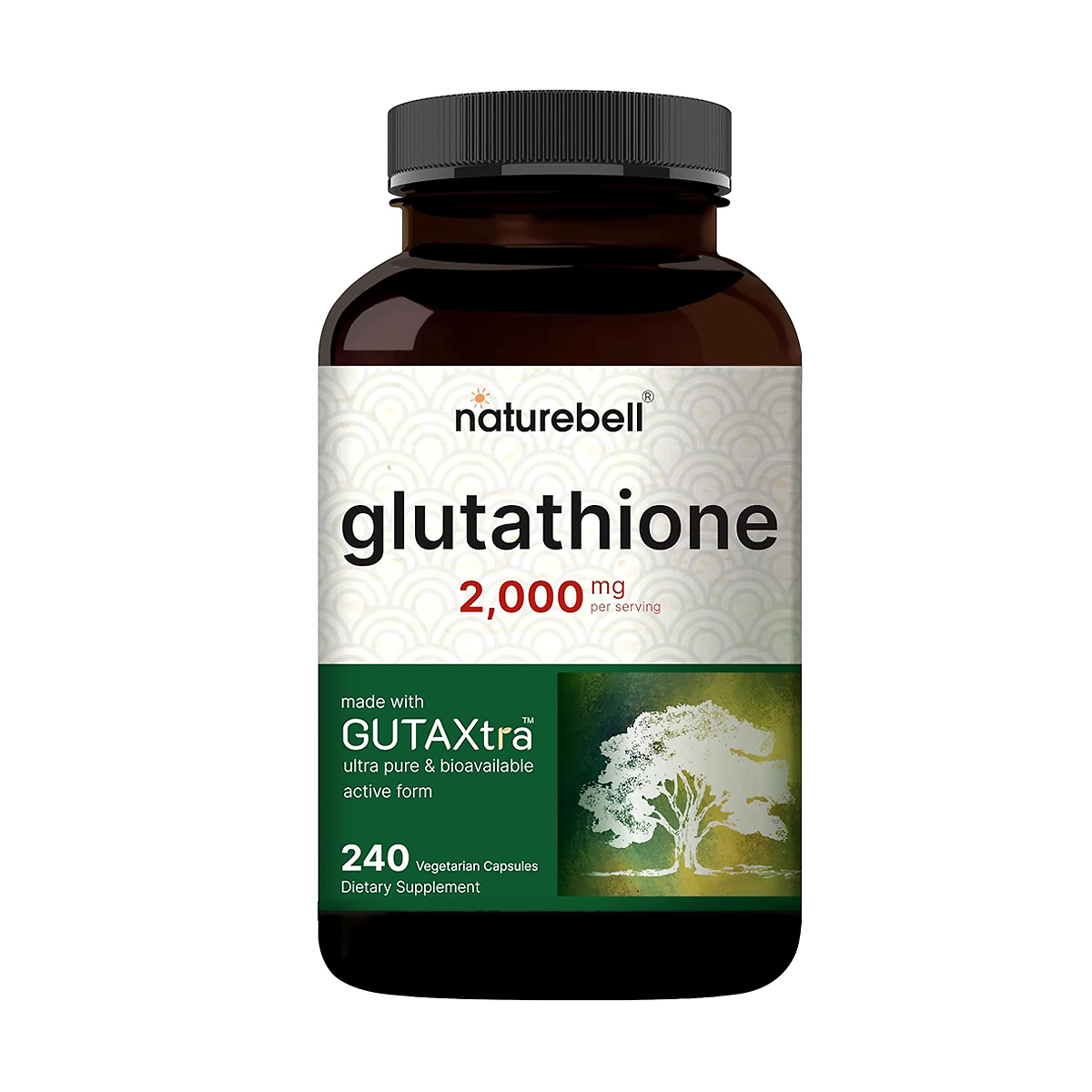
NatureBell Glutathione — 240 Vegetarian Capsules
2,000 mg of reduced glutathione per four-capsule serving, 60 servings per bottle. As covered above, trials tested 250–1,000 mg a day; this serving is at least double the highest of those. Browse more in our supplements.
View Product DetailsFrequently Asked Questions
Does oral glutathione raise glutathione levels?
Yes, in one 6-month trial. In 54 adults, 1,000 mg a day raised glutathione 30 to 35% in red cells, plasma and lymphocytes, and 250 mg raised blood levels 17%. Levels returned to baseline after a one-month washout.
Does glutathione lighten skin?
Modestly, and not durably. A 2025 systematic review found oral doses of 250 to 500 mg a day reduced a melanin index versus placebo in five randomized trials, but described the effects as unsustainable, with about half of studies at high risk of bias.
How much glutathione should I take?
No official dose exists. Trials used 250 to 1,000 mg a day. This label lists 2,000 mg per four-capsule serving, and the store directs four capsules daily. Discuss dosing with a clinician, since that intake was not tested in the trials reviewed.
Is glutathione safe?
The evidence is mixed. A 2025 systematic review described oral glutathione as having substantial adverse effects compared with topical use, while a 2025 narrative review reported limited side effects. A 30-day micellar study found no safety-marker changes at 600 mg a day. Reviewers warn against intravenous use. Safety at 2,000 mg a day is not established.
Is intravenous glutathione safe for skin lightening?
No. A 2025 review called it contraindicated due to lack of efficacy and side effects, and a narrative review cites anaphylaxis and hepatotoxicity concerns. The evidence is too limited to justify routine cosmetic use. Oral capsules are a different route.
Does glutathione detox the liver?
That claim was not tested in the human trials reviewed. The 2015 trial measured glutathione levels and one immune marker, not liver disease. Treat liver 'detox' claims as unproven and see a clinician for any liver concern.
What is the difference between reduced and liposomal glutathione?
Reduced glutathione is the active form; liposomal or micellar forms are packaged to improve absorption. A 2026 crossover study found a micellar form gave about 2.5 times more exposure than standard glutathione. This product is plain reduced glutathione.
Does the dose on the bottle match the store name?
No. The store name says 1,000 mg per serving, but the label photos say 2,000 mg per four capsules (500 mg each), and 240 capsules divided by 4 gives 60 servings. We used the label. Check your own bottle.
Sources
- Richie JP Jr, et al. Randomized controlled trial of oral glutathione supplementation on body stores of glutathione. Eur J Nutr, 2015;54(2):251-263. Accessed 29 September 2026. doi.org/10.1007/s00394-014-0706-z
- Solnier J, et al. A targeted metabolomic assessment of oral glutathione bioavailability and safety in humans: a randomized crossover clinical trial. Antioxidants, 2026;15(3):354. Accessed 29 September 2026. doi.org/10.3390/antiox15030354
- Sarkar R, et al. Glutathione as a skin-lightening agent and in melasma: a systematic review. Int J Dermatol, 2025;64(6):992-1004. Accessed 29 September 2026. doi.org/10.1111/ijd.17535
- Alzahrani TF, et al. Exploring the safety and efficacy of glutathione supplementation for skin lightening: a narrative review. Cureus, 2025;17(1):e78045. Accessed 29 September 2026. doi.org/10.7759/cureus.78045
This article is for educational purposes only and is not medical advice. It is not intended to diagnose, treat, cure, or prevent any disease. These statements have not been evaluated by the Food and Drug Administration. Talk to your doctor before starting any new supplement, especially if you are pregnant, breastfeeding, take any medication, or have a liver condition, and do not use intravenous glutathione for cosmetic purposes.