
Plants do not contain collagen. They cannot — collagen is a structural protein that only animals make. So when a bottle says "vegan collagen," it is not selling you plant-derived collagen, because no such thing exists in a capsule. What these products actually contain are the raw materials and enzyme cofactors your body uses to build its own collagen. That is a legitimate idea with one genuinely well-established pillar and several shakier ones. Here is how to tell which is which — and why the better brands are upfront about it.
Key takeaways
- Collagen is an animal protein. No plant contains it, so "plant-based collagen" is a category name, not an ingredient.
- These products are collagen-support formulas: cofactors and building blocks for your own collagen synthesis.
- Vitamin C is the strongest link in the chain — it is a required cofactor for the enzymes that stabilise collagen. Without it, collagen literally cannot form properly. That is why scurvy looks the way it does.
- Silica is the weakest. Silicon has no Recommended Dietary Allowance in the US because the evidence was judged insufficient to set one.
- Collagen-support blends are not the same product as hydrolysed collagen peptides, and the trial evidence for one does not transfer to the other.
- Why vegan collagen cannot exist in a capsule
- How your body actually builds collagen
- Vitamin C: the part that is not in doubt
- Silica and bamboo: what the evidence supports
- Collagen peptides vs collagen boosters
- How to evaluate one of these products
- What is realistic to expect
- Frequently asked questions
Why vegan collagen cannot exist in a capsule
Collagen is the most abundant protein in the human body — roughly a third of total protein — and it forms the structural scaffolding of skin, tendon, bone, cartilage and blood vessel walls. It is built from a repeating amino acid pattern wound into a distinctive triple helix.
Crucially, it is an animal protein. Plants build their structural scaffolding from cellulose, lignin and pectin instead. There is no botanical source of collagen, which means every conventional collagen supplement — powders, peptides, gummies — is derived from bovine, porcine, chicken or marine sources.
Two honest footnotes. First, genuine vegan collagen can be produced by inserting human collagen genes into yeast or bacteria and fermenting it — this is real biotechnology, used in medical and cosmetic materials. It is expensive and essentially absent from the consumer supplement aisle, so it is almost certainly not what is in a $29 bottle. Second, the better brands in this category state the distinction plainly on their own packaging: that the formula supports your body's collagen production rather than supplying collagen. When a label says that, it is being straight with you, and that is worth rewarding.
How your body actually builds collagen
Understanding the assembly process tells you exactly which ingredients could plausibly matter. As described in Biochemistry, Collagen Synthesis on the NIH's NCBI Bookshelf, the process runs roughly like this:
- Amino acid supply. Cells assemble procollagen chains rich in glycine, proline and lysine. Adequate total protein intake supplies these.
- Hydroxylation. Enzymes called prolyl and lysyl hydroxylase modify proline and lysine residues. These enzymes require vitamin C. This is the rate-limiting, non-negotiable step.
- Triple helix formation. Three chains wind together. The hydroxylated residues from step 2 form the hydrogen bonds that hold the helix stable — which is why step 2 matters so much.
- Secretion and cross-linking. Procollagen is exported from the cell, trimmed, and cross-linked into mature fibrils by lysyl oxidase, a copper-dependent enzyme.
So the genuinely defensible targets are: enough total protein, sufficient vitamin C, and adequate trace minerals such as copper and zinc. Notice what is not on that list — there is no step where silicon is required.
Vitamin C: the part that is not in doubt
If a collagen-support formula contains one thing worth paying for, it is vitamin C.
The NIH Office of Dietary Supplements lists collagen biosynthesis as a primary function of vitamin C, noting that "collagen is an essential component of connective tissue, which plays a vital role in wound healing."
The clinical proof is scurvy. Deprived of vitamin C, the hydroxylation step fails, collagen cannot form a stable helix, and existing connective tissue degrades. The result — bleeding gums, wounds reopening, skin haemorrhages, loosened teeth — is a disease of collagen failure. Few nutrient-function relationships in biology are demonstrated this unambiguously.
Zinc and copper deserve a similar framing: both participate in connective tissue metabolism, and deficiency impairs it, but supplementation above sufficiency has not been shown to boost collagen in healthy people. The NIH zinc fact sheet is worth reading before adding zinc separately, since excess zinc interferes with copper absorption — an own goal for collagen cross-linking.
Two physicians review what the collagen supplement evidence supports.
Silica and bamboo: what the evidence supports
Bamboo extract appears in nearly every vegan collagen formula because it is a concentrated natural source of silica (silicon dioxide). The marketing claim is that silica acts as a structural component or "glue" for connective tissue.
Here is the state of play, stated fairly. Silicon is present in connective tissue, and some observational research has associated higher dietary silicon intake with better bone density measures. There is a plausible mechanistic story.
But the honest counterweight is this: silicon has no Recommended Dietary Allowance or Adequate Intake in the United States. When US nutrient reference values were set, the evidence was judged insufficient to establish one — there is no defined requirement, no recognised deficiency state in humans, and no established dose. That is a meaningful signal about the maturity of the evidence, and it stands in obvious contrast to vitamin C, where the biochemistry is textbook.
| Ingredient | Role in collagen synthesis | Strength of evidence |
|---|---|---|
| Vitamin C | Required enzyme cofactor for hydroxylation | Established — textbook biochemistry |
| Total dietary protein | Supplies glycine, proline, lysine | Established |
| Copper | Cofactor for lysyl oxidase cross-linking | Established as a requirement; supplementation benefit unproven |
| Zinc | Involved in protein synthesis and wound healing | Requirement established; supplementation benefit unproven |
| Silica / bamboo | Proposed structural contributor | Weak — no US RDA or AI established |
None of this makes silica harmful or a formula worthless. It means the vitamin C in the bottle is on much firmer ground than the bamboo, and you should weight the label accordingly.
Collagen peptides vs collagen boosters
These are frequently conflated, including in comparison articles, and they are different products with different evidence bases.
| Hydrolysed collagen peptides | Vegan collagen support | |
|---|---|---|
| Contains collagen? | Yes — animal-derived, broken into short peptides | No |
| Mechanism | Peptides absorbed; may signal fibroblasts to increase collagen production | Supplies cofactors and substrate for your own synthesis |
| Human trial evidence for skin | Several randomised trials reporting modest improvements in elasticity and hydration | Little direct trial evidence on the finished blends |
| Suitable for vegans | No | Yes |
You will find bold statistics circulating for plant-based collagen — specific percentage reductions in wrinkles and pore size. Trace those numbers and they generally lead to brand-commissioned studies or marketing pages rather than independent peer-reviewed trials. We have deliberately not repeated them here, because we could not verify them against a primary source. Treat any such figure as unverified until you can find the study behind it.
The fair summary: hydrolysed collagen peptides have modest but real human evidence for skin outcomes. Collagen-support blends have sound underlying biochemistry but far less direct evidence that the finished product changes how skin looks.
How to evaluate one of these products
- Check that the label is honest. A product stating it supports your body's own collagen production is being accurate. One implying it contains plant collagen is not.
- Find the vitamin C dose. This is the ingredient with real biochemistry behind it. If the formula is vague about it, that tells you something.
- Be wary of proprietary blends. "Plant collagen boosters" as a single pooled weight prevents you from checking any individual dose — which is usually why it is done that way.
- Assess your protein intake first. Collagen synthesis needs amino acids. If overall protein intake is low, no cofactor blend compensates. This is the least glamorous and most impactful item on the list.
- Do not neglect sunscreen. Ultraviolet radiation degrades existing collagen and suppresses new synthesis. Daily sun protection preserves more collagen than any supplement adds — this is not a close contest.
- Give it 8–12 weeks. Skin turnover and connective tissue remodelling are slow. Judge nothing at three weeks.
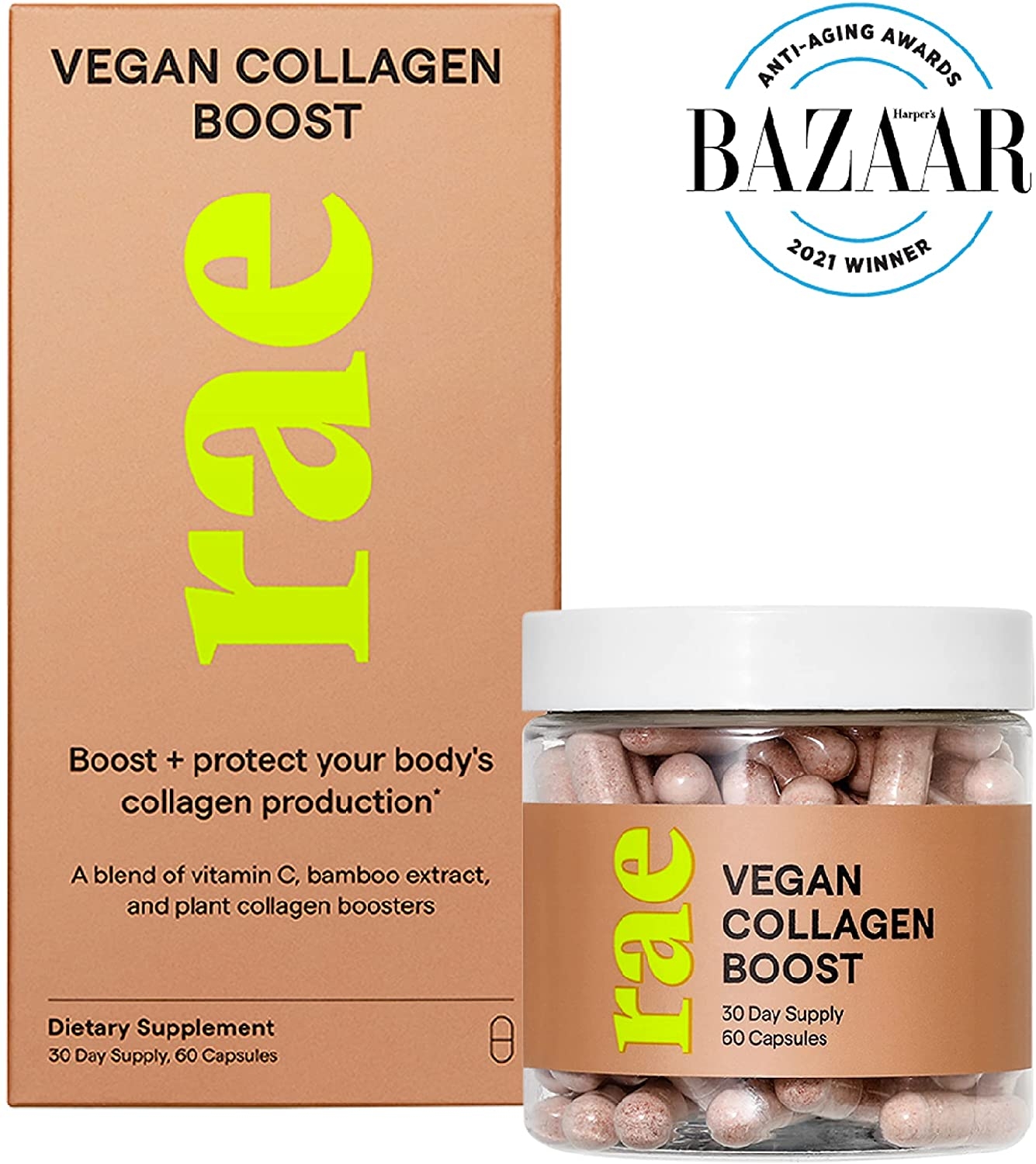
Rae Wellness Vegan Collagen Boost — Plant-Based Collagen Support for Women, 60 Capsules
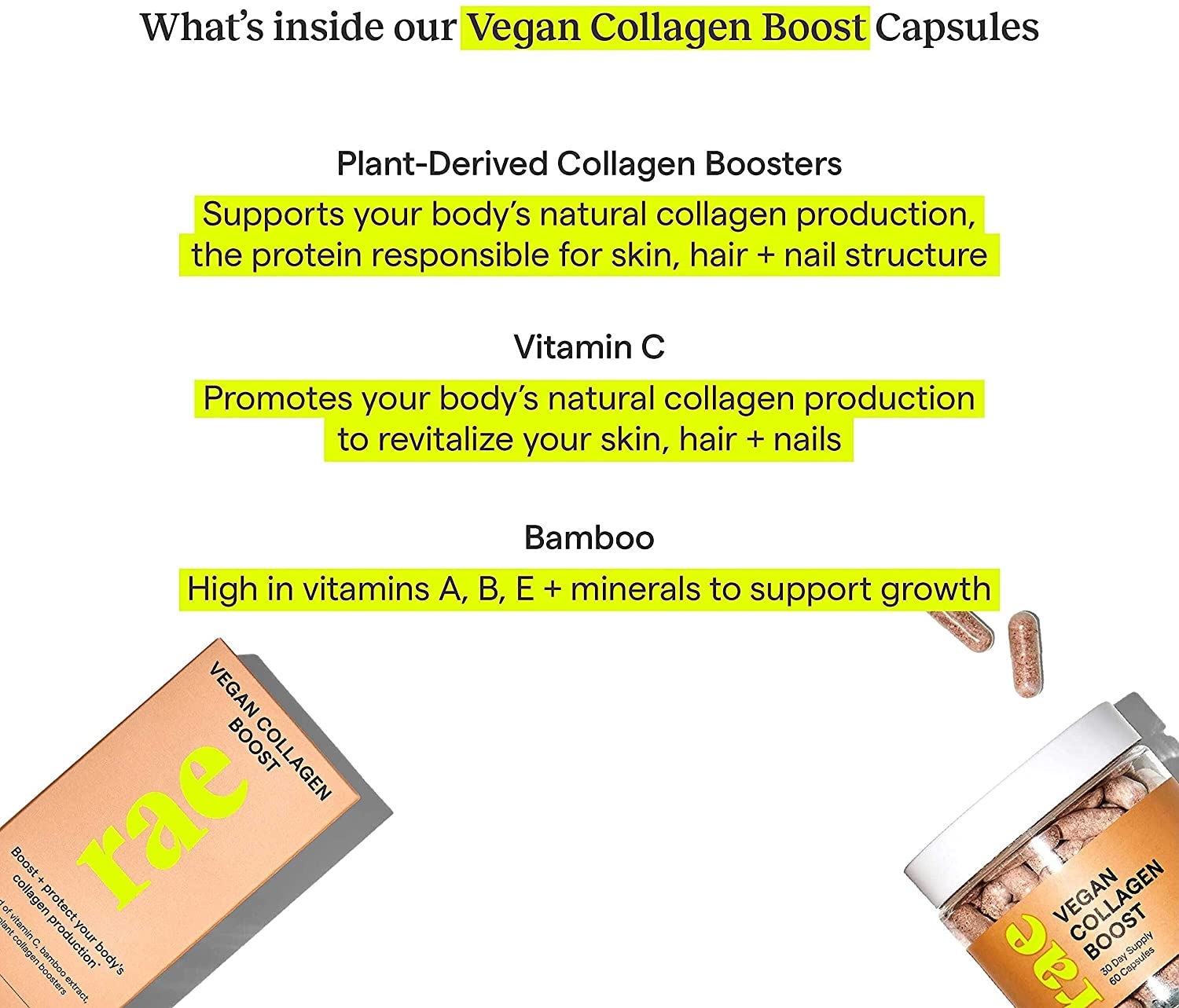
An example of the category handled honestly: the brand states outright that, unlike animal-derived collagen supplements, this formula does not provide collagen directly but supplies nutrients supporting your body's own production. It combines vitamin C — the cofactor discussed in §3 — with bamboo extract for silica and a plant-based booster blend. Two capsules daily with food.
Browse related options in Women's Health and Vitamins & Minerals.
What is realistic to expect
Collagen declines with age — that is normal biology, not a deficiency to be corrected. It is also driven substantially by factors no capsule addresses: ultraviolet exposure, smoking, high sugar intake and its effect on protein cross-linking, and sleep quality.
A collagen-support supplement is best understood as removing a potential limitation rather than adding a benefit. If your vitamin C intake is marginal, correcting it lets collagen synthesis proceed properly. If it was already adequate, the ceiling was never the cofactor, and topping it up will not raise it.
That is a less exciting proposition than the category advertises, and it is the accurate one. The interventions with the largest effect on how skin ages remain daily sun protection, not smoking, adequate protein, and sleep — none of which are sold in capsules.
A board-certified dermatologist on collagen supplements and skin.
Frequently asked questions
Is vegan collagen real?
Not as a plant-derived ingredient. Collagen is an animal protein and no plant contains it, so "vegan collagen" supplements are collagen-support formulas supplying cofactors and building blocks rather than collagen itself. Genuine vegan collagen can be produced by fermenting genetically engineered yeast or bacteria, but this is a biotechnology material rather than a typical consumer supplement ingredient.
Does vegan collagen actually work?
The underlying biochemistry is sound — vitamin C is genuinely required for collagen synthesis — but there is little direct human trial evidence that finished collagen-support blends visibly change skin. It is best understood as ensuring your body is not short of what it needs, rather than as boosting production above normal.
What is the difference between collagen peptides and vegan collagen?
Hydrolysed collagen peptides are animal-derived collagen broken into short absorbable fragments, and several randomised trials report modest improvements in skin elasticity and hydration. Vegan collagen products contain no collagen at all and instead supply nutrients such as vitamin C and silica. The trial evidence for peptides does not transfer to the support blends.
Does vitamin C really help collagen?
Yes, and this is one of the better-established facts in nutrition. Vitamin C is a required cofactor for the prolyl and lysyl hydroxylase enzymes that stabilise the collagen triple helix. Scurvy is essentially a disease of failed collagen synthesis. However, extra vitamin C beyond sufficiency does not appear to increase collagen production further.
Does bamboo silica boost collagen?
Evidence is weak. Silicon is present in connective tissue and some observational research links intake to bone density measures, but silicon has no Recommended Dietary Allowance or Adequate Intake in the United States because the evidence was judged insufficient to set one. It is on much less firm ground than vitamin C.
How long until I see results?
Allow 8 to 12 weeks. Skin turnover and connective tissue remodelling are slow processes. Bear in mind that daily sun protection, adequate protein, not smoking and good sleep have a larger effect on how skin ages than any supplement in this category.
- Biochemistry, Collagen Synthesis — StatPearls, NCBI Bookshelf (National Library of Medicine)
- NIH Office of Dietary Supplements — Vitamin C (Health Professional)
- NIH Office of Dietary Supplements — Vitamin C (Consumer)
- NIH Office of Dietary Supplements — Zinc (Health Professional)
- MedlinePlus (U.S. National Library of Medicine) — Vitamin C
- U.S. Food and Drug Administration — Dietary Supplements
Medical disclaimer. This article is for general education and is not medical advice. It is not a substitute for diagnosis or treatment from a qualified healthcare professional. Talk to your doctor or pharmacist before starting any supplement, particularly if you are pregnant or breastfeeding, managing a health condition, or taking prescription medication.
These statements have not been evaluated by the Food and Drug Administration. This product is not intended to diagnose, treat, cure, or prevent any disease.