
Colloidal oatmeal is one of the very few skincare ingredients the U.S. Food and Drug Administration formally recognises as an active drug ingredient. It is not a botanical flourish added for the label. Under federal regulation it qualifies as an over-the-counter skin protectant at concentrations as low as 0.007% — which makes a 2% formula roughly 285 times the regulatory minimum. Here is what colloidal oatmeal actually does to irritated skin, what the National Institutes of Health recommend for eczema-prone skin day to day, and how to tell a serious formula from a decorative one.
Key takeaways
- Colloidal oatmeal is an FDA-monographed OTC skin protectant, listed in 21 CFR 347.10 — a regulatory status almost no "natural" ingredient holds.
- The monograph minimum is 0.007%. Concentration is the single most useful number on an eczema product label.
- NIAMS advises lukewarm baths, once daily maximum, mild unscented cleansers, and moisturising immediately after patting dry.
- Fragrance is a named environmental trigger for atopic dermatitis — "fragrance-free" is a clinical feature, not a preference.
- NIAMS specifically prefers creams and ointments over thin, high-water or alcohol-containing lotions, which can sting broken skin. Texture matters as much as active ingredient.
What colloidal oatmeal actually is
Colloidal oatmeal is not oatmeal. It is whole oat kernel (Avena sativa) ground to a specific fineness and processed so the particles stay suspended in liquid rather than settling out — that suspension is what "colloidal" means. Tipping breakfast oats into a bath does something vaguely similar and much less effectively.
The reason it earns its place in dermatology comes down to three families of compounds that survive that processing:
- Beta-glucans. Long-chain polysaccharides that form a hydrophilic film on the skin surface, holding water against the stratum corneum. This is the moisture-retention mechanism.
- Avenanthramides. Polyphenols effectively unique to oats, studied for their anti-irritant and anti-itch activity. They are the reason oat extract behaves differently from other starches.
- Saponins. Naturally occurring surfactants that give oats a mild cleansing action without the harshness of detergent soap.
Together these produce the effect the FDA recognises: a physical protective barrier over compromised skin, plus relief of the minor irritation and itching that comes with it.
Why FDA drug status matters here
Most skincare is regulated as cosmetics, which means claims are loosely policed and ingredients need no proof of effect. Colloidal oatmeal sits in a different category entirely. It appears in the Code of Federal Regulations as an approved skin protectant active ingredient under 21 CFR 347.10, part of the FDA's over-the-counter monograph system for skin protectant drug products.
In practice that means a product containing an adequate concentration is legally an OTC drug, carries a Drug Facts panel rather than just an ingredients list, and may make specific protectant claims. The regulation sets the floor at 0.007% colloidal oatmeal — or 0.003% when combined with mineral oil.
Atopic dermatitis: what NIH says about it
Atopic dermatitis is the most common form of eczema. The National Institute of Arthritis and Musculoskeletal and Skin Diseases describes it as a common condition that usually begins in childhood, though anyone can develop it at any age.
A few patterns from NIAMS are worth knowing, because they shape what a sensible routine looks like:
| Aspect | What NIAMS reports |
|---|---|
| Core symptom | Intense itching — the defining feature, not the rash itself |
| Appearance | Red, dry patches; rashes that may ooze or bleed when scratched; skin thickening and hardening over time |
| Where it appears | Infants: face and scalp. Children: elbows, knees, neck. Adults: hands, neck, around the eyes |
| Who it affects | More frequent in non-Hispanic Black children; slightly more common in women and girls |
| Risk factors | Family history of atopic dermatitis, hay fever or asthma |
| Causes | Genes, the immune system and the environment acting together |
| Named triggers | Tobacco smoke, air pollutants, fragrances in soaps and skincare products, excessively dry skin |
That last row explains why fragrance-free formulation is not a marketing nicety for this population. A federal health institute lists fragrance in skincare as an environmental trigger. "Unscented," incidentally, is not the same claim — it can mean masking fragrance has been added to cover a base odour. Fragrance-free is the term with meaning.
The Eczema Society of Canada on bathing and moisturising for atopic dermatitis.
The soak-and-seal routine, step by step
The most consequential thing you can do for eczema-prone skin costs nothing: change when you moisturise. Water is only helpful if you trap it. Left alone, a bath is net drying, because evaporation pulls moisture out of the skin as it goes.
The approach clinicians call "soak and seal" — described by the National Eczema Association and consistent with NIAMS treatment guidance:
- Soak in lukewarm water for 10–15 minutes. Not hot. Heat strips lipids from the skin barrier and provokes itching. NIAMS advises limiting baths to once a day.
- Use a mild, unscented cleanser — sparingly. Regular soap is alkaline and defatting. Wash where you need to, not everywhere by default.
- Pat dry gently, leaving skin slightly damp. Do not rub with the towel. You want the skin still holding surface water.
- Apply medication first, if you have been prescribed any. Topical steroids or non-steroidal prescriptions go onto affected areas before the moisturiser layer.
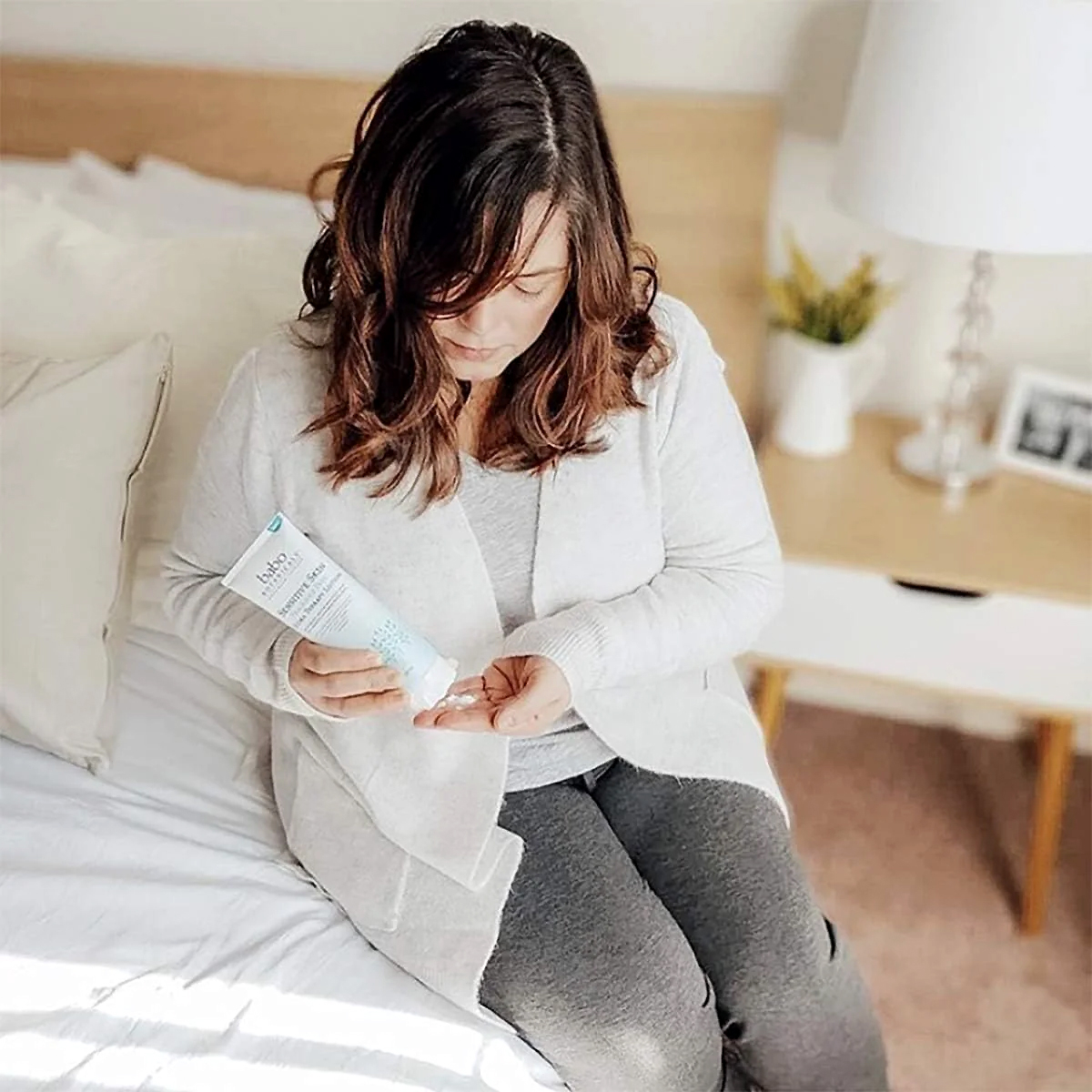
- Seal within three minutes. This is the part people skip. Moisturiser applied to damp skin locks water in; applied twenty minutes later to dry skin, it is doing a fraction of the job.
Repeat the sealing step at least twice daily, and after every hand wash if hands are affected. Consistency beats intensity — the barrier repairs gradually.
Reading a sensitive-skin label properly
Once you know what to look for, the useful information on a sensitive-skin product is a short list:
- A stated active percentage. "2% colloidal oatmeal" is a specification. "Contains oat" is a suggestion.
- Fragrance-free, explicitly. Given NIAMS lists fragrance as a trigger, this is non-negotiable for reactive skin.
- Occlusive and emollient content. Shea butter, sunflower oil and similar lipids do the sealing work that beta-glucans alone cannot. A formula combining a humectant active with real lipids is doing both halves of the job.
- A short ingredient list. Every additional botanical is another sensitisation candidate. For genuinely reactive skin, minimalism is a feature.
- Patch test anyway. Apply to a small area on the inner forearm for a few days before committing to broad application. "Hypoallergenic" is not a regulated term in the United States.
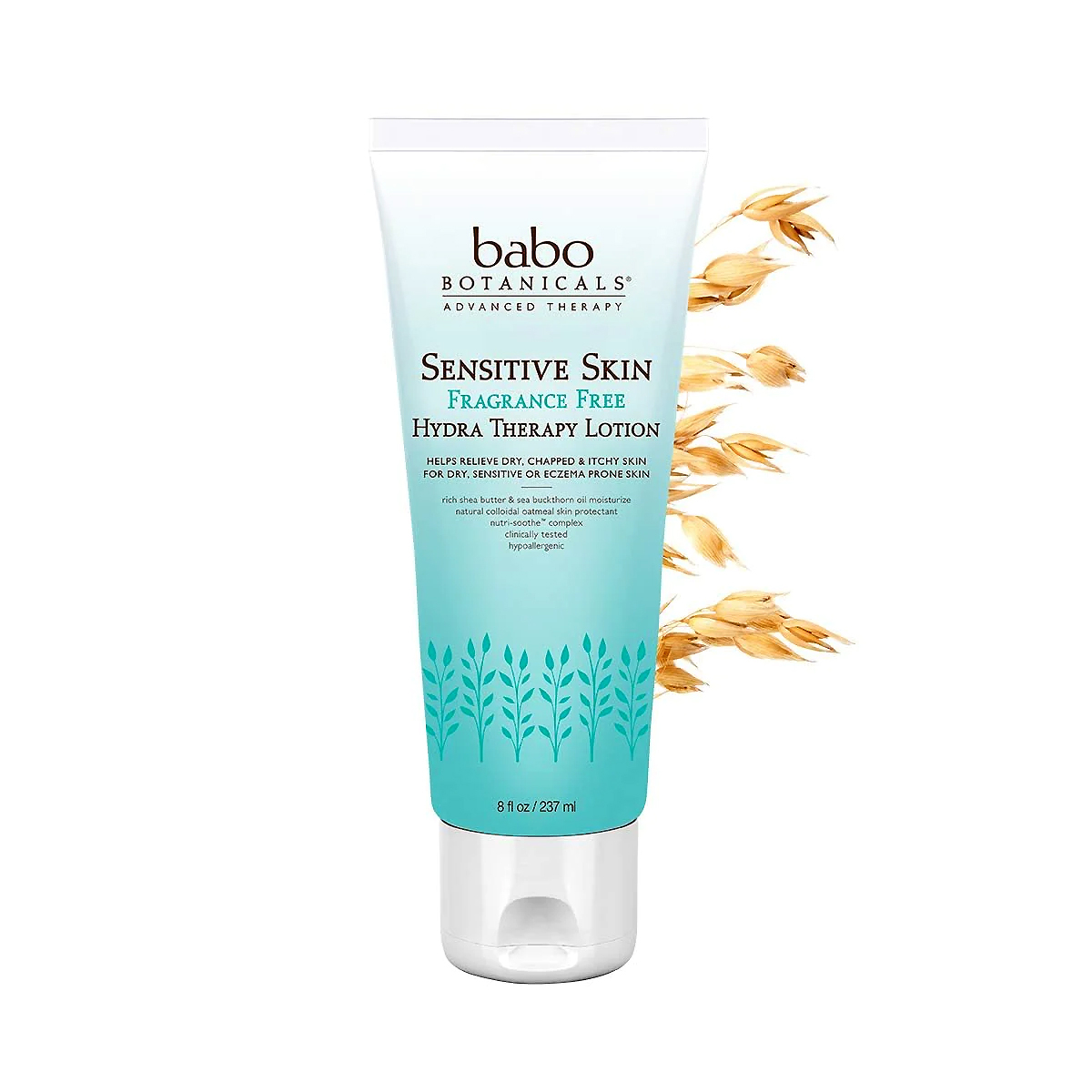
Babo Botanicals Sensitive Skin Therapy Lotion — Fragrance-Free, 2% Colloidal Oatmeal, 8 oz
A practical example of the criteria above: a stated 2% colloidal oatmeal active, fragrance-free, with shea butter, sunflower and sea buckthorn oils supplying the lipid layer. Non-greasy enough for daily full-body use, which matters when the routine calls for twice-daily application. For external use only; avoid contact with eyes.
Lotion, cream or ointment?
Here is a point most product pages will not make, and it is worth being straight about. NIAMS guidance explicitly favours creams and ointments and advises avoiding "lotions with high water or alcohol content, which can cause burning."
The distinction is about oil-to-water ratio:
| Format | Character | Best suited to |
|---|---|---|
| Lotion | Highest water content, lightest, spreads easily, absorbs fast | Large areas, daily maintenance, mild dryness, humid weather |
| Cream | Balanced oil and water, thicker, more occlusive | Moderate dryness, most eczema-prone skin, year-round use |
| Ointment | Mostly oil, greasy, minimal or no water | Cracked, severely dry or actively flaring skin; overnight use |
A well-built lotion with a meaningful oatmeal percentage and real butters and oils is a reasonable daily maintenance choice, particularly for large surface areas where an ointment would be impractical. But if skin is cracked, weeping or actively flaring, step up to a cream or ointment for that period. The right answer changes with the state of your skin and often with the season.
Choosing and applying moisturisers for atopic dermatitis.
When to stop self-treating and see a doctor
Barrier care is foundational, but it is not a treatment for moderate or severe disease. Seek medical advice if:
- Itching is disrupting sleep or daily function
- Skin is cracked, weeping, crusting yellow, or you develop fever — possible infection, which eczema-prone skin is prone to
- Patches keep spreading despite consistent moisturising
- You are reaching for over-the-counter hydrocortisone for more than a week or two at a time
- The condition is affecting a child's sleep, growth or schooling
Effective prescription options have expanded considerably in recent years, including non-steroidal topicals and biologics for severe disease. The American Academy of Dermatology's eczema resource centre and MedlinePlus are reliable places to prepare for that conversation.
NIAMS also flags supporting habits that are easy to overlook: keep fingernails short to limit scratching damage, avoid rough fabrics such as wool, maintain a stable cool indoor temperature and humidity, and manage stress — a documented flare trigger.
Frequently asked questions
Is colloidal oatmeal FDA approved?
Colloidal oatmeal is recognised by the FDA as an over-the-counter skin protectant active ingredient under 21 CFR 347.10. Products containing it at monograph concentrations are regulated as OTC drugs rather than cosmetics and carry a Drug Facts panel.
How much colloidal oatmeal does a product need to be effective?
The federal monograph sets a minimum of 0.007% colloidal oatmeal, or 0.003% when combined with mineral oil. Commercial therapeutic formulas typically use 1–2%, which is well above the regulatory floor. If a label does not state a percentage, the ingredient may be present in only token amounts.
Can I just put regular oats in the bath instead?
Not equivalently. Colloidal oatmeal is milled to a particle size that stays suspended in water so it can coat the skin. Ordinary oats largely sink and deliver far less of the beta-glucans and avenanthramides responsible for the barrier and anti-irritant effects.
How soon after a bath should I apply moisturiser?
Within about three minutes, onto skin that is still slightly damp after gentle patting. This "soak and seal" timing traps water in the skin. Applying moisturiser to fully dry skin much later is significantly less effective.
Is a lotion good enough for eczema, or do I need a cream?
NIAMS favours creams and ointments and cautions against lotions high in water or alcohol, which can sting broken skin. A rich, fragrance-free lotion with a stated oatmeal percentage and lipids such as shea butter works well for daily maintenance over large areas, but cracked or actively flaring skin generally does better with a cream or ointment.
Does fragrance-free really matter?
Yes. NIAMS lists fragrances in soaps and skincare products among the environmental triggers for atopic dermatitis. Note that "unscented" can mean a masking fragrance was added; "fragrance-free" is the more meaningful label claim.
- eCFR — 21 CFR 347.10, Skin Protectant Active Ingredients
- NIH NIAMS — Atopic Dermatitis: Overview, Symptoms & Causes
- NIH NIAMS — Atopic Dermatitis: Diagnosis, Treatment & Steps to Take
- MedlinePlus (U.S. National Library of Medicine) — Eczema
- National Eczema Association — Bathing and Eczema
- American Academy of Dermatology — Eczema Resource Center
Medical disclaimer. This article is for general education and is not medical advice. It is not a substitute for diagnosis or treatment from a qualified healthcare professional. If you have persistent, severe or infected skin symptoms, consult a doctor or dermatologist. Patch test new products before broad use.
These statements have not been evaluated by the Food and Drug Administration. This product is not intended to diagnose, treat, cure, or prevent any disease.