
The FDA’s over-the-counter anorectal monograph allows witch hazel at 10 to 50 percent in a hemorrhoid product (21 CFR 346.18), yet the American Gastroenterological Association’s 2026 clinical practice update says there is “little data to support efficacy” for topical treatments, witch hazel included. Witch hazel (Hamamelis virginiana) is a shrub whose extract is applied to the skin as an astringent, a drug that tightens the surface of irritated tissue. The cream below lists it with menthol, but neither its listing nor its four photos say how much of either is inside.
Key Takeaways
- The FDA monograph (21 CFR Part 346, text read 21 October 2026) sets witch hazel at 10 to 50 percent and menthol at 0.1 to 1 percent; this product’s listing states neither figure.
- The AGA’s 2026 update says topical astringents such as witch hazel “can be considered” but have little data behind them; fiber and avoiding straining come first.
- A 2006 meta-analysis of 7 trials in 378 people found fiber cut the risk of persisting hemorrhoid symptoms by 47 percent.
- NIDDK (reviewed October 2016) says doctors most often recommend over-the-counter creams for 1 week, and to see a doctor for any rectal bleeding.
- Hemorrhoids affect about 1 in 20 Americans and about half of adults over 50 (NIDDK, October 2016).
In this article:
- What Hemorrhoids Are, and When a Cream Is the Wrong Tool
- What the FDA Monograph Allows
- Does Witch Hazel Work? What the 2026 AGA Update Says
- What the Evidence Does Support: Fiber
- Calendula, Chamomile, Horse Chestnut and Aloe: What the Extras Add
- When to Stop Using a Cream and See a Doctor
- Inside Earth’s Care Hemorrhoid Relief Cream
- Who Might Consider It, and Who Should Skip It
- Frequently Asked Questions
What Hemorrhoids Are, and When a Cream Is the Wrong Tool
Hemorrhoids, also called piles, are swollen and inflamed veins around the anus or in the lower rectum, according to the National Institute of Diabetes and Digestive and Kidney Diseases (NIDDK). NIDDK (last reviewed October 2016) says about 1 in 20 Americans have them, and about half of adults older than 50.
This cream is labeled for external use only, so it is aimed at the external kind. NIDDK’s symptoms page lists itching, hard tender lumps and an ache when sitting, and says that for many people these “go away within a few days.” Not every anal symptom is a hemorrhoid, as the table shows.
| Symptom | What the sources say it may be | Is a cream the right first step? |
|---|---|---|
| Itching, burning or a tender lump near the anus | External hemorrhoid (NIDDK, October 2016) | Reasonable for mild symptoms: NIDDK says creams may relieve mild pain, swelling and itching |
| Bright red blood on stool, tissue or in the bowl | Often an internal hemorrhoid, but it can also signal Crohn’s, ulcerative colitis or colorectal cancer (NIDDK) | No: NIDDK says to see a doctor for any rectal bleeding |
| Sharp pain during bowel movements | Most likely an anal fissure, not a hemorrhoid (AGA, 2026) | No: hemorrhoids only cause significant pain when acutely thrombosed (AGA) |
| Severe anal pain and bleeding, with belly pain, diarrhea or fever | A reason to seek care right away (NIDDK) | No: NIDDK says to seek medical care right away |
Mayo Clinic Health System, “Hemorrhoid Help”: general background from a clinical institution; we have not checked its claims.
What the FDA Monograph Allows
Over-the-counter hemorrhoid products are regulated through an FDA monograph, 21 CFR Part 346, first published on 3 August 1990 (55 FR 31779). Under §346.1, a product is “generally recognized as safe and effective” if it meets every condition: ingredient, concentration, permitted claims and required warnings. Like the one for salicylic acid in acne products, it turns a vague promise into numbers you can check.
| Class | Ingredient and permitted range | What the label may say |
|---|---|---|
| Astringent (§346.18) | Witch hazel, 10 to 50 percent; also calamine and zinc oxide, 5 to 25 percent | “Aids in protecting irritated anorectal areas”; temporary relief of irritation or burning |
| Analgesic, anesthetic, antipruritic (§346.16) | Menthol, 0.1 to 1 percent; also camphor 0.1 to 3 percent | Temporary relief of pain or burning; “can help distract from pain”; “may provide a cooling sensation” |
| Vasoconstrictor (§346.12) | Phenylephrine hydrochloride, 0.25 percent; ephedrine sulfate, 0.1 to 1.25 percent | “Temporarily shrinks hemorrhoidal tissue” |
Two things follow. First, witch hazel plus menthol is a permitted pairing under §346.22(g). Second, the claim to shrink tissue belongs to the vasoconstrictors alone, so a witch hazel and menthol cream cannot claim to shrink hemorrhoids; the monograph’s witch hazel wording is about protecting and relieving irritation and burning.
The product’s “No Vasoconstrictors” banner has a real meaning: §346.50 requires vasoconstrictor products to warn people with heart disease, high blood pressure, thyroid disease, diabetes or an enlarged prostate, and this one carries none of those warnings. It also means the cream makes no promise about swelling.
Does Witch Hazel Work? What the 2026 AGA Update Says
The monograph says what a label may claim, not how a witch hazel cream performs in trials. The most recent clinician-facing guidance is the AGA Clinical Practice Update on hemorrhoids, published online on 29 April 2026 in Clinical Gastroenterology and Hepatology. Its third best-practice statement covers this product type:
“Topical treatments, including anesthetics, astringents (witch hazel), corticosteroids, and vasoactive agents, can be considered for treatment of symptomatic hemorrhoids, but there is little data to support efficacy.”
— Qureshi et al., AGA Clinical Practice Update, Clinical Gastroenterology and Hepatology (2026), best practice advice 3Read it carefully: it does not say witch hazel fails. It says a clinician may consider it and that few data exist, and the AGA notes its statements come from the literature and expert opinion, without formal evidence ratings. Steroid creams, it adds, should not be used for more than 2 weeks at a time.
The monograph and the AGA answer different questions: the 1990 rule decided what may be sold without a prescription and how it is labeled, while the 2026 update comments on published trials. I did not read the 1990 preamble, so I cannot say what data it rested on. One permits; the other finds the proof thin.
What the Evidence Does Support: Fiber
The best-supported advice is the least exciting. NIDDK’s treatment page (October 2016) puts high-fiber foods, a stool softener or a fiber supplement such as psyllium, liquids, and not straining ahead of any cream. Its diet page cites the Dietary Guidelines for Americans, 2020–2025: 28 grams of fiber a day on 2,000 calories.
The key trial evidence is a 2006 systematic review in the American Journal of Gastroenterology by Alonso-Coello and colleagues: seven randomized trials, 378 people with symptomatic hemorrhoids, fiber versus a non-fiber control. Persisting symptoms fell by 47 percent (relative risk 0.53, 95% CI 0.38 to 0.73) and bleeding by 50 percent (relative risk 0.50, 95% CI 0.28 to 0.89). For prolapse, pain and itching the intervals were wide enough to include no effect.
That matters for a cream shopper: fiber works on the cause (hard stools and straining), while a cream only treats the surface. If you want a fiber supplement, our article on glucomannan covers a soluble fiber with a swallowing warning, though its trials looked at weight and cholesterol, not hemorrhoids.
Calendula, Chamomile, Horse Chestnut and Aloe: What the Extras Add
Earth’s Care says its “proprietary blend” adds calendula, horse chestnut, aloe vera and chamomile to the two named actives. None appears in 21 CFR Part 346, so the monograph sets no range for them and permits no hemorrhoid claim on their behalf.
The NIH’s National Center for Complementary and Integrative Health (NCCIH, updated April 2025) says horse chestnut seed extract was traditionally used for hemorrhoids but is promoted today for chronic venous insufficiency, a leg-vein condition. The research it summarizes concerns that condition, and “very little research has been done on its use for other conditions.” I did not review evidence for calendula or aloe vera, so this article makes no claim about either.
Chamomile is the one to watch for allergy. NCCIH (updated November 2024) says people “are more likely to experience allergic reactions to chamomile if they’re allergic to related plants such as ragweed, chrysanthemums, marigolds, or daisies.” Calendula is commonly called pot marigold, so two listed plants matter for a reader with such an allergy.
The same NCCIH page carries further cautions. It says chamomile “might worsen any condition that is sensitive to exposure to estrogen, such as breast or uterine cancer,” that interactions with warfarin and some drugs metabolized by the liver have been reported, and that little is known about its safety in pregnancy or breastfeeding. NCCIH says the same of horse chestnut seed extract in pregnancy and breastfeeding. NCCIH does not say whether these cautions extend to a cream, and the listing does not say how much of either plant the cream contains, but anyone in those groups should ask a clinician before using it.
When to Stop Using a Cream and See a Doctor
Bleeding is a reason to see a doctor, not a reason to buy a cream. NIDDK says to seek help for any bleeding from the rectum, and notes that it can be a sign of Crohn’s disease, ulcerative colitis or cancer of the colon or rectum. The monograph requires every hemorrhoid product to say “In case of bleeding, consult a doctor promptly.”
The same label text sets the other limits. §346.50 requires “If condition worsens or does not improve within 7 days, consult a doctor,” matching NIDDK’s 1 week. External products must say not to put them into the rectum with fingers or an applicator, and menthol products must warn of allergic reactions: if redness, irritation, swelling or pain develop or increase, stop and consult a doctor. For children under 12, consult a doctor.
Inside Earth’s Care Hemorrhoid Relief Cream
The product in our catalogue as Hemorrhoid Relief Cream 1 Oz Witch Hazel No Parabens Earth’s Care is Earth’s Care Hemorrhoid Relief Cream, a 1 oz (28 g) tube sold for $8.99 and in stock when I checked. The tube says “Dual-Action formula” with witch hazel and menthol; the listing adds no vasoconstrictors, steroids, petrochemicals, parabens or perfumes, and directs: “apply externally to the affected area up to 6 times daily.”
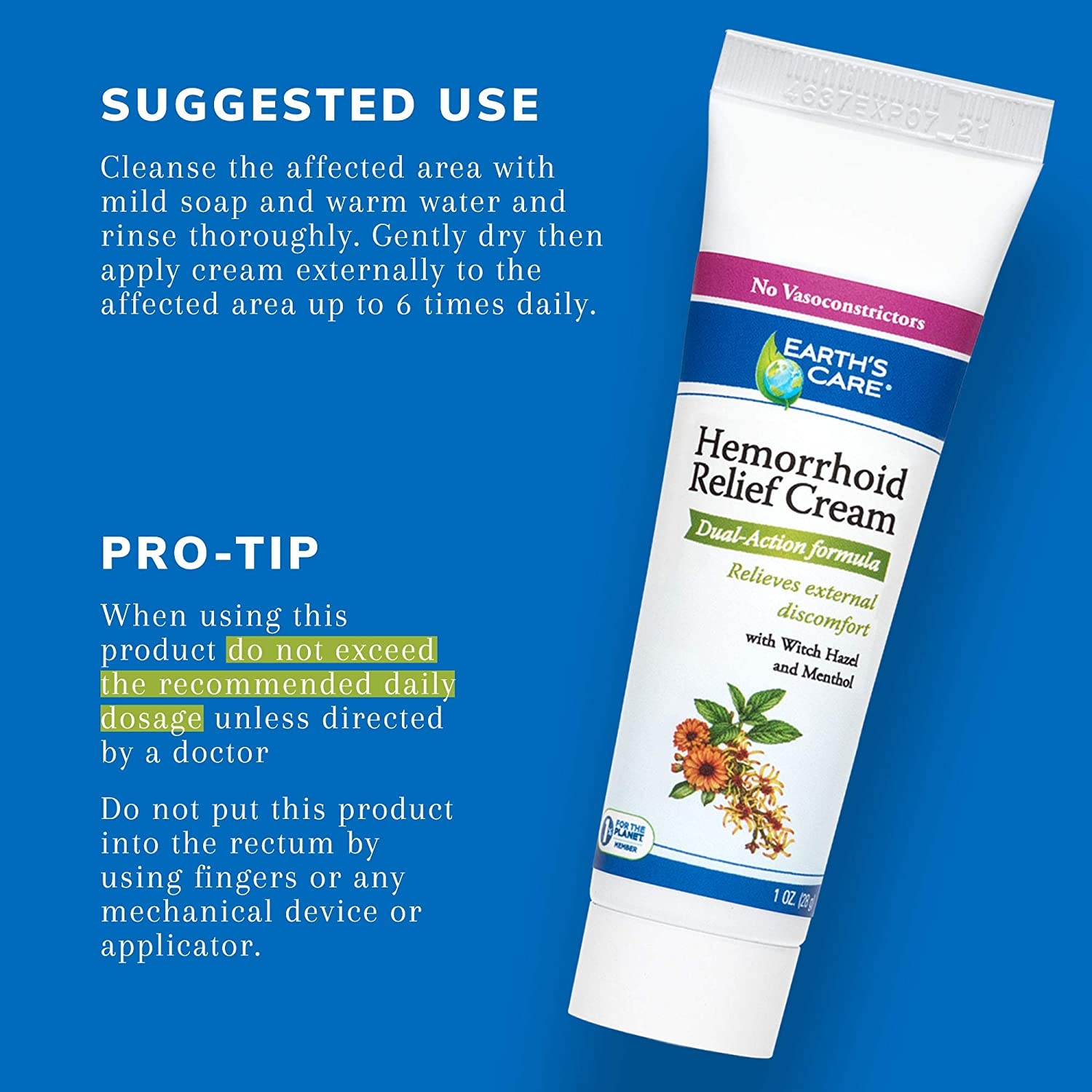
Those directions and warnings match the monograph’s wording almost word for word (§346.50(c)(2), (c)(4) and (d)), which is reassuring. But the listing lacks a Drug Facts panel: none of the four gallery photos and nothing in the description gives a percentage for witch hazel or menthol, so I cannot say whether this tube sits inside the 10 to 50 and 0.1 to 1 percent ranges.
| This product (listing and tube photos) | FDA monograph range (21 CFR 346) | Monograph directions | Tolerable Upper Limit | |
|---|---|---|---|---|
| Witch hazel | Named as an active; percentage not stated | 10 to 50 percent | Up to 6 times daily or after each bowel movement | None established (topical, not a nutrient); monograph ceiling is 50 percent |
| Menthol | Named as an active; percentage not stated | 0.1 to 1 percent | Up to 6 times daily | None established; monograph ceiling is 1 percent |
| Calendula, horse chestnut, aloe vera, chamomile | Named as other ingredients; amounts not stated | None: not listed in the monograph | None | None established |
The witch hazel range spans a factor of five, so “contains witch hazel” says little about strength. The description also credits witch hazel’s “curative qualities” to Native American tradition, which is manufacturer framing. And one gallery photo reads “Relieves itchy and irritated skin due to eczema and rashes”; the tube and description do not claim this, and this article does not evaluate it.
Who Might Consider It, and Who Should Skip It
Who this is for: adults with mild, known external hemorrhoid symptoms (itching, burning or a tender lump, no bleeding) who are already adding fiber and water, accept that the evidence is thin, and want a short-term, non-steroid, non-vasoconstrictor cream.
Who should skip it: anyone with rectal bleeding or sharp pain during bowel movements, who needs a diagnosis first; anyone symptomatic beyond 7 days; anyone allergic to ragweed, daisies, marigolds or chamomile; anyone with an estrogen-sensitive condition or taking warfarin, until they have asked a clinician; children under 12; people hoping a cream will shrink a hemorrhoid or fix its cause; and most people who have not yet tried fiber, fluids and not straining. In pregnancy, ask your clinician about this specific tube.
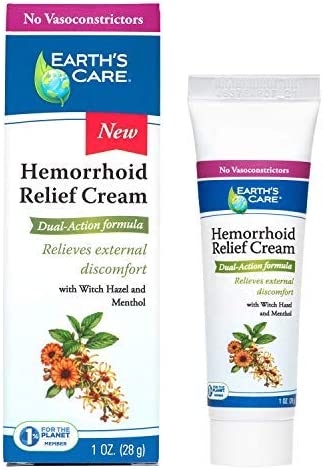
Hemorrhoid Relief Cream 1 Oz Witch Hazel No Parabens (Earth’s Care)
A 1 oz (28 g) tube of external-use cream with witch hazel and menthol, no vasoconstrictors, steroids or parabens. Percentages are not stated in the listing. Browse more in our body care range.
View Product DetailsFrequently Asked Questions
Does witch hazel shrink hemorrhoids?
Not on the evidence we found. The FDA monograph reserves the “shrinks hemorrhoidal tissue” claim for vasoconstrictors; witch hazel may claim only to protect irritated areas and relieve irritation or burning. The AGA’s 2026 update says little data supports topical astringents.
How often can you apply hemorrhoid cream?
For witch hazel or menthol products, the FDA monograph sets directions of up to 6 times daily, or after each bowel movement for witch hazel. This tube’s listing says up to 6 times daily, externally. Do not exceed the recommended daily dosage unless a doctor directs it.
How long should you use hemorrhoid cream before seeing a doctor?
About a week. The monograph requires the warning “If condition worsens or does not improve within 7 days, consult a doctor,” and NIDDK says doctors most often recommend over-the-counter products for 1 week. Any rectal bleeding warrants a doctor’s visit at once.
What is the difference between witch hazel and menthol in hemorrhoid cream?
They do different jobs. Under the monograph, witch hazel (10 to 50 percent) is an astringent that protects irritated tissue; menthol (0.1 to 1 percent) can relieve pain or burning and gives a cooling sensation. The pair is permitted together.
Is hemorrhoid cream safe during pregnancy?
Ask your clinician about the specific product. The AGA says hemorrhoids occur in up to two-thirds of women in pregnancy and that care should generally be conservative: fiber, treating constipation and topical ointments. That is general guidance, not an endorsement of this tube.
Can you use hemorrhoid cream inside the rectum?
Not this one. It is for external use, and the monograph requires such products to say “Do not put this product into the rectum by using fingers or any mechanical device or applicator.”
What works best for hemorrhoids?
Fiber, fluids and not straining. The AGA calls these reasonable first-line therapy, and a 2006 meta-analysis of 7 trials (378 people) found fiber cut the risk of persisting symptoms by 47 percent.
Can hemorrhoid cream cause a rash?
It can. The monograph requires menthol products to warn of allergic reactions, and NIDDK lists dry skin or a rash around the anus as a reason to follow up. NCCIH says chamomile adds risk for people allergic to ragweed, daisies or marigolds.
Sources
- U.S. Food and Drug Administration, via eCFR. “21 CFR Part 346: Anorectal Drug Products for Over-the-Counter Human Use.” Source: 55 FR 31779 (1990); text as of 1 October 2026. Accessed 21 October 2026. ecfr.gov
- National Institute of Diabetes and Digestive and Kidney Diseases. “Definition & Facts of Hemorrhoids.” Last reviewed October 2016. Accessed 21 October 2026. niddk.nih.gov
- National Institute of Diabetes and Digestive and Kidney Diseases. “Symptoms & Causes of Hemorrhoids.” Last reviewed October 2016. Accessed 21 October 2026. niddk.nih.gov
- National Institute of Diabetes and Digestive and Kidney Diseases. “Treatment of Hemorrhoids.” Last reviewed October 2016. Accessed 21 October 2026. niddk.nih.gov
- National Institute of Diabetes and Digestive and Kidney Diseases. “Eating, Diet, & Nutrition for Hemorrhoids.” Last reviewed October 2016. Accessed 21 October 2026. niddk.nih.gov
- Qureshi W, et al. “AGA Clinical Practice Update on Diagnosis and Treatment of Hemorrhoids: Expert Review.” Clinical Gastroenterology and Hepatology 2026;24(7):1773–1781, published online 29 April 2026. Accessed 21 October 2026. doi.org/10.1016/j.cgh.2026.04.008
- Alonso-Coello P, et al. “Fiber for the treatment of hemorrhoids complications: a systematic review and meta-analysis.” American Journal of Gastroenterology 2006;101(1):181–188. Accessed 21 October 2026. doi.org/10.1111/j.1572-0241.2005.00359.x
- National Center for Complementary and Integrative Health. “Chamomile.” Last updated November 2024. Accessed 21 October 2026. nccih.nih.gov
- National Center for Complementary and Integrative Health. “Horse Chestnut.” Last updated April 2025. Accessed 21 October 2026. nccih.nih.gov
This article is for educational purposes only and is not medical advice. It is not intended to diagnose, treat, cure, or prevent any disease. Product statements come from its store listing and photos and have not been evaluated by the Food and Drug Administration. Talk to your doctor before using any hemorrhoid product, especially if you have rectal bleeding, are pregnant or breastfeeding, or are allergic to ragweed, daisies, marigolds or chamomile.