
The European Union ties its authorized glucomannan weight-loss claim to 3 g a day, taken as three 1 g doses before meals with water as part of an energy-restricted diet (Regulation 432/2012), yet pooled trials of glucomannan for weight loss range from a non-significant 0.22 kg to a low-certainty 1.36 kg of weight lost. Glucomannan is a water-soluble dietary fiber taken from the root of the konjac plant, Amorphophallus konjac, that swells into a thick gel when it meets liquid. That swelling is the sales pitch, and also why Health Canada has warned since 2010 of choking and blockage when too little water is taken.
Key Takeaways
- A 2014 meta-analysis of 8 randomized trials found a mean weight difference of −0.22 kg (95% CI −0.62 to 0.19) versus placebo, not statistically significant (Onakpoya et al., 2014).
- A 2023 network meta-analysis of 111 trials (6,171 people) put glucomannan at −1.36 kg (95% CI −2.17 to −0.54), with low certainty (Pharmacological Research, 2023).
- For cholesterol the case is stronger: 12 studies (370 people) found about 3 g a day lowered LDL by 0.35 mmol/L, roughly 10% (Ho et al., 2017).
- Health Canada (advisory of 29 January 2010) says glucomannan powder, capsules or tablets can cause harm if taken without at least 8 ounces of water or other fluid, and should not be taken just before bed.
- This product’s label lists 2 g (2,000 mg) of glucomannan per half-level teaspoon, double the 1 g per-dose amount in the EU weight-loss claim; the listing directs one or two servings a day.
In this article:
What Glucomannan Is and Why It Swells
Glucomannan is a polysaccharide, a long chain of mannose and glucose sugars that humans cannot digest, which is why it counts as dietary fiber. Cleveland Clinic (15 May 2024) explains that konjac is the plant, glucomannan is the fiber in its root bulb, and the fiber "forms a gel-like substance when it dissolves in liquids like water or stomach fluids." A 2007 case report in Clinical Toxicology puts the same property less kindly: "expanding rapidly to many times the size of the original material."
Regulators have taken different positions on what that gel is good for.
| Regulator and document | Weight-loss claim | Cholesterol claim | Dose and water instructions |
|---|---|---|---|
| European Commission, Regulation (EU) No 432/2012 (16 May 2012), based on EFSA’s 2010 opinion | Permitted "in the context of an energy restricted diet," at 1 g per portion | Permitted, for food providing 4 g of glucomannan a day | 3 g a day for weight, in three 1 g doses, with 1–2 glasses of water before meals; choking warning required |
| Health Canada, glucomannan monograph (26 July 2024) | Not among the listed uses | Listed: 1–1.5 g, three times a day, for adults | At least 250 ml of liquid per dose; not with difficulty swallowing; ask a practitioner beyond 8 weeks (cholesterol products) |
Weight Loss: What the Pooled Trials Found
Glucomannan has been reviewed for weight loss repeatedly, and the answer depends on which analysis you read.
| Analysis | Scope | Result |
|---|---|---|
| Sood et al., 2008 | 14 studies, 531 people (all outcomes) | Body weight −0.79 kg (95% CI −1.53 to −0.05); children did not benefit as much |
| Onakpoya et al., 2014 | 8 randomized trials in overweight or obese people | −0.22 kg (95% CI −0.62 to 0.19), not statistically significant; heterogeneity I² = 65% |
| Network meta-analysis, 2023 | 111 trials, 6,171 adults, 18 nutraceuticals | Glucomannan −1.36 kg (95% CI −2.17 to −0.54), certainty of evidence rated low; psyllium −3.70 kg with moderate certainty |
| Randomized trial in children, 2019 | 96 children aged 6–17, 3 g a day for 12 weeks | BMI z-score difference 0.0 (95% CI −0.1 to 0.1); no effect on weight |
The most favorable number, 1.36 kg, is under 3 lb. The Onakpoya team put the unfavorable reading plainly:
"The evidence from available RCTs does not show that glucomannan intake generates statistically significant weight loss."
— Onakpoya, Posadzki and Ernst, Journal of the American College of Nutrition (2014)Why do the results differ? The abstracts do not say, but the 2014 analysis reported substantial disagreement among its trials (I² = 65%). The 2019 pediatric trial is the cleanest evidence: double-blind, placebo-controlled, null on weight. It did find lower LDL cholesterol at 12 weeks, and higher blood pressure in the glucomannan group (systolic at 12 weeks, diastolic at 24 weeks). Compare green tea extract, another weight-loss staple whose Cochrane review found an equally small effect.
A fair summary: at best a small loss, under 3 lb (1.36 kg), alongside a calorie-controlled diet, with low certainty. The EU claim itself is conditional on an energy-restricted diet.
Cholesterol: The Better-Supported Claim
The cholesterol evidence is more consistent. In 2017, Ho and colleagues pooled 12 randomized trials of konjac glucomannan lasting at least three weeks (370 participants, 8 trials in adults and 4 in children). LDL cholesterol was lower by 0.35 mmol/L (95% CI −0.46 to −0.25) and non-HDL cholesterol by 0.32 mmol/L (95% CI −0.46 to −0.19); the authors concluded that about 3 g a day corresponds to reductions of 10% and 7%. Six trials found no effect on apolipoprotein B.
Two cautions apply. A 2025 meta-analysis in Prostaglandins & Other Lipid Mediators found significant LDL reductions, but its authors wrote that "these significant decreases are not clinically important" and that glucomannan "only can be considered as an adjunctive therapeutic approach." And these are lab values, not heart attacks or strokes. Our red yeast rice article shows what an FDA warning looks like on another cholesterol supplement.
The Choking and Blockage Warning
This is the part of the label that product listings tend to skip. In its advisory of 29 January 2010 (now archived), Health Canada said that natural health products containing glucomannan in tablet, capsule or powder form:
"have a potential for harm if taken without at least 8 ounces of water or other fluid."
— Health Canada, public advisory on glucomannan, 29 January 2010 (archived)The advisory names the risk as "choking and/or blockage of the throat, esophagus or intestine," based on international adverse reaction case reports, and says not to take the products immediately before bed. Its required labeling says not to use them with difficulty swallowing; the 2024 monograph adds fever or undiagnosed gastrointestinal trouble.
A 2007 report in Clinical Toxicology describes a 37-year-old woman who developed delayed esophageal obstruction after a glucomannan diet aid; she cleared it by forceful vomiting, and endoscopy then found an esophageal web. The authors said the case "illustrates the potential dangers of glucomannan and other hygroscopic medications in patients with a history of upper gastrointestinal pathology." Cleveland Clinic dietitian Gillian Culbertson advises: "choose a pill or capsule that you can easily swallow and drink 8 ounces of water with it." This product is a powder: Health Canada’s monograph says to mix powder well with liquid and drink it immediately.
Genuine safety warning: never swallow glucomannan powder dry or with a sip of water. Stir it into a full glass (at least 8 oz) and drink promptly. Do not take it if you have trouble swallowing, an esophageal narrowing or any undiagnosed digestive problem, and do not take it right before lying down. If you develop chest pain, vomiting, or difficulty swallowing or breathing afterward, seek medical attention immediately.
Side Effects, Medicines and Diabetes
The gastrointestinal effects are the common ones: the Onakpoya review listed abdominal discomfort, diarrhea and constipation, and Cleveland Clinic adds gas and bloating, possibly worse with irritable bowel syndrome.
Two interaction points matter. Health Canada’s monograph says to take glucomannan a few hours before or after other medications. And Cleveland Clinic warns that people on insulin or diabetes medicines may see blood sugar fall too low. Any diabetes benefit is a reason to talk to your clinician, not to adjust medication yourself.
NutritionFacts.org, “Flushing Calories with Fiber for Weight Loss”: general background on fiber and weight, not about glucomannan supplements specifically; we have not checked its claims.
Inside NOW Glucomannan Pure Powder
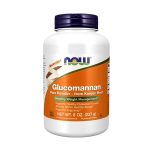
The product in our catalogue as Pure Glucomannan Powder Weight Management Supplement 8 Oz is NOW Glucomannan Pure Powder, from konjac root, in an 8 oz (227 g) bottle. Its Supplement Facts panel lists a serving of 1/2 level teaspoon (approximately 2 g), about 114 servings per container, 5 calories, 2 g carbohydrate, 2 g dietary fiber (7% of the Daily Value) and 2 g (2,000 mg) of glucomannan. There are no other ingredients.
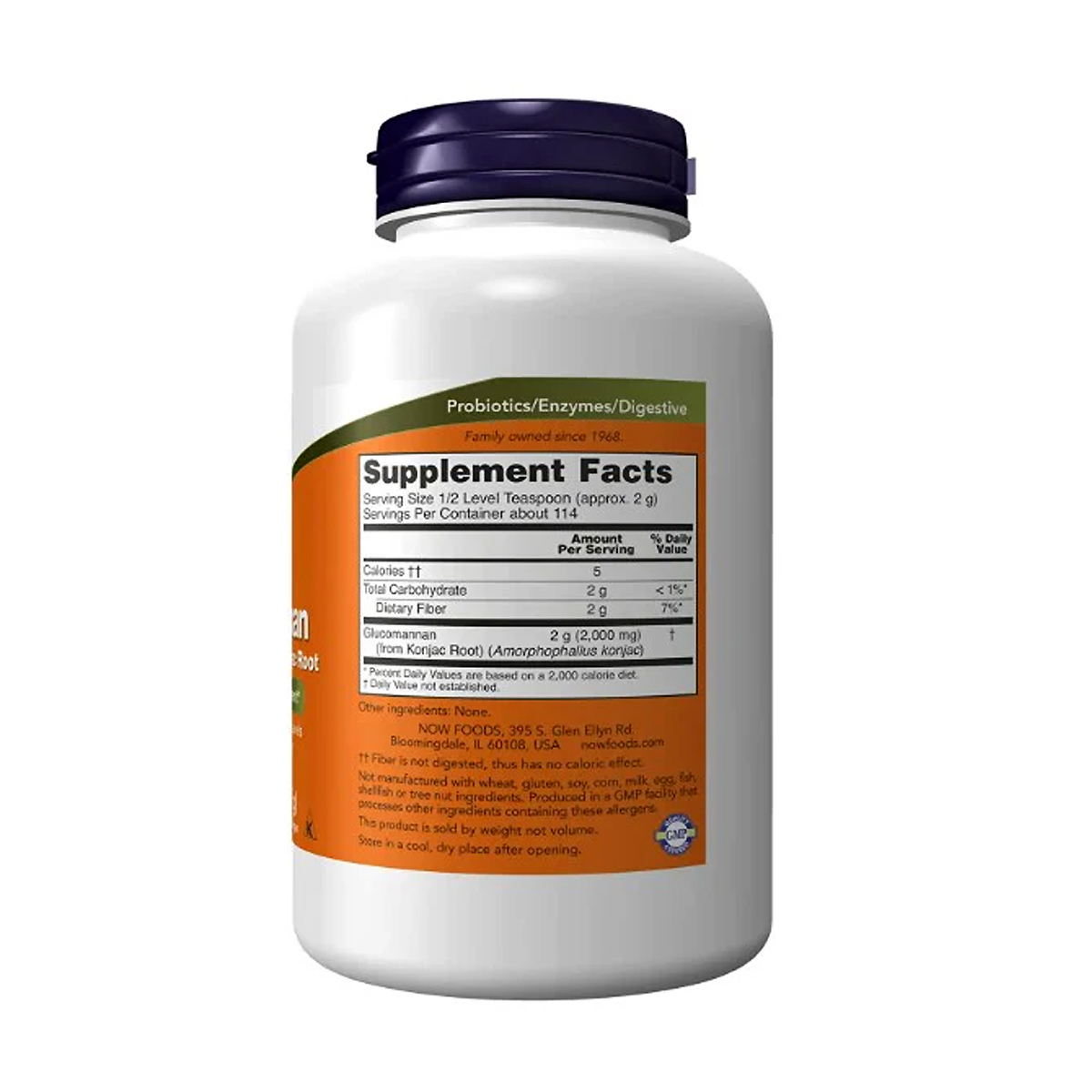
The store listing directs one half-level teaspoon, once or twice a day, with at least 8 oz of water, 30 to 45 minutes before a meal, which matches the water instruction Health Canada requires. A bottle lasts about 57 days at two servings a day and 114 at one (our calculation; the listing’s own answer is an unfilled “X-X weeks” placeholder).
| This product | Typical trial or regulatory amount | NIH RDA / AI | Tolerable Upper Limit | |
|---|---|---|---|---|
| Glucomannan, per dose | 2 g per half-level teaspoon | 1 g per dose (EU weight claim); 1–1.5 g per dose (Health Canada, cholesterol) | None: not an essential nutrient | None established |
| Glucomannan, per day | 2 g (once daily) to 4 g (twice daily), per the store listing | About 3 g (Ho 2017 trials); 3 g (EU weight); 4 g (EU cholesterol); 3–4.5 g (Health Canada) | None | None established |
| Dietary fiber | 2 g per serving, 7% of Daily Value | Daily Value of about 28 g on the label’s 2,000-calorie basis (implied by 2 g = 7%) | Daily Value, not an RDA | None established for dietary fiber |
No tolerable upper intake level has been set for glucomannan, so the practical limits are the water, the swallowing precautions and how your gut responds. A 2 g serving is larger than the single doses the EU and Health Canada use (1 g, and 1 to 1.5 g), and twice a day reaches the EU cholesterol amount of 4 g. That is our comparison, not a safety threshold, but a reason to start with half a serving.
What the label and listing claim versus the evidence: the bottle says "Healthy Weight Management" and "Supports Healthy Cholesterol Levels Already Within Healthy Range"; the store description calls it "generally safe for long-term use when taken as directed." Those are manufacturer statements. The weight evidence is small and uncertain, the cholesterol evidence is stronger, and Health Canada advises asking a practitioner about use beyond 8 weeks for cholesterol products. The store listing does not mention choking or blockage anywhere in its text.
Who Might Consider It, and Who Should Skip It
Who this is for: healthy adults with no swallowing or esophageal problems who are already following a calorie-controlled diet, accept that the weight effect is small, and will mix every dose into a full glass of water; or adults wanting a soluble fiber with a modest LDL effect, alongside advice from their clinician.
Who should skip it: anyone with trouble swallowing, an esophageal or bowel narrowing, fever, or undiagnosed digestive symptoms; anyone pregnant or breastfeeding, or with a sluggish (lazy) bowel, without medical advice (Health Canada monograph, 2024); anyone on insulin or diabetes medicine without their clinician’s agreement; children, since the one pediatric trial found no weight benefit; and most people hoping for meaningful weight loss.
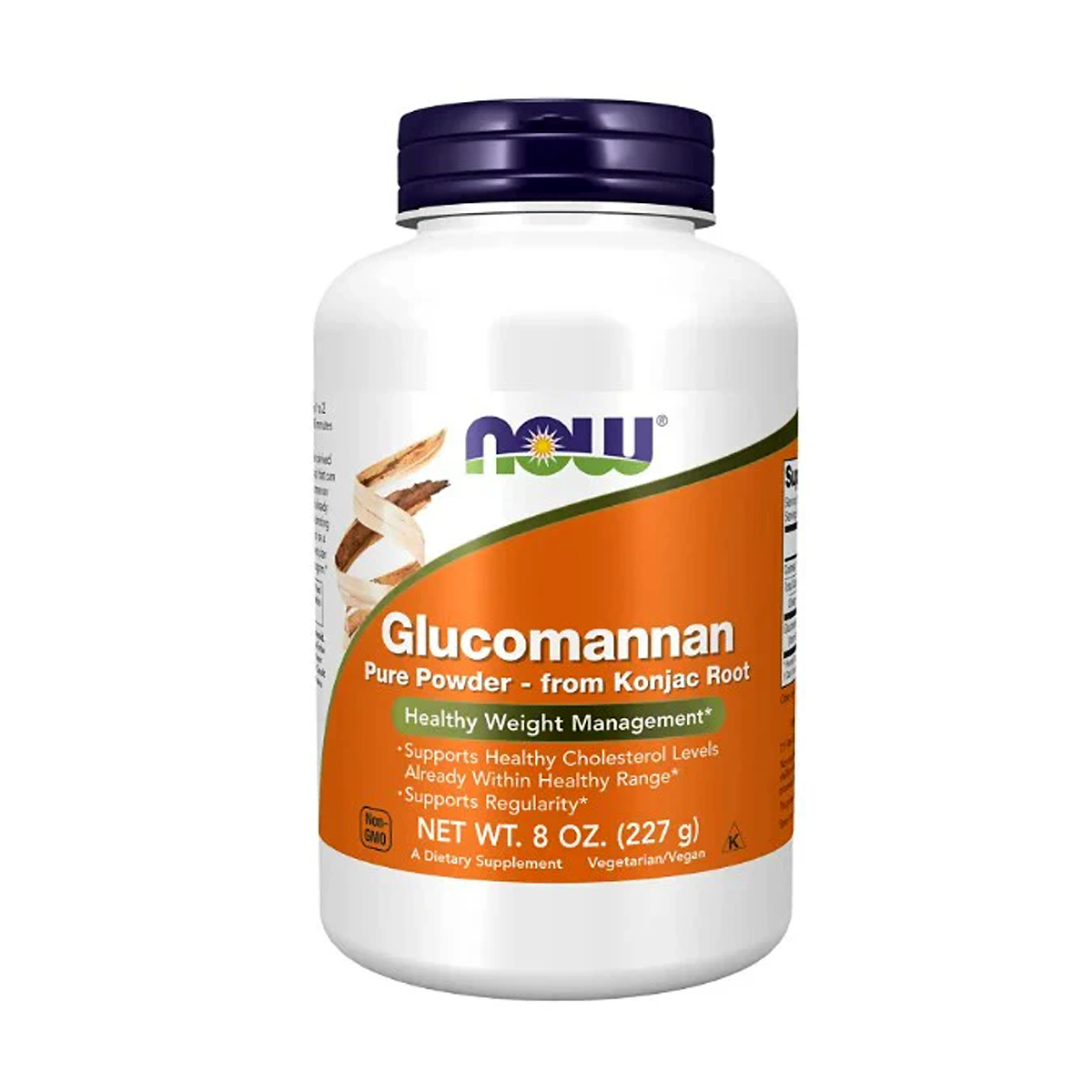
Pure Glucomannan Powder Weight Management Supplement 8 Oz (NOW Glucomannan)
2 g of glucomannan per half-level teaspoon, about 114 servings, no other ingredients. Mix into at least 8 oz of liquid; not for people with swallowing difficulties. Browse more in our general wellness range.
View Product DetailsFrequently Asked Questions
Does glucomannan help you lose weight?
Only slightly, and the evidence is uncertain. A 2014 meta-analysis of 8 trials found no significant difference (−0.22 kg); a 2023 network meta-analysis found −1.36 kg with low certainty. A 2019 trial in children found no effect.
How much glucomannan should you take a day?
It depends on the purpose. The EU weight-loss claim uses 3 g a day in three 1 g doses, its cholesterol claim 4 g, and Health Canada lists 1 to 1.5 g three times daily for cholesterol. This product’s listing directs 2 g once or twice daily.
Can glucomannan lower cholesterol?
Probably, modestly. A 2017 meta-analysis of 12 trials found about 3 g a day lowered LDL cholesterol by 0.35 mmol/L, roughly 10%. A 2025 meta-analysis called the reductions not clinically important and said glucomannan is only an adjunctive approach, so treat it as an add-on to medical advice.
Can glucomannan cause choking?
Yes. Health Canada warned in 2010 that glucomannan powder, capsules and tablets can cause choking or blockage of the throat, esophagus or intestine if taken without at least 8 ounces of fluid. Do not take it if you have difficulty swallowing, or just before bed.
How much water do you need with glucomannan powder?
At least 8 ounces (a full glass, about 250 ml) per dose, according to Health Canada’s advisory and monograph. Mix the powder well into the liquid and drink it immediately. Never swallow the dry powder with a sip of water.
What are the side effects of glucomannan?
The commonest are gas, bloating, abdominal discomfort, diarrhea and constipation, which Cleveland Clinic says may be worse with irritable bowel syndrome. Rarer but serious are choking and obstruction; seek medical help for chest pain, vomiting, or trouble swallowing or breathing after a dose.
Can you take glucomannan with other medicines?
Health Canada’s monograph says to take it a few hours before or after other medicines, because a gel-forming fiber may affect absorption. People using insulin or diabetes drugs should speak to their clinician first; Cleveland Clinic warns blood sugar can fall too low.
Is glucomannan the same as konjac?
Nearly. Konjac is the plant, and glucomannan is the soluble fiber in its root bulb, so foods like shirataki noodles contain it naturally. Supplements isolate it as a powder, capsule or tablet, which delivers far more at once than food, and carry a water warning.
Sources
- Onakpoya I, Posadzki P, Ernst E. "The efficacy of glucomannan supplementation in overweight and obesity: a systematic review and meta-analysis of randomized clinical trials." Journal of the American College of Nutrition, 2014. Accessed 7 October 2026. PubMed 24533610
- Sood N, Baker WL, Coleman CI. "Effect of glucomannan on plasma lipid and glucose concentrations, body weight, and blood pressure: systematic review and meta-analysis." American Journal of Clinical Nutrition, 2008. Accessed 7 October 2026. PubMed 18842808
- Ho HVT, et al. "A systematic review and meta-analysis of randomized controlled trials of the effect of konjac glucomannan, a viscous soluble fiber, on LDL cholesterol and the new lipid targets non-HDL cholesterol and apolipoprotein B." American Journal of Clinical Nutrition, 2017. Accessed 7 October 2026. PubMed 28356275
- "Comparative effects of nutraceuticals on body weight in adults with overweight or obesity: a systematic review and network meta-analysis of 111 randomized clinical trials." Pharmacological Research, 2023. Accessed 7 October 2026. PubMed 37778464
- "No effect of glucomannan on body weight reduction in children and adolescents with overweight and obesity: a randomized controlled trial." The Journal of Pediatrics, 2019. Accessed 7 October 2026. PubMed 31036412
- "Does glucomannan supplementation exert profitable effects on serum lipid profile in adults? A systematic review and meta-analysis." Prostaglandins & Other Lipid Mediators, 2025. Accessed 7 October 2026. PubMed 39528010
- "Esophageal obstruction from a hygroscopic pharmacobezoar containing glucomannan." Clinical Toxicology, 2007. Accessed 7 October 2026. PubMed 17357389
- European Commission. Commission Regulation (EU) No 432/2012 establishing a list of permitted health claims made on foods other than those referring to the reduction of disease risk and to children’s development and health. Official Journal of the European Union L 136, 25 May 2012. Accessed 7 October 2026. eur-lex.europa.eu
- Health Canada. "Natural Health Products containing Glucomannan May Cause Serious Choking if Used with Insufficient Fluid." Advisory, 29 January 2010 (archived). Accessed 7 October 2026. recalls-rappels.canada.ca
- Health Canada. Natural Health Product: Glucomannan (monograph). Dated 26 July 2024. Accessed 7 October 2026. webprod.hc-sc.gc.ca
- Cleveland Clinic. "5 Ways Konjac Can Help Boost Your Health." 15 May 2024. Accessed 7 October 2026. health.clevelandclinic.org
This article is for educational purposes only and is not medical advice. It is not intended to diagnose, treat, cure, or prevent any disease. These statements have not been evaluated by the Food and Drug Administration. Talk to your doctor before starting any new supplement, especially if you have trouble swallowing, a digestive condition, diabetes, are pregnant or breastfeeding, or take any prescription medication.