
Niacin (vitamin B3) is a water-soluble vitamin the body uses to turn food into usable energy and to build and repair DNA. This product's own label promises "true niacin activity" without the flush — but the one published placebo-controlled trial of this exact ingredient found it was no better than placebo at improving cholesterol, and its pharmacokinetic substudy found no evidence the ingredient was absorbed into the bloodstream at all (Keenan, Journal of Clinical Lipidology, 2013). That matters because the flush isn't a side effect being engineered away — it's the visible proof that free niacin reached the blood — and even real, bioavailable niacin has now failed its two largest cardiovascular trials, one of them in 25,673 patients, without preventing a single additional heart attack or stroke.
Key Takeaways
- Adults need just 16 mg NE (men) or 14 mg NE (women) of niacin a day (National Academies Dietary Reference Intake, via NIH). This capsule contains 640 mg of inositol hexanicotinate, the "no-flush" niacin ester.
- In a 6-week placebo-controlled trial of 120 adults with mild-to-moderate dyslipidemia, 1,500 mg/day of inositol hexanicotinate — this product's ingredient — produced no significant lipid improvement over placebo, while wax-matrix extended-release niacin cut LDL 18%; the pharmacokinetic substudy found inositol hexanicotinate showed "no evidence of bioavailability" (Keenan, J Clin Lipidol, 2013). A 2009 pharmacology review reaches the same conclusion: it "has not been shown to have any beneficial effects on lipid parameters" (Kamanna et al., Int J Clin Pract).
- In a 25,673-patient trial (HPS2-THRIVE, NEJM, 2014), adding real, bioavailable extended-release niacin to statin therapy did not significantly reduce heart attacks, strokes or revascularizations — and significantly increased serious adverse events including new-onset diabetes, infections and bleeding.
- A separate 3,414-patient U.S. and Canadian trial (AIM-HIGH) was stopped early in 2011 after a safety board found no cardiovascular benefit and flagged an unexplained excess of ischemic strokes in the niacin group — though NHLBI notes the overall stroke rate was under 1% and earlier niacin studies had not shown the increase (NHLBI, 2011).
- A February 2024 Cleveland Clinic study in Nature Medicine found 4PY, a niacin breakdown product present at high levels in roughly 1 in 4 subjects in the researchers' patient cohorts, strongly linked to heart attack, stroke and vascular inflammation — a caution about niacin intake generally, independent of any single product.
In this article:
- What Is Niacin, and What Does "No-Flush" Actually Mean?
- Does No-Flush Niacin (Inositol Hexanicotinate) Actually Work?
- Real Niacin's Own Track Record: What a 25,673-Person Trial Found
- The 2024 Warning That Applies to Niacin Generally
- Who Actually Benefits From Niacin Therapy — and Who Should Skip This Product
- Inside Life Extension No-Flush Niacin: What 640 mg Actually Delivers
- How to Approach Niacin Sensibly
- Frequently Asked Questions
What Is Niacin, and What Does "No-Flush" Actually Mean?
Niacin, also called vitamin B3, is a water-soluble vitamin the body needs to convert food into usable energy and to build and repair DNA, per the National Academies' Dietary Reference Intake report, hosted by NIH's National Library of Medicine. Adults need surprisingly little: the RDA is 16 mg of niacin equivalents a day for men and 14 mg for women 19+, figures most people clear through an ordinary diet of meat, fish, poultry, whole grains and fortified cereal.
Niacin supplements come in chemically distinct forms. Nicotinic acid — "real," free niacin — has actual clinical trial data behind it and is responsible for the well-known niacin flush, a burning, reddened sensation from binding a receptor that dilates skin blood vessels. Inositol hexanicotinate, the ingredient here, is different: six nicotinic acid units bonded to inositol, marketed on the theory the body slowly cleaves those bonds, trickling out free niacin without the flush.
| Life stage | RDA | UL (supplements/fortified foods) |
|---|---|---|
| Adult men, 19+ | 16 mg NE | 35 mg |
| Adult women, 19+ | 14 mg NE | 35 mg |
| Pregnancy / lactation | 17–18 mg NE | 35 mg |
That 35 mg adult UL is set on flushing itself as the "critical adverse effect," and the National Academies are explicit it "applies to all forms of niacin added to foods or taken as supplements." A single 640 mg capsule of this product, if fully released into the bloodstream, would represent more than eighteen times that limit — precisely why the "no-flush" claim deserves scrutiny, not reassurance.
Does No-Flush Niacin (Inositol Hexanicotinate) Actually Work?
Here's the contradiction: the absence of a flush is sold as a feature — "true niacin activity... without the typical niacin flush," per this product's own description. But the flush is the visible sign nicotinic acid reached the bloodstream. A "no-flush" product that never flushes raises an honest question: did any active niacin get released at all?
"Inositol hexanicotinate is commonly referred to as no-flush niacin or flush-free niacin, but this dietary supplement has not been shown to have any beneficial effects on lipid parameters."
— Kamanna, Ganji & Kashyap, International Journal of Clinical Practice, 2009That verdict has since been tested directly. A 6-week blinded, placebo-controlled trial published in the Journal of Clinical Lipidology in 2013 randomised 120 adults with mild-to-moderate dyslipidemia to three arms: 1,500 mg/day of wax-matrix extended-release niacin, 1,500 mg/day of inositol hexanicotinate, or placebo. The extended-release niacin lowered LDL cholesterol by 18% and total cholesterol by 11% (P < .001). Inositol hexanicotinate did neither — the trial reports it "showed no significant improvement in lipids," landing with placebo rather than with the working form. A pharmacokinetic substudy run alongside it found inositol hexanicotinate "showed no evidence of bioavailability" (Keenan, 2013).
The likely explanation is chemical: six niacin molecules bound tightly to inositol by ester bonds may pass through digestion largely intact, rather than hydrolyzing into the free acid the body needs. Note the scale — that trial used 1,500 mg/day and still measured nothing, more than twice this product's 640 mg capsule.
Real Niacin's Own Track Record: What a 25,673-Person Trial Found
Here's what the "no-flush" framing obscures: even when niacin genuinely is absorbed, at doses proven to move cholesterol numbers, the two largest modern trials found no cardiovascular payoff, and a real safety cost.
The first was AIM-HIGH, a 3,414-patient trial run across about 90 sites in the United States and Canada, adding high-dose extended-release niacin (up to 2,000 mg/day) to statin therapy in people with low HDL and high triglycerides. Stopped early in 2011, the NIH's National Heart, Lung, and Blood Institute reports the safety board found "little to no chance that adding high-dose, extended release niacin to statin treatment would show a benefit even if the study continued," and separately flagged an unexplained excess of ischemic strokes in the niacin group that "contributed to the decision to stop the trial early." NHLBI qualifies that stroke signal in the same document: "The overall frequency of stroke was less than 1 percent and previous studies of niacin therapy have not shown this increase in stroke" (NHLBI, 2011).
| Event category | Niacin + statin | Statin alone | P value |
|---|---|---|---|
| Any serious adverse event | 34.2% | 32.5% | 0.30 (not significant) |
| Gastrointestinal disorders | 7.4% | 5.5% | 0.02 |
| Infections and infestations | 8.1% | 5.8% | 0.008 |
The larger trial was HPS2-THRIVE: Oxford University's Clinical Trial Service Unit, 25,673 patients with existing vascular disease across China, the UK and four Nordic countries. Extended-release niacin plus laropiprant (added to blunt flushing) lowered LDL by 0.25 mmol/L and raised HDL by 0.16 mmol/L — real lipid movement — but per the trial unit's own results, it "did not significantly reduce the risk of major vascular events." It did significantly increase serious adverse events tied to diabetes, the gastrointestinal and musculoskeletal systems, skin, infection and bleeding, and raised statin-associated muscle-injury risk roughly fourfold. The results led to niacin/laropiprant's withdrawal from the European market and Merck halting its development.
U.S. regulators reached the same conclusion. Effective 18 April 2016, the FDA withdrew approval of Advicor and Simcor — the two fixed-dose niacin-plus-statin combination drugs — stating that "the totality of the scientific evidence no longer supports the conclusion that a drug-induced reduction in triglyceride levels and/or increase in HDL-cholesterol levels in statin-treated patients results in a reduction in the risk of cardiovascular events" (FDA, Federal Register, 2016) — for a drug with genuine, measurable niacin activity, a stronger position than an OTC capsule that may not be absorbed at all.
The 2024 Warning That Applies to Niacin Generally
Cleveland Clinic explains the 2024 discovery linking a niacin breakdown product to cardiovascular risk.
In February 2024, a Cleveland Clinic team led by Dr. Stanley Hazen published a study in Nature Medicine identifying a niacin breakdown product, 4PY, strongly associated with heart attack, stroke and other adverse cardiac events across large cohorts — present at high levels in roughly one in four people studied. Preclinical experiments showed 4PY directly triggers vascular inflammation, which damages blood vessels and contributes to atherosclerosis.
Genuine safety note: This finding is about niacin exposure broadly — from fortified food and any niacin supplement, not this product specifically — and researchers call it an early, mechanistic discovery, not a reason to stop all niacin intake. "The main takeaway is not that we should cut out our entire intake of niacin — that's not a realistic approach," Dr. Hazen said. Long-term studies of chronic 4PY elevation are still needed.
Together with AIM-HIGH and HPS2-THRIVE, this adds a third strike against "more niacin" as a path to a healthier heart — before inositol hexanicotinate's own bioavailability problem even enters the picture.
Who Actually Benefits From Niacin Therapy — and Who Should Skip This Product
Niacin therapy hasn't vanished from medicine entirely. Very high-dose prescription niacin can still have a narrow role for people with severe, treatment-resistant high triglycerides at risk of pancreatitis, managed under a physician's direct supervision — a different situation from someone reaching for an OTC bottle for general "heart health." Genuine dietary niacin deficiency (pellagra) is now rare because of food fortification, but can occur in severe alcohol use disorder or malabsorption, where the fix is medical, not a self-selected supplement.
Who this is for: On the evidence reviewed above, no group is well served by this particular product. Where higher-dose niacin genuinely has a role, it is prescription nicotinic acid chosen and monitored by a clinician — not an over-the-counter inositol hexanicotinate capsule, which the one trial to test it could not show was absorbed at all. Anyone who thinks they need niacin therapy should be having that conversation with a doctor, not selecting a supplement.
Who should skip it: Almost everyone buying this product for general cardiovascular support — the evidence suggests it may not deliver active niacin at all, and even genuine niacin therapy failed its two largest modern trials. People with liver disease, active peptic ulcers, gout, or poorly controlled diabetes should avoid niacin altogether; anyone on a statin should talk to their doctor first; and pregnant or breastfeeding people should check with their doctor before adding any niacin beyond a standard prenatal vitamin.
Inside Life Extension No-Flush Niacin: What 640 mg Actually Delivers
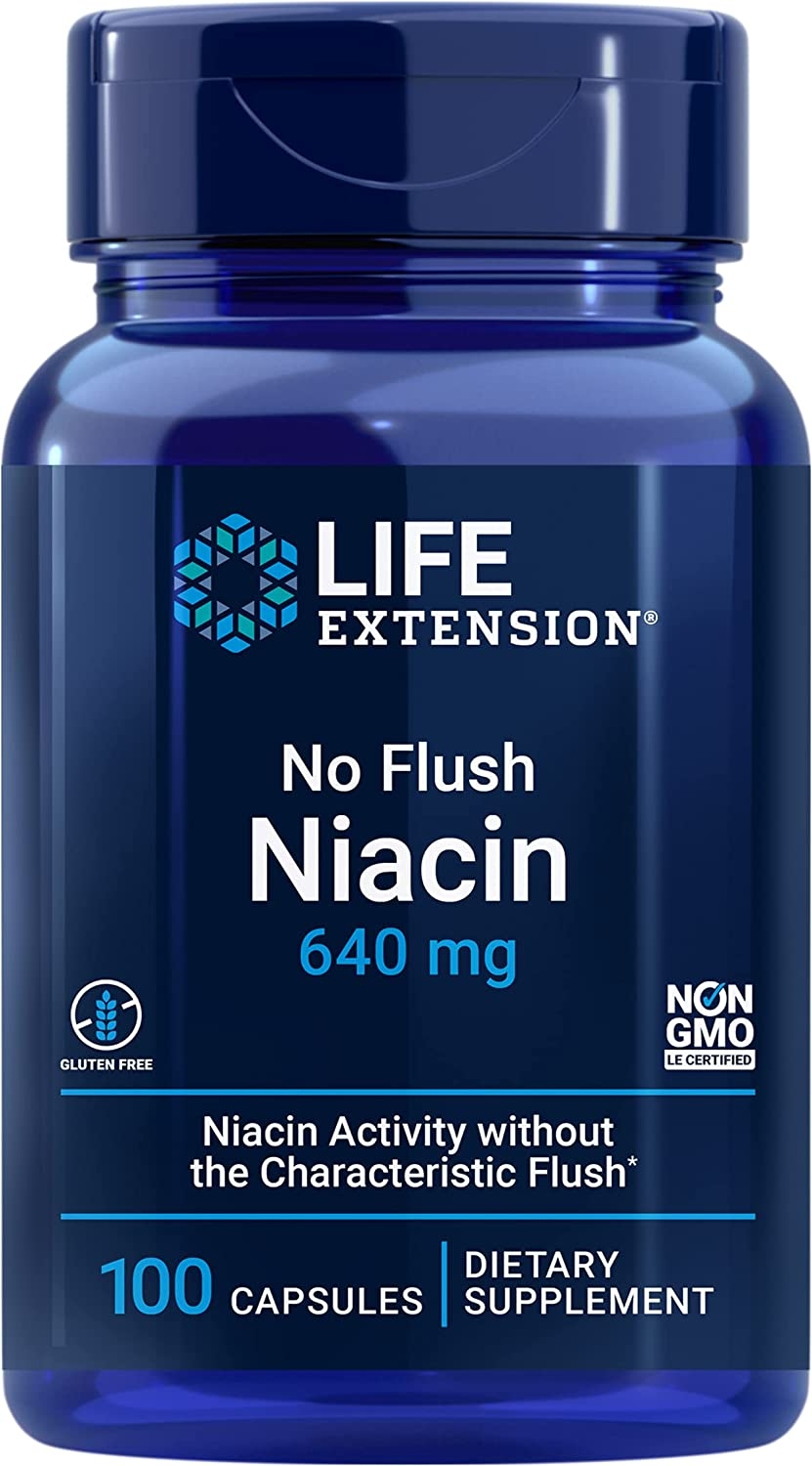
This product is a 100-capsule bottle of inositol hexanicotinate, labeled at 640 mg per capsule. Its directions read in full: "Take one (1) capsule with food, or as recommended by a healthcare practitioner" — note that the label sets no daily frequency of its own, so how long a bottle lasts depends on what a practitioner advises. Its marketing describes it as delivering "niacin activity without the flush" and supporting "cardiovascular, neurological and overall health."
| This product (label) | Typical OTC niacin shelf dose | NIH RDA | NIH Tolerable Upper Limit | |
|---|---|---|---|---|
| Inositol hexanicotinate | 640 mg per capsule; label says one capsule with food, no stated daily frequency | 250–1,000 mg/day across various "no-flush" and standard products | 16 mg NE (men) / 14 mg NE (women) | 35 mg/day (adults) — based on flushing, and the National Academies apply it to all supplemental niacin forms |
Framed plainly, this label creates a bind rather than a benefit. If inositol hexanicotinate behaves as the pharmacology literature describes — poorly hydrolyzed, no demonstrated rise in blood niacin — a 640 mg capsule is functionally a placebo dose of a vitamin most people already get enough of from food. If it somehow released its full niacin content, a single capsule would sit at more than eighteen times the adult UL, squarely in flushing territory. Either the product doesn't do much, or it would cause the exact side effect its name promises to prevent, and the flush is currently the only easy way to tell which. None of this makes the capsule acutely dangerous — inositol hexanicotinate has a long history of use with no toxicity signal, precisely because so little of it appears biologically active. The more accurate framing than "delivers niacin activity without the flush": absence of a flush is at least as consistent with poor absorption as with a gentler delivery mechanism.
Life Extension No-Flush Niacin 640 mg — 100 Capsules
Inositol hexanicotinate, 640 mg per capsule; the label directs one capsule with food, or as recommended by a healthcare practitioner. As covered above, a placebo-controlled trial and independent pharmacology reviews have not shown this niacin form to raise blood niacin or improve cholesterol, so treat any cardiovascular claim on the label with skepticism and talk to your doctor about evidence-based options first.
View Product DetailsHow to Approach Niacin Sensibly
A few practical defaults follow directly from the evidence above:
- For general cardiovascular support, an ordinary diet already covers the small amount of niacin you need — 16 mg NE for men, 14 mg NE for women — with no trial evidence that supplementing beyond that, in this ingredient form, adds benefit.
- If you and your doctor are managing high cholesterol or severe high triglycerides, know that prescription-strength, bioavailable extended-release niacin lost its FDA-backed cardiovascular indication in 2016 — a conversation about proven therapies, not a case for adding an OTC "no-flush" capsule on top.
- If you already take a statin, don't add any niacin product without your doctor's input, given the documented rise in muscle-injury risk when the two were combined in large trials.
- If you have liver disease, an active peptic ulcer, gout, or poorly controlled diabetes, avoid niacin supplementation unless your doctor directs otherwise.
For related reading, see our reviews of red yeast rice for cholesterol and CoQ10 for statin users, or browse our individual vitamins category.
Frequently Asked Questions
What is niacin and what does the body use it for?
Niacin, or vitamin B3, is a water-soluble vitamin the body needs to convert food into energy and to build and repair DNA. Adults need 16 mg NE (men) or 14 mg NE (women) a day, an amount most people already get from meat, fish, poultry, whole grains and fortified foods (National Academies Dietary Reference Intakes).
Does "no-flush" niacin actually lower cholesterol?
The evidence says no. In a 2013 placebo-controlled trial, 1,500 mg/day of inositol hexanicotinate showed no significant lipid improvement over placebo and "no evidence of bioavailability," while extended-release niacin cut LDL 18%. A 2009 review likewise found it "has not been shown to have any beneficial effects on lipid parameters."
Why does regular niacin cause flushing, and is the flush dangerous?
Flushing happens when free nicotinic acid binds a receptor that dilates skin blood vessels, causing warmth, redness and tingling. It's uncomfortable but not dangerous, and it's actually a sign active niacin reached the bloodstream — exactly what "no-flush" products aren't shown to do.
Does real, bioavailable niacin prevent heart attacks or strokes?
The two largest modern trials say no. HPS2-THRIVE (25,673 patients) and AIM-HIGH (3,414 patients) both found adding real extended-release niacin to statin therapy did not significantly reduce cardiovascular events, despite measurably improving cholesterol, and both found more serious side effects.
What is 4PY, and why did Cleveland Clinic researchers link it to heart disease in 2024?
4PY is a breakdown product formed when the body processes excess niacin. A February 2024 Cleveland Clinic study in Nature Medicine found high 4PY levels strongly associated with heart attack and stroke risk, and showed in preclinical models that it directly triggers vascular inflammation. Researchers call it an early finding, not a reason to eliminate dietary niacin.
What is the Tolerable Upper Limit for niacin, and does this product exceed it?
The National Academies set the adult UL at 35 mg/day, based on flushing, applied to all supplemental niacin forms. This product's 640 mg label dose is more than eighteen times that limit if fully absorbed — though the evidence above suggests it may not be absorbed as free niacin at all.
Can I take niacin with a statin?
Only with your doctor's guidance. In HPS2-THRIVE, adding real extended-release niacin to statin therapy raised the risk of statin-associated muscle injury roughly fourfold, on top of showing no cardiovascular benefit.
Who should avoid niacin supplements altogether?
People with liver disease, active peptic ulcers, gout, or poorly controlled diabetes should avoid niacin unless a doctor directs otherwise, as should anyone pregnant or breastfeeding without medical guidance.
Sources
- National Academies of Sciences. "Niacin," Dietary Reference Intakes. Via NIH NLM Bookshelf. Accessed 11 Sept 2026.
- LiverTox: Drug-Induced Liver Injury. "Niacin." NIDDK/NIH. Accessed 11 Sept 2026.
- Kamanna VS, Ganji SH, Kashyap ML. "The mechanism and mitigation of niacin-induced flushing." Int J Clin Pract. September 2009. Accessed 11 Sept 2026.
- Keenan JM. "Wax-matrix extended-release niacin vs inositol hexanicotinate: a comparison in persons with mild to moderate dyslipidemia." Journal of Clinical Lipidology, vol. 7, pp. 14–23. January 2013. Accessed 11 Sept 2026.
- NHLBI (NIH). "Questions and Answers: AIM-HIGH Study." Accessed 11 Sept 2026.
- Anderson TJ, et al. "Safety Profile of Extended-Release Niacin in the AIM-HIGH Trial." NEJM. July 2014. Accessed 11 Sept 2026.
- CTSU, University of Oxford. "HPS2-THRIVE: Treatment of HDL to Reduce the Incidence of Vascular Events." Accessed 11 Sept 2026.
- FDA. "AbbVie Inc.; Withdrawal of Approval of New Drug Applications for ADVICOR and SIMCOR." Federal Register. April 18, 2016. Accessed 11 Sept 2026.
- Cleveland Clinic Newsroom. "Study Discovers Link between High Levels of Niacin and Heart Disease." February 19, 2024. Accessed 11 Sept 2026.
This article is for educational purposes only and is not medical advice. It is not intended to diagnose, treat, cure, or prevent any disease. These statements have not been evaluated by the Food and Drug Administration. High-dose niacin supplementation, including "no-flush" forms, can interact with statins and other medications and is not appropriate for everyone. Talk to your doctor before starting any niacin supplement, especially if you take a statin, have liver disease, gout, a peptic ulcer, or diabetes, or are pregnant or breastfeeding.