
The largest primary-prevention trial ever run on fish oil — 25,871 people, over five years — found that a daily 1-gram dose did not lower the overall risk of heart attack, stroke, or cardiovascular death. That single fact surprises a lot of people, because "omega-3s for heart health" is one of the most repeated claims in the supplement aisle. The real picture is more specific than either "it works" or "it's useless": the evidence depends heavily on the dose, the form, and whether you already have heart disease. Here's what the trials actually found, and where a product like Nordic Naturals Ultimate Omega fits into that picture.
Key takeaways
- The VITAL trial — 25,871 healthy adults, 1 g/day omega-3, 5.3 years — found no reduction in the combined risk of major cardiovascular events.
- Prescription-strength EPA at 4 g/day (REDUCE-IT trial, 8,179 people) cut cardiovascular events by 25% in people who already had heart disease or diabetes — a much larger effect than typical supplement doses.
- In a USDA-funded analysis of 47 over-the-counter fish oil supplements, 74% contained less EPA or DHA than their label claimed — one of several independent tests collected in a 2020 peer-reviewed review.
- The FDA considers up to 5 g/day of combined EPA and DHA from supplements safe; this product's labeled dose (1,280 mg total omega-3s per serving) stays well under that even at the higher "ultimate support" amount.
- "Iodine allergy," which this product's label tells you to ask a doctor about, isn't a recognized medical condition — the American Academy of Allergy, Asthma & Immunology states iodine itself is not an allergen.
- What's actually in this product, and what omega-3s do
- How much omega-3 do you actually need?
- The five big cardiovascular trials — and what each one really found
- Where the evidence lands, condition by condition
- Not every fish oil bottle contains what the label says
- Safety: bleeding risk, irregular heartbeat, and the "iodine allergy" myth
- Who this product is — and isn't — right for
- FAQ
What's actually in this product, and what omega-3s do
Nordic Naturals Ultimate Omega (Lemon) is a fish oil supplement providing 1,280 mg of omega-3s per serving — two soft gels — sourced from anchovies and sardines. Per the product's own listing, the omega-3s are in triglyceride form, the molecular form omega-3 fats take naturally in fish, rather than the ethyl-ester form some cheaper fish oils use after processing. A 120-count bottle provides 60 servings; at the standard directions of one serving a day that is a 60-day supply, or 30 days at the "ultimate support" two-servings-a-day directions the label also lists.
The two omega-3 fatty acids that matter clinically are EPA (eicosapentaenoic acid) and DHA (docosahexaenoic acid), both long-chain omega-3s found almost exclusively in seafood and algae. According to the NIH Office of Dietary Supplements, these are distinct from ALA (alpha-linolenic acid), the shorter-chain omega-3 found in plant oils like flaxseed and walnuts, which the body converts to EPA and DHA only very inefficiently — often less than 15%. That distinction matters: a plant-based omega-3 source and a fish oil source are not interchangeable at the doses studied in the cardiovascular trials below, which all used EPA and DHA directly.
How much omega-3 do you actually need?
Here's a detail that surprises people: there is no official Recommended Dietary Allowance for EPA or DHA at all. The Institute of Medicine set an Adequate Intake only for ALA, and explicitly declined to set one for the long-chain omega-3s in fish oil, citing insufficient evidence to define a specific requirement.
| Group | ALA, AI/day |
|---|---|
| Men, 19+ years | 1.6 g |
| Women, 19+ years | 1.1 g |
| Pregnancy | 1.4 g |
| Lactation | 1.3 g |
Source: NIH Office of Dietary Supplements, Omega-3 Fatty Acids Fact Sheet for Health Professionals.
Instead of a government-set target, the working numbers in circulation come from professional societies. The American Heart Association recommends one to two servings of fatty fish per week for the general population, and roughly 1 g/day of combined EPA and DHA for people who already have coronary heart disease — a number several supplement doses, including this product's standard serving, land close to. On the upper end, the FDA has concluded that dietary supplements providing no more than 5 g/day of combined EPA and DHA are safe when used as directed; there's no official Tolerable Upper Intake Level because the Institute of Medicine didn't set one for these fatty acids specifically.
The five big cardiovascular trials — and what each one really found
"Omega-3s are good for your heart" is really a shorthand for five very different trials, run at very different doses, in very different people. Lumping them together is where most marketing claims — and most confusion — come from.
| Trial | Participants | Dose & form | Key result |
|---|---|---|---|
| VITAL (2019) | 25,871 healthy adults, no prior CVD | 1 g/day EPA+DHA supplement | No reduction in major cardiovascular events overall; 28% reduction in total heart attacks as a secondary finding |
| ASCEND (2018) | 15,480 adults with diabetes, no CVD | 1 g/day EPA+DHA supplement | No reduction in serious vascular events overall; 19% reduction in cardiovascular death as a secondary finding |
| REDUCE-IT (2019) | 8,179 with existing CVD or diabetes plus risk factors | 4 g/day prescription EPA (icosapent ethyl) | 25% reduction in cardiovascular events; 31% reduction in heart attacks; 28% reduction in stroke |
| STRENGTH (2020) | 13,078 at high cardiovascular risk | 4 g/day EPA+DHA carboxylic acid | Stopped early for no cardiovascular benefit; higher rate of irregular heartbeat |
| Cochrane review (2020) | 162,796 people, 86 combined trials | 0.5 g to 5+ g/day, 12–88 months | Triglycerides down ~15%; slight reduction in cardiovascular death and coronary events; no effect on all-cause mortality, overall cardiovascular events, or stroke |
Source: NIH Office of Dietary Supplements, Omega-3 Fatty Acids Fact Sheet for Health Professionals, summarizing trial data published in the New England Journal of Medicine, JAMA, and The Lancet.
The pattern that emerges is consistent across all five: at typical supplement doses of around 1 g/day, in people who don't yet have heart disease, the trials keep coming back null on the main outcome. The one trial that showed a large, clear benefit — REDUCE-IT — used a prescription-strength dose four times higher, a purified EPA-only formulation, and enrolled people who already had cardiovascular disease or diabetes with additional risk factors. STRENGTH used a similarly high dose of a mixed EPA/DHA formulation in a similar population and found no benefit at all, which tells researchers the purified-EPA form in REDUCE-IT — not simply the higher dose — may be doing the work. That's an active research question, not a settled one.
"Mayo Clinic Minute: Figuring out fish oil." — Mayo Clinic, on what the current evidence does and doesn't support for over-the-counter fish oil.
Where the evidence lands, condition by condition
Cardiovascular disease gets the most attention, but it's far from the only claim attached to fish oil. Here's how the rest of the evidence breaks down, per the NIH's complementary-health review.
| Claim | Evidence strength | What the research shows |
|---|---|---|
| Lowering triglycerides | Strong | Consistent ~15% reduction across trials; each 1 g/day increment lowers triglycerides by roughly 5.9 mg/dL |
| Secondary CVD prevention (existing heart disease) | Moderate-to-strong | ~1 g/day supplements linked to modest reduced mortality; 4 g/day prescription EPA shows a much larger effect |
| Primary CVD prevention (no existing heart disease) | Weak | Large trials (VITAL, ASCEND) found no reduction in the main combined outcome at 1 g/day |
| Stroke prevention | Weak | A review of 31 trials found little to no effect at typical doses |
| Pregnancy outcomes | Moderate | Associated with reduced preterm birth and low birth weight |
| Cognitive decline (healthy adults) | Weak (observational only) | Higher DHA intake linked to lower dementia risk in cohort studies; clinical trials show no effect on cognition |
| Depression | Very weak | Any effect is likely too small to be clinically meaningful, per a 2021 review |
| ADHD in children | Very weak | A 2023 analysis found no evidence of symptom improvement |
| Dry eye disease | Not supported | The large DREAM trial found supplements no better than placebo |
NIH's own complementary-health summary of this table is unambiguous: for triglycerides and, to a lesser extent, blood pressure, the evidence holds up; for most of the other conditions people buy fish oil for — mood, ADHD, dry eye, general cognitive sharpness — the evidence is either thin, inconsistent, or a null result in the best-designed trials available.
Two nuances worth carrying forward. First, the cognitive-decline data is a classic case of observational evidence outrunning trial evidence: a meta-analysis found each additional 100 mg/day of DHA intake associated with a 14% lower dementia risk and a 37% lower Alzheimer's risk, but that's a correlation in cohort studies, not a tested intervention — and when researchers actually gave people omega-3 supplements in randomized trials, cognition in healthy older adults and in people already diagnosed with Alzheimer's disease didn't improve. Second, the FDA's own qualified health claim for EPA/DHA and heart disease is written with an explicit hedge, not an endorsement:
That's the FDA's own characterization of the evidence — supportive, not conclusive — and it's a more accurate one-line summary of the cardiovascular data than most product marketing offers.
Not every fish oil bottle contains what the label says
This is the part of the fish oil story that gets the least attention, and it matters more than most of the dosing debate above. A peer-reviewed 2020 review in Current Opinion in Lipidology gathered the independent laboratory testing done on over-the-counter fish oil supplements, and the results are not reassuring. In a USDA-funded analysis of 47 products, only 10 had EPA at or above the dose on their label, and 74% contained less EPA or DHA than the label claimed. A separate study of 32 supplements in New Zealand found more than 80% carried lipid peroxide levels — a marker of rancid, degraded fish oil — above industry standards, with only 8% meeting international limits for peroxide and total oxidation. A third analysis, of leading supplements by sales, found saturated fats making up as much as 36% of total fatty acid content.
Safety: bleeding risk, irregular heartbeat, and the "iodine allergy" myth
Fish oil has a generally favorable safety profile at typical doses, with side effects usually limited to an unpleasant aftertaste, bad breath, or mild stomach upset. Two safety issues, though, are worth taking seriously rather than glossing over.
Now the myth worth correcting directly, because this product's own label repeats it: the instructions say to consult a physician "if you are allergic to iodine." According to the American Academy of Allergy, Asthma & Immunology, this isn't medically accurate. "Iodine is not an allergen," the organization states plainly, and "there have never been any reported IgE mediated (allergic) reactions to iodine." The confusion traces back to reactions people have to seafood proteins or to radiocontrast dye — both of which have nothing to do with iodine content, despite iodine being present in both.
Who this product is — and isn't — right for
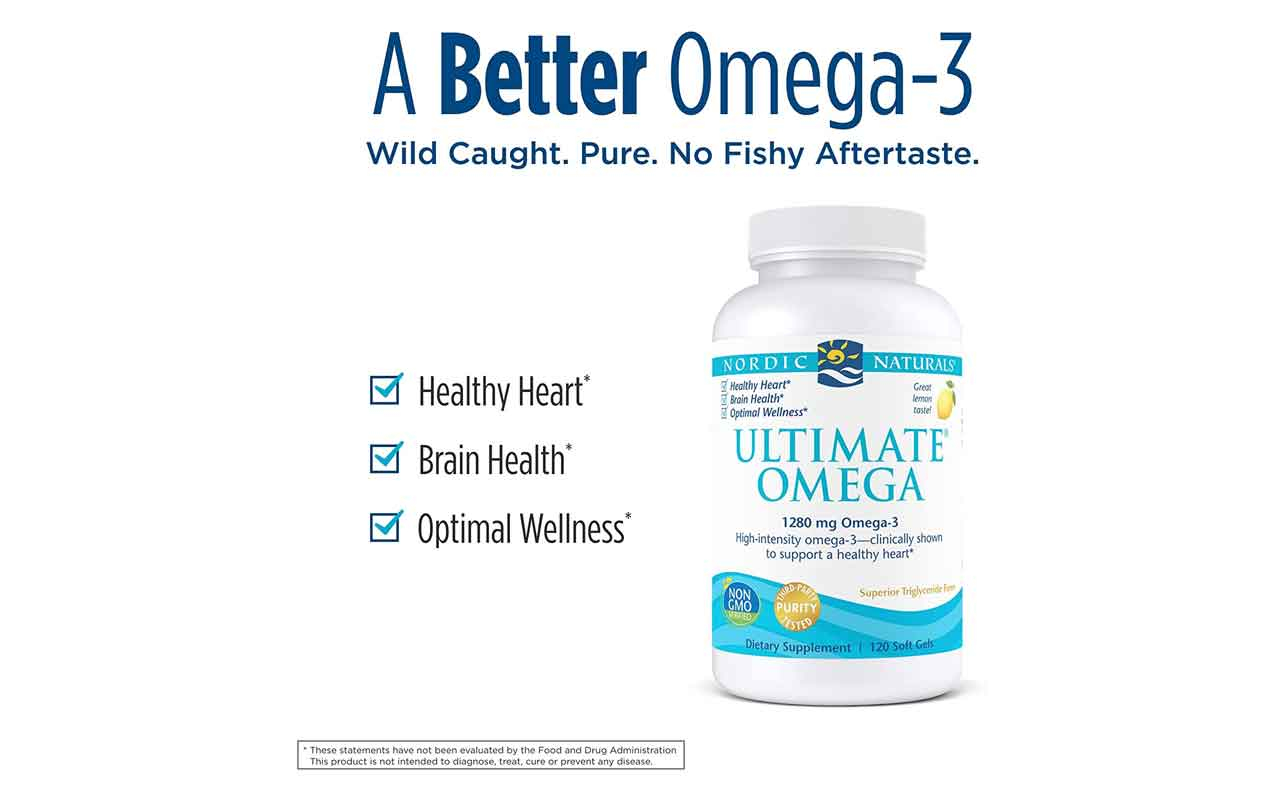
Judged against its own listing, Nordic Naturals Ultimate Omega delivers what it states: 1,280 mg of omega-3s per two-soft-gel serving, in triglyceride form, from anchovies and sardines, with a lemon flavor intended to reduce the "fish burp" some people get from fish oil. At the standard one-serving directions, that's 60 servings per bottle — a 60-day supply; at the "ultimate support" two-serving directions, those same 60 servings last 30 days. Even at the higher amount — roughly 2,560 mg/day — this product stays comfortably under the FDA's 5 g/day safety ceiling for combined EPA and DHA from supplements.
Where it fits realistically: this is a general-wellness dose in the same range studied in VITAL and ASCEND — trials that, in people without existing heart disease, didn't move the main cardiovascular needle. It is not a substitute for the 4 g/day prescription EPA shown to meaningfully reduce cardiovascular events in REDUCE-IT, and it isn't marketed as one. The most consistent, best-supported reason to take a supplement in this dose range is triglyceride support and general omega-3 intake for people who don't eat the recommended one to two servings of fatty fish per week — not a promise of heart attack prevention.
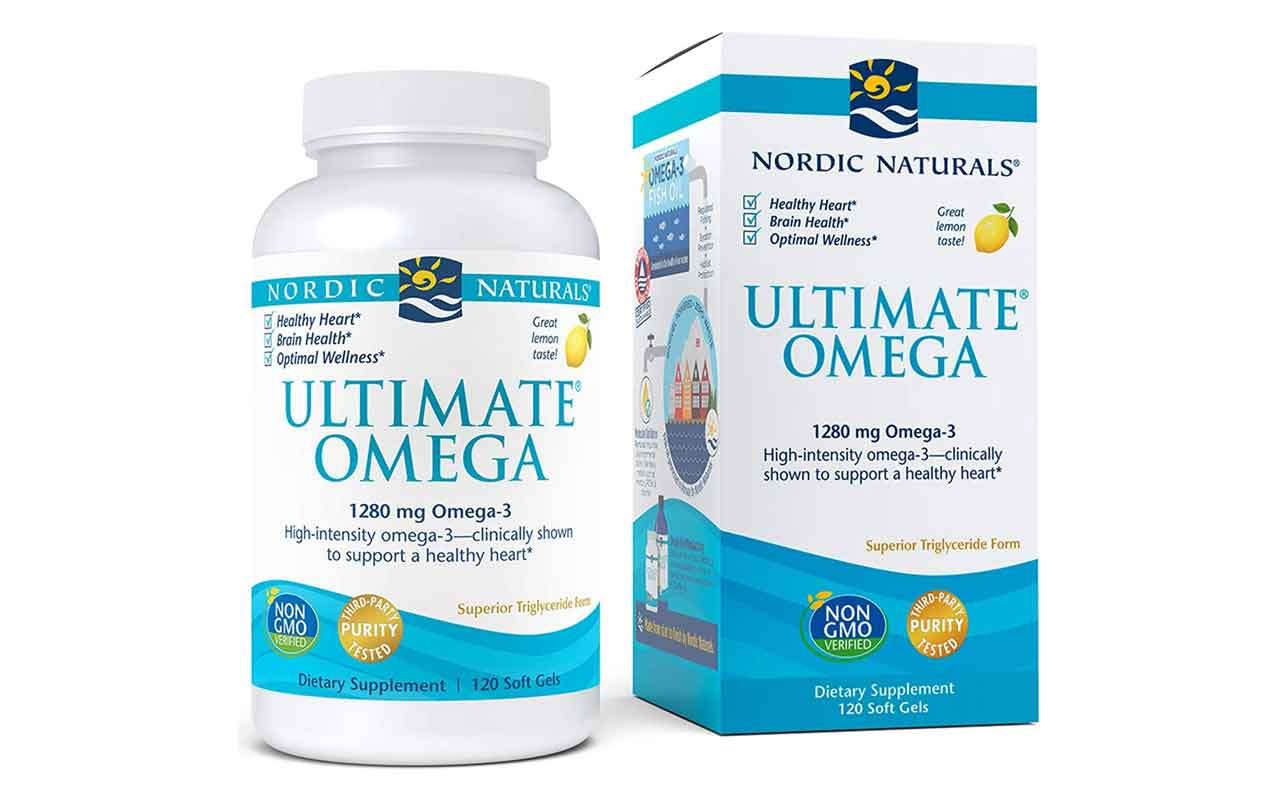
Nordic Naturals Ultimate Omega Lemon 1280mg — 120 Soft Gels
Triglyceride-form fish oil from anchovies and sardines, delivering 1,280 mg of total omega-3s, including EPA and DHA, per two-soft-gel serving. Lemon-flavored to reduce fishy aftertaste, non-GMO, gluten- and dairy-free. Consult a doctor before use if you take blood thinners or have a documented fish or shellfish allergy.
Browse the full range in our Heart & Cardiovascular category.
Frequently asked questions
Will taking fish oil prevent a heart attack?
Not reliably, if you don't already have heart disease. The largest trial to test this directly, VITAL (25,871 people, 1 g/day, 5.3 years), found no reduction in the combined risk of major cardiovascular events. Larger benefits have only been shown at prescription doses in people who already have cardiovascular disease or diabetes.
How much omega-3 should I take per day?
There's no official RDA for EPA or DHA specifically. The American Heart Association suggests roughly 1 g/day of combined EPA and DHA for people with existing heart disease, and one to two servings of fatty fish per week for general health. The FDA considers up to 5 g/day from supplements safe.
Can I take fish oil with blood thinners?
Talk to your doctor first. High-dose fish oil can prolong bleeding time, and the NIH advises caution when combining it with warfarin or other anticoagulants, even though typical supplement doses have not been shown to significantly affect warfarin's anticoagulant activity in most studies.
Am I at risk if I'm allergic to iodine?
"Iodine allergy" isn't a medically recognized condition — the American Academy of Allergy, Asthma & Immunology states iodine itself is not an allergen and has never been documented to cause an IgE-mediated allergic reaction. The real precaution with a fish-oil supplement is a documented allergy to fish or shellfish protein, which is a separate and legitimate concern.
Does it matter if the fish oil is "triglyceride form" instead of "ethyl ester form"?
Triglyceride form is the natural form omega-3s take in fish and is generally considered better absorbed than the ethyl-ester form some lower-cost supplements use after processing, though head-to-head absorption differences are modest rather than dramatic.
Are all fish oil supplements equally potent?
No. A 2020 peer-reviewed review collected the independent testing on OTC fish oil: in a USDA-funded analysis of 47 products, 74% contained less EPA or DHA than the label claimed, and in a separate study of 32 products, more than 80% exceeded industry oxidation limits. Third-party certification (such as IFOS or USP testing) is the most reliable way to verify a specific product's actual potency and purity.
- NIH Office of Dietary Supplements — Omega-3 Fatty Acids, Fact Sheet for Health Professionals
- NIH Office of Dietary Supplements — Omega-3 Fatty Acids, Fact Sheet for Consumers
- NIH National Center for Complementary and Integrative Health — Omega-3 Supplements: In Depth
- MedlinePlus — Omega-3 Fatty Acids (Drug Information)
- U.S. Food and Drug Administration — Qualified Health Claims for EPA and DHA Omega-3 and Risk of Hypertension and Coronary Heart Disease
- American Academy of Allergy, Asthma & Immunology — Radiocontrast and Seafood Allergy
- Sherratt SCR, et al. "Are dietary fish oil supplements appropriate for dyslipidemia management?" Current Opinion in Lipidology, 2020 (PMC, NIH)
This article is for educational purposes only and is not a substitute for professional medical advice, diagnosis, or treatment. Always consult a qualified healthcare provider before starting any supplement, especially if you take blood thinners, have a bleeding disorder, have a fish or shellfish allergy, have atrial fibrillation, or are pregnant or breastfeeding. These statements have not been evaluated by the Food and Drug Administration. This product is not intended to diagnose, treat, cure, or prevent any disease.