
Two meta-analyses published in 2025 asked the same question, whether garlic extract lowers blood pressure in people with hypertension, and got answers that differ by a factor of two: a systolic drop of 8.1 mmHg in one, 4.2 mmHg in the other. Garlic supplements are concentrated extracts of Allium sativum bulbs, standardized to sulfur compounds such as allicin. The NIH's summary is more cautious than either paper, and the "immune support" label on this bottle rests on even thinner ground.
Key Takeaways
- NCCIH (updated February 2025) says garlic supplements "may reduce levels of total cholesterol and low-density lipoprotein (LDL) cholesterol to a small extent" in people with high cholesterol, and blood pressure "to a small extent" with "limited evidence."
- A 2025 meta-analysis of 12 reports (738 patients) found systolic pressure fell 8.12 mmHg; another of 10 RCTs found 4.21 mmHg, with a diastolic drop of 3.13 mmHg.
- A Cochrane review found one trial (146 people, 12 weeks) that met its criteria for garlic and the common cold: 24 colds versus 65 on placebo, but the reviewers called the evidence "insufficient."
- NCCIH warns that "taking garlic supplements may increase the risk of bleeding," especially around surgery or with anticoagulants or aspirin.
- One serving here is 2 capsules (1,200 mg extract), standardized to 10,000 ppm allicin potential, about 12 mg by our arithmetic; the label allows 1 to 4 servings a day, up to 4,800 mg.
In this article:
- What Garlic Supplements Are, and What NCCIH Says
- Blood Pressure: Two 2025 Reviews, Two Answers
- Cholesterol and Blood Sugar
- Immune Support: One Trial
- Safety: Bleeding, Surgery and Medicines
- Inside Life Extension Optimized Garlic 1200 mg
- Who Might Consider It, and Who Should Skip It
- Frequently Asked Questions
What Garlic Supplements Are, and What NCCIH Says
According to NCCIH, garlic has a long history in foods and folk medicine, and today it "is promoted as a dietary supplement for various purposes, including helping to manage high blood cholesterol, high blood pressure, and diabetes; preventing various types of cancer; and enhancing immune function." Unlike many supplements, garlic has been heavily studied: "A great deal of research has been done on garlic, especially on its effects on levels of cholesterol and related lipids."
That volume of research is why the conclusions below are more specific than for most supplements, and also why the disagreements are informative. NCCIH's own reading is modest across the board, and it is worth holding onto as we look at the pooled numbers.
Blood Pressure: Two 2025 Reviews, Two Answers
NCCIH says that "limited evidence suggests that garlic supplements may reduce blood pressure to a small extent in people who have high blood pressure." Two 2025 meta-analyses, both restricted to people with hypertension, put numbers on it:
| Review | Studies | Systolic change (95% CI) | Diastolic change (95% CI) |
|---|---|---|---|
| Ma et al., Asian Biomedicine, 2025 | 12 reports; 405 garlic, 333 placebo | −8.12 mmHg (−10.95 to −5.28) | −4.26 mmHg (−5.99 to −2.52) |
| Tang et al., Frontiers in Nutrition, 2025 | 10 RCTs; garlic versus control or conventional medication | −4.21 (−5.74 to −2.69) | −3.13 (−4.42 to −1.84) |
Both find a statistically significant fall, so the direction is consistent. The size is not. The first review's authors concluded that "a sufficient number of trials have already been performed to reach a consensus conclusion, and further trials are not required," a claim NCCIH's "limited evidence" wording does not share. The second review found garlic users had slightly more adverse reactions, mostly gastrointestinal discomfort and bad breath, though not significantly so. Differences in which trials were included, in product type and in patient populations may explain the gap. Ma’s abstract gives no doses; Tang’s reports the systolic fall was significant in the subgroup given “a garlic dosage of 2.4 mg,” without saying which preparation or constituent that figure measures, so it cannot be mapped onto the 1,200 mg of extract in this product. If heart health is your goal, the fish oil article shows what a very large trial found for another heart supplement.
"Garlic supplements may reduce levels of total cholesterol and low-density lipoprotein (LDL) cholesterol to a small extent in people who have high blood cholesterol levels."
— NIH National Center for Complementary and Integrative Health, Garlic (last updated February 2025)Cholesterol and Blood Sugar
A 2024 meta-analysis in Nutrients (Zhao and colleagues) of randomized trials of garlic and its supplements reported the following mean differences:
| Measure | Mean difference (95% CI) |
|---|---|
| Total cholesterol | −14.17 (−19.31 to −9.03) |
| LDL cholesterol | −8.20 (−15.58 to −0.81) |
| HDL cholesterol | +2.06 (1.54 to 2.59) |
| Triglycerides | No substantial impact |
| Fasting blood glucose | −7.01 (−8.53 to −5.49) |
| HbA1c | −0.66 (−0.76 to −0.55) |
The LDL interval runs to −0.81, close to zero, and the HbA1c estimate carried heterogeneity of 62.9%. NCCIH's phrasing, "to a small extent," fits: small, plausible and not dramatic. The same page adds that garlic supplements "may reduce blood sugar to a small extent in people with diabetes."
Immune Support: One Trial
This is the claim in the product's name and store listing: "Immune Support." NCCIH is candid here: "Dietary supplements that contain garlic have been promoted as boosters for the immune system, particularly during cold and flu season. However, very little research has been done on this topic. A 2022 review identified only two studies that suggest a possible benefit, and both studies included only small numbers of people and had weaknesses in the research."
The Cochrane review of garlic for the common cold (Lissiman and colleagues, 2014) reached the same place. Of eight potentially relevant trials, only one met its criteria: 146 participants took a garlic supplement (with 180 mg of allicin content) or placebo once daily for 12 weeks. There were 24 colds in the garlic group versus 65 in the placebo group, and fewer days of illness (111 versus 366), but recovery time once ill was similar (4.63 versus 5.63 days). The trial relied on self-reported colds. The reviewers concluded there is "insufficient clinical trial evidence," that a single trial suggested garlic "may prevent occurrences of the common cold but more studies are needed," and that "claims of effectiveness appear to rely largely on poor-quality evidence."
For a comparison with other immune-season supplements, our elderberry article covers a 312-person trial.
Mayo Clinic on herbs and dietary supplements.
Safety: Bleeding, Surgery and Medicines
NCCIH says garlic taken orally "has been used safely in research studies that lasted as long as 7 years," with side effects that include breath and body odor, abdominal pain, flatulence and nausea, and that some people have allergic reactions. The important caution is different: "Taking garlic supplements may increase the risk of bleeding. If you take garlic supplements, make sure to tell your health care providers. This is especially important if you are going to have surgery or if you take medicines, such as anticoagulants or aspirin, that may also affect bleeding."
Genuine safety warning: tell every clinician who treats you, and your surgical team before any procedure, if you take garlic supplements, particularly at the higher doses this label allows. NCCIH also says garlic "may not be safe for use during pregnancy or while breastfeeding when taken orally in amounts greater than those found in foods."
Inside Life Extension Optimized Garlic 1200 mg
Life Extension Immune Support Optimized Garlic is a bottle of 200 vegetarian capsules. The Supplement Facts panel lists a serving of two capsules, with 100 servings per container, containing 1,200 mg of garlic extract (bulb) "std. to 10,000 ppm allicin potential," with no established Daily Value. Other ingredients are vegetable cellulose (the capsule), microcrystalline cellulose and vegetable stearate. The label directs two capsules one to four times daily with the heaviest meals, and cautions that garlic taken on an empty stomach may cause irritation.
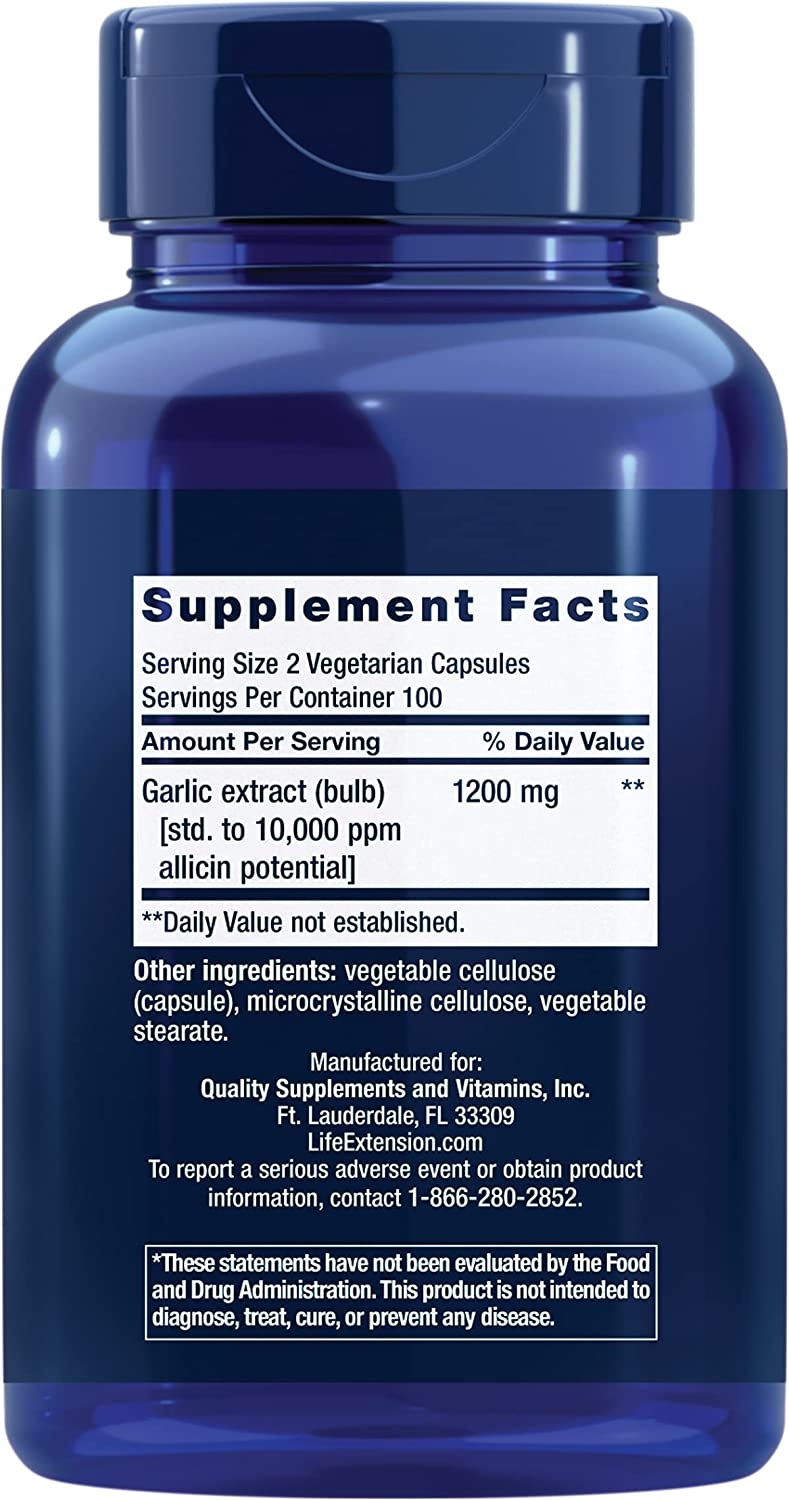
Here is the basis issue. "10,000 ppm allicin potential" means 1% by weight: 1,200 mg × 1% is about 12 mg of allicin potential per serving, which is our arithmetic and not a printed figure. "Allicin potential" generally refers to the allicin a preparation can produce, as opposed to allicin already present in it. The Cochrane cold trial described its product as containing 180 mg of "allicin content." These are different measures on different bases, so the 12 mg and the 180 mg should not be compared directly. Note also that the label allows up to four servings a day, or 4,800 mg of extract, four times the amount in a single serving.
| This product | Typical trial dose | NIH RDA / AI | Tolerable Upper Limit | |
|---|---|---|---|---|
| Garlic extract | 1,200 mg per 2-capsule serving; 1–4 servings daily (1.2–4.8 g) | Ma 2025 abstract: not stated. Tang 2025 abstract: significant systolic subgroup at “a garlic dosage of 2.4 mg” (basis not stated). The Cochrane cold trial used a supplement with 180 mg allicin content daily | None: not an essential nutrient | None established; NCCIH notes use for up to 7 years in studies |
| Allicin potential | 10,000 ppm, about 12 mg per serving (our arithmetic) | Different basis (“allicin content”); not comparable | None | None |
What the listing claims versus what the evidence supports: the store description says garlic "aids in supporting our immune system and safeguards against oxidative stress," that its constituents "help maintain normal blood platelet activity," and that garlic "can increase natural glutathione levels, which are crucial for cellular detoxification." Those are manufacturer statements. NCCIH says very little research exists on immune support, and the sources reviewed here do not address glutathione or "detoxification." The platelet statement is the one that overlaps with NCCIH's bleeding warning.
Who Might Consider It, and Who Should Skip It
Who this is for: healthy adults who want a garlic supplement, have checked with their clinician first, are not taking anticoagulants or aspirin, have no surgery scheduled, and accept that the effects measured in the research above were small. It is not a substitute for any prescribed treatment for blood pressure or cholesterol.
Who should skip it: anyone taking anticoagulants or aspirin without their prescriber's agreement; anyone with surgery or a procedure coming up; anyone pregnant or breastfeeding; anyone buying it mainly to prevent colds, where the evidence is one trial; and, frankly, most people, who have no need for a concentrated extract.
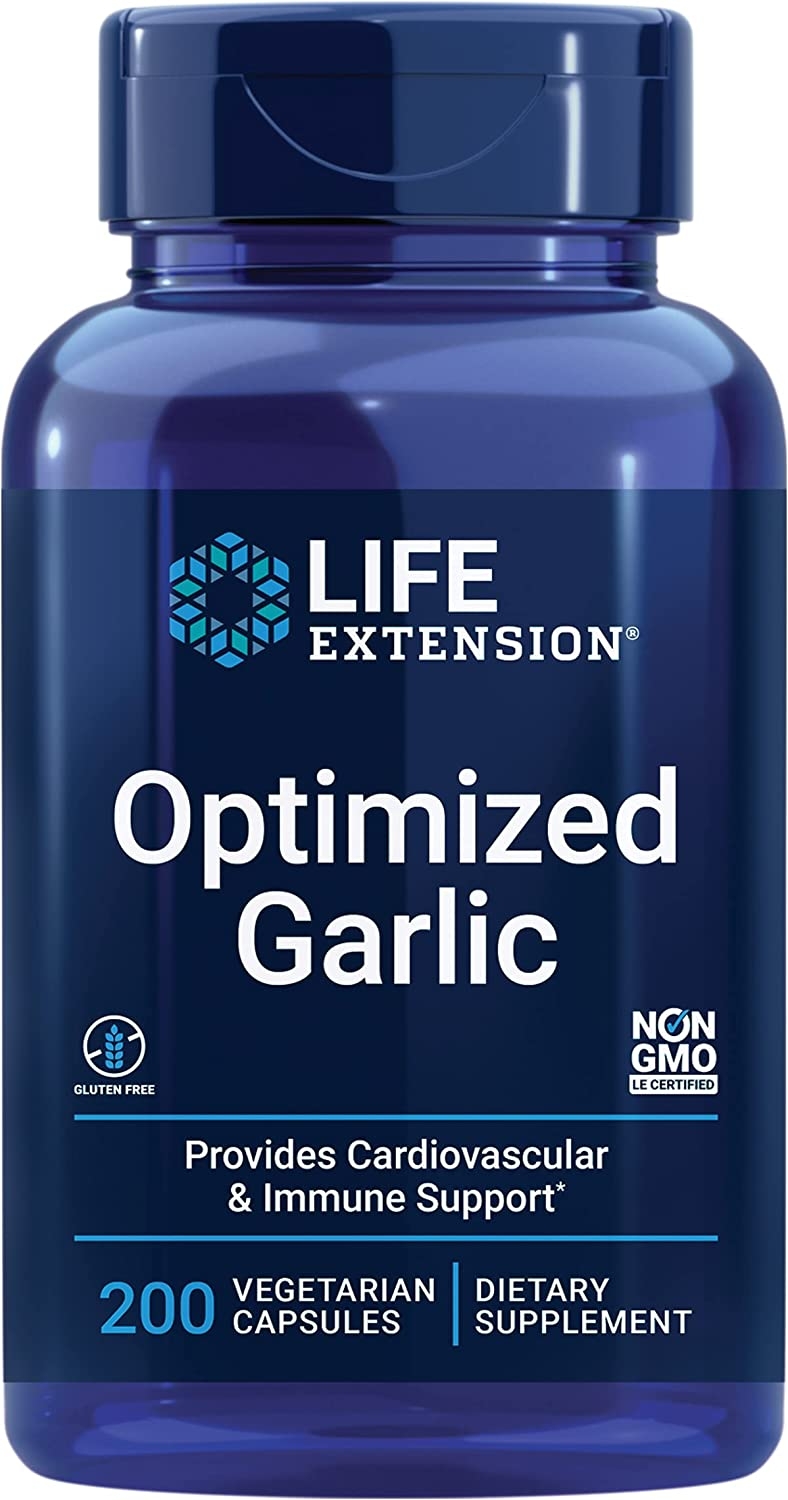
Life Extension Optimized Garlic 1200 mg — 200 Veggie Caps
1,200 mg of garlic extract per two-capsule serving, standardized to 10,000 ppm allicin potential, 100 servings per bottle. As covered above, NCCIH warns garlic supplements may increase bleeding risk; tell your clinicians if you take them. Browse more in our immune support category.
View Product DetailsFrequently Asked Questions
Does garlic lower blood pressure?
A little, in people with hypertension. Two 2025 meta-analyses found significant drops, 8.12 mmHg systolic in one and 4.21 in the other. NCCIH describes the evidence as limited and the effect as small. It is not a replacement for prescribed treatment.
Does garlic lower cholesterol?
Slightly. NCCIH says garlic supplements may reduce total and LDL cholesterol to a small extent in people with high cholesterol. A 2024 meta-analysis found LDL fell by 8.20 (95% CI −15.58 to −0.81), with no substantial effect on triglycerides.
Does garlic help prevent colds?
Possibly, but evidence is thin. A Cochrane review found one qualifying trial of 146 people with 24 colds on garlic versus 65 on placebo. Reviewers called the evidence insufficient and said claims rely largely on poor-quality evidence.
How much garlic extract should I take?
No official dose exists. This label directs two capsules (1,200 mg of extract) one to four times daily with the heaviest meals. Follow the label or your clinician's advice, and note that the higher label doses have not been separately studied in the sources reviewed here.
Can garlic supplements increase bleeding risk?
Yes, that is NCCIH's main safety warning. It says taking garlic supplements may increase the risk of bleeding and to tell your health care providers, especially before surgery or if you take anticoagulants or aspirin.
Is it safe to take garlic supplements long term?
NCCIH says garlic taken orally has been used safely in research studies lasting as long as seven years. Side effects include breath and body odor, abdominal pain, flatulence and nausea. Some people are allergic. Pregnant or breastfeeding women should avoid amounts above food levels.
What does '10,000 ppm allicin potential' mean?
It means 1% by weight: the extract could yield allicin equal to about 1% of its mass when its precursor alliin is converted. For 1,200 mg that is roughly 12 mg. It is a standardization marker, not a measure of allicin already present.
Should I take garlic with food?
The label directs taking it with the heaviest meals and cautions that garlic on an empty stomach may cause irritation. NCCIH lists abdominal pain and nausea among garlic's side effects, so food is a sensible default; ask your clinician if you have questions.
Sources
- NIH National Center for Complementary and Integrative Health. "Garlic." Last updated February 2025. Accessed 29 September 2026. nccih.nih.gov
- Ma X, Zhang H, Jia J. The effect of garlic on the lowering of blood pressure in the patients with hypertension: an updated meta-analysis and trial sequential analysis. Asian Biomed, 2025;19(3):131-140. Accessed 29 September 2026. doi.org/10.2478/abm-2025-0016
- Tang Y, et al. Meta-analysis on the safety and efficacy of long-term garlic consumption as an adjunctive treatment for hypertension. Front Nutr, 2025;12:1656809. Accessed 29 September 2026. doi.org/10.3389/fnut.2025.1656809
- Zhao X, et al. Effects of garlic on glucose parameters and lipid profile: a systematic review and meta-analysis on randomized controlled trials. Nutrients, 2024;16(11):1692. Accessed 29 September 2026. doi.org/10.3390/nu16111692
- Lissiman E, Bhasale AL, Cohen M. Garlic for the common cold. Cochrane Database Syst Rev, 2014;(11):CD006206. Accessed 29 September 2026. doi.org/10.1002/14651858.cd006206.pub4
- NIH National Center for Complementary and Integrative Health. "Using Dietary Supplements Wisely." Last updated January 2019. Accessed 29 September 2026. nccih.nih.gov
This article is for educational purposes only and is not medical advice. It is not intended to diagnose, treat, cure, or prevent any disease. These statements have not been evaluated by the Food and Drug Administration. Talk to your doctor before starting any new supplement, especially if you are pregnant, breastfeeding, take anticoagulants, aspirin or any other prescription medication, or have surgery planned, and tell your care team about all supplements you take.