
A 2017 Cochrane review of 15 randomised trials and 71,422 people found that lowering homocysteine with folate, vitamin B6 or vitamin B12 did not reduce heart attacks or deaths — yet the front of this folate-and-B12 capsule's label reads “Cardiovascular Health Support.” Folate (vitamin B9) is a water-soluble B vitamin the body uses to make DNA and new cells, and methylfolate (5-MTHF) is the form that circulates in your blood. Its best-evidenced benefit, preventing neural tube birth defects, was proven for synthetic folic acid, not methylfolate.
Key Takeaways
- Across 15 trials and 71,422 participants, homocysteine-lowering B vitamins did not change heart attack risk (RR 1.02) or all-cause death (RR 1.01); stroke fell slightly (RR 0.90) (Cochrane, 2017 update).
- The USPSTF gives a grade A to 400–800 mcg of daily folic acid for anyone who could become pregnant (August 2023).
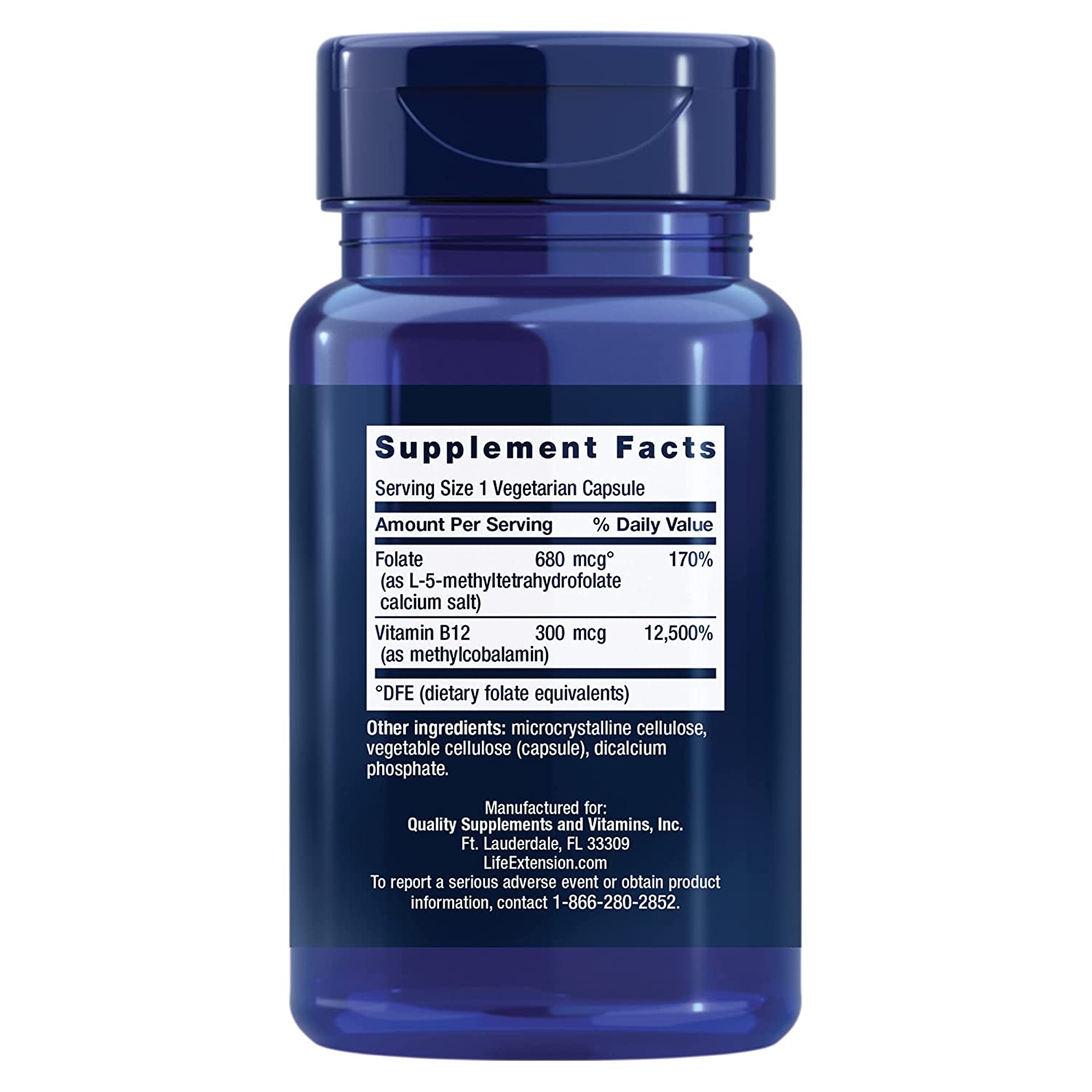
- One capsule supplies 680 mcg DFE of folate as L-5-methyltetrahydrofolate (170% of the Daily Value) and 300 mcg of B12 as methylcobalamin, 125 times the 2.4 mcg adult RDA.
- Methylfolate raised red blood cell folate more than folic acid in a 144-woman trial (Am J Clin Nutr, 2006), yet the CDC still recommends 400 mcg of folic acid, not 5-MTHF, even with an MTHFR variant (NIH ODS, 2022).
- The 1,000 mcg adult upper limit applies to synthetic folate from supplements and fortified foods, not only to folic acid; vitamin B12 has no established upper limit (NIH ODS, 2022 and 2025).
In this article:
- Folate, Folic Acid and Methylfolate: What Is the Difference?
- The One Benefit With A-Grade Evidence, and the Form It Was Proven For
- Does Lowering Homocysteine Protect the Heart?
- Is Methylfolate Actually Better Than Folic Acid?
- The B12 Half: A Big Dose, No Upper Limit, One Real Catch
- Inside Life Extension BioActive Folate & Vitamin B12
- Who Should Consider It, and How to Use It Sensibly
- Frequently Asked Questions
Folate, Folic Acid and Methylfolate: What Is the Difference?
The three words are not interchangeable. According to the NIH Office of Dietary Supplements (ODS, updated November 2022), “folate” is the generic term for food folates and for the folates in supplements and fortified foods, including folic acid. Folic acid is the synthetic form used in most supplements and fortified grains. 5-MTHF, also sold as L-methylfolate, is the main folate in your plasma, and some supplements contain it directly.
ODS calls frank deficiency rare in the US, but even counting supplements 17% of women aged 19 to 30 fall below the average requirement (ODS, 2022). The adult Recommended Dietary Allowance is 400 mcg DFE (dietary folate equivalents), 600 mcg DFE in pregnancy. One mcg DFE equals 0.6 mcg of folic acid taken with food, but for 5-MTHF ODS says conversion factors “have not been formally established,” and the FDA lets manufacturers use 1.7 or their own lower factor.
The One Benefit With A-Grade Evidence, and the Form It Was Proven For
Preventing neural tube defects is the strongest claim folate has. The USPSTF (reaffirmed August 2023) recommends that everyone planning to or able to become pregnant take 400 to 800 mcg of folic acid daily, starting at least a month before conception and continuing through the first 2 to 3 months of pregnancy. It notes that nearly half of US pregnancies are unplanned.
The original proof was the Medical Research Council trial: in 1,817 women who had already had an affected pregnancy, folic acid was associated with a 72% protective effect (relative risk 0.28, 95% CI 0.12–0.71), with 6 defects against 21 (Lancet, 1991). The FDA's health-claim rule, 21 CFR 101.79, describes that trial as using 4 mg (4,000 mcg) of folic acid.
Two caveats apply. ODS notes that studies since US fortification began in 1998 “do not demonstrate a clear protective association,” possibly because of fortification or small samples. And every recommendation above names folic acid; none of the graded evidence tests methylfolate.
“The Story of Folic Acid Fortification” — a video from the US Centers for Disease Control and Prevention on the history of folic acid fortification.
Does Lowering Homocysteine Protect the Heart?
The theory was reasonable, and the trials did not bear it out. Folate, B6 and B12 all lower homocysteine, which is higher in people with heart disease, so researchers tested whether lowering it prevented events.
| Source | Who and what | Result |
|---|---|---|
| HOPE-2 trial (NEJM, 2006) | 5,522 patients aged 55+ with vascular disease or diabetes; 2.5 mg folic acid + 50 mg B6 + 1 mg B12 daily vs placebo, about 5 years | Cardiovascular death, heart attack or stroke: 18.8% vs 19.8% (RR 0.95, 95% CI 0.84–1.07). Stroke RR 0.75 (0.59–0.97). Hospitalisation for unstable angina RR 1.24 (1.04–1.49) |
| Meta-analysis of 8 trials (Arch Intern Med, 2010) | 37,485 people at raised vascular risk; folic acid lowered homocysteine by an average 25% | Major vascular events RR 1.01 (0.97–1.05); stroke RR 0.96 (0.87–1.06); cancer RR 1.05 (0.98–1.13); all-cause death RR 1.02 (0.97–1.08) |
| Cochrane review (2017 update) | 15 trials, 71,422 participants; B6, B9 or B12 alone or combined | Heart attack RR 1.02 (0.95–1.10); all-cause death RR 1.01 (0.96–1.06); stroke RR 0.90 (0.82–0.99); serious adverse events RR 1.07 (1.00–1.14) |
The pattern is consistent: no effect on heart attacks or death, and at most a small reduction in stroke. HOPE-2 included 50 mg of B6 a day, a vitamin with its own documented upper limit, covered in our vitamin B6 upper-limit article.
The label's “Cardiovascular Health Support” carries an asterisk pointing to the FDA disclaimer, and the store listing says the capsule “benefits the heart, brain, GI system, and more.” Those are manufacturer statements; the trials tested folic acid-based regimens, not this product.
Is Methylfolate Actually Better Than Folic Acid?
Better absorbed in some measurements, not proven better for any outcome you can feel. The “optimal absorption” wording on the product page is a manufacturer claim.
| Question | Evidence | What it shows |
|---|---|---|
| Raises red blood cell folate more? | 144 healthy women aged 19–33, 24 weeks: 400 mcg folic acid, 416 mcg 5-MTHF, 208 mcg 5-MTHF or placebo (Am J Clin Nutr, 2006) | Red cell folate rose significantly more with 416 mcg 5-MTHF than with 400 mcg folic acid |
| Lowers homocysteine more? | 142 healthy Malaysian women, 12 weeks: 1 mg folic acid, 1.13 mg L-5-MTHF or placebo (J Nutr, 2018) | Different effects on blood folate, “no differences” in homocysteine lowering |
| As bioavailable? | NIH ODS review (updated 2022) | Supplemental 5-MTHF is “the same as or greater than” folic acid |
MTHFR is where much of the interest comes from. A common variant, 677C>T, makes the enzyme that converts folate to 5-MTHF less active. ODS calls the research on whether carriers benefit from 5-MTHF “inconclusive,” then adds the sentence that matters most:
“the Centers for Disease Control and Prevention (CDC) recommends 400 mcg/day of folic acid, not 5-MTHF, for people who could become pregnant, even if they have a 677C>T MTHFR polymorphism”
— NIH Office of Dietary Supplements, Folate: Fact Sheet for Health Professionals, updated 30 November 2022Methylfolate can suit some adults under a clinician's guidance, but it is not an upgrade for pregnancy prevention.
The B12 Half: A Big Dose, No Upper Limit, One Real Catch
Vitamin B12 has no tolerable upper intake level, so 300 mcg is a value question, not a safety one. NIH ODS (updated July 2025) calls B12 “generally considered to be safe, even at high doses.” Absorption falls steeply as the dose rises: about 50% below 1–2 mcg, 2% at 500 mcg and 1.3% at 1,000 mcg. ODS gives no figure for 300 mcg, but at those doses about 10 to 13 mcg is absorbed, still several times the RDA.
Mean food intake was 5.84 mcg for men and 3.69 mcg for women in 2017–March 2020 survey data, so one capsule is roughly 50 to 80 times typical intake. ODS lists older adults, people with pernicious anaemia, gastrointestinal disorders or stomach surgery, and vegetarians and vegans as most likely to run low, as covered in our vitamin B12 evidence guide.
The catch is the interaction. ODS states that “large amounts of folate can correct the megaloblastic anemia, but not the neurological damage, that can result from vitamin B12 deficiency,” and says the worry has shifted to folate possibly worsening the anaemia and cognitive symptoms. Having B12 in the same capsule does not make unexplained anaemia or numbness safe to self-treat.
Genuine safety warning: if you have unexplained fatigue, pale skin, tingling or numbness, or memory changes, ask for a blood test before taking folate. ODS also says people taking methotrexate for cancer should consult their oncologist first, and people on antiepileptic drugs such as carbamazepine or valproate should check with their prescriber. For the B12 half, ODS notes that metformin and gastric acid inhibitors (proton pump inhibitors and H2 blockers) can lower B12 levels, and advises regular users to discuss their B12 status with their healthcare provider.
Inside Life Extension BioActive Folate & Vitamin B12
The label's serving is one capsule, with directions to “Take one (1) capsule daily, or as recommended by a healthcare practitioner,” and a warning to consult a physician if you are pregnant or lactating.
| This product (1 capsule) | Typical shelf dose | NIH RDA / AI (adult) | Tolerable Upper Limit | |
|---|---|---|---|---|
| Folate | 680 mcg DFE (as L-5-MTHF calcium salt) | 400 mcg of folic acid is the generally available over-the-counter dose; 800 mcg is the top of the USPSTF range (2023) | 400 mcg DFE (600 in pregnancy) | 1,000 mcg of synthetic folate from supplements and fortified foods, set in mcg rather than DFE; ODS gives no separate figure for 5-MTHF |
| Vitamin B12 | 300 mcg (as methylcobalamin) | Varies widely; our B12 guide covers a product at over 2,000 times the RDA | 2.4 mcg | None established, because high doses are generally considered safe |
The folate figure is 1.7 times the 400 mcg DFE RDA and 1.13 times the 600 mcg DFE pregnancy RDA. The label does not state how many micrograms of 5-MTHF itself a capsule holds; if the maker used the FDA's 1.7 factor it would be about 400 mcg, but that is an inference, not a label fact.
One point in the store listing needs correcting. It says women who are fertile should get “600–800 mcg of folate every day.” The Food and Nutrition Board advises 400 mcg of folic acid daily for those capable of becoming pregnant, the USPSTF says 400 to 800 mcg, and 600 mcg DFE is the pregnancy RDA.
Who Should Consider It, and How to Use It Sensibly
If you want folate and B12 and prefer methylated forms, this capsule delivers both, and one capsule a day (680 mcg DFE, equivalent to 400 mcg of folic acid) stays well under the 1,000 mcg upper limit for supplemental folate. Taking more than the label’s one capsule, or stacking it with a multivitamin and fortified cereals, pushes supplemental folate toward that limit; ODS notes the limit does not apply to high doses taken under medical supervision, so go beyond it only with a clinician. If you could become pregnant, the evidence-backed route is 400 mcg of folic acid; a clinician can say whether a methylfolate product belongs alongside it.
Who this is for: an adult who has been advised to take folate and B12 together, has had B12 status checked, and has a specific reason to prefer methylfolate and methylcobalamin, such as a clinician's advice about an MTHFR variant or a diet low in B12 foods.
Who should skip it: most people. A healthy adult who eats leafy greens, beans and fortified grains is unlikely to gain anything measurable, and nobody should buy it for the heart on the strength of the homocysteine trials. Anyone with unexplained anaemia or numbness should be tested first, and anyone who could become pregnant should take the 400 mcg of folic acid the USPSTF advises.
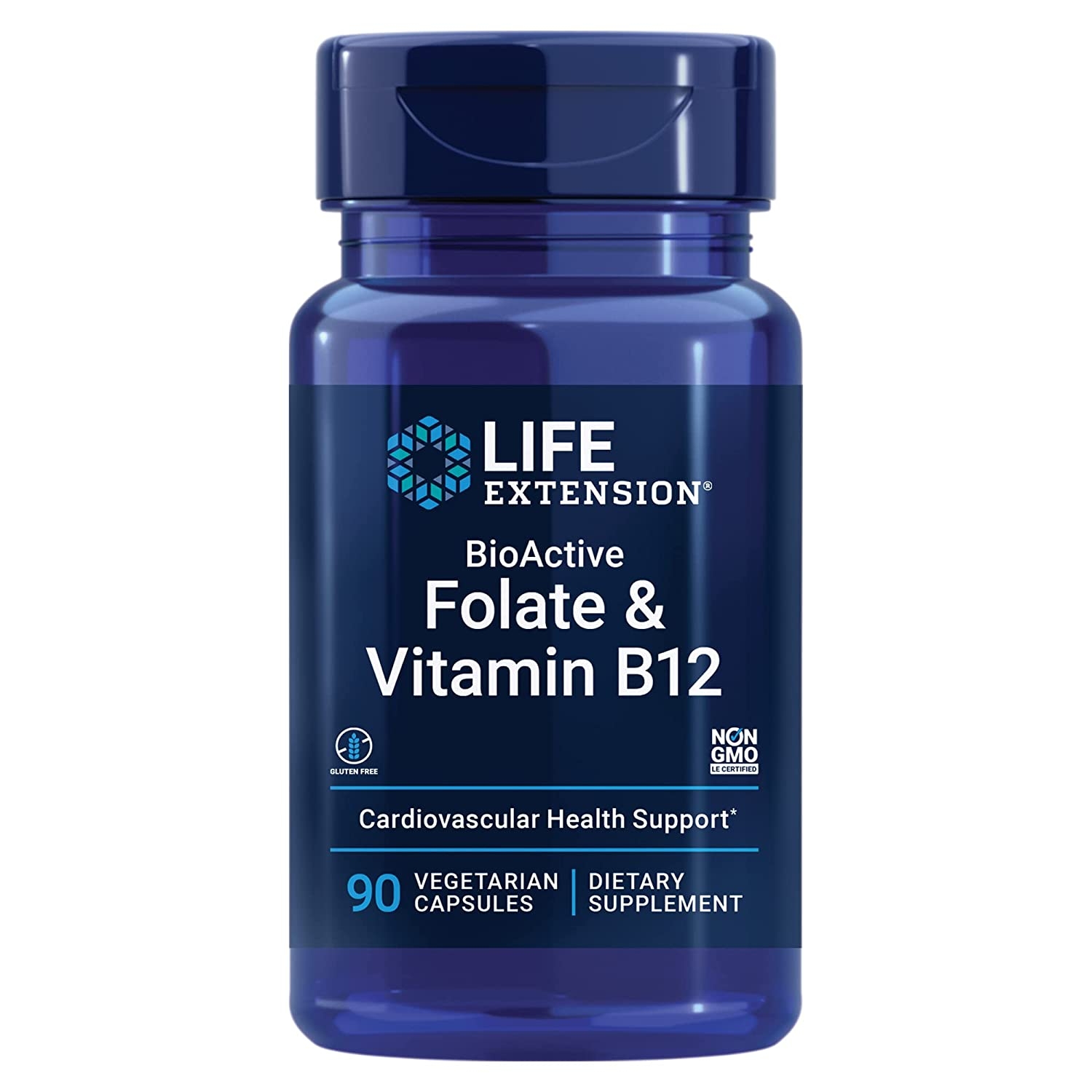
Life Extension BioActive Folate & Vitamin B12 — 90 Vegetarian Capsules
680 mcg DFE folate as L-5-methyltetrahydrofolate and 300 mcg vitamin B12 as methylcobalamin per capsule; one capsule daily per the label. Also browse our vitamins range.
View Product DetailsFrequently Asked Questions
What is the difference between folate, folic acid and methylfolate?
Folate is the umbrella term for vitamin B9. Folic acid is the synthetic form in fortified foods and most supplements. Methylfolate (5-MTHF) is the form that circulates in blood and is sold in some supplements. The pregnancy evidence names folic acid.
Is methylfolate better than folic acid?
It raised red blood cell folate more than folic acid in a 144-woman trial (2006), but a 142-woman trial (2018) found no difference in homocysteine lowering. No trial shows it prevents more neural tube defects, and the CDC still recommends folic acid.
How much folate do adults need per day?
The adult Recommended Dietary Allowance is 400 mcg DFE a day, 600 mcg DFE in pregnancy and 500 mcg DFE while breastfeeding (NIH ODS, 2022).
Does folate lower homocysteine, and does that protect the heart?
Folic acid lowered homocysteine by an average 25% across 8 trials, but a 2017 Cochrane review of 15 trials found no change in heart attacks (RR 1.02) or deaths (RR 1.01), and a small reduction in stroke (RR 0.90).
Can you take too much folate?
The adult upper limit is 1,000 mcg a day of synthetic folate from supplements and fortified foods, set in mcg rather than DFE (NIH ODS, 2022). The main concern is hiding a B12 deficiency, so check B12 status first.
Is it safe to take 300 mcg of vitamin B12?
B12 has no established upper limit because it is generally considered safe even at high doses (NIH ODS, 2025). Absorption drops as the dose rises, so most of 300 mcg passes through unabsorbed.
Should I take methylfolate if I have an MTHFR variant?
The evidence is inconclusive (NIH ODS, 2022). Some people might benefit from 5-MTHF, but the CDC recommends 400 mcg of folic acid, not 5-MTHF, for people who could become pregnant even with that variant.
Can folate hide a vitamin B12 deficiency?
Yes. NIH ODS (2022) says large amounts of folate can correct the megaloblastic anaemia but not the neurological damage of B12 deficiency, and may worsen the anaemia and cognitive symptoms. If you have unexplained fatigue, numbness or memory problems, get tested before supplementing.
Sources
- Cochrane. "Homocysteine-lowering interventions (B-complex vitamin therapy) for preventing cardiovascular events." 2017 update. Accessed 5 October 2026. cochrane.org
- NIH Office of Dietary Supplements. "Folate – Fact Sheet for Health Professionals." Updated 30 November 2022. Accessed 5 October 2026 (Internet Archive copy). ods.od.nih.gov (archived)
- NIH Office of Dietary Supplements. "Vitamin B12 – Fact Sheet for Health Professionals." Updated 2 July 2025. Accessed 5 October 2026 (Internet Archive copy). ods.od.nih.gov (archived)
- US Preventive Services Task Force. "Folic Acid Supplementation to Prevent Neural Tube Defects." Final recommendation, 1 August 2023. Accessed 5 October 2026. uspreventiveservicestaskforce.org
- US Food and Drug Administration. "21 CFR 101.79 – Health claims: Folate and neural tube defects." eCFR, current as of 1 October 2026. Accessed 5 October 2026. ecfr.gov
- MRC Vitamin Study Research Group. "Prevention of neural tube defects: results of the Medical Research Council Vitamin Study." Lancet 338(8760):131–137, 1991. Accessed 5 October 2026. Europe PMC record
- Lonn E, et al. (HOPE 2 Investigators). "Homocysteine lowering with folic acid and B vitamins in vascular disease." N Engl J Med 354(15):1567–1577, 2006. Accessed 5 October 2026. Europe PMC record
- Clarke R, et al. "Effects of lowering homocysteine levels with B vitamins on cardiovascular disease, cancer, and cause-specific mortality: meta-analysis of 8 randomized trials." Arch Intern Med 170(18):1622–1631, 2010. Accessed 5 October 2026. Europe PMC record
- Lamers Y, et al. "Red blood cell folate concentrations increase more after supplementation with [6S]-5-methyltetrahydrofolate than with folic acid in women of childbearing age." Am J Clin Nutr 84(1):156–161, 2006. Accessed 5 October 2026. Europe PMC record
- Henderson AM, et al. "l-5-Methyltetrahydrofolate supplementation increases blood folate concentrations to a greater extent than folic acid supplementation in Malaysian women." J Nutr 148(6):885–890, 2018. Accessed 5 October 2026. Europe PMC record
- MedlinePlus (National Library of Medicine). "Folic Acid." Topic page, no revision date shown. Accessed 5 October 2026. medlineplus.gov
This article is for educational purposes only and is not medical advice. It is not intended to diagnose, treat, cure, or prevent any disease. These statements have not been evaluated by the Food and Drug Administration. Dietary supplements are not approved by the FDA before they are sold. Talk to your doctor before starting any new supplement, especially if you are pregnant, breastfeeding, planning a pregnancy, take any medication, or have anaemia, a B12 deficiency, or a kidney condition.