
The NIH’s own osteoarthritis treatment guide — the federal reference for the joint condition curcumin is most often bought for — doesn’t mention turmeric or curcumin at all. That's not a reason to dismiss it: an 8-week, placebo-controlled trial found a standardised curcumin extract measurably eased knee osteoarthritis pain. But the same NIH review that credits curcumin with "initial" positive findings also warns that curcumin products engineered for "increased bioavailability" — the exact selling point on the label of the product featured below — have been linked to liver damage. Both facts are true at once, and a shopper deserves to see both before they buy.
Key takeaways
- An 8-week randomised trial of 1,000 mg/day of a standardised curcumin extract improved knee pain scores significantly more than placebo (p = 0.045 to p < 0.001, depending on the measure).
- NIH's National Center for Complementary and Integrative Health (NCCIH) says evidence for turmeric/curcumin in osteoarthritis is "initial" and positive, but that higher-quality research is still needed before any firm conclusion.
- NCCIH separately warns that curcumin products with "increased bioavailability" — added black pepper extract, for example — have been linked to reported cases of liver damage.
- A published case report documents a 78-year-old woman who developed jaundice and liver enzymes over 20 times the normal upper limit after one month on 500 mg/day of a curcumin supplement; she recovered after stopping it.
- The featured product's "1500mg Turmeric Curcumin" serving is mostly raw turmeric root powder — its standardised, 95%-curcuminoid extract contributes roughly 142.5 mg of curcuminoids, against the roughly 500 mg of curcuminoids a day (1,000 mg of a 50%-curcuminoid extract) used in the positive knee-pain trial.
- What turmeric and curcumin actually are
- What the evidence shows for joint pain
- The bioavailability boost cuts both ways
- What NIAMS's own osteoarthritis guide leaves out
- Reading the label: what "1500mg Turmeric Curcumin" actually means
- Dosing, safety, and who should be cautious
- How to choose a turmeric supplement
- FAQ
What turmeric and curcumin actually are
Turmeric is a plant in the ginger family grown across Southeast Asia and India, used for centuries in Chinese, Indian, Islamic, and Thai traditional medicine for indigestion, infections, arthritis, and liver disease. According to the NIH National Center for Complementary and Integrative Health (NCCIH), curcumin is the active compound that gives the spice its yellow colour, and it's the ingredient most turmeric supplements are standardised against.
Oral turmeric or curcumin is marketed today for osteoarthritis, depression, allergies, itching, and high cholesterol. NCCIH's overall verdict is blunt: “We don’t know enough to definitively conclude if turmeric or curcumin is beneficial for any health purposes.” Joint pain is the one area where the picture is more encouraging.
What the evidence shows for joint pain
NCCIH notes that several meta-analyses have evaluated oral turmeric or curcumin for osteoarthritis measures like knee pain and stiffness, and that initial findings are positive — while adding that higher-quality research is still needed and that topical curcumin's effectiveness remains unclear.
One of the more rigorous individual trials behind that verdict is a randomised, double-blind, placebo-controlled study of a standardised curcumin extract (50% curcuminoids) in adults with knee osteoarthritis, indexed on PubMed Central. Participants took 500 mg of the extract twice daily — 1,000 mg/day total — for 8 weeks, with consistent results across several validated pain scales:
| Outcome measure | Curcumin group | Placebo group | Statistical significance |
|---|---|---|---|
| KOOS knee pain score (improvement) | +11.98 points | +5.52 points | p = 0.009 |
| Numeric pain rating (reduction) | −2.09 points | −1.57 points | p = 0.001 |
| Japanese Orthopaedic Association score | +9.59 points | +1.11 points | p < 0.001 |
| Reached minimal clinically important difference | 33% of participants | 19% of participants | p = 0.045 |
| Reduced their pain medication use | 37% of participants | 13% of participants | reported, not a primary endpoint |
Source: randomised controlled trial of a curcumin extract (Curcugen®) for knee osteoarthritis pain, National Institutes of Health PubMed Central.
No serious adverse effects were reported, and side-effect frequency was similar between groups. That's encouraging for an 8-week trial — but it's one trial, at one dose, over two months. It doesn't establish that curcumin works as well as an NSAID long-term, and it doesn't mean every curcumin product on the shelf will replicate it, since the extract used was standardised and dosed precisely — something not every retail bottle discloses clearly.
"Turmeric Curcumin and Osteoarthritis" — NutritionFacts.org, reviewing the clinical trial evidence for curcumin in knee osteoarthritis.
The bioavailability boost cuts both ways
Curcumin on its own is notoriously hard for the body to absorb, which is why most modern supplements — including the one featured in this article — add black pepper extract (piperine, often sold as BioPerine) to improve uptake. That's a real, documented pharmacological effect. But it comes with a warning attached, straight from NCCIH's own turmeric fact sheet:
That warning isn't theoretical. A case report indexed on PubMed Central describes a 78-year-old woman with type 2 diabetes and hypertension who developed jaundice and pale, clay-coloured stools after roughly one month of taking 500 mg/day of a curcumin supplement. Liver enzymes were more than 20 times the upper limit of normal, and clinicians scored the case as a "probable" reaction using a standard causality-assessment tool. She recovered after stopping it — enzymes fell 48% within a week, and liver function had normalised by 42 days, remaining normal at 18-month follow-up.
One case report doesn't prove that all enhanced-bioavailability curcumin causes liver injury, and it's exactly the pattern NCCIH is flagging: a formulation designed to push more curcumin into the bloodstream is also, mechanically, pushing more curcumin through the liver to be metabolised.
What NIAMS's own osteoarthritis guide leaves out
The National Institute of Arthritis and Musculoskeletal and Skin Diseases (NIAMS) publishes the federal government's own guide to diagnosing and treating osteoarthritis. Its treatment section covers oral pain relievers, oral and topical anti-inflammatory medications, corticosteroid injections, hyaluronic acid injections for the knee, exercise and physical therapy, and weight management. Turmeric, curcumin, and dietary supplements are not mentioned anywhere in it.
That's not because NIAMS is unaware of them — it reflects where supplement research sits relative to interventions with decades of trial data behind them. NIAMS also notes that osteoarthritis is the most common form of arthritis, more common in older adults, and more likely to affect women after age 50 and following menopause, with hands, knees, hips, neck, and lower back the joints most commonly involved.
Reading the label: what "1500mg Turmeric Curcumin" actually means
This is the part of the label easiest to misread. A 3-capsule serving lists 1,500 mg of "Turmeric Curcumin," but that figure is a sum of three separate ingredients, not 1,500 mg of the active compound:
| Ingredient | Amount | What it is |
|---|---|---|
| Turmeric (Curcuma longa root), raw powder | 1,350 mg | Whole-root powder; curcuminoid content is not standardised or stated |
| Turmeric extract, standardised to 95% curcuminoids | 150 mg | The only portion with a guaranteed curcuminoid yield — approximately 142.5 mg |
| BioPerine (black pepper extract) | 10 mg | Piperine, added to improve absorption |
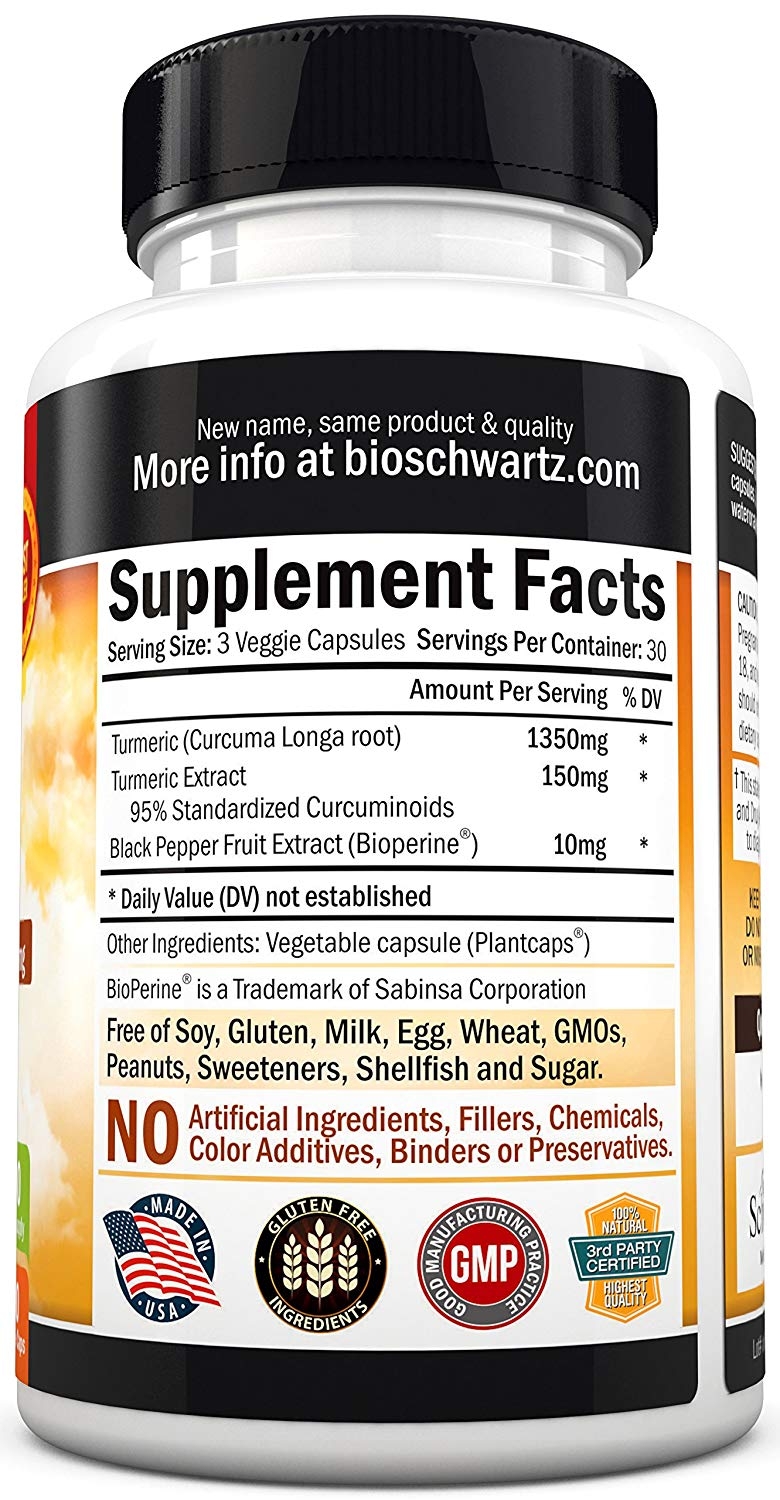
Put plainly: the guaranteed curcuminoid content of this product’s standardised extract is around 142.5 mg per 3-capsule serving, or about 285 mg a day if the label’s twice-daily option is followed. The knee-osteoarthritis trial above used 1,000 mg a day of an extract standardised to 50% curcuminoids — roughly 500 mg of curcuminoids daily, more than this product delivers on either schedule. Taking extra capsules to close that gap is not the conclusion to draw: the label sets its own ceiling, and the liver-injury signal described above is tied to pushing more curcumin into circulation, not less. The remaining 1,350 mg is raw turmeric root powder, whose curcuminoid concentration the label doesn't specify, so it can't be added to that total with any precision. None of this means the product is mislabelled — every ingredient and weight is disclosed accurately — but "1500mg Turmeric Curcumin" on the front of a bottle is not the same claim as "1500mg of curcumin," and shoppers should check the supplement facts panel rather than the headline number.
Dosing, safety, and who should be cautious
NCCIH says oral turmeric or curcumin is likely safe in recommended amounts for up to 2 or 3 months — but its wording is specifically “conventionally formulated… (not modified to enhance bioavailability)”, and longer-term data is limited. That qualifier matters here: the featured product contains BioPerine precisely to enhance bioavailability, so it is not the kind of formulation that reassurance was written about. Reported side effects include nausea, vomiting, acid reflux, stomach upset, diarrhoea, or constipation.
| Group | Guidance, per the product's safety information |
|---|---|
| Pregnant or nursing | Consult a physician before use; NCCIH separately advises turmeric supplements may be unsafe in pregnancy |
| Under 18 | Consult a physician before use |
| GERD, IBS, stomach ulcers, or asthma | May adversely affect these existing conditions |
| Anyone on prescription medication | Talk to a healthcare provider first (general NCCIH guidance for herbal products) |
| Anyone noticing jaundice, dark urine, or unusual fatigue | Stop the supplement and seek medical advice — possible liver signal, per NCCIH |
The product's own directions call for 3 capsules once or twice daily with food and water, and its own FAQ describes one bottle as a 30-day supply at the labelled dose.
How to choose a turmeric supplement
If joint pain is the goal, three things matter more than the total milligrams on the front of the label: the standardised curcuminoid percentage of the extract (95% is a common, reputable standard), the milligram amount that percentage applies to (not the raw powder), and whether an absorption enhancer like piperine is disclosed with a specific amount. Third-party testing for heavy metals — which this product's manufacturer states it performs — is also worth checking for.
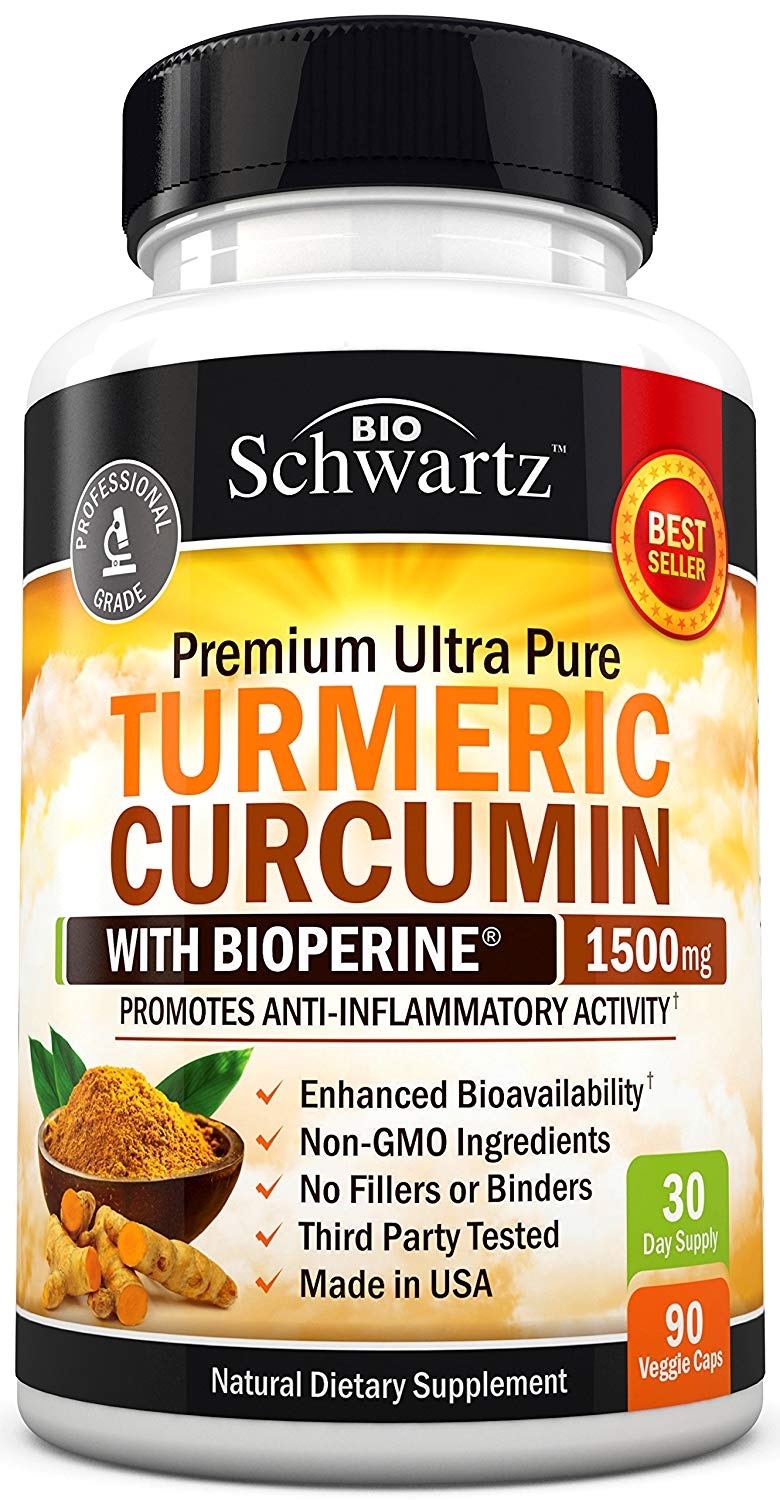
Turmeric Curcumin Bioperine 1500mg — Joint Support Supplement
A 3-capsule serving combines 1,350 mg of raw turmeric root powder with 150 mg of a 95%-standardised curcuminoid extract (about 142.5 mg of curcuminoids) and 10 mg of BioPerine for absorption. Made in the USA and third-party tested per the manufacturer, directions call for 3 capsules once or twice daily with food. Not a replacement for standard osteoarthritis care — read the safety information above first, especially if pregnant, nursing, or managing a GI condition.
Browse the full range in our Herbal Supplements category.
Frequently asked questions
Does turmeric or curcumin actually reduce joint pain?
The evidence is encouraging but early. NCCIH describes meta-analyses on turmeric/curcumin for osteoarthritis as "initial" and positive, and one 8-week randomised trial found a standardised 1,000 mg/day curcumin extract significantly outperformed placebo on multiple knee-pain scales. NCCIH says higher-quality research is still needed before a firm conclusion.
Why do curcumin supplements add black pepper extract (BioPerine)?
Curcumin is poorly absorbed on its own, and piperine (branded BioPerine) is added to improve how much reaches the bloodstream. It's a real effect, but NCCIH also warns that curcumin products engineered for increased bioavailability have been linked to reported liver damage — a trade-off, not a pure upside.
Is it safe to take a turmeric or curcumin supplement every day?
NCCIH’s “likely safe for up to 2 or 3 months at recommended amounts” verdict is written about conventionally formulated turmeric or curcumin — explicitly not products modified to enhance bioavailability, which is what a BioPerine formula is. Data beyond 2 to 3 months is limited either way. Watch for fatigue, nausea, poor appetite, dark urine, or jaundice, and stop the supplement and see a doctor if they appear.
Can turmeric or curcumin supplements interact with my medications?
NCCIH's general guidance is to talk with a healthcare provider before using any herbal product if you take other medicine. Given the liver-injury case reports tied to enhanced-bioavailability formulas, that conversation matters more if you take medications the liver also has to process.
Who shouldn't take this product?
Per the product's own safety information, anyone pregnant or nursing, under 18, or managing GERD, IBS, stomach ulcers, or asthma should consult a physician first, as should anyone with a known medical condition. NCCIH separately advises turmeric supplements may be unsafe during pregnancy.
Does "1500mg Turmeric Curcumin" on the label mean 1500mg of the active compound?
No. The 1,500 mg total splits into 1,350 mg of raw turmeric root powder (curcuminoid content not standardised or stated) and a 150 mg extract standardised to 95% curcuminoids — roughly 142.5 mg of guaranteed curcuminoids, plus 10 mg of BioPerine. The guaranteed active-compound dose is meaningfully lower than the front-of-bottle number suggests.
Sources
- NIH National Center for Complementary and Integrative Health — Turmeric
- NIAMS — Osteoarthritis
- NIAMS — Osteoarthritis: Diagnosis, Treatment, and Steps to Take
- PubMed Central — Randomised, double-blind, placebo-controlled trial of a curcumin extract for knee osteoarthritis pain
- PubMed Central — Drug-induced liver injury attributed to a curcumin supplement (case report)
- U.S. Food and Drug Administration — Questions and Answers on Dietary Supplements
This article is educational and not a substitute for professional medical advice, diagnosis, or treatment. Consult a qualified healthcare provider before starting any supplement, especially if pregnant or breastfeeding, managing a liver or gastrointestinal condition, or taking prescription medication. These statements have not been evaluated by the Food and Drug Administration. This product is not intended to diagnose, treat, cure, or prevent any disease.