
In the largest trial ever run on the question — 1,583 people with knee osteoarthritis, funded by the National Institutes of Health — glucosamine and chondroitin, alone or combined, did not significantly relieve joint pain better than a placebo. Glucosamine and chondroitin are naturally occurring compounds the body uses to build and maintain cartilage, the connective tissue that cushions joints, and they are sold together in some of the best-selling joint supplements on the market. The one subgroup that did show a statistically significant benefit was a secondary, after-the-fact analysis — not the trial's main result, and not something the trial was designed or powered to test on its own.
Key Takeaways
- The NIH-funded GAIT trial (Glucosamine/chondroitin Arthritis Intervention Trial), the largest of its kind, randomized 1,583 patients with knee osteoarthritis to glucosamine, chondroitin, both combined, celecoxib, or placebo for 24 weeks (New England Journal of Medicine, 2006).
- Overall, the combination produced a 66.6% response rate versus 60.1% for placebo — a difference that did not reach statistical significance (p=0.09), while the celecoxib comparison arm did (70.1%, p=0.008).
- A secondary, exploratory subgroup of patients with moderate-to-severe pain did show a significant benefit from the combination — 79.2% versus 54.3% for placebo (p=0.002) — but this was an after-the-fact analysis, not the trial's pre-specified primary endpoint (AHRQ comparative effectiveness review, 2011).
- A 2008 follow-up of 572 of the original participants, tracking joint damage on X-ray for 2 years, found no difference in joint space narrowing between any active treatment and placebo (NCCIH, updated 2023).
- This product supplies 750 mg of glucosamine sulfate and 600 mg of chondroitin sulfate per serving — roughly half the 1,500 mg / 1,200 mg doses GAIT actually tested — plus 500 mg of MSM, an ingredient the trial never evaluated.
In this article:
- What Are Glucosamine and Chondroitin, and Why Are They Sold Together?
- Does the Combination Relieve Joint Pain? What the GAIT Trial Found
- The Follow-Up Data: What Happened to the Joints Themselves
- Is It Safe? Shellfish, Blood Thinners, and Blood Sugar
- Inside Amazing Formulas Glucosamine Chondroitin MSM: What's Actually in the Capsule
- How to Use Glucosamine and Chondroitin Sensibly
- Frequently Asked Questions
What Are Glucosamine and Chondroitin, and Why Are They Sold Together?
Glucosamine and chondroitin are two different substances the body relies on to build and maintain cartilage — the smooth tissue that cushions the ends of bones inside a joint so they don't grind against each other. Glucosamine is an amino sugar used as a building block for cartilage; chondroitin sulfate is a larger molecule, a component of cartilage itself, that helps it retain water and resist compression. Neither is an essential nutrient with a Recommended Dietary Allowance the way a vitamin is — the body makes its own supply, and supplement forms are manufactured separately, most often from the shells of shrimp, crab, and lobster.
Osteoarthritis (OA) is, in the words of the MedlinePlus Medical Encyclopedia, "the most common joint disorder," caused by cartilage that breaks down and wears away over time, producing the pain, swelling, and stiffness that define it. Because cartilage loss is the central problem, and glucosamine and chondroitin are raw materials cartilage is built from, the theory is straightforward: give the joint more of what it needs to repair itself. That theory is exactly what the largest trial ever conducted on the question was designed to test.
Does the Combination Relieve Joint Pain? What the GAIT Trial Found
The Glucosamine/chondroitin Arthritis Intervention Trial, known as GAIT, was a multicenter, double-blind trial funded by the National Institutes of Health and published in the New England Journal of Medicine in 2006. It randomized 1,583 adults with symptomatic knee osteoarthritis into five groups for 24 weeks: 1,500 mg of glucosamine hydrochloride daily, 1,200 mg of chondroitin sulfate daily, both combined, 200 mg of celecoxib daily (a prescription anti-inflammatory, included as a positive control), or placebo. The outcome that mattered was a 20% or greater reduction in knee pain.
| Treatment arm | All patients | Moderate-to-severe pain subgroup |
|---|---|---|
| Placebo | 60.1% | 54.3% |
| Glucosamine alone | 64.0% (p=0.30 vs. placebo) | 65.7% |
| Chondroitin alone | 65.4% (p=0.17 vs. placebo) | 61.4% |
| Glucosamine + chondroitin | 66.6% (p=0.09 vs. placebo) | 79.2% (p=0.002 vs. placebo) |
| Celecoxib (positive control) | 70.1% (p=0.008 vs. placebo) | 69.4% |
Read across the "all patients" column and the headline result is plain: neither glucosamine nor chondroitin, alone or combined, produced a statistically significant improvement over placebo, according to response-rate data compiled in an Agency for Healthcare Research and Quality comparative effectiveness review hosted on NCBI Bookshelf. Celecoxib, included specifically to confirm the trial could detect a genuine effect, did clear that bar — which rules out "insensitive trial design" as the explanation for the null result on the supplements.
"No major safety problems have been identified in large studies of glucosamine and chondroitin for osteoarthritis."
National Center for Complementary and Integrative Health, updated 2023The one result that did reach significance sits in the second column: among participants with moderate-to-severe pain at the start of the trial, the combination arm reached a 79.2% response rate versus 54.3% for placebo (p=0.002). That's the figure most often repeated in marketing for glucosamine-chondroitin products. It's also a secondary, exploratory subgroup analysis performed after the fact — not the pre-specified primary endpoint above. Subgroup findings like this are hypothesis-generating, not conclusive — the trial was neither designed nor powered to test that subgroup on its own, and the 24-week whole-population result above remains GAIT's primary finding.
The Follow-Up Data: What Happened to the Joints Themselves
Pain scores are subjective. A separate question — did the supplements actually slow the physical damage to the joint? — was addressed in a follow-up study, described by the National Center for Complementary and Integrative Health (NCCIH), in which 572 of the original GAIT participants continued treatment for two full years, with X-rays used to measure joint space width — a standard, objective marker of cartilage loss in osteoarthritis. The result: joint space narrowing did not differ between the placebo group and any of the treatment groups, glucosamine, chondroitin, or the combination (NCCIH, page updated October 2023).
Within GAIT itself the story is consistent: the full-population pain result was null, the one positive signal was a secondary subgroup finding, and when its researchers measured the joint rather than relying on a pain questionnaire, they found no structural benefit either. The wider literature, though, is genuinely split — and NCCIH says so plainly. A 2015 Australian trial of 605 participants found that the group taking both glucosamine and chondroitin did show a reduction in joint space narrowing, though neither ingredient alone did; two further two-year trials of chondroitin alone (622 and 300 participants) also found improvements in joint space compared with placebo. NCCIH's own summary of these conflicting results is that whether glucosamine and chondroitin affect joint structure "is uncertain" and that "studies have had inconsistent results" (NCCIH, updated 2023). That is a good deal weaker than the "rebuilds cartilage" claim some labels imply — but it is not the flat negative the US trial would suggest on its own.
Cleveland Clinic on the range of treatments used to manage knee osteoarthritis, from exercise and weight management through to injections and surgery.
That's worth sitting with. The National Institute of Arthritis and Musculoskeletal and Skin Diseases (NIAMS), the NIH institute responsible for osteoarthritis, publishes a dedicated treatment page listing pain relievers, anti-inflammatory medication, topical treatments, corticosteroid injections, hyaluronic acid injections, exercise, weight management, braces, and surgery. Glucosamine and chondroitin appear nowhere on it. MedlinePlus takes a softer line, listing "pills, such as glucosamine and chondroitin sulfate" among things that "may help" (MedlinePlus, reviewed 2026) — a real difference in how two NIH-linked sources frame the same evidence: plausible enough to mention, not established enough for the specialty institute to recommend.
Is It Safe? Shellfish, Blood Thinners, and Blood Sugar
NCCIH's bottom line on safety is reassuring on the whole: "no major safety problems have been identified in large studies of glucosamine and chondroitin for osteoarthritis." That's not the same as no cautions at all. NCCIH flags that glucosamine may raise blood glucose in some people, and that both ingredients are associated with an increased risk of bleeding in people taking the blood-thinner warfarin. Safety data in pregnancy and breastfeeding is limited, which is why NCCIH and manufacturer labels default to "check with your doctor" for that group.
Genuine safety note: Because glucosamine is most often manufactured from shrimp, crab, or lobster shells, products containing it — including this one — are commonly labeled with a shellfish caution. A 2024 clinical commentary in the Mediterranean Journal of Rheumatology explains why the risk is lower than the warning implies: shellfish allergy is caused by proteins in the flesh, not the shell, and small studies of shellfish-allergic patients taking shrimp-derived glucosamine "concluded that glucosamine usage is safe and does not pose any significant risk of allergic reactions." Even so, discuss it with your doctor or allergist first if you have a documented shellfish allergy.
People on warfarin or other anticoagulants, people with diabetes who haven't discussed it with their doctor, and anyone pregnant or breastfeeding are the groups where the evidence counsels caution. Outside those groups, NCCIH's large-trial safety record is genuinely reassuring — the open question here is whether it works, not primarily whether it's dangerous.
Inside Amazing Formulas Glucosamine Chondroitin MSM: What's Actually in the Capsule
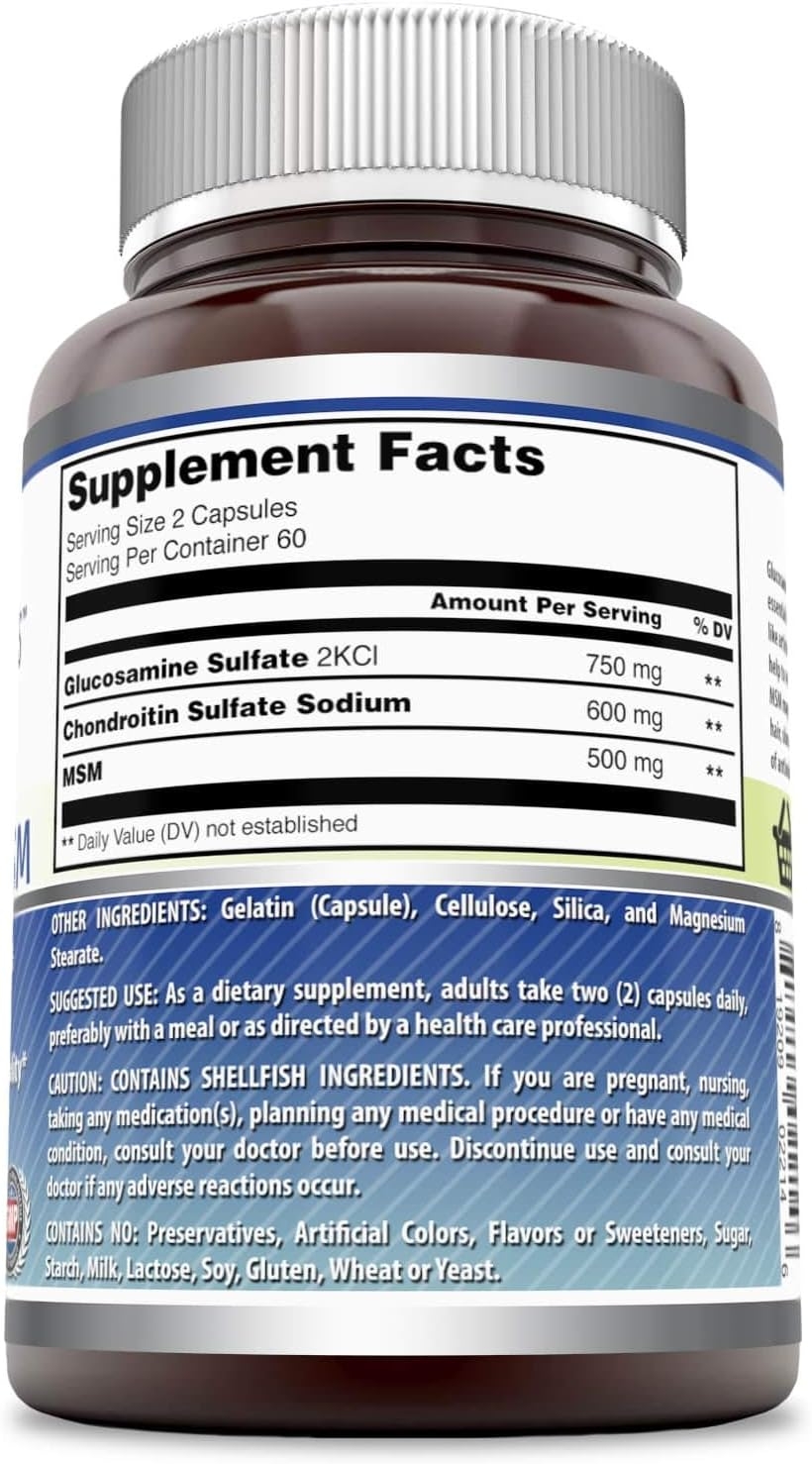
This is a 120-capsule bottle from Amazing Formulas, dosed at a 2-capsule daily serving (60 servings per container), sold in Champ Vita's supplements category. Each serving provides 750 mg of glucosamine sulfate 2KCl, 600 mg of chondroitin sulfate sodium, and 500 mg of MSM, with no daily value established for any of the three because none has an official recommended intake. The label directs two capsules daily with a meal, and states plainly that the product "CONTAINS SHELLFISH INGREDIENTS."
| This product (per 2-capsule serving) | GAIT trial dose (tested, per day) | Typical shelf dose | Established Upper Limit | |
|---|---|---|---|---|
| Glucosamine | 750 mg (as glucosamine sulfate 2KCl) | 1,500 mg (as glucosamine hydrochloride) | 750–1,500 mg | None established — not an essential nutrient with an NIH-set intake ceiling |
| Chondroitin sulfate | 600 mg | 1,200 mg | 600–1,200 mg | None established |
| MSM | 500 mg | Not evaluated in GAIT | 500–3,000 mg | None established |
A note on the dose, for accuracy: At its labeled 2-capsule serving, this product supplies exactly half the glucosamine and half the chondroitin sulfate that GAIT tested — 750 mg versus 1,500 mg, and 600 mg versus 1,200 mg — using glucosamine sulfate rather than the hydrochloride form GAIT used. It also adds 500 mg of MSM, an ingredient GAIT did not test at all. None of that makes the product mislabeled; the label matches its own Supplement Facts panel exactly. It means a shopper comparing this bottle to "the NIH trial" should know the trial tested a different, higher-dose combination of two ingredients, not three.
Framed honestly: this is a clean, clearly labeled formula from a GMP-certified, USA-manufactured facility, free of gluten, soy, dairy, and artificial additives, at roughly half the dose the largest trial in the field actually studied. Whether that matters depends on what you're hoping for — and the honest answer is that even the full GAIT dose didn't clear the bar for the average person with knee osteoarthritis.
Who this is for: Adults who want an inexpensive, clearly labelled glucosamine-chondroitin product for general joint and cartilage support, who have read the evidence above and hold realistic expectations of it, and who have raised it with the doctor already looking after their joints.
Who should skip it: Most people expecting a proven, guaranteed fix — the trial's primary result didn't clear statistical significance. Anyone on warfarin or another blood thinner, anyone with diabetes who hasn't checked in with their doctor, anyone pregnant or breastfeeding, and anyone with a shellfish allergy who hasn't cleared it with an allergist.
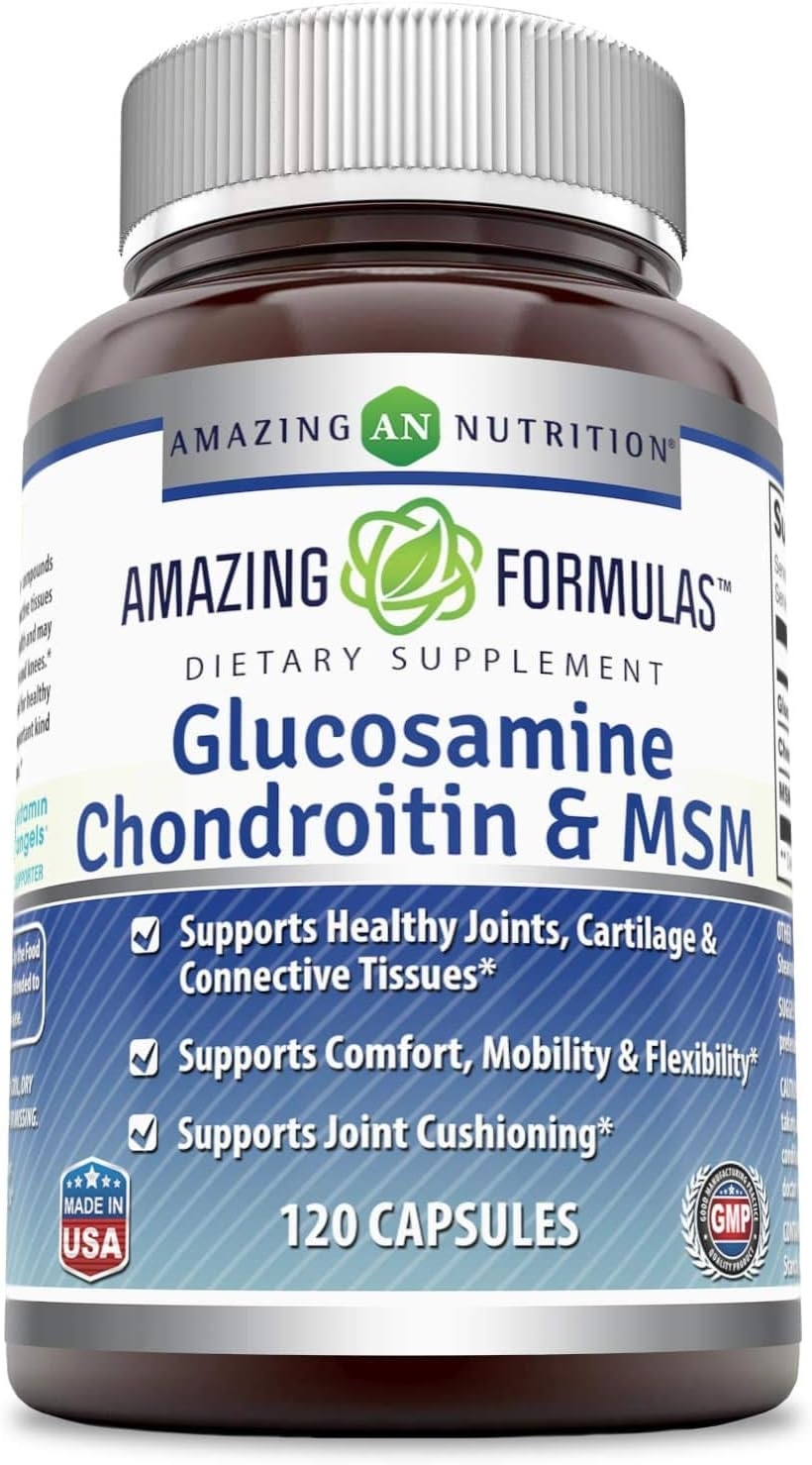
Amazing Formulas Glucosamine Chondroitin MSM — 120 Capsules
750 mg glucosamine sulfate, 600 mg chondroitin sulfate, and 500 mg MSM per 2-capsule serving, a 60-day supply, GMP-manufactured in the USA. Contains shellfish-derived ingredients; consult your doctor first if you take blood thinners, have diabetes, are pregnant or breastfeeding, or have a shellfish allergy.
View Product DetailsHow to Use Glucosamine and Chondroitin Sensibly
If you decide to try it, take it as labeled — two capsules daily with a meal — and give it a realistic trial window; the studies behind these numbers ran 24 weeks or longer, so judging it after a few days isn't a fair test. It is not a substitute for anything a doctor has prescribed, and it should not displace what NIAMS does document evidence for: weight management if relevant, a structured exercise program, and medical care for pain that isn't adequately controlled. Tell your doctor you're taking it, especially if you're on a blood thinner, have diabetes, or have a shellfish allergy. Calibrate expectations to the evidence above: the placebo group in the largest trial here also had a real, if modest, response rate (60.1%) — a reminder that osteoarthritis pain fluctuates on its own, supplement or not.
Frequently Asked Questions
Do glucosamine and chondroitin actually work for joint pain?
The largest trial on the question, the NIH-funded GAIT trial (1,583 participants, 2006), found no statistically significant pain relief from either ingredient, alone or combined, versus placebo. A secondary subgroup with moderate-to-severe pain did show a significant benefit from the combination, but that finding was exploratory, not the confirmed primary result.
What was the GAIT trial, exactly?
A National Institutes of Health-funded study published in the New England Journal of Medicine in 2006. It randomized 1,583 adults with knee osteoarthritis to 1,500 mg/day glucosamine hydrochloride, 1,200 mg/day chondroitin sulfate, both combined, 200 mg/day celecoxib, or placebo for 24 weeks, measuring the share of patients with a 20% or greater pain reduction.
Does glucosamine or chondroitin rebuild cartilage?
A 2008 follow-up tracked 572 of the original GAIT participants for two years using X-rays to measure joint space width, a standard marker of cartilage loss. It found no difference between any treatment group and placebo (NCCIH) — evidence against a disease-modifying, cartilage-rebuilding effect, despite these being raw materials cartilage is built from.
Is glucosamine safe if I have a shellfish allergy?
Most glucosamine is manufactured from shellfish shells, and shellfish allergy is caused by proteins in the flesh, not the shell. A 2024 clinical commentary in the Mediterranean Journal of Rheumatology reports that small studies of shellfish-allergic patients taking shrimp-derived glucosamine found it safe. Even so, talk to your doctor or allergist first if you have a documented shellfish allergy, and note that manufacturer labels, including this one, carry a shellfish caution regardless.
Can I take glucosamine and chondroitin with blood thinners like warfarin?
Use caution. NCCIH specifically notes that both glucosamine and chondroitin are associated with an increased risk of bleeding in people taking warfarin. Talk to your doctor before combining them.
Why does this product use half the dose the GAIT trial tested?
It supplies 750 mg of glucosamine sulfate and 600 mg of chondroitin sulfate per serving, versus the 1,500 mg glucosamine hydrochloride and 1,200 mg chondroitin sulfate GAIT tested. That's a formulation choice, not a labeling error — the label accurately states its own doses. It means the trial evidence above applies to a higher dose than this product delivers.
Does adding MSM make glucosamine and chondroitin more effective?
GAIT didn't test MSM at all, so there's no equivalent trial evidence for the three-ingredient combination this product uses. MSM has its own separate, smaller research base and should be judged on that evidence, not assumed to add to the GAIT results.
Does NIAMS, the NIH's own arthritis institute, recommend glucosamine and chondroitin?
No. NIAMS's dedicated osteoarthritis treatment page lists pain relievers, anti-inflammatory medication, injections, exercise, weight management, and surgery, and does not mention glucosamine or chondroitin. MedlinePlus takes a softer position, listing them among options that “may help.” The honest read is that the evidence is considered plausible enough to mention, not strong enough for the specialty institute to recommend.
Sources
- National Center for Complementary and Integrative Health. "Glucosamine and Chondroitin for Osteoarthritis." Updated October 2023. Accessed 27 August 2026.
- Agency for Healthcare Research and Quality (NCBI Bookshelf). "Analgesics for Osteoarthritis: An Update of the 2006 Comparative Effectiveness Review" — Table 14, GAIT trial response rates. Published October 2011. Accessed 27 August 2026.
- MedlinePlus Medical Encyclopedia. "Osteoarthritis." National Library of Medicine. Reviewed 9 April 2026. Accessed 27 August 2026.
- National Institute of Arthritis and Musculoskeletal and Skin Diseases. "Osteoarthritis: Diagnosis, Treatment, and Steps to Take." Last reviewed September 2023. Accessed 27 August 2026.
- Mediterranean Journal of Rheumatology. Commentary on glucosamine and shellfish allergy. Published April 2024. Accessed 27 August 2026.
- U.S. Food and Drug Administration. "Dietary Supplements." Content current as of 1 October 2024. Accessed 27 August 2026.
This article is for educational purposes only and is not medical advice. It is not intended to diagnose, treat, cure, or prevent any disease. Under the Dietary Supplement Health and Education Act (DSHEA), these statements have not been evaluated by the Food and Drug Administration; manufacturers, not the FDA, are responsible for evaluating a supplement's safety and labeling before it reaches the market. Talk to your doctor before starting any new supplement, especially if you take a blood thinner such as warfarin, have diabetes, are pregnant or breastfeeding, or have a shellfish allergy.