
In 2018 the European Food Safety Authority concluded that "it was not possible to identify an EGCG dose from green tea extracts that could be considered safe," after finding that doses of 800 mg EGCG a day or more, taken as a supplement, raised liver enzymes in clinical trials. Green tea extract is a concentrated powder made from the leaves of Camellia sinensis, standardized to polyphenols called catechins, the most abundant of which is EGCG. The capsule sold here works out to roughly 326 mg of EGCG, below that threshold, and its label says to take it without food.
Key Takeaways
- EFSA (2018) found that green tea extract at or above 800 mg EGCG/day is associated with raised ALT and AST in a small percentage (usually under 10%) of people, and that moderate or worse liver abnormalities occurred in 5.1% of over 500 people taking 843 mg/day for a year.
- EFSA also noted that one product containing an 80% ethanolic extract caused hepatotoxicity at a dose equal to just 375 mg EGCG a day, so staying under 800 mg is not a guarantee.
- A Cochrane review of green tea for weight loss found a mean difference of −0.04 kg (95% CI −0.5 to 0.4) in six studies outside Japan, and concluded any loss is "not likely to be clinically important" (Cochrane, 2012).
- NCCIH (updated February 2025) says green tea reduced total and LDL cholesterol "to a small extent" and that liver injury, though uncommon, has been reported primarily with green tea extracts in tablet or capsule form.
- Per the label, one capsule contains 725 mg of extract standardized to 98% polyphenols and 45% EGCG, or about 326 mg EGCG by our arithmetic, directed "without food."
In this article:
- Green Tea Versus Green Tea Extract
- Weight and Cholesterol: What the Trials Show
- The Liver Question: What EFSA Found
- Food, Fasting and the Label's "Without Food"
- Drug Interactions
- Inside Life Extension Mega Green Tea Extract (Decaffeinated)
- Who Might Consider It, and Who Should Skip It
- Frequently Asked Questions
Green Tea Versus Green Tea Extract
According to NCCIH, green, black and oolong teas all come from the same plant and differ only in how the leaves are processed; green tea leaves are steamed, pan fried and dried but not fermented. NCCIH says that "no safety concerns have been reported for green tea consumed as a beverage by adults," but adds the contrast that matters here: "Although uncommon, liver injury has been reported in some people who used green tea products, primarily green tea extracts in tablet or capsule form."
The dose difference explains why. EFSA estimated that the mean daily EGCG intake from green tea infusions in the EU is 90 to 300 mg, with high-level consumers up to 866 mg, while food supplements containing green tea catechins provide anywhere from 5 to 1,000 mg of EGCG a day. A capsule concentrates in one swallow what a drinker spreads across cups and meals. That is the central fact of this article: the drink and the extract are the same plant but not the same exposure.
Weight and Cholesterol: What the Trials Show
NCCIH's summary of the evidence is cautious: "Although many studies have been done on green tea and its extracts, definite conclusions cannot yet be reached on whether green tea is helpful for most of the purposes for which it is used." On the two most common reasons people buy it:
| Outcome | Evidence | Result |
|---|---|---|
| Weight loss | Cochrane review (Jurgens et al., 2012): 6 studies outside Japan, 532 people, 12–13 weeks | Mean difference −0.04 kg (95% CI −0.5 to 0.4); eight Japanese studies (1,030 people) ranged from −0.2 to −3.5 kg but could not be pooled |
| Weight maintenance | Two studies, 184 people | No significant effect |
| Cholesterol | NCCIH, randomized trials, mostly extract supplements | Total and LDL cholesterol reduced "to a small extent"; HDL and triglycerides unaffected |
| Liver enzymes | 15 RCTs (Mahmoodi et al., 2020) | No overall significant change; reduced in fatty liver disease, but a small significant increase in healthy participants |
The Cochrane authors' conclusion is direct: green tea preparations "appear to induce a small, statistically non-significant weight loss in overweight or obese adults," and "because the amount of weight loss is small, it is not likely to be clinically important." NCCIH is similarly modest, saying the catechins and caffeine "may have a modest effect on body weight" that varies with the product and the person's activity level. Note also that this capsule is decaffeinated, and caffeine is one of the two components the weight-loss hypothesis relies on.
"Although many studies have been done on green tea and its extracts, definite conclusions cannot yet be reached on whether green tea is helpful for most of the purposes for which it is used."
— NIH National Center for Complementary and Integrative Health, Green Tea (last updated February 2025)The Liver Question: What EFSA Found
The EFSA Panel on Food Additives and Nutrient Sources added to Food reviewed dozens of intervention studies and case reports in a 2018 scientific opinion on green tea catechins. Its findings, in one table:
| Exposure | What EFSA reported |
|---|---|
| Traditional green tea infusion, 90–300 mg EGCG/day (mean EU intake) | Generally considered safe at reported intakes; rare liver injury after infusions, most probably an idiosyncratic reaction |
| Supplements, 5–1,000 mg EGCG/day (range on the market) | Highly variable products; no safe dose could be identified |
| Below 800 mg EGCG/day, up to 12 months | No evidence of hepatotoxicity in the clinical studies reviewed, with one exception |
| One 80% ethanolic extract product, 375 mg EGCG/day | Hepatotoxicity reported |
| 800 mg EGCG/day or more, 4 months or longer | ALT and AST elevations in a small percentage (usually under 10%) of people |
| 843 mg EGCG/day for one year, over 500 people | Moderate or more severe liver abnormalities in 5.1%; EFSA reports odds ratios of 7.0 (95% CI 2.4 to 20.3) from this study's data |
Other reviews are less alarming, and it would be misleading to leave them out. A 2016 systematic review in the European Journal of Clinical Nutrition (Isomura and colleagues) examined 34 randomized trials: liver-related adverse events appeared in four trials, involving seven people on green tea extract versus one on control (summary odds ratio 2.1, 95% CI 0.5 to 9.8), most were mild liver-enzyme elevations, and none were serious. The authors concluded, cautiously, that such events "are expected to be rare." A 2018 review in Regulatory Toxicology and Pharmacology (Hu and colleagues) of 159 human intervention studies found hepatic adverse events dose-dependent and tied to concentrated, catechin-rich preparations taken as large bolus doses, and derived a safe intake level of 338 mg EGCG/day for solid bolus doses.
Both of those findings and EFSA's are consistent: liver problems are uncommon, they cluster in concentrated supplement forms, and the individual is part of the risk. NCCIH says people with a specific variant of an immune-function gene appear especially susceptible, and that 5 to 15 percent of Americans have it. There is no routine test that tells you whether you are one of them. If you have any liver condition, our milk thistle article shows how little trial evidence exists for many liver-support supplements.
Genuine safety warning: if you take green tea extract and develop yellowing of the skin or eyes (jaundice), stomach pain, dark urine, nausea, unusual tiredness or loss of appetite, stop taking it and contact a health care practitioner. These are the symptoms of liver trouble that Health Canada's green tea extract monograph, as described by EFSA, tells users to watch for.
Food, Fasting and the Label's "Without Food"
EFSA reports that human data show green tea extract given under fasting conditions and as a single bolus leads to a significant increase in blood exposure to EGCG compared with administration with food and in split doses. It also notes that the US FDA mandated that trials of oral EGCG be run with food, and that Health Canada's updated green tea extract monograph (2017) instructs users to "take with food," to consult a practitioner if they have a liver disorder, are pregnant or breastfeeding, or have an iron deficiency, and states that "rare, unpredictable cases of liver injury associated with green tea extract-containing products have been reported."
This product's label directs one capsule daily "without food." That is the manufacturer's stated direction, but it is the opposite of Health Canada's instruction as EFSA reports it, and it is the condition EFSA associates with higher EGCG exposure. We are not suggesting you change the directions on your own; we are suggesting you ask a pharmacist or physician which is right for you, especially if you have any liver, iron or medication concern. Our iron article covers that side of the Health Canada advice.
Cleveland Clinic on green tea as a drink, the form NCCIH reports no safety concerns for in adults.
Drug Interactions
NCCIH lists three specific interactions: green tea at high doses has been shown to reduce blood levels, and therefore the effectiveness, of nadolol, a beta-blocker; green tea extract can reduce blood levels of the cholesterol-lowering drug atorvastatin; and an NCCIH-funded study showed an interaction with raloxifene, used to treat osteoporosis. It adds that green tea "may also interact with other medicines." Side effects of extract supplements include nausea, constipation, abdominal discomfort and increased blood pressure. If you take any medicine, NCCIH's advice is to talk with your provider first. Our red yeast rice article covers another cholesterol-related supplement with its own FDA caveat.
Inside Life Extension Mega Green Tea Extract (Decaffeinated)
Life Extension Mega Green Tea Extract (Decaffeinated) is a 100-count bottle of vegetarian capsules. The Supplement Facts panel lists a serving of one capsule containing 725 mg of green tea decaffeinated leaf extract "std. to 98% polyphenols, 45% EGCG," with no established Daily Value. Other ingredients are vegetable cellulose (the capsule), rice flour, stearic acid and silica. The label directs one capsule daily without food and states that each serving contains a small amount of caffeine, a maximum of 3.6 mg. At one capsule a day, the bottle is a 100-day supply.
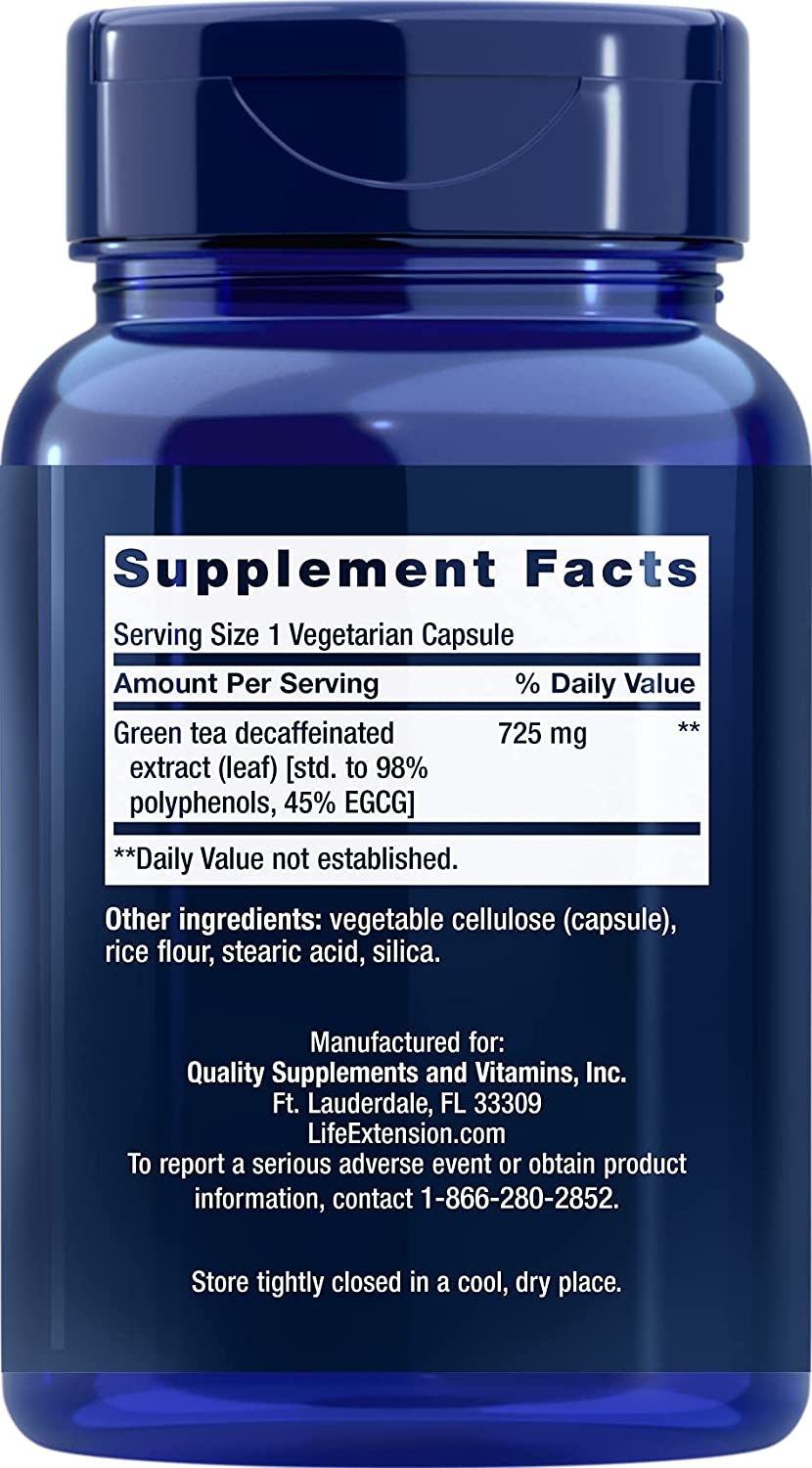
The label does not print an EGCG milligram figure, but the standardization percentages imply one: 725 mg × 45% is about 326 mg of EGCG per capsule. That is our own arithmetic from the label's percentages, not a printed number, and assay results can differ from the nominal figure. It sits below EFSA's 800 mg threshold and just under the 338 mg level Hu and colleagues derived for solid bolus doses, but above the top of EFSA's 90 to 300 mg range for typical tea drinkers.
| This product | Typical intake or trial threshold | NIH RDA / AI | Tolerable Upper Limit | |
|---|---|---|---|---|
| EGCG | About 326 mg per capsule (725 mg × 45%); 1 capsule daily | 90–300 mg/day from tea (EFSA); enzyme elevations at 800 mg/day or more (EFSA); 338 mg/day derived safe bolus level (Hu et al.) | None: not an essential nutrient | None established; EFSA could not identify a safe dose from extracts |
| Caffeine | Maximum 3.6 mg per capsule (label) | Green tea beverage contains caffeine (NCCIH) | None | Not applicable at this amount |
What the listing claims versus what the evidence supports: the store description says a single capsule contains "the same amount of EGCG as about three cups of green tea," calls EGCG a "potent anti-aging phytonutrient," says the polyphenols are "demonstrated to enhance metabolic health, protect nerve cells and nerve function," and that green tea can "support keeping blood triglyceride, LDL, and cholesterol levels at healthy levels." Those are manufacturer statements. The Cochrane weight-loss result is not clinically important, NCCIH reports no effect on triglycerides, and the LDL effect is small. The listing does not mention the EFSA liver findings or the Health Canada food instruction.
Who Might Consider It, and Who Should Skip It
Who this is for: healthy adults with no liver condition who have discussed the extract with a clinician, are not on interacting medicines, and understand that the expected benefit is a small LDL change and no meaningful weight loss.
Who should skip it: anyone with a liver disorder; anyone pregnant or breastfeeding; anyone with an iron deficiency without medical advice; anyone taking nadolol, atorvastatin or raloxifene; anyone who has had unexplained liver-enzyme elevations; and, frankly, most people, for whom a cup of tea avoids the concentrated exposure NCCIH and EFSA describe.
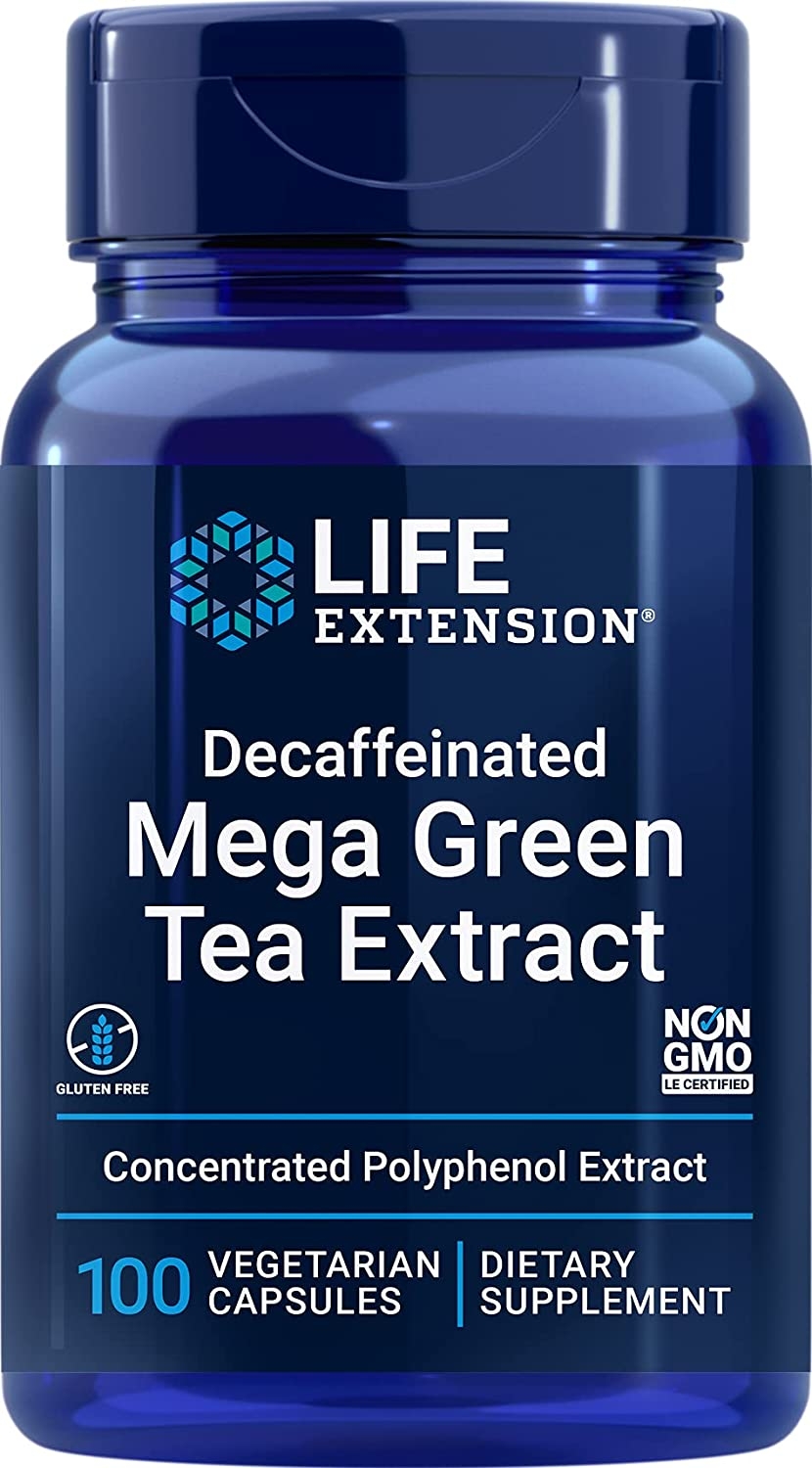
Life Extension Mega Green Tea Extract (Decaffeinated) — 725 mg, 100 Vegetarian Capsules
725 mg of decaffeinated green tea leaf extract per capsule, standardized to 98% polyphenols and 45% EGCG (about 326 mg EGCG by our calculation). As covered above, EFSA could not identify a safe dose of EGCG from extracts; talk to your clinician first. Browse more in our herbal supplements.
View Product DetailsFrequently Asked Questions
Is green tea extract safe for your liver?
Usually, but not always. Liver injury from green tea extract is uncommon but documented. EFSA found liver enzymes rose at 800 mg EGCG a day or more and could not identify a dose it considered safe. Stop use and seek care if you develop jaundice or dark urine.
How much EGCG is in one capsule of this extract?
The label lists 725 mg of extract standardized to 45% EGCG but prints no EGCG figure. Multiplying gives about 326 mg per capsule. That is calculated from the label, not measured, and actual assays can vary from nominal values.
Does green tea extract help you lose weight?
Not meaningfully. A Cochrane review found a mean weight difference of −0.04 kg across six non-Japanese studies of 532 people, and concluded any loss is small and unlikely to be clinically important. It also had no significant effect on maintaining lost weight.
Does green tea extract lower cholesterol?
Slightly. NCCIH says green tea, mostly as extract supplements, reduced total and LDL cholesterol to a small extent in randomized trials, while HDL and triglycerides did not change. It does not say the change is large enough to matter clinically.
Should green tea extract be taken with food?
EFSA says fasting and bolus dosing significantly raise EGCG exposure versus food and split doses, and Health Canada's monograph says to take it with food. This label says without food. Ask a pharmacist or physician which suits you.
What medicines interact with green tea?
NCCIH lists nadolol (a beta-blocker), atorvastatin (a statin) and raloxifene (an osteoporosis drug), and says green tea may interact with other medicines. Ask your health care provider before starting the extract if you take any prescription.
Is decaffeinated green tea extract as effective?
Unknown. NCCIH says the catechins and caffeine in green tea may have a modest effect on weight. This capsule has at most 3.6 mg of caffeine, so evidence from caffeinated products may not apply to it.
Is a capsule the same as drinking green tea?
No. NCCIH reports no safety concerns for green tea as a drink, while liver injury has been reported mainly with extract capsules and tablets. EFSA estimates tea drinkers take in 90 to 300 mg of EGCG a day; this capsule supplies roughly 326 mg at once.
Sources
- NIH National Center for Complementary and Integrative Health. "Green Tea." Last updated February 2025. Accessed 29 September 2026. nccih.nih.gov
- EFSA Panel on Food Additives and Nutrient Sources added to Food (ANS). Scientific opinion on the safety of green tea catechins. EFSA Journal, 2018;16(4):e05239. Accessed 29 September 2026. doi.org/10.2903/j.efsa.2018.5239
- Jurgens TM, et al. Green tea for weight loss and weight maintenance in overweight or obese adults. Cochrane Database Syst Rev, 2012. Accessed 29 September 2026. doi.org/10.1002/14651858.cd008650.pub2
- Isomura T, et al. Liver-related safety assessment of green tea extracts in humans: a systematic review of randomized controlled trials. Eur J Clin Nutr, 2016;70(11):1221-1229. Accessed 29 September 2026. doi.org/10.1038/ejcn.2016.78
- Hu J, et al. The safety of green tea and green tea extract consumption in adults: results of a systematic review. Regul Toxicol Pharmacol, 2018;95:412-433. Accessed 29 September 2026. doi.org/10.1016/j.yrtph.2018.03.019
- Mahmoodi M, et al. Effects of green tea or green tea catechin on liver enzymes in healthy individuals and people with nonalcoholic fatty liver disease: a systematic review and meta-analysis of randomized clinical trials. Phytother Res, 2020;34(7):1587-1598. Accessed 29 September 2026. doi.org/10.1002/ptr.6637
- NIH National Center for Complementary and Integrative Health. "Using Dietary Supplements Wisely." Accessed 29 September 2026. nccih.nih.gov
This article is for educational purposes only and is not medical advice. It is not intended to diagnose, treat, cure, or prevent any disease. These statements have not been evaluated by the Food and Drug Administration. Talk to your doctor before starting any new supplement, especially if you have a liver condition, are pregnant, breastfeeding, iron deficient, or take any prescription medication, and stop use and seek care if you develop symptoms of liver trouble.