
A 2017 NIH-reviewed analysis of 17 trials and 3,631 non-hospitalised people found that probiotics cut the risk of antibiotic-associated diarrhoea by about half — and that is the single best result probiotics have, though NCCIH calls even this conclusion tentative because the quality of the underlying studies was only moderate. Most other claims on probiotic labels, from "supports immunity" to "aids weight management," rest on far thinner ground. Here's what the National Institutes of Health's own reviews actually say, condition by condition, and how a specific 30-billion-CFU organic probiotic on this site's shelves stacks up against that evidence.
- A 2017 review of 17 studies (3,631 participants, none hospitalised) found probiotics reduced antibiotic-associated diarrhoea risk by about half — a conclusion NCCIH itself rates as tentative, because study quality was only moderate.
- A separate 2017 analysis of 31 studies (8,672 patients) found it "moderately certain" that probiotics lower the risk of C. difficile diarrhoea in adults and children receiving antibiotics.
- NIDDK says evidence for probiotics as an IBS treatment remains inconclusive: "researchers are still studying" it.
- The FDA has specifically warned of severe or fatal infections in premature infants given probiotics — a real safety signal, not a hypothetical one.
- NCCIH reports adult probiotic/prebiotic use quadrupled between 2007 and 2012, reaching about 4 million U.S. adults in a 30-day period by 2012.
- The featured product's own label states its 30-billion-CFU count is guaranteed only "at the time of manufacturing" — not through the expiration date.
What probiotics actually are
According to the NIH's National Center for Complementary and Integrative Health (NCCIH), "probiotics are live microorganisms that are intended to have health benefits when consumed or applied to the body." They occur naturally in fermented foods like yogurt and kefir, and are sold as standalone dietary supplements in capsules, tablets and powders. The most commonly used organisms belong to two bacterial genera, Lactobacillus and Bifidobacterium, though a yeast, Saccharomyces boulardii, is also used in some products.
That distinction between genus, species and strain matters more than most labels let on. NCCIH is explicit that "different types of probiotics may have different effects" — a strain shown to help with one condition in a clinical trial does not automatically confer the same benefit in a different strain, even one from the same species. This is the single biggest gap between what a bottle's front label implies (a general, all-purpose "gut health" benefit) and what the underlying research actually supports (specific strains, tested for specific conditions, at specific doses).
Your gut is also not a blank slate probiotics are filling. Harvard T.H. Chan School of Public Health's Nutrition Source explains that the gut microbiome already consists of "trillions of microorganisms (also called microbiota or microbes) of thousands of different species," shaped by genetics, birth and infant feeding, diet, and medication exposure — particularly antibiotics. Harvard notes that "a high-fiber diet in particular affects the type and amount of microbiota in the intestines," and raises a genuinely open research question: whether people with an already fibre-rich diet see any measurable benefit from adding a probiotic supplement on top of it.
| Condition | What the evidence shows | Source |
|---|---|---|
| Antibiotic-associated diarrhoea | Risk reduced by about half — but NCCIH rates the conclusion tentative (moderate study quality) | 2017 review, 17 trials, 3,631 non-hospitalised participants (cited by NCCIH) |
| C. difficile diarrhoea during antibiotics | "Moderately certain" risk reduction | 2017 review, 31 trials, 8,672 patients (cited by NCCIH) |
| Infant colic in breastfed infants | Some benefit with strain Lactobacillus reuteri DSM 17938 | 2018 review (cited by NCCIH) |
| Necrotising enterocolitis in premature infants | Benefit shown in very-low-birth-weight infants, though individual studies varied and not all found one — see the safety warning below | 2017 review, 23 trials, 7,325 infants (cited by NCCIH) |
| Irritable bowel syndrome (IBS) | Inconclusive; "researchers are still studying" it | NIDDK |
| Urinary tract infections; asthma, wheezing and hay fever | Reviews found no beneficial effect | NCCIH |
| Constipation in children, acne | Evidence too thin or too conflicting to draw a conclusion | NCCIH |
Where the evidence is strong — and where it isn't
The best-supported use for probiotics is preventing antibiotic-associated diarrhoea — though even here, "best-supported" comes with a caveat worth stating up front. When antibiotics wipe out gut bacteria indiscriminately — killing helpful species along with the infection they're targeting — diarrhoea is a common side effect. NCCIH cites a 2017 review of 17 studies covering 3,631 people who were not hospitalised, which found that giving probiotics alongside antibiotics was associated with a decrease of about half in the likelihood of antibiotic-associated diarrhoea. NCCIH immediately qualifies it: that conclusion "was considered tentative because the quality of the studies was only moderate." The number is real, and it is still the strongest signal in this field — but it rests on moderate-quality evidence, not settled science. A related, larger 2017 analysis of 31 studies and 8,672 patients went further, concluding it is "moderately certain that probiotics can reduce the risk" of the more serious complication, Clostridioides difficile diarrhoea.
Beyond antibiotic-related diarrhoea, the evidence thins quickly. For infant colic, a 2018 review found the specific strain Lactobacillus reuteri DSM 17938 associated with successful treatment in breastfed infants — but that is a finding about one strain, not probiotics as a category. For irritable bowel syndrome — arguably the condition most people associate with "gut health" supplements — the NIH's own digestive-disease institute, NIDDK, is blunt: "researchers are still studying the use of probiotics to treat IBS," and it advises patients to talk with a doctor before using probiotics for it. Elsewhere the NCCIH picture is more negative still, not merely uncertain: a 2015 review of 9 studies (735 participants) found no evidence of benefit for preventing urinary tract infections, and infant probiotic exposure showed no effect on the risk of asthma, wheezing or hay fever. For constipation in children and for acne, the research is genuinely too thin or too conflicting to support a conclusion either way.
Mayo Clinic Press on what current research does and doesn't support for probiotic supplements.
How the FDA actually regulates probiotic supplements
Most probiotics reach store shelves as dietary supplements, which the FDA regulates very differently from drugs. As the NIH Office of Dietary Supplements puts it, "research studies in people to prove that a dietary supplement is safe are not required before the supplement is marketed, unlike for drugs." The agency's oversight is largely reactive — it can act once a product is on the market if a safety problem emerges, but it does not pre-approve formulations or verify label claims before launch. That responsibility sits with the manufacturer instead: "It is the responsibility of dietary supplement manufacturers/distributors to ensure that their products are safe and that their label claims are truthful and not misleading."
This is also why every legitimate probiotic label carries some version of the same disclaimer. A manufacturer can legally state that a product "supports digestive health" or "helps maintain intestinal balance" — these are structure/function claims — but only alongside the required statement: "This statement has not been evaluated by the Food and Drug Administration. This product is not intended to diagnose, treat, cure, or prevent any disease." NCCIH also notes that depending on how a probiotic product is marketed, the FDA "might regulate it as a dietary supplement, a food ingredient, or a drug" — three different regulatory paths for what can be, biologically, the same organism.
A closer look: Amazing Formulas Organic Probiotic 30 Billion
One product on Champ Vita's shelves that fits this category directly is the Amazing Formulas Organic Probiotic 30 Billion CFU, 60 Tablets. We read the Supplement Facts panel directly off the product's own label photography rather than relying solely on the catalogue description, since the two didn't fully agree on form — the description mentions "capsules" in places, while the Supplement Facts panel and the product title both specify tablets. One further note for anyone comparing bottles: the product is listed here under the Amazing Formulas name, but the bottle itself is branded Amazing Flora™, manufactured and distributed by Amazing Nutrition of Jersey City, NJ.
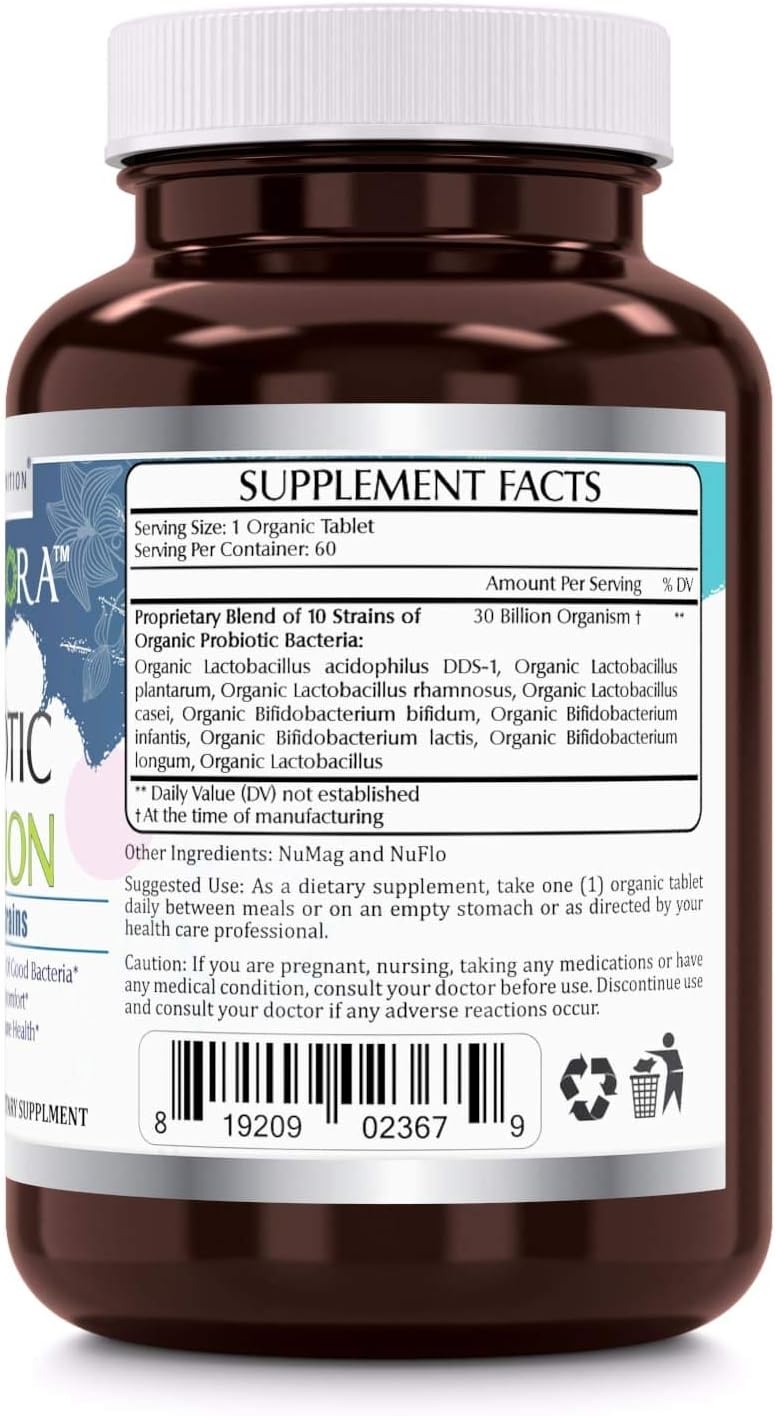
| Detail | What the label states |
|---|---|
| Serving size | 1 organic tablet |
| Servings per container | 60 |
| Potency | 30 billion organisms (CFU) per tablet, "at the time of manufacturing" |
| Strain blend | Proprietary blend of 10 organic probiotic strains, including Lactobacillus acidophilus DDS-1, L. plantarum, L. rhamnosus, L. casei, Bifidobacterium bifidum, B. infantis, B. lactis and B. longum |
| Daily Value | Not established (the label states this plainly — there is no official DV for probiotic CFU counts) |
| Certification | USDA Certified Organic, certified by Baystate Organic Certifiers |
| Suggested use | One tablet daily, between meals or on an empty stomach, or as directed by a healthcare professional |
| Free from | Milk, lactose, soy, gluten, wheat, yeast, fish, artificial sweeteners/colours/flavours; sodium free |
| Storage | No refrigeration required; store in a cool, dry place |
Two things are worth being direct about. First, "30 billion CFU" is a manufacturer figure guaranteed at the point of manufacturing, not through the tablet's shelf life — the label itself flags this with a dagger footnote, and live-organism counts can decline in storage. Second, the specific ten-strain blend and "one tablet daily" dosing here are not what the antibiotic-diarrhoea and C. difficile trials above tested — those studies used a range of different strains and doses. That doesn't make the product ineffective; it means the strong NIH-reviewed evidence supports the category and mechanism, not a guarantee about this exact formulation for any specific condition. That gap between category-level and product-level evidence is exactly what NCCIH means when it says different probiotics may have different effects.
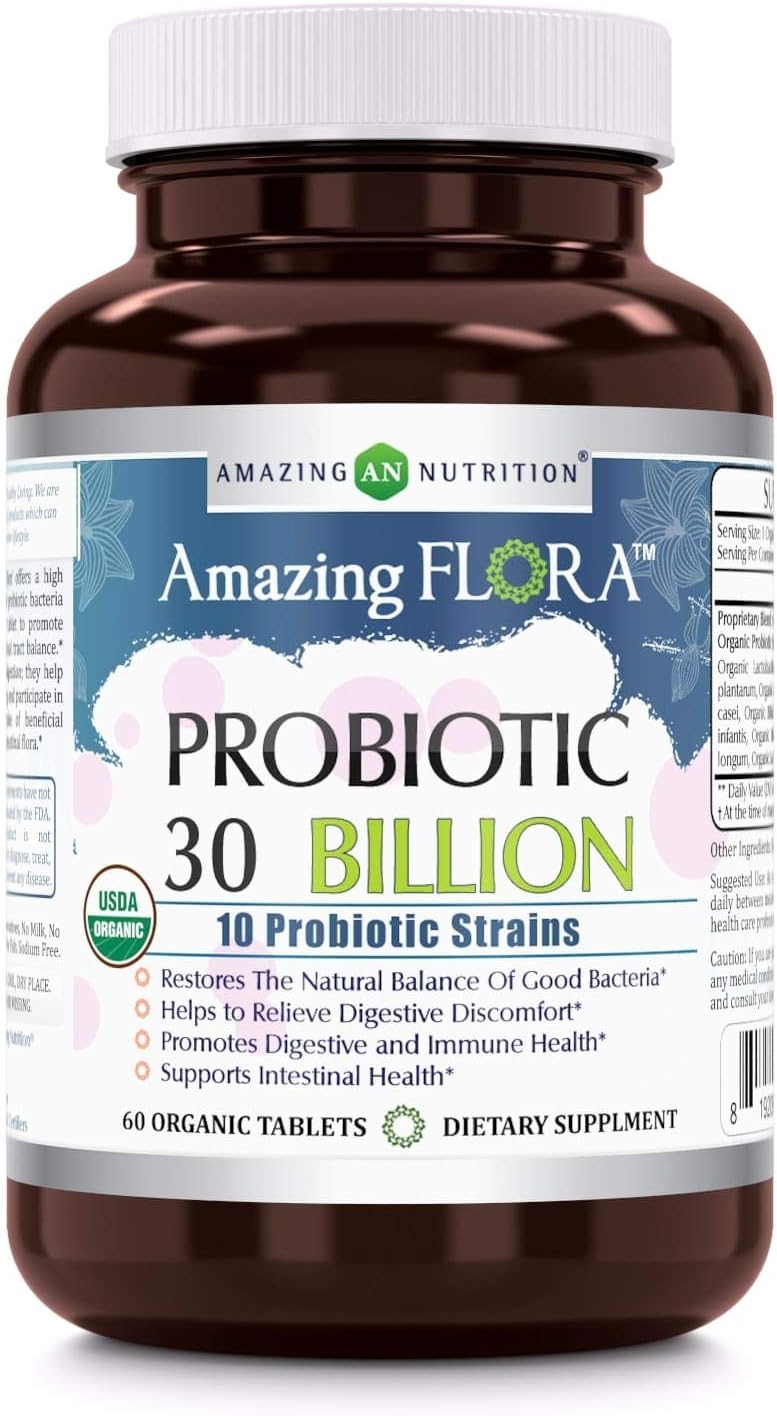
Amazing Formulas Organic Probiotic 30 Billion CFU delivers a USDA-certified organic, 10-strain blend at one tablet a day, with no refrigeration needed. It's free of milk, soy, gluten, wheat and artificial additives, which makes it a reasonable pick for anyone avoiding common allergens in a daily supplement. As with any probiotic, talk to your doctor first if you're pregnant, nursing, taking medication, or managing a chronic condition — the label says so directly.
View this productWho should be cautious with probiotics
Probiotics are generally well tolerated by healthy adults, but "generally safe" is not the same as "safe for everyone," and this is the point where honest reporting matters most. NCCIH states plainly: "Cases of severe or fatal infections have been reported in premature infants who were given probiotics, and the U.S. Food and Drug Administration (FDA) has warned health care providers about this risk." NCCIH also flags that probiotics can, in rarer cases, cause infections in other vulnerable people, produce harmful substances, or transfer antibiotic-resistance genes between bacteria.
For most otherwise-healthy adults taking a probiotic for general digestive support, NCCIH puts the risk of harmful effects low, reserving its warnings for people with severe illnesses or compromised immune systems. Where trials have tracked tolerability directly — a review of 23 allergic-rhinitis studies covering 1,919 participants, for instance — NCCIH notes that few side effects were reported. The label caution on the featured product reflects this correctly: "If you are pregnant, nursing, taking any medications or have any medical condition, consult your doctor before use. Discontinue use and consult your doctor if any adverse reactions occur."
How to read a probiotic label
Because probiotics aren't pre-approved and effects are strain-specific, the label is doing more work than on most supplements. A few things worth checking before buying any probiotic, not just this one:
- CFU count and when it's measured. "At time of manufacturing" is a different, weaker promise than "through expiration date." Neither is dishonest, but they're not equivalent.
- Named strains, not just a total count. "10 strains" tells you less than seeing which strains, since the clinical evidence above is strain-specific.
- Storage instructions. Some probiotics require refrigeration to maintain potency; others, like this one, are formulated to be shelf-stable.
- The FDA disclaimer. Its presence is a compliance signal, not a mark of quality — but its absence on a product claiming to treat a specific disease would be a red flag.
According to NIH's Office of Dietary Supplements FAQ, every supplement is legally required to carry a Supplement Facts label listing active ingredients and amounts — which is exactly the information worth reading before the front-of-bottle marketing copy.
Frequently asked questions
Do probiotics actually work?
For some specific uses, yes — most convincingly for reducing antibiotic-associated diarrhoea, where a 2017 review of 17 studies and 3,631 non-hospitalised people found roughly a 50% risk reduction. Even that conclusion is rated tentative by NCCIH, because the underlying study quality was only moderate. For many other commonly advertised uses, including general immune support or weight management, NIH's own reviewers describe the evidence as inconclusive, insufficient, or in some cases simply negative.
What does CFU mean, and is a higher number always better?
CFU stands for colony-forming units — a count of live organisms in a serving. A higher CFU count is not automatically more effective; the clinical trials behind the strongest evidence used specific strains at specific doses, and there's no NIH-established Daily Value for probiotic CFUs to use as a benchmark, as this product's own label notes.
Are probiotic supplements approved by the FDA before they're sold?
No. As dietary supplements, they don't require FDA safety testing or approval before going to market. The FDA can act after the fact if problems arise, but responsibility for safety and truthful labelling sits with the manufacturer under the DSHEA framework.
Can a probiotic supplement treat IBS or other digestive conditions?
The NIH's digestive disease institute, NIDDK, says the research is still ongoing and recommends discussing probiotic use for IBS with a doctor rather than self-treating. No probiotic supplement, including the one featured here, is intended to diagnose, treat, cure or prevent any disease.
Who should avoid or be cautious with probiotics?
People who are pregnant or breastfeeding, immunocompromised, critically ill, or have a central venous catheter should consult a doctor first. The FDA has specifically warned about severe and fatal infections in premature infants given probiotics.
Do probiotics need to be refrigerated?
It depends on the product. Some strains and formulations need refrigeration to stay viable; others are formulated to be shelf-stable, like the featured product, which states "no refrigeration required" directly on its label.
This article is for educational purposes only and is not medical advice. These statements have not been evaluated by the Food and Drug Administration. This product is not intended to diagnose, treat, cure, or prevent any disease. Talk to your doctor before starting any new supplement, especially if you are pregnant, nursing, taking medication, or managing a chronic health condition.