
A 2024 randomized trial of 120 people in BMJ Nutrition, Prevention & Health claimed apple cider vinegar (ACV) causes weight loss; it was retracted in 2025, and the trials that remain tested liquid vinegar at 15 to 30 mL a day, not a 600 mg gummy. Apple cider vinegar is vinegar made from fermented apple juice, and its main active ingredient is acetic acid. The gummies sold here supply 600 mg of ACV per three-gummy serving, alongside 6 g of added sugar, and the label does not say how much acetic acid that contains.
Key Takeaways
- The 2024 Lebanese trial (120 participants, 5, 10 or 15 mL of ACV daily for 12 weeks) concluded ACV "could be a promising antiobesity supplement that does not produce any side effects"; it was retracted in 2025, and a critique in the same journal was titled "Improbable data characteristics and extreme effects of apple cider vinegar on weight loss."
- A 2025 meta-analysis of 10 RCTs (789 people) found ACV reduced weight by an SMD of −0.39 (95% CI −0.63 to −0.15), with benefits limited to up to 12 weeks and best at 30 mL/day of liquid.
- In type 2 diabetes, a 2025 meta-analysis of 7 studies found fasting blood sugar fell 21.9 mg/dL (95% CI −29.19 to −14.67); a 2021 meta-analysis of 9 studies in mixed populations found a smaller 7.97 mg/dL fall.
- Cleveland Clinic says ACV's "purported benefits are just that: purported. Not proven," and notes the FDA "doesn't regulate" ACV pills and gummies.
- Per the label, one serving is 3 gummies with 600 mg ACV, 30 calories and 6 g added sugars (12% of the Daily Value); the store copy says 2 gummies daily and mentions B vitamins the label does not list.
In this article:
- What Is Apple Cider Vinegar, and What Did the Studies Test?
- The Retracted Weight-Loss Study
- Weight and Blood Sugar: What the Meta-Analyses Found
- Gummies Versus Liquid: A Dose Mismatch
- Safety, Medicines and Teeth
- Inside Horbaach Apple Cider Vinegar Gummies
- Who Might Consider It, and Who Should Skip It
- Frequently Asked Questions
What Is Apple Cider Vinegar, and What Did the Studies Test?
Apple cider vinegar is a fermented liquid whose sour taste comes from acetic acid. Nearly all of the human research on ACV tests it as a drink, diluted or taken with meals, in amounts measured in milliliters or tablespoons. Cleveland Clinic's dietitian describes a 2007 study in which 1 to 2 ounces first thing in the morning for 12 weeks led to modest weight loss of 2 to 4 pounds, and a 2018 study of just 39 participants in which the vinegar was added to a reduced-calorie diet, so "we don't know if the weight loss was due to the calorie reduction, the apple cider vinegar, or both."
Its overall verdict, on the page titled "Does Apple Cider Vinegar Help You Lose Weight?", is that "its purported benefits are just that: purported. Not proven." That is the context in which to read everything below.
The Retracted Weight-Loss Study
In 2024, BMJ Nutrition, Prevention & Health published a randomized, double-blind, placebo-controlled study of 120 overweight and obese Lebanese adolescents and young adults (Abou-Khalil and colleagues). Participants received 5, 10 or 15 mL of ACV or a placebo daily for 12 weeks. It reported "significant reductions" in weight, body mass index, waist and hip circumference, body fat ratio, blood glucose, triglycerides and cholesterol, and concluded that ACV "could be a promising antiobesity supplement that does not produce any side effects."
The journal formally retracted that article in 2025. The retraction notice states that it "retracts the article," and a 2025 critique in the same journal by Malbouby, Trexler and Heathers carries the title "Improbable data characteristics and extreme effects of apple cider vinegar on weight loss." The abstracts we could read do not say whether any later meta-analysis pooled the retracted trial, so we cannot say how much of the pooled evidence below depended on it. What we can say is that the single most dramatic weight-loss result for ACV is no longer part of the published record.
"Its purported benefits are just that: purported. Not proven."
— Cleveland Clinic, on apple cider vinegar and weight lossWeight and Blood Sugar: What the Meta-Analyses Found
Pooled evidence exists beyond that one trial, and it is more modest:
| Review | Studies | Key results |
|---|---|---|
| Castagna et al., Nutrients, 2025 (body composition) | 10 RCTs, 789 adults with type 2 diabetes and/or overweight, at least 4 weeks | Weight SMD −0.39 (95% CI −0.63 to −0.15); BMI −0.65 (−1.05 to −0.26); waist −0.34 (−0.67 to −0.02); heterogeneity 61–83%; effects in studies up to 12 weeks, at 30 mL/day |
| Arjmandfard et al., Frontiers in Nutrition, 2025 (glycemic control) | 7 studies in type 2 diabetes | Fasting blood sugar −21.93 mg/dL (−29.19 to −14.67); HbA1c −1.53 (−2.65 to −0.41); no effect on insulin resistance (HOMA-IR); each 1 mL/day associated with −1.255 mg/dL |
| Hadi et al., BMC Complement Med Ther, 2021 (lipids and glucose) | 9 studies, 10 arms | Total cholesterol −6.06 mg/dL; fasting glucose −7.97 mg/dL (I² 75%); HbA1c −0.50 (I² 91%); no effect on LDL, HDL, insulin or HOMA-IR; in healthy people, fasting glucose and HDL rose |
Three cautions apply. For most outcomes the heterogeneity is high (I² between 61% and 91%), meaning the studies disagree. Every dose reported is liquid vinegar in milliliters. And the largest glucose effect is in people with type 2 diabetes; in healthy participants the 2021 review found fasting glucose went up slightly. Cleveland Clinic's summary of the mechanism is that ACV can slow how fast food leaves the stomach, and it warns that this matters for people with gastroparesis. If blood sugar is your concern, our alpha-lipoic acid article covers another supplement studied in diabetes.
The U.S. FDA on how dietary supplements, including gummies and pills, are regulated.
Gummies Versus Liquid: A Dose Mismatch
Here is the gap between the research and the product. The trials used roughly 15 to 30 mL of liquid vinegar a day. A milliliter of vinegar weighs about a gram, so that is on the order of 15 to 30 g of liquid, our approximation. The label on this product lists "Apple Cider Vinegar 600 mg" per three-gummy serving, or 0.6 g. Whatever form that 600 mg takes, whether dried powder or concentrate, the label does not say, and it does not state an acetic acid amount. We searched Europe PMC for studies measuring the acetic acid content of ACV gummies and did not find any, so the amount of the studied active ingredient in a serving is unknown.
Cleveland Clinic makes a related point about the category: "Apple cider vinegar is also available in pills or gummies, though the U.S. Food and Drug Administration (FDA) doesn't regulate these supplements." In precise terms, dietary supplements are not approved by the FDA before they are sold, which is why the label's stated amounts are the manufacturer's own claims. Note also that we found no randomized trial of ACV gummies. Everything in the tables above is evidence about liquid vinegar. If you are curious how gummy-format supplements fare generally, our biotin article covers another popular beauty supplement whose label doses far outrun the research.
Safety, Medicines and Teeth
Cleveland Clinic lists who should be cautious. It says "there's convincing evidence that apple cider vinegar can impact blood sugar and insulin levels and may cause low blood sugar (hypoglycemia) when used alongside insulin," and that people with low potassium, people taking diuretics or laxatives, and people on certain blood pressure medications should talk to their provider first. It also says the acidity of straight ACV can erode tooth enamel and "burn your esophagus."
Genuine safety warning: if you use insulin or diabetes medicine, take diuretics, laxatives or blood pressure drugs, have low potassium, or have gastroparesis, ask your provider before taking apple cider vinegar in any form. Published case reports have linked ACV products to acute pancreatitis (an 84-year-old woman taking a weight-loss supplement containing ACV) and, in a man with long-term vinegar use, to liver injury that improved when he stopped. These are single case reports and cannot show cause, but they are why a clinician should know what you take.
The store's short description also states that gummies "do not contact tooth enamel directly" and calls this "a genuine advantage." The sources reviewed here do not test that claim, and the label shows these gummies contain sugars, glucose syrup and citric acid, so we have not repeated it as fact.
Inside Horbaach Apple Cider Vinegar Gummies
Horbaach Apple Cider Vinegar Gummies come in a bottle of 90 vegan gummies. The Supplement Facts panel lists a serving of three gummies, with 30 servings per container, providing 30 calories, 7 g total carbohydrate, 6 g total sugars (all 6 g added, 12% of the Daily Value), 20 mg sodium and 600 mg of apple cider vinegar with no established Daily Value. Other ingredients are glucose syrup, sucrose, pectin, sodium citrate, natural flavor, citric acid, natural palm leaf glaze, vegetable oil and black carrot juice concentrate for color. The label directs adults to take three vegan gummies daily, preferably with a meal, which makes the bottle a 30-day supply.
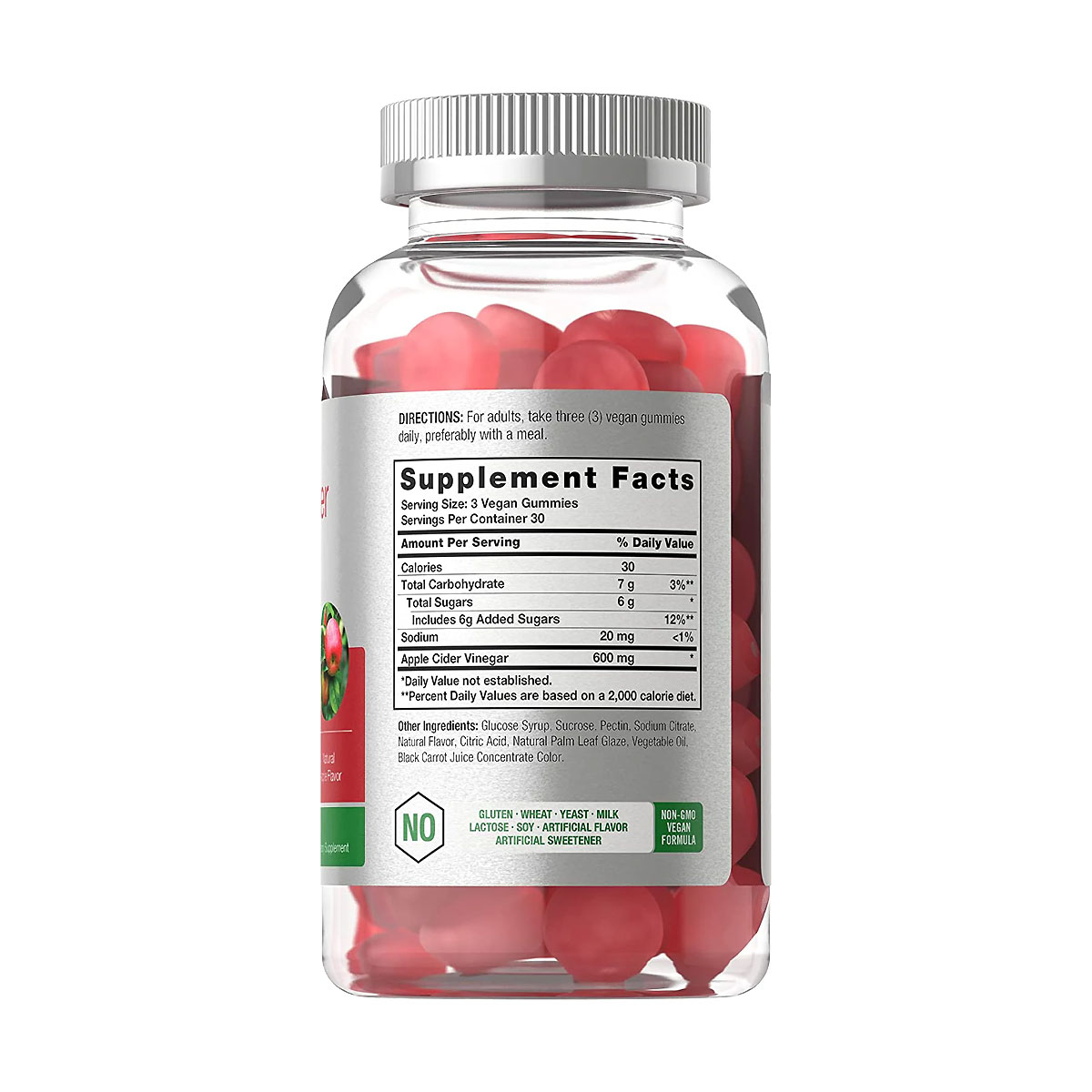
A correction, for accuracy: this store's description says "adults can chew two gummies daily" and that a bottle is a "45-day supply," and its short description says the gummies are "typically accompanied by vitamins B9 and B12." The bottle's own label directs three gummies daily, which makes a 30-day supply, and its Supplement Facts panel lists no B vitamins. The store's 600 mg per serving figure matches the label only if a serving is three gummies. We have used the label throughout.
| Detail | Store copy | Product label |
|---|---|---|
| Gummies per serving | Two gummies daily | Three gummies daily |
| Bottle lasts | 45 days | 30 days (90 gummies, 30 servings) |
| ACV per serving | 600 mg | 600 mg (per 3 gummies) |
| B vitamins | "Typically accompanied by vitamins B9 and B12" | None listed |
| Added sugar | Not mentioned | 6 g per serving (12% DV) |
| This product | Typical trial dose | NIH RDA / AI | Tolerable Upper Limit | |
|---|---|---|---|---|
| Apple cider vinegar | 600 mg per 3-gummy serving (form and acetic acid content not stated) | 15–30 mL/day of liquid vinegar; benefits at 30 mL/day in one subgroup | None: not an essential nutrient | None established; Cleveland Clinic advises no more than two tablespoons a day of liquid |
| Added sugars | 6 g per serving (12% DV) | Not applicable | Daily Value per label | Not applicable |
What the listing claims versus what the evidence supports: the store description says ACV gummies offer "digestive support" and an "immune system boost," and the short description says the acetic acid "may slow gastric emptying and blunt post-meal glucose spikes." Those are manufacturer statements. The sources reviewed here do not test digestive or immune benefits, and the blood-sugar research is on liquid vinegar in milliliter doses. The listing's customer testimonials are anecdotes, not evidence.
Who Might Consider It, and Who Should Skip It
Who this is for: healthy adults who dislike the taste of vinegar, are curious, have talked with a clinician, and accept that the product is unproven, contains added sugar, and delivers an unspecified amount of the substance the studies tested.
Who should skip it: anyone taking insulin, diuretics, laxatives or blood pressure medicine without their prescriber's agreement; anyone with low potassium or gastroparesis; anyone managing blood sugar who would rather not add 6 g of sugar per serving; anyone buying it to lose weight, given the retraction and the modest pooled results; and, frankly, most people, who can get whatever benefit exists from a splash of diluted vinegar on a salad.
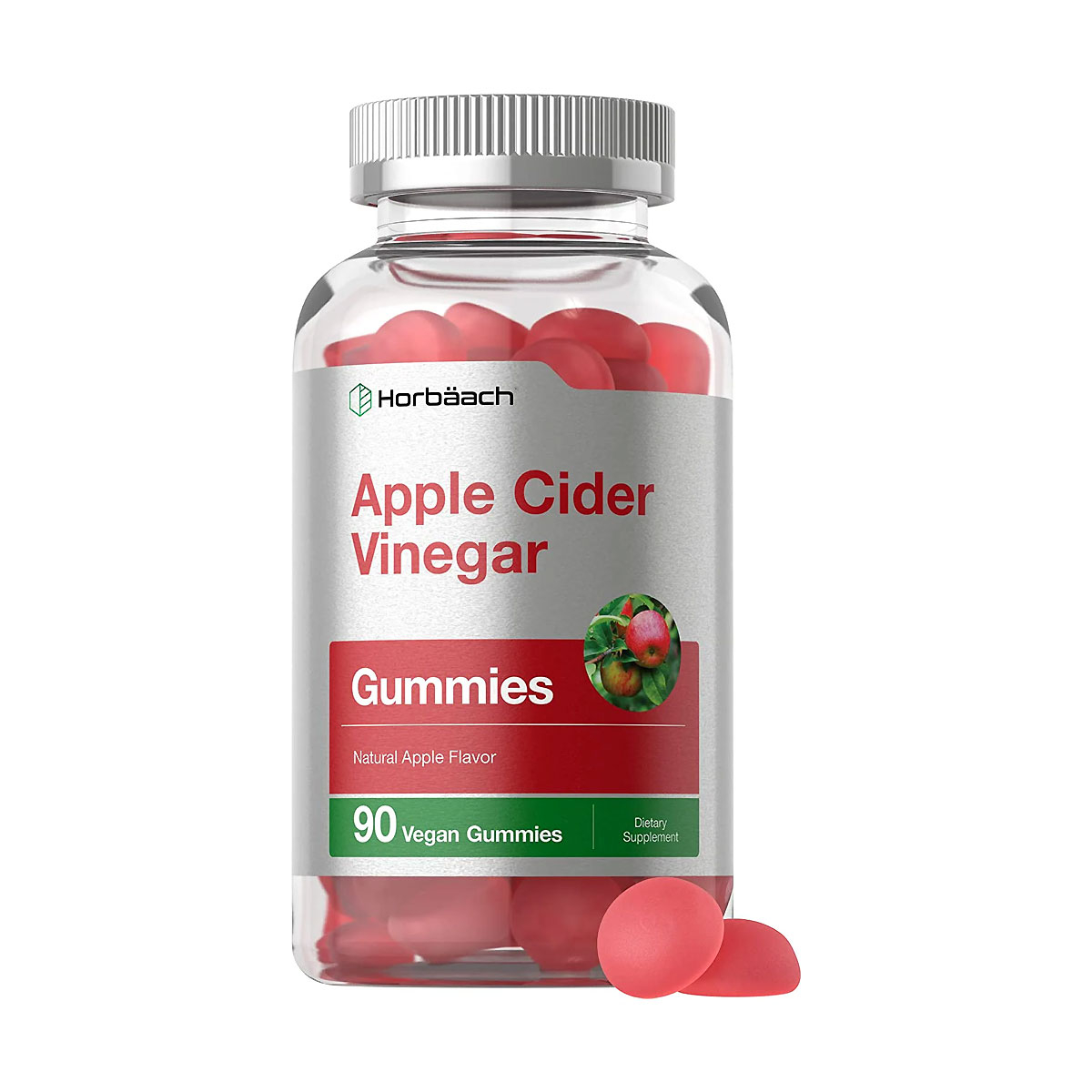
Horbaach Apple Cider Vinegar Gummies — 90 Vegan Gummies
600 mg of apple cider vinegar per three-gummy serving with 6 g added sugars, 30 servings per bottle. As covered above, the evidence is for liquid vinegar in milliliter doses, and the best-known weight-loss trial was retracted. Browse more in our supplements.
View Product DetailsFrequently Asked Questions
Does apple cider vinegar help you lose weight?
Slightly, at best. A 2025 meta-analysis of 10 trials found a small weight reduction with liquid ACV up to 12 weeks, but studies varied widely. A prominent 2024 weight-loss trial was retracted in 2025, and Cleveland Clinic calls the benefits unproven.
Do apple cider vinegar gummies work?
Unknown. We found no randomized trial of ACV gummies. The research tested liquid vinegar at 15 to 30 mL daily, while these gummies list 600 mg of ACV per serving without stating acetic acid content.
Does apple cider vinegar lower blood sugar?
In type 2 diabetes, somewhat. A 2025 meta-analysis of seven studies found fasting blood sugar fell about 21.9 mg/dL, and a 2021 review found about 8 mg/dL across studies. In healthy people fasting glucose rose slightly, and the studies used liquid vinegar.
How many ACV gummies should I take?
The label directs three gummies daily, preferably with a meal, providing 600 mg of ACV. The store's description says two gummies, which does not match the label. Follow the bottle or your clinician's advice.
Is apple cider vinegar safe every day?
Cleveland Clinic says the evidence so far is that ACV “is safe for most people in small amounts,” and advises no more than two tablespoons of liquid daily. It cautions people on insulin, diuretics, laxatives, or blood pressure medicine, and those with low potassium. Rare case reports link it to pancreatitis and liver injury.
Do ACV gummies contain sugar?
Yes. The label lists 6 g of added sugars per three-gummy serving, 12% of the Daily Value, plus 30 calories, and glucose syrup and sucrose among the ingredients. That is worth weighing if you take ACV to manage blood sugar.
Does apple cider vinegar damage teeth?
Straight liquid ACV can, according to Cleveland Clinic, which says acetic acid can erode tooth enamel and burn the esophagus if taken undiluted. Whether gummies avoid this has not been tested in the sources reviewed, and these gummies contain sugars and citric acid.
What happened to the apple cider vinegar weight-loss study?
A 2024 randomized trial of 120 Lebanese participants claimed large weight and cholesterol reductions. The journal retracted it in 2025, and a critique in the same journal cited improbable data characteristics and extreme effects. It is no longer part of the published record.
Sources
- Cleveland Clinic. "Does Apple Cider Vinegar Help You Lose Weight?" Published 27 March 2024. Accessed 29 September 2026. health.clevelandclinic.org
- Cleveland Clinic. "What Apple Cider Vinegar Can (and Can't) Do for You." Published 20 May 2025. Accessed 29 September 2026. health.clevelandclinic.org
- Abou-Khalil R, Andary J, El-Hayek E. Apple cider vinegar for weight management in Lebanese adolescents and young adults with overweight and obesity: a randomised, double-blind, placebo-controlled study. BMJ Nutr Prev Health, 2024;7(1):61-67 (retracted 2025). Accessed 29 September 2026. doi.org/10.1136/bmjnph-2023-000823
- Retraction notice: Apple cider vinegar for weight management in Lebanese adolescents and young adults. BMJ Nutr Prev Health, 2025;8(2):693. Accessed 29 September 2026. doi.org/10.1136/bmjnph-2023-000823ret
- Malbouby V, Trexler ET, Heathers J. Improbable data characteristics and extreme effects of apple cider vinegar on weight loss. BMJ Nutr Prev Health, 2025;8(1):e000997. Accessed 29 September 2026. doi.org/10.1136/bmjnph-2024-000997
- Castagna A, et al. Effect of apple cider vinegar intake on body composition in humans with type 2 diabetes and/or overweight: a systematic review and meta-analysis of randomized controlled trials. Nutrients, 2025;17(18):3000. Accessed 29 September 2026. doi.org/10.3390/nu17183000
- Arjmandfard D, et al. Effects of apple cider vinegar on glycemic control and insulin sensitivity in patients with type 2 diabetes: a GRADE-assessed systematic review and dose-response meta-analysis of controlled clinical trials. Front Nutr, 2025;12:1528383. Accessed 29 September 2026. doi.org/10.3389/fnut.2025.1528383
- Hadi A, et al. The effect of apple cider vinegar on lipid profiles and glycemic parameters: a systematic review and meta-analysis of randomized clinical trials. BMC Complement Med Ther, 2021;21(1):179. Accessed 29 September 2026. doi.org/10.1186/s12906-021-03351-w
- Alvarez L, et al. Unveiling a sour truth: acute pancreatitis linked to apple cider vinegar supplement. ACG Case Rep J, 2024;11(9):e01482. Accessed 29 September 2026. doi.org/10.14309/crj.0000000000001482
- Andonie CR, et al. Apple cider vinegar-induced hepatotoxicity: a rare case report. Oxf Med Case Reports, 2025;2025(7):omaf097. Accessed 29 September 2026. doi.org/10.1093/omcr/omaf097
This article is for educational purposes only and is not medical advice. It is not intended to diagnose, treat, cure, or prevent any disease. These statements have not been evaluated by the Food and Drug Administration. Talk to your doctor before starting any new supplement, especially if you are pregnant, breastfeeding, have diabetes, take insulin, diuretics, laxatives or blood pressure medication, have low potassium, or have a medical condition.