
The North American Menopause Society's 2023 position statement concludes that "there is insufficient evidence to support the use of black cohosh" for hot flashes and night sweats, and rates that advice Level I, its strongest grade of evidence — yet the store listing for this capsule says black cohosh "may raise estrogen levels," a mechanism the National Cancer Institute's summary (updated October 2024) says has been refuted for the extracts used in clinical trials. Black cohosh (Actaea racemosa, formerly Cimicifuga racemosa) is a North American plant of the buttercup family whose root is sold as a supplement for menopause symptoms. The capsule reviewed here holds 540 mg of unstandardised root, and the product carries a liver-safety caution that its listing does not mention.
Key Takeaways
- A Cochrane review of 16 randomised trials in 2,027 women found no significant difference from placebo in hot flash frequency (0.07 flashes a day, 95% CI −0.43 to 0.56) (Cochrane, 2012).
- A 2023 review of 22 studies found improvement in hot flashes but not in anxiety or depressive symptoms, so the evidence is split, not settled (NCCIH, updated November 2024).
- The trials used a median of 40 mg a day for a mean of 23 weeks; this capsule has 540 mg of root, about 13.5 times the 40 mg figure, though root powder and extract cannot be compared milligram for milligram (Cochrane, 2012; NCI PDQ, 2024).
- The US Pharmacopeial Convention counted 30 reports of possible liver injury and required a warning statement on black cohosh products (cited in NAMS, 2023).
- In a 2022 laboratory comparison, 45.5% of black cohosh food supplements had quality problems, mainly adulteration (Frontiers in Pharmacology, 2022).
In this article:
- What Is Black Cohosh, and What Does the Listing Promise?
- Does It Work? Two Reviews, Two Answers
- The Estrogen Claim Does Not Survive the Evidence
- The Liver Warning and the Quality Problem
- Inside Amazing Formulas Black Cohosh 540 mg: Label Versus Listing
- Who Might Consider It, and Who Should Skip It
- Frequently Asked Questions
What Is Black Cohosh, and What Does the Listing Promise?
According to the National Center for Complementary and Integrative Health (NCCIH, updated November 2024), black cohosh grows in North America, was used by Native Americans for a range of conditions, and has been used medicinally in Germany since the late 19th century. Today it is "promoted as a dietary supplement for menopause symptoms." NAMS calls it "the most purchased botanical for menopause symptoms" (NAMS, 2023).
The store listing claims that black cohosh contains "phytoestrogens" that mimic estrogen, relieves hot flashes and mood swings, helps sleep and suits women with premenstrual syndrome. Each is tested below.
Does It Work? Two Reviews, Two Answers
The honest answer depends on which review you read. The Cochrane review by Leach and Moore (2012) pooled 16 randomised trials of 2,027 peri- and postmenopausal women, all using black cohosh alone, at a median of 40 mg a day for a mean of 23 weeks. It found no significant difference from placebo in hot flashes or symptom scores, and rated trial quality as generally unclear because of poor reporting.
| Source | What it examined | Conclusion |
|---|---|---|
| Cochrane review (2012) | 16 randomised trials, 2,027 women | Hot flash frequency 0.07 per day different from placebo (95% CI −0.43 to 0.56, three trials, 393 women); symptom scores SMD −0.10 (95% CI −0.32 to 0.11, four trials, 357 women); "insufficient evidence" |
| Meta-analysis of 22 studies (2023, as summarised by NCCIH) | Black cohosh extracts, alone or with other herbs | "Potentially beneficial" for overall menopause symptoms and hot flashes; no improvement in anxiety or depressive symptoms |
| European Medicines Agency (herbal monograph, 2018) | About 20 clinical studies, over 6,000 patients, dry extracts made with a solvent such as ethanol | "Well-established use" for hot flushes and excessive sweating in adult women; not beyond 6 months without a doctor |
| NAMS position statement (2023) | Nonhormone options for hot flashes and night sweats | Black cohosh "not recommended" (Level I) |
| NCI PDQ summary (updated 31 October 2024) | Black cohosh in breast cancer patients and survivors | Open-label studies show benefit; "gold-standard clinical investigations fail to confirm this effect" |
These do not all contradict each other. Cochrane's search ended in March 2012; the 2023 meta-analysis is newer but includes combination products. The European regulator accepts dry extracts made with a solvent for adults, for no more than six months without medical advice. NAMS, which weighs the same evidence for US clinicians, still comes down against it:
"At this time, there is insufficient evidence to support the use of black cohosh for VMS."
— North American Menopause Society, The 2023 nonhormone therapy position statement, Menopause 30(6), 2023 (VMS = vasomotor symptoms: hot flashes and night sweats)The same statement says hormone therapy "remains the most effective treatment" for these symptoms and lists nonhormone options such as cognitive-behavioural therapy, SSRIs, SNRIs, gabapentin and fezolinetant; choosing among them is a clinician's call. For the other widely bought menopause supplement, see our soy isoflavones and menopause guide covers the other most-bought menopause supplement.
A Mayo Clinic video on non-hormonal treatment guidelines for hot flashes; I could review only its title, and it does not cover this supplement.
The Estrogen Claim Does Not Survive the Evidence
The product description says "black cohosh contains natural compounds called phytoestrogens that resemble the activities of estrogen" and that "black cohosh extract may raise estrogen levels and relieve symptoms like hot flashes, irritability, and mood swings." The National Cancer Institute's PDQ summary, written by an independent editorial board, reads the laboratory literature differently:
"Purported estrogenic actions of black cohosh are refuted by current, up-to-date laboratory and clinical studies of commercially available hydroalcoholic extracts."
— NCI PDQ Integrative, Alternative, and Complementary Therapies Editorial Board, Black Cohosh (PDQ), Health Professional Version, updated 31 October 2024PDQ adds that the plant's triterpene glycosides show "no apparent direct binding to the estrogen receptor." NAMS (2023) says black cohosh "at one time" was thought to be estrogenic, but that its active ingredients and mechanism are unclear; serotonin pathways are one proposal. The listing states as fact a mechanism the main reference sources call unsupported.
| Listing claim (manufacturer or store text) | What the sources say |
|---|---|
| Phytoestrogens "may raise estrogen levels" | Refuted for commercially available hydroalcoholic extracts (NCI PDQ, 2024); "at one time" thought to be estrogenic (NAMS, 2023) |
| Relieves hot flashes, irritability, mood swings | Hot flashes: mixed (Cochrane 2012 no effect; 2023 review modest benefit). Anxiety and depressive symptoms: no significant improvement (NCCIH, 2024) |
| Promotes more peaceful sleep | I found no sleep result for black cohosh in the sources reviewed |
| Recommended for premenstrual syndrome | "There aren't enough reliable data to show whether black cohosh is effective for other uses" than menopause (NCCIH, 2024) |
The Liver Warning and the Quality Problem
NCCIH (updated November 2024) says it has been used safely in research studies lasting up to a year and is generally well tolerated, but also: "Cases of liver damage—some very serious—have been reported in people taking products labeled as black cohosh." It adds that these problems are rare and that black cohosh may not have caused them.
Genuine safety warning: NAMS reports that after examining all reported cases, the US Pharmacopeial Convention's botanicals expert committee found 30 reports possibly related to black cohosh and directed that products carry this statement: "Discontinue use and consult a healthcare practitioner if you have a liver disorder or develop symptoms of liver trouble, such as abdominal pain, dark urine, or jaundice." The European Medicines Agency also lists liver problems among its side effects, frequency unknown. This product's label does not reproduce the USP statement.
The NCI PDQ summary (2024) describes the reports as one case of acute liver failure, two of hepatitis and two of mild enzyme elevation, many in people taking several botanicals, and judges that adulteration with Asian Actaea species is "the most plausible cause." That points to a second problem, quality. A 2022 study in Frontiers in Pharmacology compared herbal products sold under different regulatory categories using a fingerprinting method (HPTLC). All products licensed as traditional herbal medicines were high quality, but 45.5% of black cohosh food supplements and 66.6% of black cohosh herbal drugs and preparations showed quality issues, mainly adulterations. A US dietary supplement sits on the food-supplement side of that divide, though the study did not test this product. NCCIH notes that some commercial products "contain the wrong herb." More on herbs and the liver is in our ashwagandha guide.
Inside Amazing Formulas Black Cohosh 540 mg: Label Versus Listing
I checked the three product photographs against the store description. The Supplement Facts panel lists a serving size of one capsule, 120 servings per container, and "Black Cohosh (Cimicifuga racemosa) (root)" at 540 mg, with Daily Value not established. The suggested use is one capsule daily, preferably with a meal. The 540 mg figure matches the title, so there is no dose conflict between label and listing.
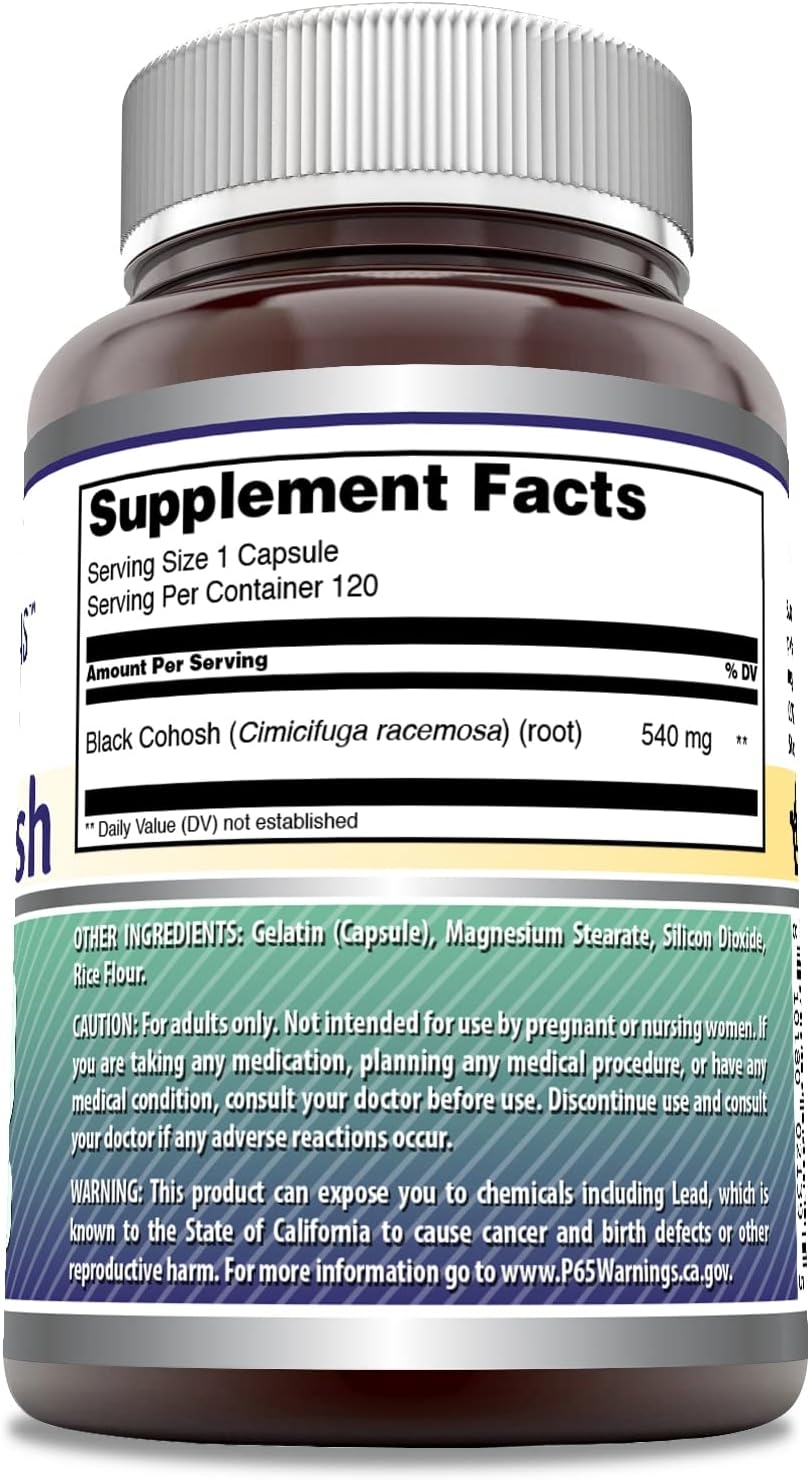
Two points differ between listing and label. First, the short description calls the product a "root extract", but the label says root, with no extract ratio and no standardisation to a marker compound; PDQ notes that commercial products are commonly standardised to a triterpene (23-epi-26-deoxyactein). Second, the dose is far from the trials, as the table shows.
| This product | Typical studied dose | NIH RDA / AI | Tolerable Upper Limit | |
|---|---|---|---|---|
| Black cohosh root | 540 mg per capsule, one capsule daily (label); form not standardised | Median 40 mg a day across 16 trials, mean 23 weeks (Cochrane, 2012); 39 mg and 127.3 mg compared in one trial, with equivalent benefit (NCI PDQ, 2024) | None established; this is an herb, not a nutrient, and the label says Daily Value not established | None established; long-term safety studies are lacking and some groups advise a 6-month limit (NCI PDQ, 2024; EMA, 2018) |
At 540 mg the capsule holds about 13.5 times the 40 mg a day that PDQ gives as the recommended dose of crude drug, and about 4.2 times the higher dose in the two-dose trial. The comparison has limits: the trials mostly used dry extracts, so 540 mg of root powder is not 540 mg of extract, and I cannot convert between them. No trial I read tested this preparation, so its effect and safety are unknown.
The label also carries a California Proposition 65 notice that the product "can expose you to chemicals including Lead," and says it is for adults only and not for pregnant or nursing women. NCCIH agrees black cohosh "may not be safe for use during pregnancy or while breastfeeding." It is also not blue cohosh, a different herb that NCCIH links to serious complications in infants when used to induce labour.
Who Might Consider It, and Who Should Skip It
Breast cancer survivors are a special case. PDQ (2024) reports two randomised, placebo-controlled trials (131 and 85 women) in survivors that found no difference from placebo for hot flashes, and it flags a possible tamoxifen interaction through the CYP2D6 enzyme, seen at a very high dose of 1,090 mg twice daily and of questionable clinical relevance.
Who this is for: an adult woman with mild to moderate hot flashes and night sweats who has talked to her clinician, understands the evidence is mixed and that the studied dose is far lower than 540 mg, has no liver condition, and is willing to stop at six months or sooner if symptoms do not ease or liver symptoms appear.
Who should skip it: most people. That includes anyone who is pregnant, trying to conceive or breastfeeding; anyone with a liver disorder, dark urine, yellowing skin or unexplained fatigue; women with a history of breast or uterine cancer unless their specialist agrees; women on tamoxifen or other prescribed hormonal treatment; and anyone buying it for sleep, mood or premenstrual symptoms, where the sources found no reliable evidence. Women with severe hot flashes should ask about the options NAMS recommends instead.
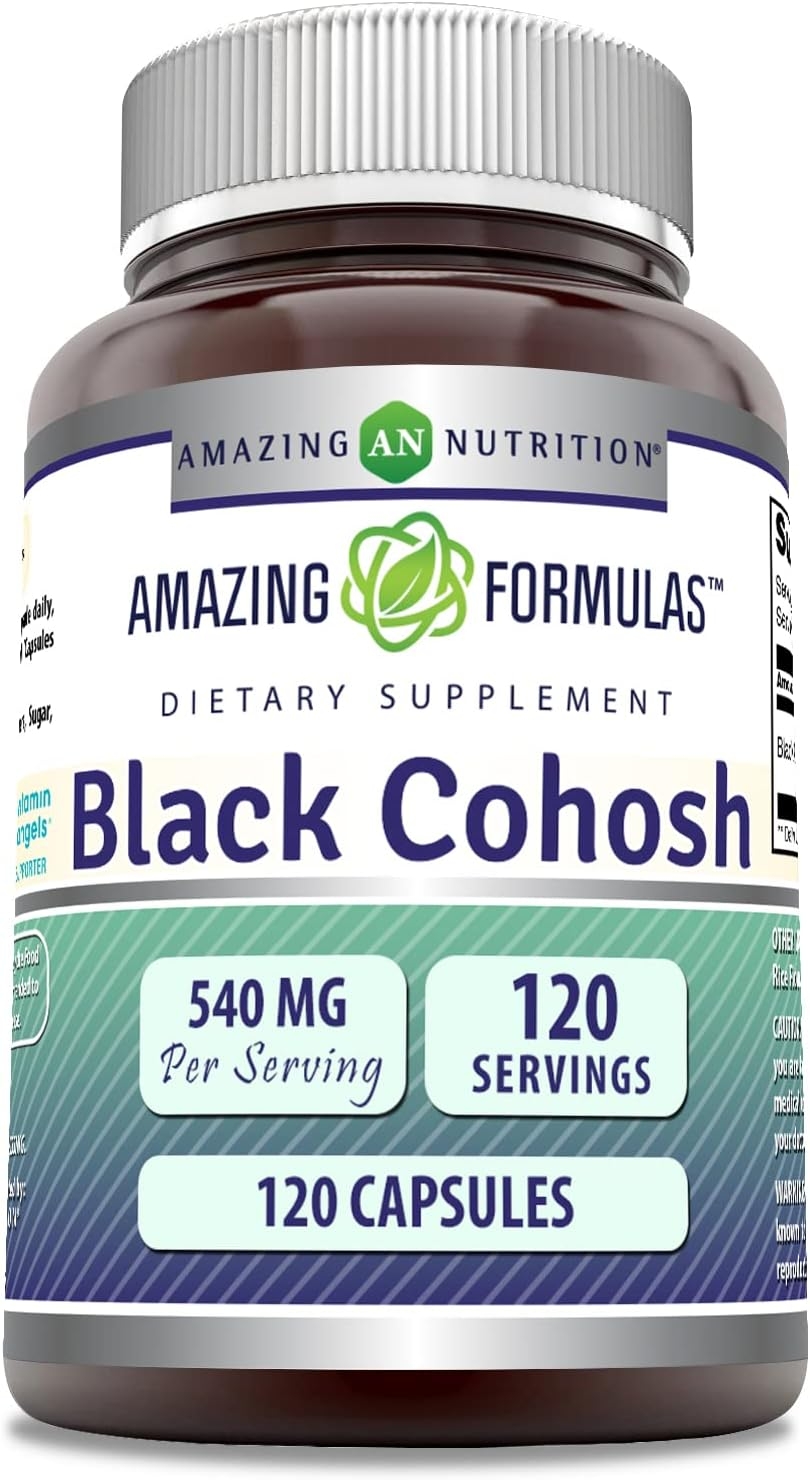
Amazing Formulas Black Cohosh 540 mg — 120 Capsules
Black cohosh root, 540 mg per capsule, one capsule daily per the label, 120 capsules per bottle. The dose is well above those used in trials. Also browse our hormonal balance range.
View Product DetailsFrequently Asked Questions
Does black cohosh really help with hot flashes?
The evidence is split. A 2012 Cochrane review of 16 trials and 2,027 women found no significant difference from placebo, while a 2023 review of 22 studies found improvement in hot flashes. NAMS (2023) does not recommend it, rating that advice Level I.
Is black cohosh bad for your liver?
Possibly, rarely. NCCIH (2024) says cases of liver damage, some very serious, have been reported in people taking products labeled as black cohosh, though it is uncertain the herb caused them. Stop it and see a clinician if you have dark urine, yellowing skin, abdominal pain or unexplained fatigue.
Does black cohosh act like estrogen?
Not according to the best current sources. The NCI PDQ summary (updated 2024) says purported estrogenic actions are refuted by laboratory and clinical studies of commercially available extracts, and NAMS (2023) says it was once thought to be estrogenic. Its mechanism is unclear; serotonin effects are one proposal.
How much black cohosh should you take a day?
Trials in the Cochrane review used a median of 40 mg a day of extract, and one trial found 39 mg and 127.3 mg equally effective (NCI PDQ, 2024). This product's label directs one 540 mg capsule of root a day.
How long can you safely take black cohosh?
Studies lasted as long as a year without major safety signals (NCCIH, 2024), but long-term safety data are lacking. The European Medicines Agency advises against using its approved black cohosh medicines for longer than six months without consulting a doctor.
Can you take black cohosh if you have had breast cancer?
Only with specialist advice. NCCIH (2024) says it is uncertain whether black cohosh is safe for women who have had hormone-sensitive conditions such as breast or uterine cancer, and PDQ flags a possible tamoxifen interaction. Two placebo-controlled trials in survivors found no hot-flash benefit.
Is black cohosh safe during pregnancy or breastfeeding?
It may not be. NCCIH (2024) says black cohosh may not be safe in pregnancy or while breastfeeding, and this product's label says it is not intended for pregnant or nursing women. Anyone pregnant, trying to conceive or breastfeeding should check with a clinician before using any herbal product.
Does black cohosh help with sleep or premenstrual symptoms?
No reliable evidence was found. NCCIH (2024) says there are not enough reliable data to show black cohosh works for uses other than menopause symptoms, such as premenstrual syndrome, and its 2023 review found no improvement in anxiety or depressive symptoms.
Sources
- National Center for Complementary and Integrative Health (NIH). "Black Cohosh." Last updated November 2024. Accessed 4 October 2026. nccih.nih.gov
- National Cancer Institute. "Black Cohosh (PDQ) – Health Professional Version." Updated 31 October 2024. Accessed 4 October 2026. cancer.gov
- The North American Menopause Society. "The 2023 nonhormone therapy position statement of The North American Menopause Society." Menopause 30(6):573–590, 2023. Accessed 4 October 2026. menopause.org
- Cochrane. Leach MJ, Moore V. "Black cohosh (Cimicifuga spp.) for menopausal symptoms." Cochrane Database of Systematic Reviews, 2012, CD007244; search current to March 2012. Accessed 4 October 2026. cochrane.org
- European Medicines Agency. "Cimicifugae rhizoma – herbal medicinal product" (HMPC summary for the public, published 26 July 2018). Accessed 4 October 2026. ema.europa.eu
- Frommenwiler DA, et al. "Investigation of market herbal products regulated under different categories: How can HPTLC help to detect quality problems?" Frontiers in Pharmacology, 2022. Accessed 4 October 2026. frontiersin.org
This article is for educational purposes only and is not medical advice. It is not intended to diagnose, treat, cure, or prevent any disease. These statements have not been evaluated by the Food and Drug Administration. Dietary supplements are not approved by the FDA before they are sold. Talk to your doctor before starting any new supplement, especially if you are pregnant, breastfeeding, take any medication, have liver disease, or have had a hormone-sensitive condition.