
Ashwagandha is one of the few herbal supplements where the NIH will actually say something positive — and one of the few carrying a documented liver warning. Both facts are true, and most articles give you only one of them. The National Center for Complementary and Integrative Health says some preparations "may be effective for insomnia and stress." The NIH's own LiverTox database records roughly 23 published cases of clinically apparent liver injury. Here is how to hold both ideas at once, plus the label detail that determines whether a product resembles what was actually tested.
Key takeaways
- NCCIH states that some ashwagandha preparations may be effective for insomnia and stress. Evidence for anxiety specifically remains unclear.
- Evidence is insufficient for cognitive function, athletic performance, diabetes, menopause and asthma — despite heavy marketing in all of these.
- NIH LiverTox documents ~23 published cases of liver injury, typically appearing 2–12 weeks after starting, and assigns a likelihood score of B ("likely cause").
- Safety data covers short-term use of up to about 3 months. Long-term safety is simply not established.
- Root powder is not the same as a standardised extract. Most clinical trials used 300–600 mg of standardised root extract — not raw powder — so milligram counts are not comparable.
What ashwagandha is
Withania somnifera is an evergreen shrub native to India, Africa and the Middle East, used in Ayurvedic medicine for thousands of years. The National Center for Complementary and Integrative Health identifies its bioactive compounds as withanolides, a family of steroidal lactones with anti-inflammatory and antioxidant properties.
It is usually classed as an "adaptogen" — a term for substances said to help the body resist stressors of all kinds. Worth knowing: adaptogen is a traditional and commercial category, not a regulatory or pharmacological one. It describes a claim, not a verified mechanism.
The species name somnifera means "sleep-inducing," which is a reasonable clue about which of its effects has the longest observational history — and, as it turns out, some of the better modern evidence.
What the evidence actually supports
NCCIH is unusually specific here, and the distinctions matter because they do not match how ashwagandha is marketed:
| Use | NCCIH assessment |
|---|---|
| Insomnia and sleep | May be effective for some preparations |
| Stress | May be effective for some preparations |
| Anxiety | Evidence unclear |
| Testosterone and sperm quality | Limited evidence; 2–4 months of use |
| Cognitive function | Insufficient evidence |
| Athletic performance | Insufficient evidence |
| Diabetes, menopause, asthma, female infertility | Insufficient evidence |
Note the phrase NCCIH repeats: "some ashwagandha preparations." That qualifier is doing real work, and §5 explains why.
Stress and sleep are also the two outcomes most vulnerable to placebo effects, since both are self-reported and both respond strongly to the simple act of doing something deliberate about them. That does not make the finding worthless — it makes it modest, which is exactly how NCCIH frames it.
Neuroscientist Ben Rein, PhD, works through the published ashwagandha trials.
The cortisol claim, examined
Nearly every ashwagandha product on the market says some version of "supports healthy cortisol levels." It is worth understanding what that does and does not mean.
Cortisol is a hormone produced by the adrenal glands on a daily rhythm — high in the morning to get you going, tapering across the day. It is not a "bad" hormone, and lowering it is not automatically good. Several trials have reported reductions in serum cortisol alongside improvements in self-reported stress scores, which is the basis for the claim.
Two caveats keep it honest. First, "supports healthy cortisol levels" is deliberately unfalsifiable marketing language — the FDA permits structure/function claims like this precisely because they stop short of asserting a medical effect. Second, cortisol reduction in a trial is a biomarker, not a benefit in itself. What matters is whether people feel and function better, and there NCCIH's verdict is a qualified "may."
The liver injury signal
This is the section most ashwagandha content omits, and it is the reason to read a label carefully rather than treat the herb as inert because it is natural.
NCCIH states plainly: "Although it is rare, there have been a number of cases that link liver injury to ashwagandha supplements." The detail sits in LiverTox, the NIH database of drug- and supplement-induced liver injury maintained by the National Institute of Diabetes and Digestive and Kidney Diseases:
| Finding | Detail |
|---|---|
| Published cases | Approximately 23, across Iceland, the US, Spain, Germany, Poland and India |
| Time to onset | Typically 2 to 12 weeks after starting |
| Injury pattern | Predominantly cholestatic or mixed, often with jaundice and itching |
| Usual outcome | Most resolved fully within 1–4 months of stopping |
| Worst outcomes | Rare fatal injury or emergency transplant, mainly with pre-existing cirrhosis or advanced liver disease |
| LiverTox likelihood score | B — "likely cause" of clinically apparent liver injury |
Keep the scale in proportion: roughly 23 published cases against many millions of users is genuinely rare, and most recovered fully after stopping. But "rare" is not "impossible," and the signal is strong enough that the NIH classifies it as a likely cause. That is worth a moment's thought before starting a daily herb indefinitely.
Christy Risinger, MD, a board-certified internist, reviews the data and the safety picture.
Root powder vs standardised extract — the label detail that matters
If you take one practical thing from this article, make it this.
The clinical trials behind ashwagandha's reputation overwhelmingly used standardised root extracts — concentrated preparations guaranteed to contain a specified percentage of withanolides, typically dosed at 300–600 mg per day. Branded extracts such as KSM-66 and Sensoril exist precisely because standardisation is what makes a botanical reproducible.
Many retail products instead contain raw root powder — the dried, milled root, unconcentrated. Because powder is far less potent by weight, labels carry much larger numbers: 1,000 mg, 1,400 mg, sometimes more. Those figures look generous next to "600 mg" on an extract, and they are not comparable in either direction without knowing the withanolide content.
Does black pepper extract help?
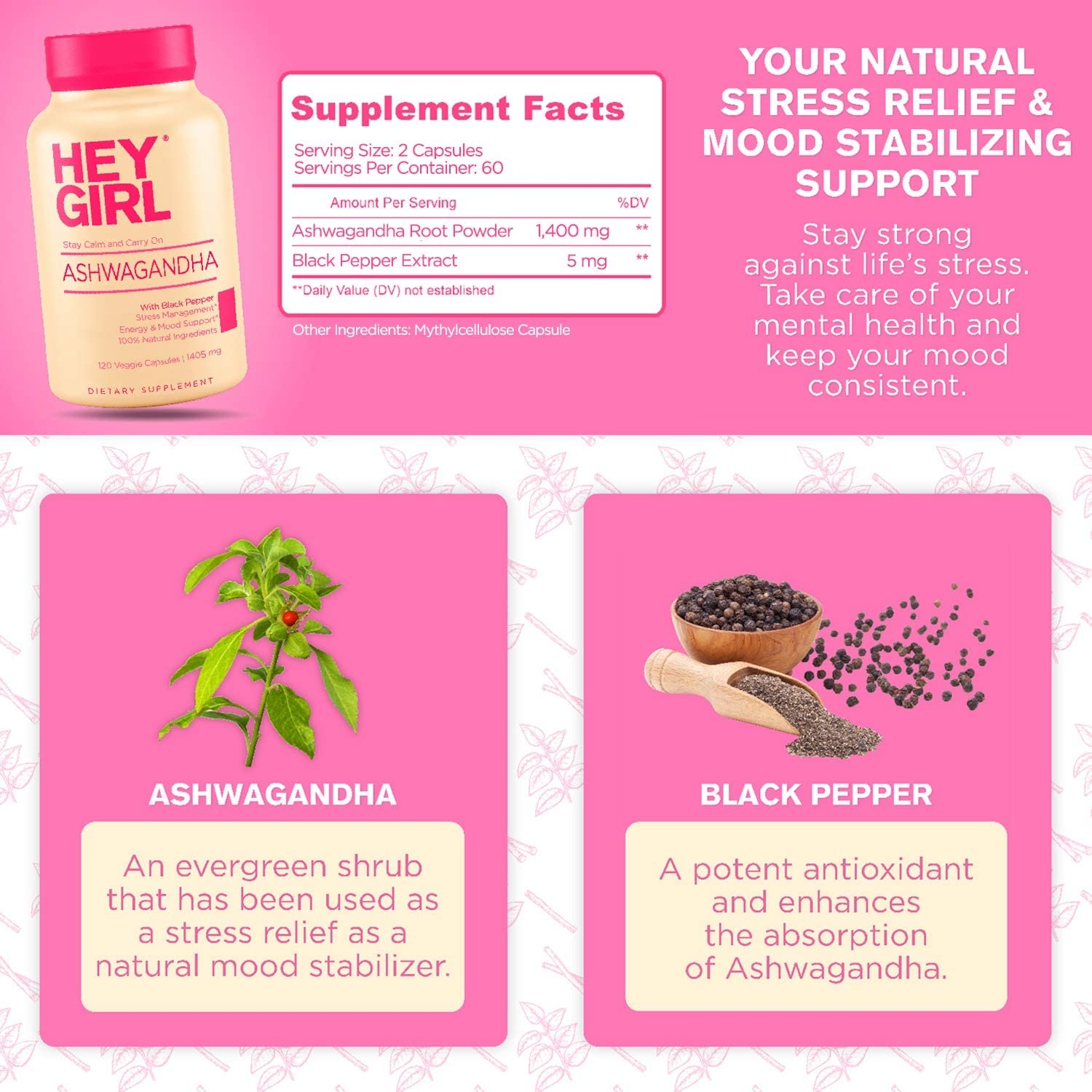
Many formulas add piperine, the active compound in black pepper, often as the branded ingredient BioPerine. The rationale is real: piperine inhibits certain intestinal and hepatic enzymes and drug transporters, slowing the breakdown of some compounds and raising their blood levels. The best-documented case is curcumin, where piperine substantially increases absorption.
Two honest qualifications. Evidence that piperine meaningfully increases withanolide absorption specifically is much thinner than the curcumin data it borrows credibility from. And the same enzyme inhibition that boosts absorption is a genuine drug interaction mechanism — piperine can raise blood levels of medications metabolised by those pathways. If you take prescription medication, that is a pharmacist conversation, not a footnote.
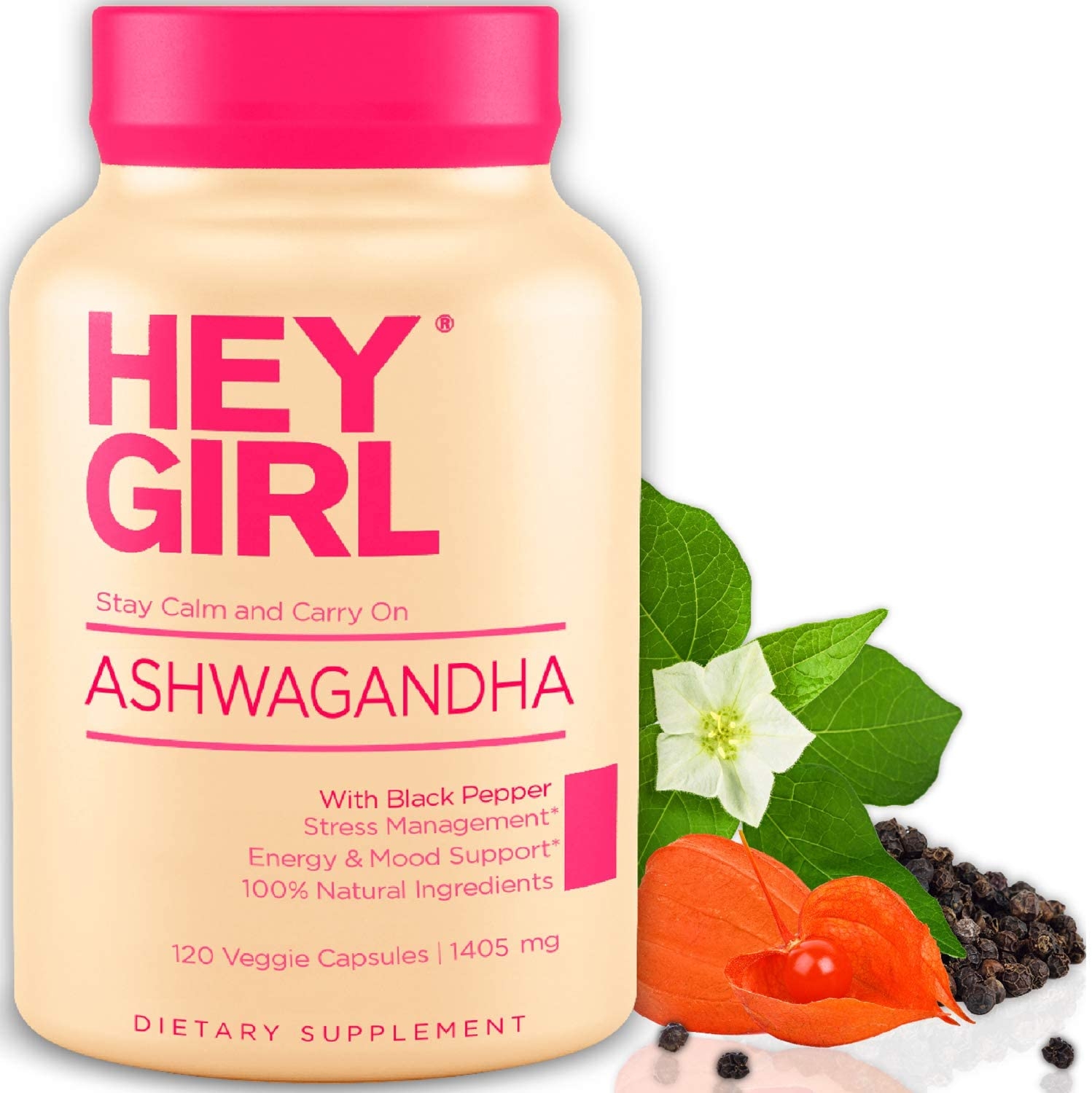
Hey Girl Ashwagandha Capsules — 1,400 mg Organic Root Powder with Black Pepper, 120 Count
A worked example of the format discussed above: 1,400 mg of organic ashwagandha root powder per serving with 5 mg of black pepper extract, two capsules daily with food. Note that this is root powder rather than a standardised withanolide extract, so use §5 to set expectations rather than comparing the milligram figure directly against trial doses.
Who should not take it
NCCIH lists a broad set of groups who should avoid ashwagandha or seek medical advice first:
- Pregnant or breastfeeding — avoid entirely
- Thyroid disorders — ashwagandha can affect thyroid hormone levels
- Autoimmune conditions — potential immune-stimulating activity
- Hormone-sensitive prostate cancer
- Anyone scheduled for surgery — sedative effects may compound anaesthesia; stop well in advance
- Existing liver disease — see §4
- Anyone taking diabetes medication, blood pressure medication, immunosuppressants, sedatives, anti-seizure drugs or thyroid medication
Common side effects even in people without those risk factors include drowsiness, stomach upset, diarrhoea and vomiting. Taking capsules with food helps with the digestive effects; the drowsiness is arguably a feature if you are taking it for sleep, and a problem if you take it in the morning.
Because supplements are not pre-approved for safety or efficacy — see the FDA's dietary supplement overview — third-party testing and an available Certificate of Analysis carry real weight for a botanical, where identity and contamination are live concerns. MedlinePlus has a good plain-language primer on evaluating supplements generally, and browse related options in General Wellness.
Frequently asked questions
Does ashwagandha actually work for stress?
NCCIH says research shows some ashwagandha preparations may be effective for insomnia and stress. That is a genuine positive assessment by the standards applied to herbal supplements, but it is qualified: effects are modest, and evidence for anxiety specifically is described as unclear.
Is ashwagandha bad for your liver?
The NIH LiverTox database records roughly 23 published cases of clinically apparent liver injury linked to ashwagandha and assigns it a likelihood score of B, meaning a likely cause. Injury typically appeared 2–12 weeks after starting and most cases resolved within 1–4 months of stopping, though rare fatal cases and transplants have occurred, mainly in people with pre-existing liver disease. It is rare relative to how many people use it, but real.
How long can I safely take ashwagandha?
Safety data covers short-term use of up to about three months. Longer-term safety has not been established, so extended continuous use is not supported by evidence. Many people cycle it or use it for defined periods rather than indefinitely.
What is the difference between ashwagandha root powder and extract?
Root powder is simply the dried, milled root. A standardised extract is concentrated and guaranteed to contain a set percentage of withanolides, the active compounds. Most clinical trials used 300–600 mg of standardised extract, so a large milligram figure on a raw powder product is not equivalent. Look for a withanolide percentage on the label.
Why is black pepper extract added to ashwagandha?
Piperine, the active compound in black pepper, inhibits certain metabolic enzymes and can increase absorption of some compounds — best documented for curcumin. Evidence specific to withanolides is thinner. The same mechanism can also raise blood levels of prescription medications, so check with a pharmacist if you take any.
Who should avoid ashwagandha?
NCCIH advises against use during pregnancy and breastfeeding, and lists caution for people with thyroid disorders, autoimmune conditions, hormone-sensitive prostate cancer, liver disease, or upcoming surgery, and for anyone taking diabetes, blood pressure, thyroid, sedative, anti-seizure or immunosuppressant medication.
- NIH National Center for Complementary and Integrative Health — Ashwagandha
- LiverTox: Ashwagandha — National Institute of Diabetes and Digestive and Kidney Diseases (NCBI Bookshelf)
- MedlinePlus (U.S. National Library of Medicine) — Dietary Supplements
- U.S. Food and Drug Administration — Dietary Supplements
- NIH National Institute on Aging — Dietary Supplements for Older Adults
Medical disclaimer. This article is for general education and is not medical advice. It is not a substitute for diagnosis or treatment from a qualified healthcare professional. Talk to your doctor or pharmacist before starting ashwagandha, particularly if you are pregnant or breastfeeding, have a thyroid, autoimmune or liver condition, or take prescription medication.
These statements have not been evaluated by the Food and Drug Administration. This product is not intended to diagnose, treat, cure, or prevent any disease.