
Nearly half of Americans consume less magnesium than they need, according to federal survey data — not from a fringe estimate, but from an analysis of 2013–2016 NHANES data showing 48% of people of all ages take in less magnesium from food and beverages than their Estimated Average Requirement. Most of these people have no diagnosed deficiency and no symptoms. But the mineral is a cofactor in more than 300 enzyme systems, and the gap between "enough to avoid symptoms" and "enough for the amounts studied in clinical trials" is where most of the real debate about magnesium supplements sits.
Key takeaways
- 48% of Americans get less magnesium from food than their Estimated Average Requirement (NIH, NHANES 2013–2016 data).
- The RDA is 400–420 mg/day for adult men and 310–320 mg/day for adult women, rising to 350–360 mg/day in pregnancy.
- The Tolerable Upper Intake Level for supplemental magnesium is 350 mg/day for adults 9 and older — food-based magnesium has no upper limit because the kidneys excrete the excess.
- A Cochrane review of 12 trials found magnesium supplementation lowered diastolic blood pressure by only 2.2 mmHg — a real but modest effect, not a substitute for treatment.
- The American Academy of Neurology rates magnesium "probably effective" for migraine prevention, but the doses studied exceed the adult UL and call for medical supervision.
- What magnesium does in the body
- How common is magnesium inadequacy, really?
- Magnesium, blood pressure, and heart disease
- Magnesium and type 2 diabetes
- Magnesium and bone health
- Magnesium for migraine prevention
- Not all magnesium supplements absorb the same way
- Who's actually at risk, and who should be cautious
- FAQ
What magnesium does in the body
Magnesium is an abundant mineral that the body cannot manufacture, so every milligram has to come from food, water, or supplements. According to the NIH Office of Dietary Supplements, it acts as a cofactor in more than 300 enzyme systems governing protein synthesis, muscle and nerve function, blood glucose control, and blood pressure regulation. It is also required for the structural development of bone and for the synthesis of DNA, RNA, and the antioxidant glutathione.
Roughly 30–40% of the magnesium in food is absorbed by the body, and the kidneys tightly regulate how much is excreted in urine — which is why symptomatic deficiency in otherwise healthy people is uncommon even though many people fall short of the RDA on any given day.
| Age group | Male | Female | Pregnancy | Lactation |
|---|---|---|---|---|
| 9–13 years | 240 mg | 240 mg | — | — |
| 14–18 years | 410 mg | 360 mg | 400 mg | 360 mg |
| 19–30 years | 400 mg | 310 mg | 350 mg | 310 mg |
| 31–50 years | 420 mg | 320 mg | 360 mg | 320 mg |
| 51+ years | 420 mg | 320 mg | — | — |
Source: NIH Office of Dietary Supplements, Magnesium Fact Sheet for Health Professionals.
How common is magnesium inadequacy, really?
The NIH's own framing is careful here, and it's worth repeating exactly: symptomatic deficiency from low intake alone is uncommon in healthy people, because the kidneys limit how much magnesium is lost in urine. What's common is inadequacy — intakes that sit below the RDA without causing overt symptoms. The NHANES 2013–2016 analysis found that men 71 and older, along with adolescent boys and girls, were the groups most likely to fall short.
Diet quality is the main driver. Good sources of magnesium are foods people tend to under-eat: green leafy vegetables, legumes, nuts, seeds, and whole grains. Refining grains strips out the nutrient-rich germ and bran, which substantially lowers magnesium content — one reason a diet heavy in processed carbohydrates tends to run short.
| Food | Magnesium | % Daily Value |
|---|---|---|
| Pumpkin seeds, roasted, 1 oz | 156 mg | 37% |
| Chia seeds, 1 oz | 111 mg | 26% |
| Almonds, dry roasted, 1 oz | 80 mg | 19% |
| Spinach, boiled, ½ cup | 78 mg | 19% |
| Black beans, cooked, ½ cup | 60 mg | 14% |
| Peanut butter, smooth, 2 tbsp | 49 mg | 12% |
| Banana, 1 medium | 32 mg | 8% |
Source: NIH Office of Dietary Supplements, Magnesium Fact Sheet for Health Professionals (USDA FoodData Central values). DV = 420 mg.
"Why you need magnesium." — Cleveland Clinic, an academic medical center, on magnesium's role in nerve, muscle, and heart function.
Magnesium, blood pressure, and heart disease
This is the category where the evidence is most likely to be oversold, so it's worth stating plainly: magnesium supplements only marginally lower blood pressure. A Cochrane review of 12 clinical trials in 545 people with hypertension found that magnesium supplementation for 8 to 26 weeks produced only a 2.2 mmHg reduction in diastolic blood pressure. A separate meta-analysis of 22 studies in 1,173 adults found systolic pressure dropped 3–4 mmHg and diastolic 2–3 mmHg — a real but small effect, nowhere near what a prescribed antihypertensive delivers.
The FDA has weighed in directly on the marketing claim. It permits a qualified health claim stating that "consuming diets with adequate magnesium may reduce the risk of high blood pressure," but is explicit that "the evidence is inconsistent and inconclusive." Products carrying that claim must provide at least 84 mg of magnesium per serving and, for supplements, no more than 350 mg.
On the observational side, a meta-analysis of prospective cohort data found that an additional 100 mg/day of dietary magnesium was associated with an 8% lower risk of total stroke and a 9% lower risk of ischemic stroke. Association isn't causation, but it's a consistent pattern across multiple large cohorts.
Magnesium and type 2 diabetes
People with insulin resistance or type 2 diabetes lose more magnesium in urine as blood glucose rises, and several large cohort studies link higher magnesium intake to lower diabetes risk — one meta-analysis of seven studies covering 286,668 people found each additional 100 mg/day of magnesium was associated with a 15% lower risk of developing type 2 diabetes. But that's diet, tracked over years, in people who didn't yet have diabetes.
The clinical-trial evidence for treating existing diabetes with magnesium supplements is thin and inconsistent. In a Brazilian trial, 128 patients with poorly controlled diabetes took a daily placebo or 500 mg or 1,000 mg of magnesium oxide (300 or 600 mg elemental magnesium); after 30 days only the higher dose raised magnesium levels and improved glycemic control. In a separate trial, magnesium aspartate providing 369 mg/day for three months had no effect on glycemic control in 50 patients already taking insulin. The American Diabetes Association's position, as summarized by NIH, is that there currently isn't enough evidence to recommend magnesium supplements for glycemic control.
Magnesium and bone health
Between 50% and 60% of the body's magnesium is stored in bone, and some studies link higher magnesium intake to greater bone mineral density, while women with osteoporosis tend to have lower serum magnesium than women without it. A short 30-day study of postmenopausal women with osteoporosis found that 290 mg/day of magnesium citrate suppressed markers of bone turnover compared with placebo — a signal, not proof of fracture prevention.
The National Institute of Arthritis and Musculoskeletal and Skin Diseases lists calcium and vitamin D, not magnesium, as the primary nutritional levers for bone health — magnesium's role is described as supportive and still under study, not established. That's the honest framing: magnesium belongs in a bone-health conversation, but it isn't the headline nutrient.
Magnesium for migraine prevention
This is the strongest single indication in the NIH review. Low serum and tissue magnesium levels are associated with migraine, and the American Academy of Neurology and the American Headache Society concluded in an evidence-based guideline update that magnesium therapy is "probably effective" for migraine prevention.
Three of four small placebo-controlled trials found modest reductions in migraine frequency at doses up to 600 mg/day — well above the 350 mg adult UL for supplemental magnesium. The fourth trial found no benefit, and researchers suspected poor absorption, since many participants reported diarrhea. Translation: this is a use case with real evidence behind it, but not one to self-dose at high levels without a clinician involved.
Not all magnesium supplements absorb the same way
Supplement labels list different magnesium salts, and they are not interchangeable. Per NIH ODS, forms that dissolve well in liquid — magnesium aspartate, citrate, lactate, and chloride — tend to be more completely absorbed than magnesium oxide or magnesium sulfate. Magnesium oxide is inexpensive and widely used, but it's also one of the forms most commonly associated with a laxative effect and diarrhea at higher doses, alongside magnesium carbonate, chloride, and gluconate.

Who's actually at risk, and who should be cautious
NIH identifies four groups more likely to run short: people with gastrointestinal diseases (Crohn's disease, celiac disease) that cause chronic diarrhea or malabsorption; people with type 2 diabetes, who lose more magnesium in urine; people with chronic alcohol dependence; and older adults, who both absorb less and excrete more as they age.
Several common medications interact with magnesium in ways worth knowing about before combining them:
| Medication class | Examples | Effect |
|---|---|---|
| Oral bisphosphonates | Alendronate (Fosamax) | Magnesium reduces absorption; separate doses by 2+ hours |
| Tetracyclines & quinolones | Doxycycline, ciprofloxacin | Magnesium forms insoluble complexes; take antibiotic 2 hrs before or 4–6 hrs after magnesium |
| Loop & thiazide diuretics | Furosemide, hydrochlorothiazide | Increase urinary magnesium loss over time |
| Proton pump inhibitors | Esomeprazole, lansoprazole | Can cause low serum magnesium after 1+ year of use |
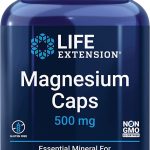
Life Extension Magnesium Caps 500 mg — 100 Vegetarian Capsules
Uses three forms of magnesium — oxide, citrate and succinate — in a single vegetarian capsule, gluten-free and Non-GMO certified. Worth reading carefully: at 500 mg per capsule this is already above the 350 mg adult UL for supplemental magnesium, and the label directs one capsule one to three times daily, which at the top of that range is well beyond it. Check your total intake from food and other supplements, and treat doses above 350 mg/day as something to agree with a healthcare provider rather than self-select.
Browse the full range in our Minerals and Heart & Cardiovascular categories.
Frequently asked questions
How much magnesium do I actually need per day?
The RDA is 400 mg/day for men 19–30 and 420 mg/day for men 31 and older; for women it's 310 mg/day at 19–30 and 320 mg/day from 31 onward, rising slightly during pregnancy. These totals include magnesium from food, water, and supplements combined.
Can I get too much magnesium from food alone?
No. The Tolerable Upper Intake Level of 350 mg/day applies only to magnesium from supplements and medications. Magnesium from food doesn't pose a health risk in healthy people because the kidneys excrete the excess in urine.
What are the early signs of magnesium deficiency?
Loss of appetite, nausea, vomiting, fatigue, and weakness are the earliest signs. As deficiency worsens, numbness, tingling, muscle cramps, and abnormal heart rhythms can occur — but according to NIH, symptomatic deficiency from diet alone is uncommon in otherwise healthy people.
Does magnesium actually help you sleep?
This is a widely marketed claim, but it's worth being direct: the NIH Office of Dietary Supplements' evidence review of magnesium covers blood pressure, diabetes, osteoporosis, and migraine — it does not include a sleep section, because the supporting trial evidence isn't strong or consistent enough for NIH to summarise a verified effect. Treat "magnesium for sleep" as an unproven, popular claim rather than an established benefit.
Which form of magnesium should I look for on a label?
If absorption is the priority, look for citrate, glycinate, lactate, chloride, or aspartate forms over magnesium oxide, which NIH notes is among the least bioavailable common forms and more likely to cause diarrhea at higher doses.
Who should talk to a doctor before taking a magnesium supplement?
Anyone with kidney disease, anyone taking bisphosphonates, tetracycline or quinolone antibiotics, diuretics, or long-term proton pump inhibitors, and anyone considering migraine-prevention doses that approach or exceed 350 mg/day of supplemental magnesium.
- NIH Office of Dietary Supplements — Magnesium, Fact Sheet for Health Professionals
- NIH Office of Dietary Supplements — Magnesium, Fact Sheet for Consumers
- MedlinePlus Medical Encyclopedia — Magnesium Deficiency
- MedlinePlus Medical Encyclopedia — Magnesium in Diet
- National Institute on Aging — Vitamins and Supplements
- NIAMS — Osteoporosis
- U.S. Food and Drug Administration — Dietary Supplements
This article is for educational purposes only and is not a substitute for professional medical advice, diagnosis, or treatment. Always consult a qualified healthcare provider before starting any supplement, especially if you have kidney disease, take prescription medications, or are pregnant or breastfeeding. These statements have not been evaluated by the Food and Drug Administration. This product is not intended to diagnose, treat, cure, or prevent any disease.