
Riboflavin deficiency is uncommon in the United States, according to MedlinePlus (reviewed January 2025), yet one capsule of this supplement carries 400 mg, roughly 308 times the 1.3 mg adult RDA for men. Riboflavin (vitamin B2) is a water-soluble B vitamin the body uses to release energy from carbohydrates, proteins and fats and to help make red blood cells. The 400 mg figure is not random: it is the dose used in the best-known migraine trial.
Key Takeaways
- A 1998 trial of 55 migraine patients gave 400 mg a day for 3 months: 59% of the riboflavin group had at least a 50% cut in headache days versus 15% on placebo (Schoenen, Neurology, 1998).
- A 2026 meta-analysis of 12 trials (749 people) found 1.39 fewer migraine attacks (95% CI −2.52 to −0.25), but with very high inconsistency between trials (I² = 91.7%).
- The American Academy of Neurology and American Headache Society rated riboflavin Level B, “probably effective” for adult migraine prevention in their 2012 guideline.
- In children the picture is mixed: a 2008 trial of 48 children given 200 mg found no benefit over placebo (12 of 27 vs 14 of 21 improved by half or more).
- The Institute of Medicine (1998) could not set an upper limit because the safety evidence was insufficient, and it reported a maximum of about 27 mg absorbed from a single oral dose.
In this article:
- What Riboflavin Is and Who Actually Lacks It
- The Trial Behind the 400 mg Dose
- What the Reviews and Guidelines Conclude
- Children: Where the Evidence Splits
- Safety, Absorption and the Bright Yellow Urine
- Inside Amazing Formulas Riboflavin 400 mg
- Who Might Consider It, and Who Should Skip It
- Frequently Asked Questions
What Riboflavin Is and Who Actually Lacks It
According to MedlinePlus (review date January 2025), riboflavin is water soluble, so it is not stored and leftover amounts leave in the urine. It helps produce red blood cells and release energy from food. Dairy, eggs, green leafy vegetables, meats, legumes, nuts and fortified cereals supply it; light destroys it.
Real deficiency is rare. MedlinePlus says lack of riboflavin is “not common” in the United States; severe deficiency causes anemia, mouth or lip sores, skin complaints and a sore throat. The Institute of Medicine’s 1998 report put median food intake near 2 mg a day for men and 1.5 mg for women, and the 95th percentile from food plus supplements at 4 to 10 mg.
| Measure | Amount | Source |
|---|---|---|
| RDA, men 14 and older | 1.3 mg a day | MedlinePlus, reviewed January 2025 |
| RDA, women 19 and older | 1.1 mg a day (1.4 mg in pregnancy, 1.6 mg while breastfeeding) | MedlinePlus, reviewed January 2025 |
| Maximum absorbed from one oral dose | About 27 mg | Institute of Medicine, 1998 |
| Tolerable Upper Intake Level | None established | Institute of Medicine, 1998 |
The store listing says riboflavin is “regarded as an essential part of energy.” That is true of its role in metabolism, but none of the sources we read tested a supplement for energy in people who are not deficient. That is a gap in what we found, not proof of no effect; this article focuses on the one use with trial data.
The Trial Behind the 400 mg Dose
The dose on this label comes from a study by Belgian neurologist Jean Schoenen and colleagues. In a randomized trial published in Neurology in 1998 (PubMed 9484373), 55 migraine patients took 400 mg of riboflavin or placebo for 3 months. In the intention-to-treat analysis, riboflavin was superior for attack frequency (p = 0.005) and headache days (p = 0.012). The proportion of “responders,” patients whose headache days fell by at least half, was 15% on placebo and 59% on riboflavin, a number needed to treat of 2.3. Three minor adverse events occurred, two in the riboflavin group (diarrhea and polyuria) and one on placebo (abdominal cramps).
“Because of its high efficacy, excellent tolerability, and low cost, riboflavin is an interesting option for migraine prophylaxis and a candidate for a comparative trial with an established prophylactic drug.”
— Schoenen et al., Neurology (1998), abstractThe authors called it a candidate for a head-to-head comparison: a call for more research, not a verdict.
What the Reviews and Guidelines Conclude
| Source | Scope | What it concluded |
|---|---|---|
| AAN and American Headache Society guideline, 2012 | Adults with episodic migraine; 15 studies of NSAIDs and complementary therapies | Riboflavin, magnesium, feverfew and several NSAIDs “probably effective” (Level B); CoQ10 “possibly effective” (Level C) |
| Thompson and Saluja, systematic review, 2017 | 11 clinical trials | Five trials consistently positive in adults; four mixed in children and adolescents; two combination-therapy trials showed no benefit; side effects mild |
| Dose-response meta-analysis, 2026 | 12 trials, 749 people | Frequency: weighted mean difference −1.39 (95% CI −2.52 to −0.25), I² = 91.7%. Duration: −1.36 (95% CI −2.69 to −0.03), I² = 90.4%. Benefit rose linearly up to 400 mg a day |
The NHS migraine page (reviewed March 2026) also lists vitamin B2 among prevention options. The 2012 guideline (Holland et al., full text on PMC) rated magnesium at the same Level B as riboflavin, and CoQ10 one step lower. “Probably effective” is a real endorsement, but it is the middle of the scale, not the top.
The 2026 meta-analysis (Journal of Research in Medical Sciences) is the most recent pooling we found. Its authors list two limitations: some included studies had no control group, and some were small. The average reduction of 1.39 attacks is modest, the interval runs from a quarter of an attack to 2.5, and an I² above 90% means the trials disagreed far more than chance would explain.
National Headache Foundation, “Does vitamin B2 help prevent migraine?” We include it as background from a headache charity and have not used it as a source for any figure in this article.
Children: Where the Evidence Splits
The first randomized trial in children (MacLennan et al., Journal of Child Neurology, 2008; PubMed 18984840) compared 200 mg a day against placebo in 48 children. A 50% or greater reduction in attacks was seen in 14 of 21 placebo children (67%) and 12 of 27 riboflavin children (44%), not a significant difference.
“These results suggest that riboflavin is not an effective therapy for preventing migraine in children.”
— MacLennan et al., Journal of Child Neurology (2008), abstractNot every pediatric trial agrees. The 2026 meta-analysis’s summary table lists a 2018 Iranian trial in children aged 5 to 13 where 100 mg a day showed no effect on frequency while 200 mg reduced it. The 2017 review called the pediatric results mixed. This product is an adult label, so it is not a children’s product.
Safety, Absorption and the Bright Yellow Urine
Riboflavin has an unusually clean record, but the reason is more interesting than “it is just a vitamin.”
“The evidence on adverse effects is not sufficient to set a Tolerable Upper Intake Level (UL) for riboflavin.”
— Institute of Medicine, Dietary Reference Intakes for Thiamin, Riboflavin… (1998), Chapter 5That does not say high doses are proven safe, only that the data were too thin to name a ceiling. The same chapter notes that large-dose studies “have not been designed to systematically evaluate adverse effects,” but reports no adverse effects in 49 patients taking 400 mg a day for at least 3 months in an earlier Schoenen study.
Absorption is the other limit. The Institute of Medicine puts bioavailability at about 95% of food flavin, “up to a maximum of about 27 mg absorbed per single meal or dose.” By our arithmetic, 27 mg is under 7% of a 400 mg capsule. The capsule is not necessarily wasted, since the trials used 400 mg, but the dose is trial-derived, not absorption-derived.
The side effect people notice is color. Cleveland Clinic’s medication page lists bright yellow urine as a side effect that usually does not require medical attention, and and a Cleveland Clinic specialist (21 August 2023) says the color “is simply a sign that your body is getting rid of the vitamin it didn’t use and can’t store.”
A supplement is not a substitute for a diagnosis. The NHS (page reviewed 10 March 2026) says to get emergency help for a headache that came on suddenly and is extremely painful, or one with problems speaking, vision loss, confusion, a seizure, weakness on one side of the body or after a head injury. It advises seeing a doctor if attacks are getting worse or happen more than once a week.
Inside Amazing Formulas Riboflavin 400 mg
The product is Amazing Formulas Riboflavin (Vitamin B2) 400 mg, 120 capsules. Its Supplement Facts panel lists one capsule as the serving, 120 servings, and riboflavin (as vitamin B2) 400 mg with a printed Daily Value of 23,529%. Other ingredients are gelatin, magnesium stearate, silicon dioxide and microcrystalline cellulose; the label states it contains no sugar, milk, lactose, gluten, wheat, yeast, fish or sodium.
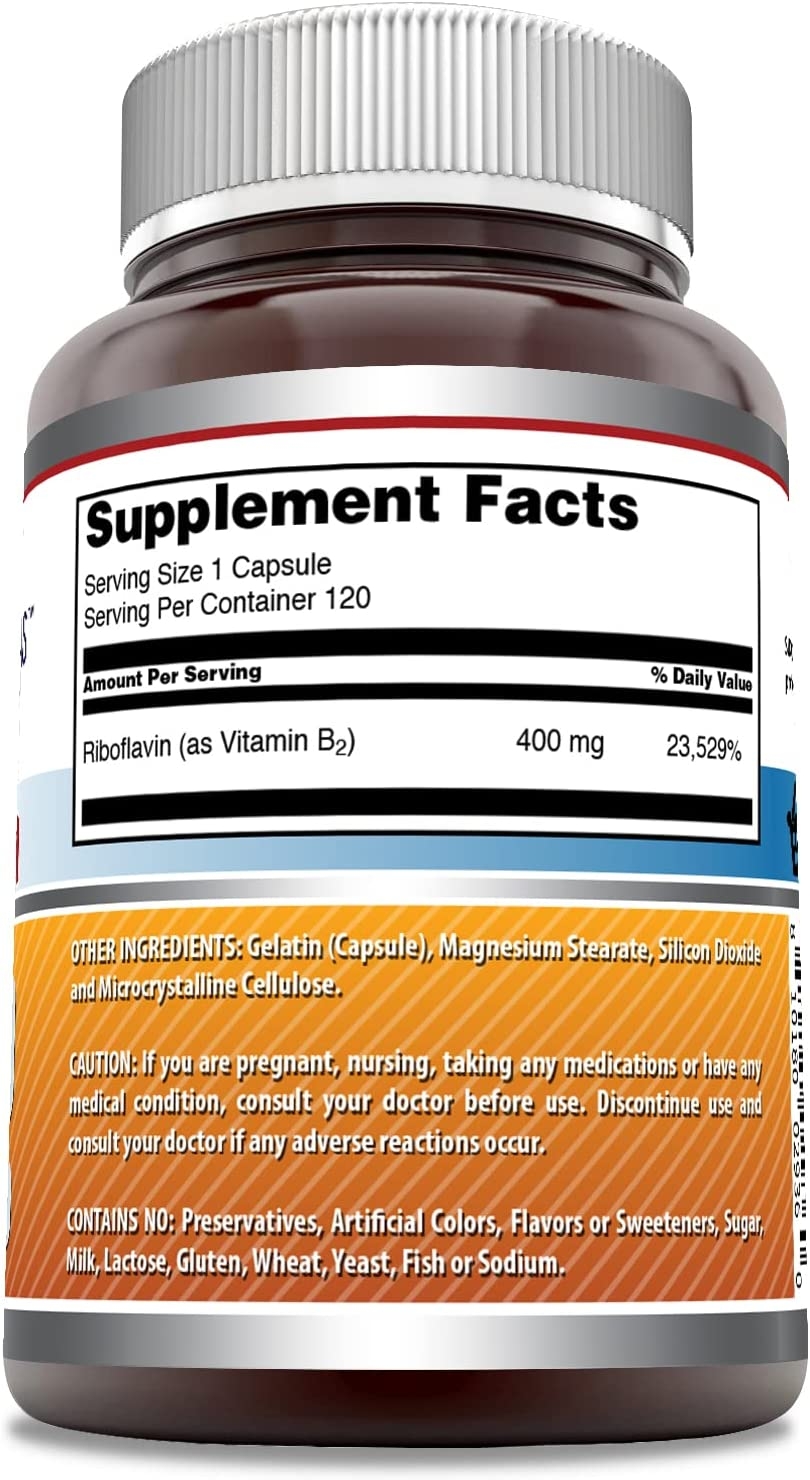
The back label’s suggested use is: “As a dietary supplement, adults take one (1) capsule daily, preferably with a meal or as directed by a health care professional.” That matches the trial dose of 400 mg once a day, though we could not confirm the trial capsules were formulated like this one.
One label detail does not add up. 23,529% is 400 mg divided by a 1.7 mg Daily Value. The FDA’s Daily Value page (content current as of March 2024) lists riboflavin at 1.3 mg, which would make it about 30,769%. The percentage is cosmetic, but it shows the panel uses an older reference value. The store listing also has typos (“400 milligrans,” “Riboflovin”); the label reads correctly.
| This product | Dose in the evidence | NIH / IOM RDA | Tolerable Upper Limit | |
|---|---|---|---|---|
| Riboflavin, adults, per day | 400 mg (one capsule, per label) | 400 mg a day for 3 months (Schoenen 1998) | 1.3 mg (men), 1.1 mg (women) | None established; evidence insufficient to set one |
| Riboflavin, children | Adult label: one capsule daily for adults | 200 mg a day for 12 weeks (MacLennan 2008, no benefit) | 0.9 mg (ages 9–13) | None established |
At 400 mg this capsule is about 308 times the adult male RDA and 364 times the female RDA of 1.1 mg. No upper limit exists to exceed. What matters is whether you have a reason to take that much; for someone on a normal diet, the extra is largely excreted.
Listing versus evidence: the store description credits riboflavin with supporting adrenal function and, via homocysteine control, cardiovascular health. Those are manufacturer statements we could not verify; the only use with trial data at this dose is adult migraine prevention, which the label itself does not claim.
Who Might Consider It, and Who Should Skip It
Who this is for: adults with frequent migraine who have already seen a clinician, want a low-cost option with a Level B guideline rating, and will judge it over about 3 months with a headache diary.
Who should skip it: most people without migraine, whose normal diet already supplies the RDA; anyone seeking an energy boost, since no trial we read supports that in non-deficient adults; children, given the mixed pediatric trials; anyone with new, worsening or alarming headaches; and anyone pregnant, breastfeeding or on medication without their doctor’s agreement, as the label advises.
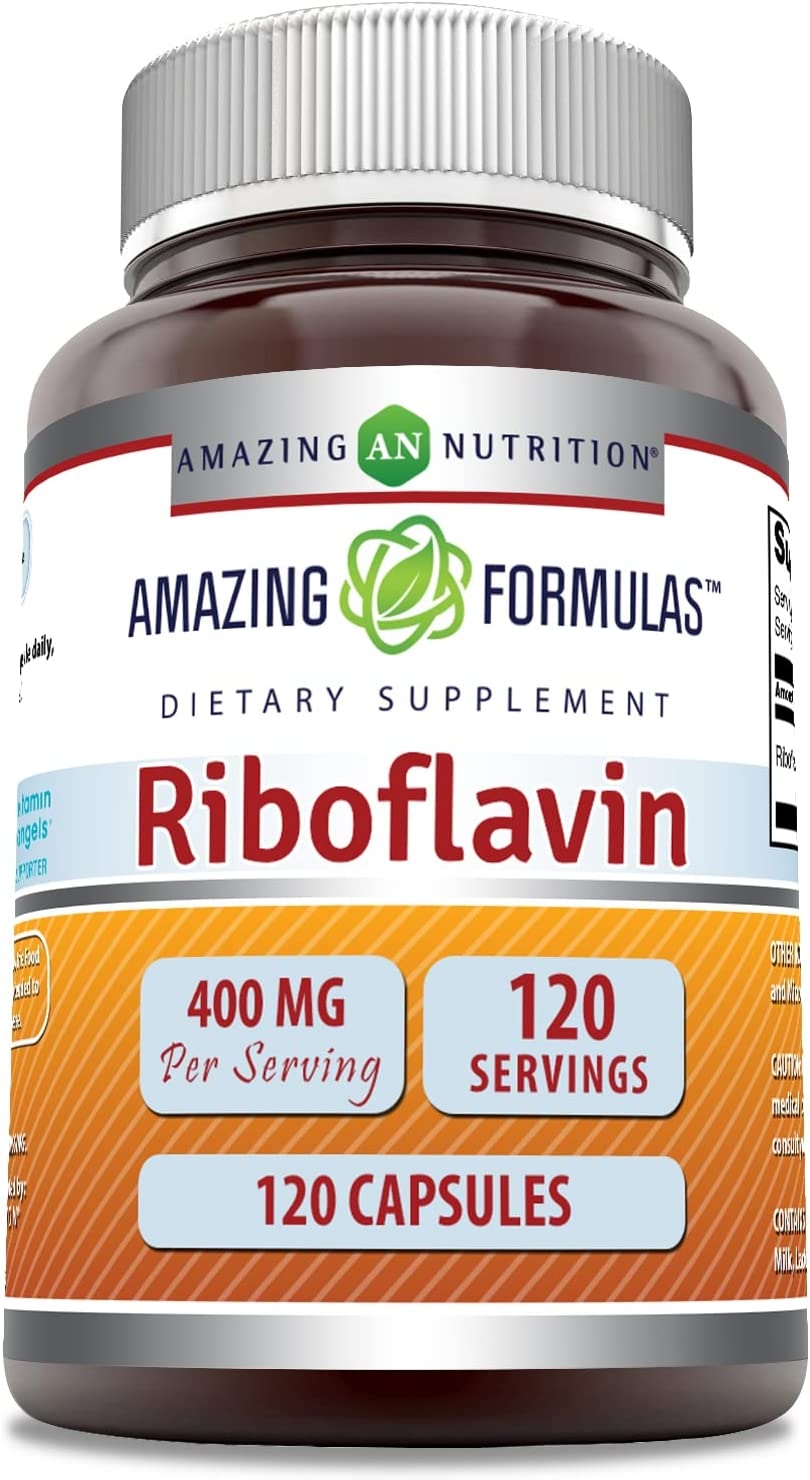
Amazing Formulas Riboflavin B2 400 mg, 120 Capsules
400 mg of riboflavin per capsule, 120 capsules, with the label directing adults to take one capsule daily, preferably with a meal. Not a children’s product. Browse more in our supplements range.
View Product DetailsFrequently Asked Questions
What is riboflavin (vitamin B2) used for?
Riboflavin is a B vitamin the body needs to release energy from food and make red blood cells. Supplement trials mostly test it for migraine prevention, where a 2012 guideline rated it probably effective for adults. Most people get enough from food.
How much riboflavin is used for migraine?
The best-known trial used 400 mg a day for 3 months (Schoenen, 1998), and a 2026 meta-analysis found benefit rising up to 400 mg a day. That is about 308 times the adult male RDA, so discuss it with a clinician first.
Can you take too much riboflavin?
No upper limit has been set; the Institute of Medicine said in 1998 the evidence was insufficient to set one. Trials reported minor effects such as diarrhea and increased urination. Long-term safety at high doses has not been studied well.
Why does riboflavin turn urine bright yellow?
Riboflavin is naturally yellow, and the body excretes what it cannot use or store in the urine. Cleveland Clinic lists bright yellow urine as a side effect that usually does not need medical attention.
How long does riboflavin take to work for migraines?
The trials in the 2026 review’s summary table mostly ran 12 to 16 weeks, and the 1998 trial measured the result after 3 months. Do not expect a result in days. A headache diary kept for a month before starting and throughout helps you judge whether it is working, and if not, stop.
Is riboflavin safe during pregnancy?
The RDA rises to 1.4 mg in pregnancy and 1.6 mg while breastfeeding, but we did not find safety data for 400 mg doses in either. This product’s label advises anyone pregnant or nursing to consult a doctor before use, which is the right course.
Does riboflavin give you energy?
Riboflavin helps the body release energy from food, and severe deficiency can cause anemia. But none of the sources we read tested a supplement for energy in people who are not deficient, so a 400 mg capsule is not a proven energy booster.
Is 400 mg of riboflavin safe for children?
This product is labeled for adults only. In children the evidence is mixed: a 48-child trial of 200 mg found no benefit, and other pediatric trials differed by dose. No children’s upper limit exists, so a pediatrician should decide on any riboflavin for a child.
Sources
- Institute of Medicine. “Dietary Reference Intakes for Thiamin, Riboflavin, Niacin, Vitamin B6, Folate, Vitamin B12, Pantothenic Acid, Biotin, and Choline,” Chapter 5, Riboflavin. National Academy Press, 1998. Accessed 8 October 2026. nap.nationalacademies.org
- MedlinePlus Medical Encyclopedia. “Riboflavin.” Review date 21 January 2025. Accessed 8 October 2026. medlineplus.gov
- Schoenen J, Jacquy J, Lenaerts M. “Effectiveness of high-dose riboflavin in migraine prophylaxis. A randomized controlled trial.” Neurology, 1998. Accessed 8 October 2026. PubMed 9484373
- Holland S, et al. “Evidence-based guideline update: NSAIDs and other complementary treatments for episodic migraine prevention in adults.” American Academy of Neurology and American Headache Society, Neurology, 2012. Accessed 8 October 2026. PMC3335449
- Thompson DF, Saluja HS. “Prophylaxis of migraine headaches with riboflavin: A systematic review.” Journal of Clinical Pharmacy and Therapeutics, 2017. Accessed 8 October 2026. PubMed 28485121
- “The effect of riboflavin on the mean attack frequency, severity, and duration of migraine headaches: A systematic review and dose-response meta-analysis of clinical trials.” Journal of Research in Medical Sciences, 2026. Accessed 8 October 2026. doi:10.4103/jrms.jrms_547_24
- MacLennan SC, et al. “High-dose riboflavin for migraine prophylaxis in children: a double-blind, randomized, placebo-controlled trial.” Journal of Child Neurology, 2008. Accessed 8 October 2026. PubMed 18984840
- NHS. “Migraine.” Page last reviewed 10 March 2026. Accessed 8 October 2026. nhs.uk
- Cleveland Clinic. “Riboflavin (Vitamin B2): Uses & Side Effects.” Undated medication page. Accessed 8 October 2026. my.clevelandclinic.org
- Cleveland Clinic Health Essentials. “4 Health Benefits of Riboflavin (Vitamin B2).” 21 August 2023. Accessed 8 October 2026. health.clevelandclinic.org
- U.S. Food and Drug Administration. “Daily Value on the Nutrition and Supplement Facts Labels.” Content current as of March 2024. Accessed 8 October 2026. fda.gov
This article is for educational purposes only and is not medical advice. It is not intended to diagnose, treat, cure, or prevent any disease. These statements have not been evaluated by the Food and Drug Administration. Talk to your doctor before starting any new supplement, especially if you have frequent or severe headaches, are pregnant or breastfeeding, or take any prescription medication.