
HMB (beta-hydroxy-beta-methylbutyrate), a metabolite of the amino acid leucine, is sold on the promise that it "preserves lean mass," yet the most recent meta-analysis of HMB with resistance training in adults over 50 (13 trials, 561 people, Age and Ageing, 2026) found no significant effect on muscle mass. A 2018 meta-analysis of trained athletes found effect sizes of essentially zero for strength. The evidence for HMB is not empty, but it is narrower, and more tangled up with the people who own the patents, than the front of the tub suggests.
Key Takeaways
- A 2026 meta-analysis of 13 trials and 561 adults aged 50+ found HMB added no significant benefit to resistance training for muscle mass (SMD 0.05, 95% CI −0.10 to 0.20) or strength (SMD 0.04) (Age and Ageing, 2026).
- In trained and competitive athletes, a 2018 meta-analysis of 6 trials (193 people) found a bench-press effect size of 0.00 and a leg-press effect size of 0.09, none significant (J Sci Med Sport, 2018).
- Where results are more positive: a 2018 meta-analysis found HMB lowered creatine kinase by 60.71 U/L (95% CI −78.12 to −43.29), a blood marker of muscle damage, and a 2015 review of 7 trials in adults 65+ found greater muscle mass gain.
- The International Society of Sports Nutrition (2025) judges chronic HMB use of 1.5–3 g/day safe for at least one year, but two of its authors disclose ties to companies that marketed HMB and to active HMB patents.
- Per the label, each roughly 1 g serving of this powder holds 770 mg of HMB and 130 mg of calcium; at 3 servings a day that is about 2.3 g of HMB.
In this article:
- What Is HMB, and Who Funds the Evidence?
- Trained Athletes: The Meta-Analysis That Found Nothing
- Older Adults: One Positive Review, Three Larger Ones That Disagree
- Recovery: Better Blood Markers
- Safety and Dose
- Inside NOW Sports HMB Powder
- Who Might Consider It, and Who Should Skip It
- Frequently Asked Questions
What Is HMB, and Who Funds the Evidence?
HMB is a metabolite of leucine, a branched-chain amino acid, and it is naturally produced in humans and other animals, according to the 2025 International Society of Sports Nutrition (ISSN) position stand. Two supplement forms have been studied: calcium HMB (HMB-Ca), which is what this product contains, and a free acid form (HMB-FA). Muscle is constantly being built and broken down, and the ISSN's summary is that HMB appears to act by enhancing muscle protein synthesis and suppressing muscle protein breakdown.
The same paper carries a disclosure statement worth reading before its conclusions. Its first author is listed as an inventor on a number of active HMB-related patents and was previously employed at Metabolic Technologies, Inc., "which until recently had marketed HMB-Ca and HMB-FA." A second author is also listed as an inventor on active HMB-related patents. Two further authors are listed as inventors on HMB-related patents, others disclose industry grants and consulting, and the society itself states it "has received on occasion grant support from companies that sell, market, or manufacture HMB." None of this makes the review wrong, and the disclosure is commendably plain. It does mean the most favorable summary of HMB comes from people with a stake in it, which is why the independent meta-analyses below matter.
The label on this product is a reminder that HMB is a licensed ingredient: it says the nutritional uses of calcium HMB are licensed to NOW Health Group and that the myHMB trademark is licensed from Metabolic Technologies.
Trained Athletes: The Meta-Analysis That Found Nothing
If you already train seriously, the pooled evidence is the least encouraging. A 2018 meta-analysis in the Journal of Science and Medicine in Sport (Sanchez-Martinez and colleagues) pooled six randomized trials with 193 participants. The results held when the authors split trials by dose, duration, training level and diet, and their conclusion was that they found "no effect of HMB supplementation on strength and body composition in trained and competitive athletes."
| Outcome | Effect size (ES) | Significant (p<0.05)? |
|---|---|---|
| Bench press strength | 0.00 | No |
| Leg press strength | 0.09 | No |
| Body mass | −0.01 | No |
| Fat-free mass | 0.16 | No |
| Fat mass | −0.20 | No |
The ISSN position stand reads the same body of research more generously, saying HMB may improve strength and power in untrained individuals but that "its performance benefits in trained athletes are mixed and increase with an increase in study duration (>6 weeks)." Those two statements are compatible: a small and inconsistent effect can show up in some trials and vanish when the trials are pooled. If you are comparing HMB with other sports-nutrition ingredients, our pre-workout ingredient guide grades a typical blend one ingredient at a time.
Older Adults: One Positive Review, Three Larger Ones That Disagree
The National Institute on Aging (2022) defines sarcopenia as "a decline in muscle mass, strength, and function" and notes that poor nutrition and lack of exercise can increase the odds of developing it. HMB's best case is here, and four meta-analyses have tested it:
| Review | Trials / people | Population and comparison | What it found |
|---|---|---|---|
| Wu et al., Arch Gerontol Geriatr, 2015 | 7 RCTs; 147 HMB, 140 control | Adults 65+, HMB versus control | Greater muscle mass gain (SMD 0.352, 95% CI 0.11 to 0.594); no significant fat mass change |
| Courel-Ibáñez et al., Nutrients, 2019 | 10 RCTs; 384 people | Adults 50–80, HMB plus exercise versus exercise alone | "No or fairly low impact" on body composition, strength or performance |
| García-Alonso et al., Nutrients, 2025 | 10 RCTs; 596 people | Older adults, resistance training plus HMB versus training alone | Handgrip SMD 0.24 (0.00 to 0.48); SPPB SMD 0.54 (0.12 to 0.95); no significant effect on gait speed, lean mass or fat mass; 5 of 10 trials at high risk of bias |
| Wang et al., Age and Ageing, 2026 | 13 RCTs; 561 people | Adults 50+, resistance training plus HMB | Muscle mass SMD 0.05 (−0.10 to 0.20); strength SMD 0.04 (−0.72 to 0.63); fat mass SMD 0.24 (−0.01 to 0.49) |
The pattern is worth reading slowly. The one clearly positive result compares HMB with a control in older adults, where the authors suggested it may help prevent muscle atrophy caused by bed rest or other factors. Once the comparison becomes HMB plus exercise versus exercise alone, the benefit shrinks toward zero. The 2025 review found modest gains in handgrip and a physical performance battery but nothing in lean mass, and half its trials carried a high risk of bias. The 2026 review went furthest, concluding that HMB "cannot be recommended as a routine adjunct to resistance training in individuals who are able to undertake structured exercise."
"The combination of HMB supplementation and resistance training does not improve body composition or muscle strength in adults aged 50 years and older."
— Wang et al., Age and Ageing, 2026 (meta-analysis of 13 randomized trials)Mayo Clinic on muscle loss and aging, the decline the older-adult trials above were measuring.
Recovery: Better Blood Markers
The claim on the front of the tub is "Enhances Recovery," and this is where the pooled data are most favorable. A 2018 meta-analysis in the Journal of the American College of Nutrition (Rahimi and colleagues) looked at healthy adults after exercise-induced muscle damage. Across 10 studies (324 participants), HMB lowered creatine kinase by 60.71 U/L (95% CI −78.12 to −43.29); across 8 studies (229 participants) it lowered lactate dehydrogenase by 15.42 U/L (95% CI −22.2 to −8.6). The effect was statistically significant in studies lasting over 6 weeks.
The authors themselves describe these as "indirect markers of muscle damage." A lower enzyme level in the blood is a genuine, measurable signal, but it is not the same as less soreness, faster return to training, or more muscle. That gap between a marker and an outcome is the central caveat on the recovery claim.
Safety and Dose
On safety the 2025 ISSN position stand is reassuring: it states that available data suggest "long-term oral HMB supplementation (e.g. 1.5-3 g/d) is safe for humans for at least one year," and that short-term dosing up to 6 g/day for 8 weeks had no adverse effects. It also reports no negative effects on glucose tolerance and insulin sensitivity in humans, though it notes some rodent studies found worse glucose control and says more research on long-term use is needed. That is a favorable safety record, but it comes from the same body of literature, with the same disclosed interests, discussed above.
The position stand's benchmark dose is 38 mg per kilogram of body weight per day, which its trial tables list as roughly 3 g/day of HMB-Ca. That works out to about 3 g for an 80 kg adult. The sources reviewed here do not address use in pregnancy or breastfeeding, so those readers should ask a clinician rather than infer safety.
Inside NOW Sports HMB Powder
NOW Sports HMB Powder is a single-ingredient powder in a 90 g (3.2 oz) tub. The Supplement Facts panel lists a serving of one-quarter level teaspoon (approximately 1 g), with about 90 servings per container, and "Other ingredients: None." The store's directions say to take a serving two to three times daily, mixed into water or a beverage. The front label carries the claims "Enhances Recovery," "Preserves Lean Mass" and "Maintains Muscle," each with the asterisk pointing to the standard statement that the FDA has not evaluated them.
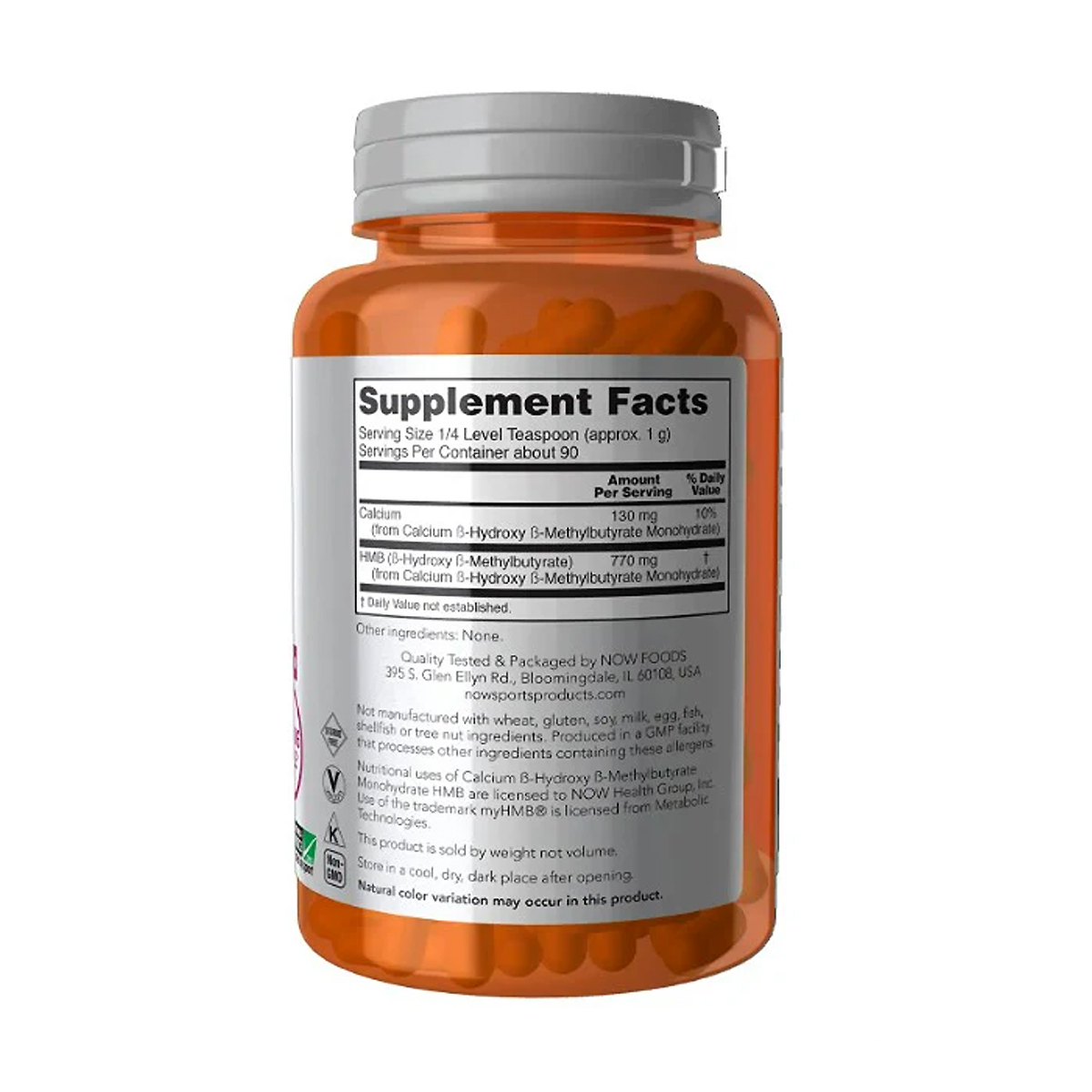
Here the difference between HMB and HMB-Ca matters. The panel gives 770 mg of HMB "from" calcium HMB monohydrate, plus 130 mg of calcium, which is 10% of the Daily Value per the label. The ISSN's trial tables list doses of the calcium salt by weight (for example, "3 g HMB-Ca"), so that figure means roughly 3 g of powder. Because this tub is a pure powder, three servings a day is about 3 g of HMB-Ca, matching that trial dose, and delivers about 2.3 g of HMB and 390 mg of calcium. (If you take calcium separately, our calcium article covers the NIH upper limit.)
| This product | Typical trial dose | NIH RDA / AI | Tolerable Upper Limit | |
|---|---|---|---|---|
| HMB | 770 mg per ~1 g serving; 1.54–2.31 g at the listing's 2–3 servings a day | 38 mg/kg/day, about 3 g/day HMB-Ca (ISSN, 2025) | None: not an essential nutrient | None established; studied up to 6 g/day for 8 weeks and 1.5–3 g/day for a year |
| Calcium (from the HMB salt) | 130 mg per serving (10% DV); 390 mg at 3 servings | Not reported separately | Not restated here; see label %DV | Not approached at these amounts |
A note on the store listing: the description says the product is "trusted by sport professionals," supports "faster recovery from strenuous exercise" and maintains "muscle strength and mass." Those are manufacturer claims. As the tables above show, the pooled evidence supports a marker-level recovery effect, a mixed picture in trained athletes and a small or null effect when HMB is added to exercise in older adults. The listing's customer testimonials are anecdotes, not evidence.
Who Might Consider It, and Who Should Skip It
Who this is for: adults who cannot currently do structured resistance training, such as during bed rest or recovery from illness, and have raised HMB with a clinician; and adults curious about a low-risk experiment who understand the expected effect is small and unproven.
Who should skip it: most people who already lift regularly, since the pooled athlete data show no effect; anyone over 50 who is able to follow a resistance-training program, where the 2026 review found no added benefit; anyone pregnant or breastfeeding without medical advice; and anyone who would be spending money instead of exercising or eating enough protein.
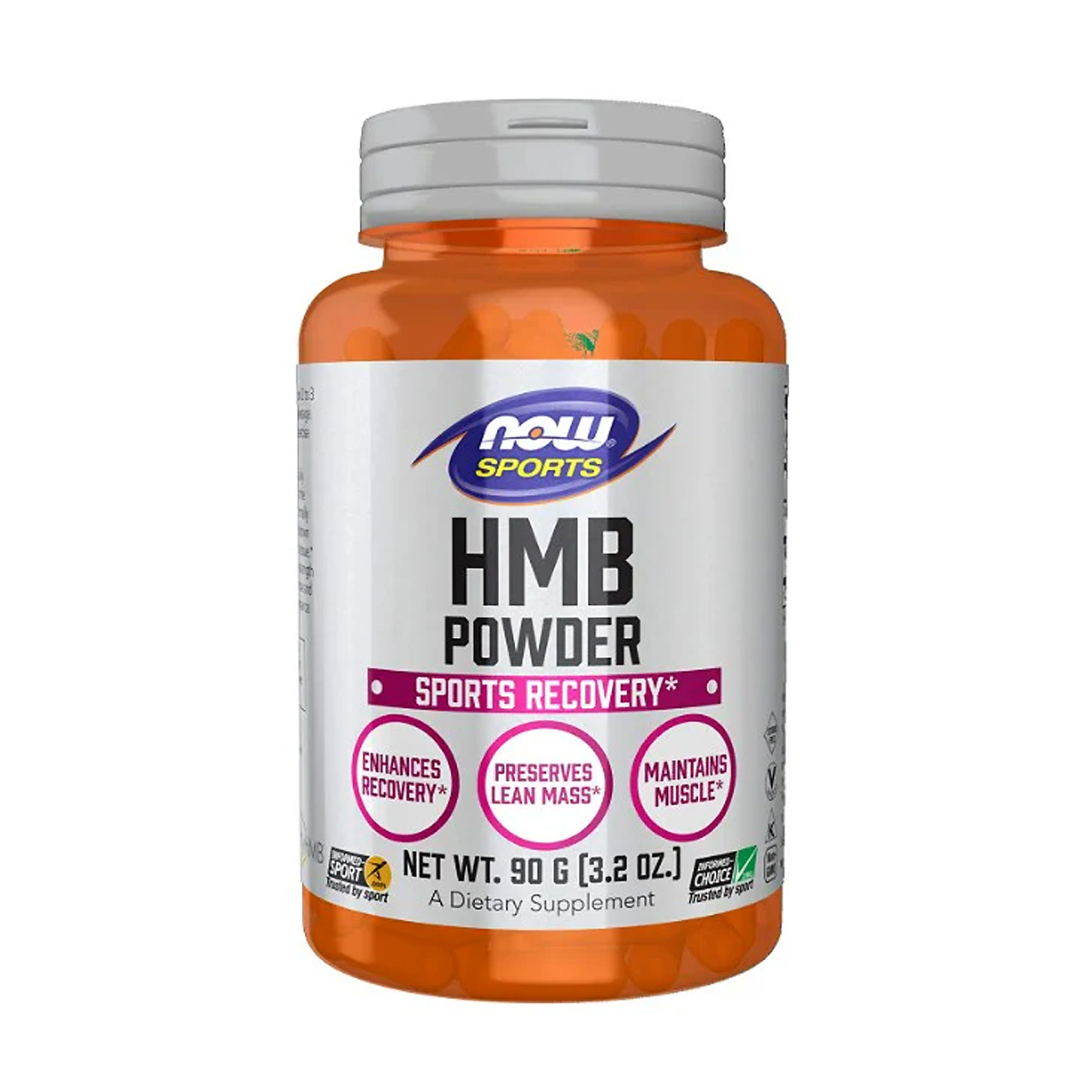
NOW Sports HMB Powder — 3.2 oz (90 g)
Single-ingredient calcium HMB powder, 770 mg HMB and 130 mg calcium per roughly 1 g serving, about 90 servings. As covered above, the evidence for muscle gain is weak; the recovery evidence is at the blood-marker level. Also browse our protein powders.
View Product DetailsFrequently Asked Questions
What does HMB do for muscle?
HMB is a leucine metabolite that appears to increase muscle protein synthesis and reduce breakdown. In trials the practical effect is small: a 2026 meta-analysis of 13 trials found no added muscle mass benefit in adults over 50 doing resistance training, and a 2018 review found none in trained athletes.
How much HMB should I take per day?
The ISSN's 2025 position stand uses 38 mg per kg of body weight per day, roughly 3 g of calcium HMB for an 80 kg adult. This tub's store directions suggest a roughly 1 g serving two to three times daily, about 1.5 to 2.3 g of HMB.
Is HMB safe to take long term?
The ISSN position stand says long-term use of 1.5 to 3 g per day appears safe for at least one year, and up to 6 g per day for 8 weeks caused no adverse effects. Its authors disclose ties to HMB companies, and pregnancy and breastfeeding were not covered.
Does HMB help recovery after exercise?
It lowers blood markers of muscle damage. A 2018 meta-analysis found creatine kinase fell 60.71 U/L across 10 studies. Those are indirect markers, though, so the result does not prove less soreness or faster training recovery.
Does HMB work for older adults?
Evidence is mixed. A 2015 review of seven trials in adults 65 and older found greater muscle mass gain, but reviews in 2019, 2025 and 2026 found little or no added benefit when HMB was combined with exercise. The 2026 review did not recommend it as a routine add-on.
What is the difference between HMB and leucine?
HMB is a metabolite of leucine, meaning the body produces it from that amino acid. Leucine is a branched-chain amino acid found in protein. Supplements such as this one contain HMB itself, in the form of calcium HMB monohydrate, rather than leucine.
Why does this HMB powder contain calcium?
The HMB is supplied as its calcium salt, calcium HMB monohydrate. The label lists 130 mg of calcium per serving, 10% of the Daily Value, all from that salt. At three servings a day that is 390 mg of calcium.
Who should not take HMB?
Most people who train regularly will likely see no benefit. Anyone pregnant or breastfeeding, or taking medication, should ask a clinician first, because the sources reviewed here do not address those situations. Adults able to do resistance training are better served by training itself.
Sources
- Rathmacher JA, et al. International Society of Sports Nutrition position stand: beta-hydroxy-beta-methylbutyrate (HMB). J Int Soc Sports Nutr, 2025;22(1):2434734. Accessed 29 September 2026. doi.org/10.1080/15502783.2024.2434734
- Sanchez-Martinez J, et al. Effects of beta-hydroxy-beta-methylbutyrate supplementation on strength and body composition in trained and competitive athletes: a meta-analysis of randomized controlled trials. J Sci Med Sport, 2018;21(7):727-735. Accessed 29 September 2026. doi.org/10.1016/j.jsams.2017.11.003
- Rahimi MH, et al. The effects of beta-hydroxy-beta-methylbutyrate supplementation on recovery following exercise-induced muscle damage: a systematic review and meta-analysis. J Am Coll Nutr, 2018;37(7):640-649. Accessed 29 September 2026. doi.org/10.1080/07315724.2018.1451789
- Wu H, et al. Effect of beta-hydroxy-beta-methylbutyrate supplementation on muscle loss in older adults: a systematic review and meta-analysis. Arch Gerontol Geriatr, 2015;61(2):168-175. Accessed 29 September 2026. doi.org/10.1016/j.archger.2015.06.020
- Courel-Ibáñez J, et al. Health benefits of beta-hydroxy-beta-methylbutyrate (HMB) supplementation in addition to physical exercise in older adults: a systematic review with meta-analysis. Nutrients, 2019;11(9):2082. Accessed 29 September 2026. doi.org/10.3390/nu11092082
- García-Alonso A, et al. The role of HMB supplementation in enhancing the effects of resistance training in older adults. Nutrients, 2025;17(22):3624. Accessed 29 September 2026. doi.org/10.3390/nu17223624
- Wang G, et al. Efficacy of HMB supplementation as an adjunct to resistance training in older adults: a comprehensive meta-analysis. Age and Ageing, 2026;55(3):afag073. Accessed 29 September 2026. doi.org/10.1093/ageing/afag073
- National Institute on Aging. "How can strength training build healthier bodies as we age?" Published 30 June 2022. Accessed 30 September 2026. nia.nih.gov
This article is for educational purposes only and is not medical advice. It is not intended to diagnose, treat, cure, or prevent any disease. These statements have not been evaluated by the Food and Drug Administration. Talk to your doctor before starting any new supplement, especially if you are pregnant, breastfeeding, over 65, take any medication, or have a medical condition.