
The average American already eats about 108 mcg of selenium a day from food, nearly double the 55 mcg adult RDA, according to the NIH Office of Dietary Supplements (updated 4 September 2025), yet this capsule adds another 200 mcg. Selenium is an essential trace mineral that the body builds into about 25 selenoproteins, enzymes involved in thyroid hormone metabolism, DNA synthesis and protection from oxidative damage. The stake is a trial result worth knowing before you buy: in the 35,533-man SELECT trial, 200 mcg a day did not prevent prostate cancer.
Key Takeaways
- NHANES data (2017–March 2020) put average selenium intake from food and drinks at 108 mcg a day, against an adult RDA of 55 mcg (NIH ODS, updated 2025).
- SELECT randomized 35,533 men to 200 mcg of selenium a day and found no prostate cancer prevention: hazard ratio 1.04 (99% CI 0.87–1.24) (JAMA, 2009).
- A 2018 Cochrane review of 10 trials and 27,232 participants found no beneficial effect of selenium supplements on cancer risk, and rated that evidence high certainty.
- For Hashimoto’s thyroiditis, a pooled review of 16 trials (1,494 adults) found lower thyroid antibodies, but a nine-trial review found no change in TSH or quality of life (NIH ODS, 2025).
- The adult Tolerable Upper Intake Level is 400 mcg; the European Food Safety Authority set 255 mcg in 2023. A 2008 liquid-supplement mix-up poisoned 201 people in 10 US states.
In this article:
- What Selenium Does and Who Actually Lacks It
- Cancer: Two Trials, Two Different Answers
- Heart and Brain: What the Trials Found
- Thyroid: The Strongest Case, With Caveats
- Too Much: Limits, Symptoms and a Poisoning Outbreak
- Inside Life Extension Super Selenium Complex
- Who Might Consider It, and Who Should Skip It
- Frequently Asked Questions
What Selenium Does and Who Actually Lacks It
Selenium is a trace element the body needs only in small amounts, from food. MedlinePlus (review date 21 January 2025) says lack of selenium is rare in the United States and that taking a supplement on top of food is not currently recommended for the conditions it may be linked to.
The NIH Office of Dietary Supplements fact sheet (updated 4 September 2025) says selenium deficiency is very rare in the United States and Canada. Where it occurs it is dramatic: Keshan disease, a heart-muscle disease, appeared in parts of China where adults averaged no more than 10 mcg a day. The fact sheet names people in selenium-poor regions, on kidney dialysis, or living with HIV as at risk of inadequate intake.
| Measure | Amount | Source |
|---|---|---|
| RDA, men and women 19+ | 55 mcg a day (60 mcg in pregnancy, 70 mcg while breastfeeding) | NIH ODS, updated 2025 |
| Daily Value on labels | 55 mcg | NIH ODS, updated 2025 |
| Average US intake, food and drinks | 108 mcg a day (men 132, women 94) | NHANES 2017–March 2020, via NIH ODS |
| Tolerable Upper Intake Level | 400 mcg a day, from food and supplements | NIH ODS, updated 2025 |
| European upper limit | 255 mcg a day | EFSA 2023, via NIH ODS |
Foods can overshoot easily. The same fact sheet lists Brazil nuts at 544 mcg per ounce (6 to 8 nuts) and 3 ounces of cooked yellowfin tuna at 92 mcg. Because food already covers the RDA for most people, the question for any capsule is not “is selenium important?” (it is) but “who is short of it?”
Cancer: Two Trials, Two Different Answers
Selenium’s reputation as a cancer-protective mineral comes largely from one trial and then a reversal. The Nutritional Prevention of Cancer trial (begun 1983) gave 1,312 US adults with a history of nonmelanoma skin cancer 200 mcg a day as selenium yeast or placebo for a mean of 4.5 years. It did not reduce skin cancer recurrence, but a secondary analysis found 49% fewer prostate cancers in men taking selenium. The effect was strongest in men whose blood selenium was low at the start (below 10.6 mcg/dL) and absent above 12.3 mcg/dL (NIH ODS, 2025).
SELECT was built to test that hypothesis properly. Reported in JAMA in 2009 (Lippman et al., full text on PMC), it randomized 35,533 men aged 50 or 55 and over to selenium (200 mcg a day as L-selenomethionine), vitamin E, both, or placebo. At a median follow-up of 5.46 years, selenium alone gave a prostate cancer hazard ratio of 1.04 (99% CI 0.87–1.24) against placebo, so no benefit. The vitamin E half of this trial is covered in our vitamin E and cancer prevention article.
“Well-designed and well-conducted RCTs have shown no beneficial effect of selenium supplements in reducing cancer risk (high certainty of evidence).”
— Cochrane Database of Systematic Reviews, “Selenium for preventing cancer” (2018), abstractThat is the 2018 Cochrane conclusion, covering 83 studies (PMC copy). For low-risk-of-bias trials, the risk ratio for any cancer was 1.01 (95% CI 0.93–1.10; 3 studies, 19,475 participants). The review also reported more alopecia and dermatitis in SELECT, more high-grade prostate cancer in men with the highest background selenium, a slightly increased type 2 diabetes risk, and a suggested increase in melanoma risk in low-risk-of-bias trials. Observational studies linked higher selenium status to lower cancer incidence (odds ratio 0.72), but with very low certainty and no dose-response pattern.
The FDA agrees: per the NIH fact sheet, it said in 2009 that it was “highly unlikely” that selenium supplements reduce prostate cancer risk.
Heart and Brain: What the Trials Found
For cardiovascular disease, SELECT found no effect of 200 mcg a day on events in 17,488 well-nourished men over 7 to 12 years, and a Cochrane review of 12 trials (19,715 adults) found no reduction in fatal or nonfatal events (NIH ODS, 2025).
“Overall, clinical trial evidence does not support the use of selenium supplementation for reducing the risk of CVD, particularly in healthy people who obtain sufficient selenium from food.”
— NIH Office of Dietary Supplements, Selenium fact sheet for health professionals (updated 2025)One nuance: a 43-trial meta-analysis found cardiovascular mortality 23% lower with antioxidant formulas that contained selenium than with those that did not, a whole-formula effect that cannot be credited to selenium alone (NIH ODS, 2025). For brain health, PREADVISE gave 7,540 healthy men aged 60 and older 200 mcg a day (with or without vitamin E) for 5.4 years and found no difference in new dementia (NIH ODS, 2025). NIH concludes the evidence does not support supplements for cognitive decline in people who are replete.
| Outcome | Evidence | Finding |
|---|---|---|
| Cancer, overall | Cochrane 2018, 10 trials, 27,232 people | No benefit; high certainty |
| Prostate cancer | SELECT 2009, 35,533 men | HR 1.04 (99% CI 0.87–1.24) |
| Cardiovascular disease | SELECT subset, 17,488 men; Cochrane, 19,715 adults | No reduction in events |
| Alzheimer’s / dementia | PREADVISE, 7,540 men, 5.4 years | No difference from placebo |
| Thyroid antibodies (Hashimoto’s) | 16 trials, 1,494 adults | Lower TPOAb; no effect on TSH in a 9-trial review |
Thyroid: The Strongest Case, With Caveats
The thyroid holds more selenium than any other organ, and selenoproteins convert the hormone T4 to its active form T3 and protect the gland from the hydrogen peroxide made during hormone synthesis (NIH ODS, 2025). This is where supplements have their best argument. A meta-analysis of 16 trials in 1,494 adults with Hashimoto’s thyroiditis, using 80 to 200 mcg a day for 3 to 12 months, found lower thyroid peroxidase antibodies (TPOAb) in people taking levothyroxine, and selenomethionine worked better than sodium selenite, possibly because it is absorbed better. Where baseline status was reported, participants were deficient to marginal (3.7 to 8.5 mcg/dL).
But a lower antibody number is not the same as feeling better. A separate review of nine controlled trials (679 participants, 80 to 200 mcg a day) found no effect on TSH, thyroid ultrasound findings or quality of life, and its authors concluded the evidence does not support selenium for the condition. In pregnancy the results are mixed: 200 mcg of selenomethionine cut postpartum thyroid disorders from 48.6% to 28.6% in 151 women with positive TPOAb, but a trial using 60 mcg of selenium yeast found no antibody reduction, and the American Thyroid Association made a weak recommendation against selenium in this group in 2017 (NIH ODS, 2025).
Iodine, the other thyroid mineral, has its own ceiling; see our iodine upper-limit guide.
Too Much: Limits, Symptoms and a Poisoning Outbreak
The NIH fact sheet (updated 2025) says chronic high intake causes selenosis, most commonly hair loss and brittle or lost nails, plus a garlic odor on the breath, a metallic taste, rash, nausea, diarrhea and fatigue. The 400 mcg adult upper limit was set from hair and nail brittleness and loss.
Doses that have gone wrong in real life. In 2008, 201 people in 10 states were poisoned by a liquid supplement containing 200 times the labeled selenium. The CDC-led investigation (MacFarquhar et al., Archives of Internal Medicine, 2010) put the median dose at 41,749 mcg a day. Symptoms included diarrhea (78%), fatigue (75%) and hair loss (72%); 52% still had nail changes at 90 days or more.
The FDA says supplement makers, not the agency, are responsible for evaluating safety and labeling before marketing (FDA). The more common risk is the slow one: stacking a 200 mcg capsule on a diet that already supplies about 108 mcg. By our arithmetic that is about 308 mcg, 77% of the US limit and above Europe’s 255 mcg.
The fact sheet names one medication interaction: cisplatin, a chemotherapy drug, can lower selenium levels in the body, and a Cochrane review found the evidence that selenium eases chemotherapy side effects insufficient (NIH ODS, 2025). Anyone receiving chemotherapy should ask their oncologist before taking selenium.
Inside Life Extension Super Selenium Complex
The product is Life Extension Super Selenium Complex 200 mcg & Vitamin E, 100 vegetarian capsules. Its Supplement Facts panel lists a serving of one capsule providing vitamin E 20.1 mg (as D-alpha tocopheryl succinate; 134% Daily Value) and selenium 200 mcg (364% Daily Value). The back label breaks the selenium down into three forms, each stated per capsule: L-selenomethionine 50 mcg, sodium selenite 50 mcg and Se-methyl L-selenocysteine 100 mcg. Other ingredients are microcrystalline cellulose, vegetable cellulose capsule, dicalcium phosphate, stearic acid and silica.
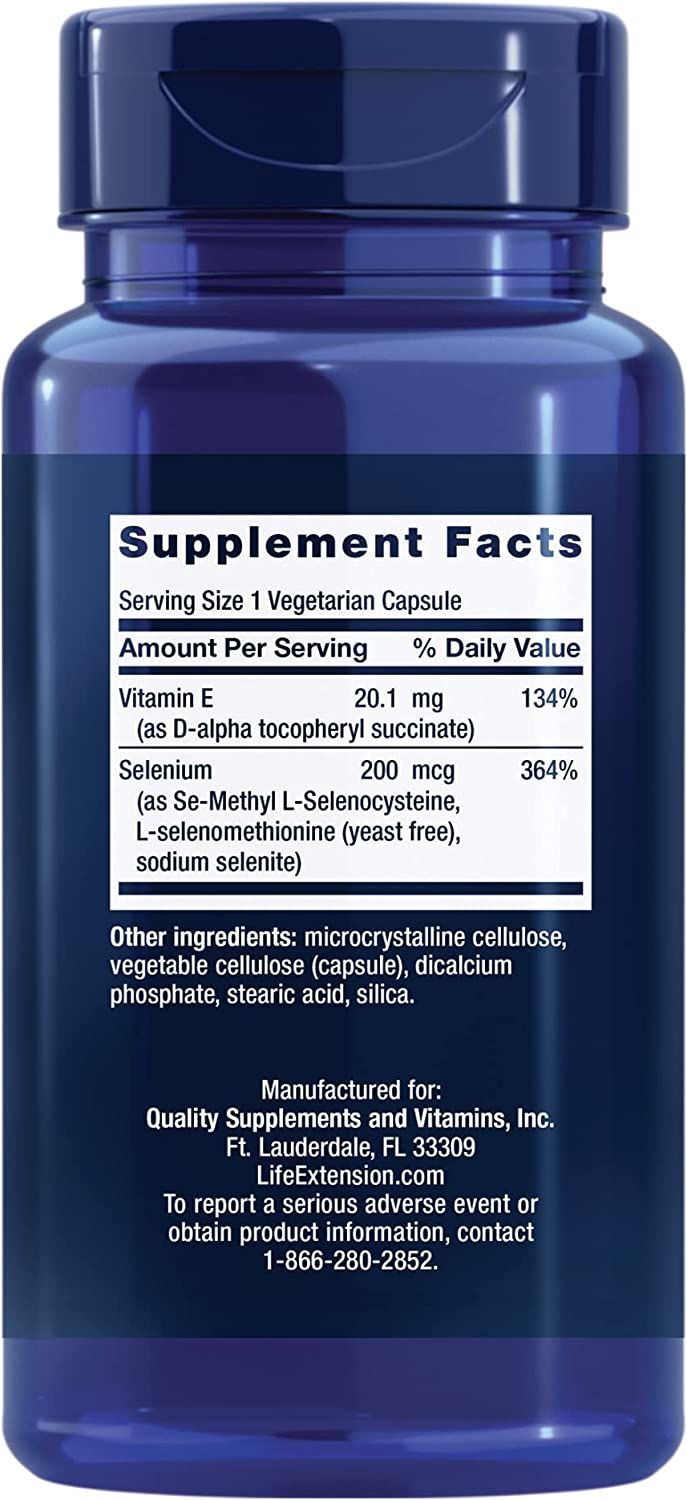
The label directs: “Take one (1) capsule daily with food, or as recommended by your healthcare practitioner,” and warns pregnant or lactating readers and anyone treated for a medical condition to consult a physician.
| This product | Typical shelf dose | NIH RDA | Tolerable Upper Limit | |
|---|---|---|---|---|
| Selenium, adults, per day | 200 mcg (one capsule, per label) | Stand-alone 100–400 mcg; with vitamin E 50–200 mcg (NIH ODS) | 55 mcg | 400 mcg (NIH); 255 mcg (EFSA 2023) |
| Selenium plus average food | About 308 mcg (200 + 108) | Not applicable | 55 mcg | 400 mcg (NIH); 255 mcg (EFSA) |
| Vitamin E (as D-alpha tocopheryl succinate) | 20.1 mg | Not compared in the sources we read | Not compared in the sources we read (label prints 134% Daily Value) | Not checked for this article |
At 200 mcg, one capsule is 3.6 times the RDA and half the US upper limit. That dose matches the trials above (SELECT and the Nutritional Prevention of Cancer trial both used 200 mcg a day), but those trials tested selenomethionine or selenium yeast, not this three-form mix. The NIH fact sheet does not describe trials of Se-methyl L-selenocysteine, the form supplying half this capsule’s selenium, so we cannot say how it compares.
Listing versus evidence: the store description says the product “increases longevity,” “promotes heart health, brain health and healthy cell division,” and notes that “some of the world’s longest-living people” have high selenium. Those are manufacturer statements: NIH finds trials do not support heart or cognitive protection in people who get enough from food, and we found no trial evidence for longevity. The vitamin E here (20.1 mg, by our arithmetic about 30 IU) is far below SELECT’s 400 IU.
Who Might Consider It, and Who Should Skip It
Who this is for: adults with a documented low selenium status or a clinician’s recommendation, such as people on long-term dialysis or living with HIV, those eating strictly plant-based diets in low-selenium regions, and people with Hashimoto’s whose doctor has suggested a trial of selenium alongside standard treatment.
Who should skip it: most people eating a normal US diet, whose food already provides about twice the RDA; anyone who eats Brazil nuts regularly or takes a multivitamin with selenium; men over 55, given the SELECT sub-study advice; people at risk of type 2 diabetes; anyone receiving cisplatin or other chemotherapy without their oncologist’s advice; and anyone pregnant or breastfeeding without a doctor’s advice.
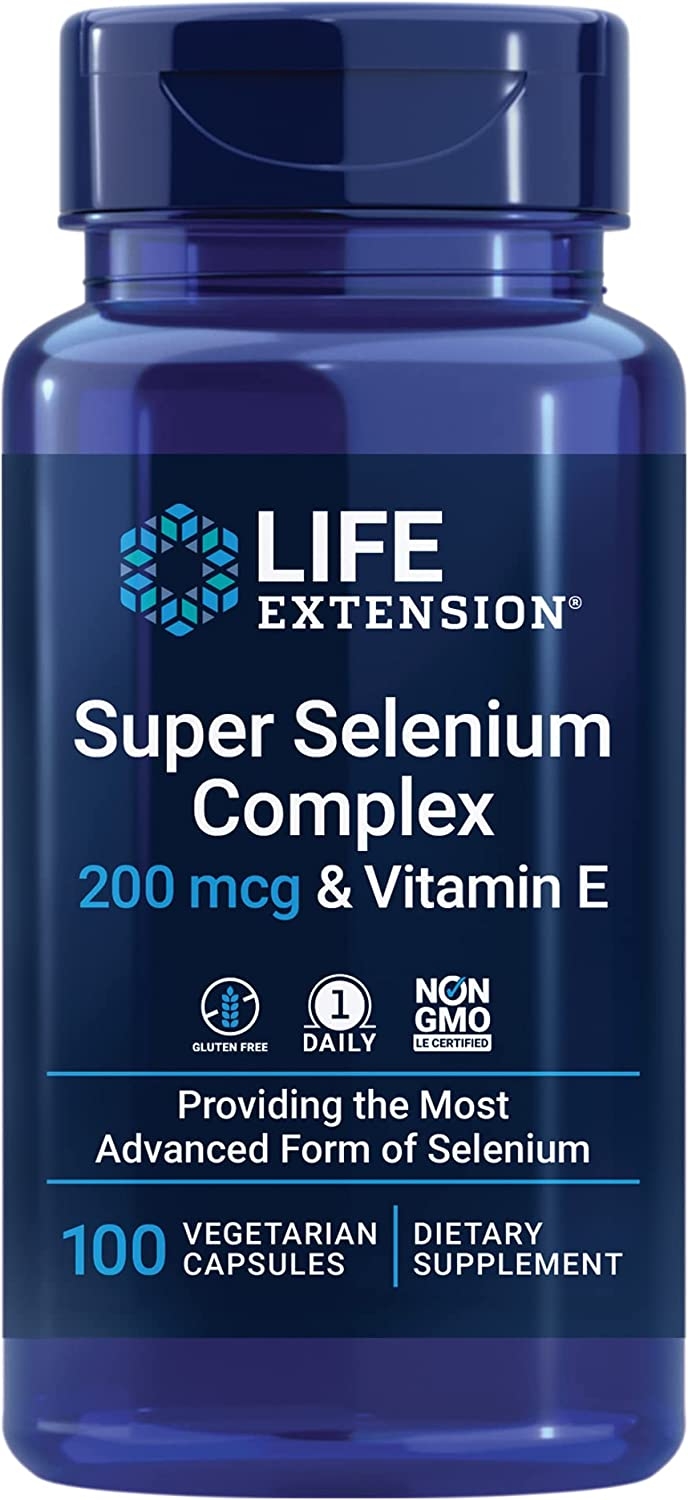
Life Extension Super Selenium Complex 200 mcg, 100 Vegetarian Capsules
200 mcg of selenium from three forms plus 20.1 mg of vitamin E per capsule, 100 capsules, with the label directing one capsule daily with food. Browse more in our supplements range.
View Product DetailsFrequently Asked Questions
What is selenium good for?
Selenium is an essential mineral that the body builds into about 25 selenoproteins, which support thyroid hormone metabolism, DNA synthesis and protection from oxidative damage. Most Americans get enough from food, so benefits from extra supplements are unproven in healthy people.
How much selenium should you take a day?
The adult RDA is 55 mcg a day, or 60 mcg in pregnancy and 70 mcg while breastfeeding. Average US intake from food alone is about 108 mcg. The upper limit is 400 mcg from food and supplements combined (NIH ODS, 2025).
Is 200 mcg of selenium too much?
It is below the 400 mcg US upper limit but 3.6 times the RDA. With average food intake of 108 mcg it totals about 308 mcg, which exceeds Europe’s 255 mcg limit. Many people do not need it, so ask a clinician first.
Does selenium prevent cancer?
No trial evidence shows that it does. SELECT (35,533 men) found no prostate cancer prevention, and the 2018 Cochrane review rated the no-benefit finding for supplements high certainty. Higher blood selenium is linked to less cancer in observational studies, but that evidence is very low certainty.
Does selenium help an underactive thyroid?
Trials in Hashimoto’s thyroiditis found selenium lowers thyroid antibodies, but a nine-trial review found no effect on TSH or quality of life. NIH says more research is needed.
What are the signs of too much selenium?
The earliest signs are a garlic odor on the breath and a metallic taste. The most common signs of selenosis are hair loss and brittle or lost nails, then rash, nausea, diarrhea, fatigue and irritability. See a clinician if you notice them.
Which foods are highest in selenium?
Brazil nuts lead, at 544 mcg per ounce in USDA data cited by NIH, though values vary widely, and a single nut can hold 68 to 91 mcg. Cooked yellowfin tuna (92 mcg per 3 ounces), sardines, shrimp, pork, beef and eggs follow.
Should men over 55 take selenium supplements?
NIH reports that a SELECT sub-study found more high-grade prostate cancer in men with higher baseline selenium, and its authors recommended men over 55 avoid doses above recommended dietary intakes. Discuss any selenium supplement with your doctor first.
Sources
- NIH Office of Dietary Supplements. “Selenium: Fact Sheet for Health Professionals.” Updated 4 September 2025. Accessed 9 October 2026 (archived copy, because the live page blocks automated access). web.archive.org snapshot of ods.od.nih.gov
- MedlinePlus Medical Encyclopedia. “Selenium in diet.” Review date 21 January 2025. Accessed 9 October 2026. medlineplus.gov
- Lippman SM, Klein EA, Goodman PJ, et al. “Effect of selenium and vitamin E on risk of prostate cancer and other cancers: the Selenium and Vitamin E Cancer Prevention Trial (SELECT).” JAMA, 7 January 2009. Accessed 9 October 2026. PMC3682779
- Vinceti M, Filippini T, Del Giovane C, et al. “Selenium for preventing cancer.” Cochrane Database of Systematic Reviews, 2018. Accessed 9 October 2026. PMC6491296
- MacFarquhar JK, Broussard DL, Melstrom P, et al. “Acute selenium toxicity associated with a dietary supplement.” Archives of Internal Medicine, 8 February 2010. Accessed 9 October 2026. PMC3225252
- U.S. Food and Drug Administration. “Dietary Supplements.” Current page. Accessed 9 October 2026. fda.gov
This article is for educational purposes only and is not medical advice. It is not intended to diagnose, treat, cure, or prevent any disease. These statements have not been evaluated by the Food and Drug Administration. Talk to your doctor before starting any new supplement, especially if you have a thyroid condition, are pregnant or breastfeeding, or take any prescription medication.