
Carnosine is sold as an "anti-aging peptide" that blocks glycation, yet a 2018 systematic review of the anti-glycation research found 36 studies, of which only two were in humans: 19 were test-tube experiments and 15 were animal studies. Carnosine (beta-alanyl-L-histidine) is a dipeptide the body makes naturally from the amino acids beta-alanine and histidine. The human trials that do exist are small, mixed, and mostly run in people with diabetes, not in healthy adults hoping to age well.
Key Takeaways
- A 2018 systematic review of carnosine and advanced glycation end products (AGEs) found 36 studies: 19 in vitro, 15 animal, 2 human, and the authors noted there were "few human studies" (Amino Acids, 2018).
- Two human AGE trials disagree: a 54-patient type 2 diabetes trial (1,000 mg/day, 12 weeks) lowered AGE markers, while a 36-child trial (500 mg/day, 2 months) found no change in AGEs.
- In a 2026 review of 13 studies, the strength of evidence that carnosine combined with anserine or antioxidants slows cognitive decline was rated low, and its memory-scale gain rested on three trials from a single research team (Nutrients, 2026).
- In a 2025 dose-escalation study of 16 healthy volunteers, oral carnosine was well tolerated up to 10 g, but little circulating carnosine remained after 4 hours (Nutrients, 2025).
- This capsule holds 500 mg of L-carnosine; the label directs 1 capsule once or twice daily, or 500–1,000 mg/day, half or less of the 2 g/day used in one 2024 randomized trial.
In this article:
- What Is Carnosine, and Where Did "Anti-Aging" Come From?
- Does Oral Carnosine Reach Your Blood?
- The Glycation Claim: 36 Studies, Two in Humans
- Cognition, Inflammation and Muscle: What Humans Show
- Safety and Dose
- Inside Life Extension Carnosine 500 mg
- Who Might Consider It, and Who Should Skip It
- Frequently Asked Questions
What Is Carnosine, and Where Did "Anti-Aging" Come From?
Carnosine is a naturally occurring dipeptide, meaning two amino acids joined together. A 2021 systematic review in Biomedicines (Caruso and colleagues) notes that carnosine "was proposed as an anti-aging agent more than 20 years ago," that it is found at low millimolar concentrations in the brain, and that animal studies have shown antioxidant, anti-inflammatory and anti-aggregation activity. Note where that evidence sits: animal models. The step from a rodent brain to a capsule in a healthy adult is the one that needs human trials, and the rest of this article is about what those trials show.
The bottle in our catalogue calls carnosine an "Anti-Aging Peptide" on the front label, and the store listing says it inhibits formation of AGEs, protects muscle cells from oxidative stress and "helps the heart muscle contract more efficiently." Those are manufacturer statements. As you will see, the sources reviewed for this article address the first, partially address the second, and do not address the third.
Does Oral Carnosine Reach Your Blood?
This is the question a capsule has to answer first, and the literature gives two answers that sound contradictory. A 2021 study in the International Journal of Molecular Sciences (Oppermann and colleagues) states that "after oral ingestion, the dipeptide is not detectable in human serum because of rapid degradation by serum carnosinase," an enzyme found in human blood. The same paper adds that intact carnosine is excreted in urine for up to five hours after intake, and its experiments suggest red blood cells may take some carnosine up and shield it from the enzyme.
A 2025 Nutrients study (Ali and colleagues) measured it directly in 16 healthy volunteers and found something more nuanced:
| Measure | Finding |
|---|---|
| Tolerability, single dose | Safe and well tolerated up to 10 g |
| At 15 g | 77% had side effects: headache (43.5%), nausea (21.7%), paraesthesia (21.7%) |
| Plasma timing | Peak within the first hour; little circulating carnosine beyond 4 hours |
| Brain (5 volunteers, MRI spectroscopy) | Rose at 1 hour, back to baseline by 5 hours |
| Long-term (4 volunteers) | 5 g twice daily for 4 weeks: no adverse events |
So carnosine does appear in plasma after a dose, but briefly, and the brain signal was gone within hours. Those doses were also far larger than a 500 mg capsule. Neither study shows that a lasting change in tissue levels follows from ordinary supplement doses, which is what an "anti-aging" claim would need.
The Glycation Claim: 36 Studies, Two in Humans
Advanced glycation end products form when sugars bind to proteins, fats or DNA without an enzyme guiding the reaction. The 2018 systematic review by Ghodsi and Kheirouri, published in Amino Acids, searched everything up to April 2018 and found that all but two of the 36 studies suggested carnosine can prevent AGE formation. A finding that holds up in a dish is not the same as a finding that holds up in a person, and the authors said so:
"There were few human studies. The mechanism by which carnosine prevents the formation of AGEs needs further investigation."
— Ghodsi & Kheirouri, Amino Acids, 2018 (systematic review of 36 studies)Two randomized trials have since put carnosine into people, with opposite results:
| Trial | Participants and dose | Result |
|---|---|---|
| Houjeghani et al., Nutrition Research, 2018 | 54 adults with type 2 diabetes; two 500 mg capsules daily; 12 weeks | Versus placebo: carboxymethyl lysine (an AGE) −91.8 ng/mL, fasting glucose −13.1 mg/dL, HbA1c −0.6%, triglycerides −29.8 mg/dL |
| Ghodsi et al., Annals of Clinical Biochemistry, 2019 | 36 children with autism; 500 mg daily; 2 months | "Did not significantly alter" plasma AGEs or lipoxidation precursors |
Neither trial tested healthy older adults, the audience for an anti-aging capsule. The positive one enrolled people with type 2 diabetes, a different population from healthy adults, so it cannot be assumed to apply to someone with normal blood sugar. A 2025 meta-analysis in BMC Endocrine Disorders (8 trials, 377 people with prediabetes or type 2 diabetes) found carnosine or beta-alanine lowered fasting glucose (SMD −0.53, 95% CI −0.75 to −0.31) and HbA1c (SMD −0.36, 95% CI −0.59 to −0.12), while LDL and HDL cholesterol did not change significantly. That meta-analysis pooled carnosine and beta-alanine, so it is not a clean read on carnosine alone.
Cleveland Clinic's expert on how many anti-aging products a person actually needs.
Cognition, Inflammation and Muscle: What Humans Show
Beyond glycation, three outcomes get the most attention. Each has a human answer, and each is more cautious than the marketing:
| Outcome | Evidence | Verdict in the sources |
|---|---|---|
| Cognition | 2026 review, 13 studies (12 RCTs): five RCTs of L-carnosine versus placebo found no significant differences in most cognitive measures; three RCTs from a single team found gains on one memory scale (pooled change 1.70, 95% CI 0.19 to 3.2) using anserine/carnosine | "Low strength of evidence"; more high-quality RCTs needed |
| Inflammation and oxidative stress | 2024 meta-analysis, 9 trials, 350 people, carnosine and related dipeptides: CRP −0.97 mg/L, TNF-α −3.60 pg/mL, MDA −0.34 µmol/L; no effect on IL-6, adiponectin, GSH, SOD or TAC | Some markers improved, others did not. A 2024 RCT (2 g/day, 14 weeks, 49 adults with prediabetes or type 2 diabetes) found no change in inflammatory markers |
| Muscle and bone | Secondary analysis of that same 2024 RCT: 2 g/day for 14 weeks | No effect on grip strength, lean mass or bone density |
The cognition row deserves a closer look because it is the most-cited anti-aging hope. The 2021 review found five studies in which carnosine/anserine at 1 g/day for 12 weeks improved global cognitive function, but it also concluded that larger, long-term trials were needed. The 2026 update rated the evidence low; its favorable pooled results involved carnosine combined with anserine or antioxidants, and the memory-scale result rested on three trials from one research team. If memory is your concern, the ginkgo biloba article shows what a large NIH-funded trial found for another supplement sold on the same promise.
On the muscle row, the store listing says carnosine protects muscle cells from oxidative stress during and after exercise. The one randomized trial in the reviewed sources that measured muscle strength and lean mass, at 2 g/day, found no effect in adults with prediabetes or type 2 diabetes. That does not settle the question for athletes, but it does not support the claim either. The same applies to antioxidants generally: our vitamin E article covers a very large NIH trial of another antioxidant supplement.
Safety and Dose
Within the studies reviewed, the safety signal is reassuring at supplement-scale doses: the 2025 healthy-volunteer study found carnosine safe and well tolerated up to a single 10 g dose, and no adverse events with 5 g twice daily for four weeks in four volunteers. That last group is tiny, and side effects appeared at 15 g. Those were supervised research doses, not a guide to self-dosing: this product's label warns "Do not exceed recommended dose," which is one capsule once or twice daily. The sources reviewed here do not cover pregnancy, breastfeeding, children outside the autism trial, or interactions with medicines, so the label's advice to consult a physician if pregnant, lactating or under treatment for a medical condition is the operative guidance.
Inside Life Extension Carnosine 500 mg
Life Extension Carnosine 500 mg is a 60-count bottle of vegetarian capsules. The Supplement Facts panel lists one capsule as the serving, containing 500 mg of L-carnosine with no established Daily Value. Other ingredients are vegetable cellulose (the capsule), microcrystalline cellulose, stearic acid and silica. The label directs one capsule once or twice daily, or as recommended by a healthcare practitioner, which makes the bottle a 30- to 60-day supply.
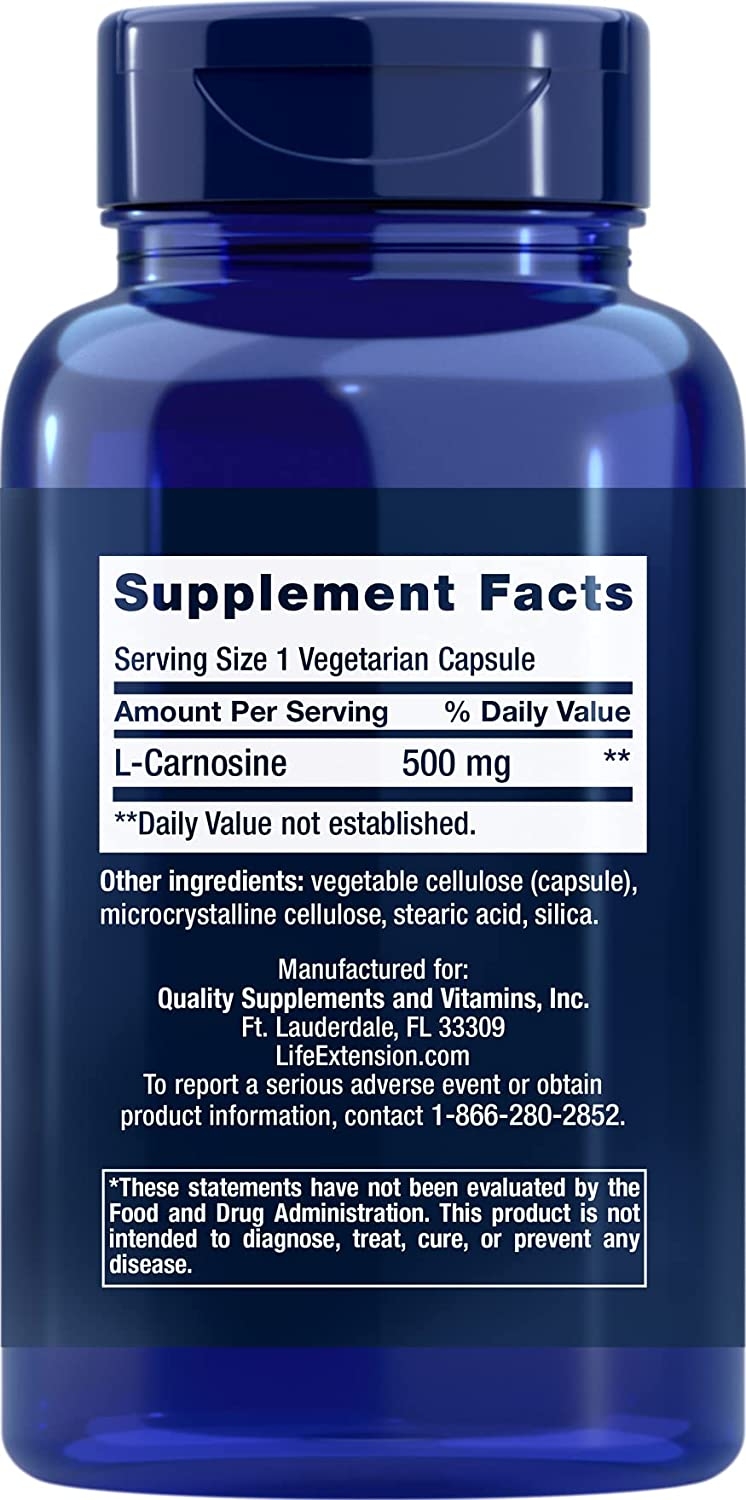
| This product | Typical trial dose | NIH RDA / AI | Tolerable Upper Limit | |
|---|---|---|---|---|
| L-carnosine | 500 mg per capsule; 500–1,000 mg/day at the label's 1–2 capsules | 500 mg/day (autism trial); 1,000 mg/day (diabetes trial); 2 g/day (2024 RCT); cognition studies: 1 g/day of an anserine/carnosine blend, mostly anserine | None: the body makes it and it is not an essential nutrient | None established; single doses to 10 g were well tolerated, 15 g was not |
At its maximum label dose, this product matches the 1 g/day used in the diabetes trial and is half the 2 g/day used in the 2024 randomized trial. It does not match the cognition studies: in the 2021 Biomedicines review, three gave 1 g/day of an anserine/carnosine blend at a 2:1 or 3:1 ratio (one used 750 mg anserine with 250 mg carnosine) and two gave 100–200 mg of carnosine alongside other ingredients. None gave 1 g of carnosine alone, and this capsule contains no anserine. It is a single, clearly declared ingredient at a dose inside the range that has been studied, and that is the most that can be said for it.
What the listing claims versus what the evidence supports: the store description says carnosine "inhibits formation of advanced glycation end products," "provides powerful antioxidant benefits," and "helps the heart muscle contract more efficiently," and that supplements are "a crucial component of your overall health regimen" because carnosine declines with age. Those are manufacturer statements. The human evidence on glycation is two small trials with opposite results, antioxidant markers are mixed, and we found nothing in the reviewed sources on heart-muscle contraction. We have not verified the claim that levels decline with age.
Who Might Consider It, and Who Should Skip It
Who this is for: healthy adults who have talked with a clinician and want to try a well-labeled, single-ingredient carnosine at a dose within the studied range, and who accept that nothing in the human data shows it slows aging.
Who should skip it: anyone pregnant or breastfeeding; anyone managing diabetes or taking medication who has not cleared it with their prescriber, since the strongest results are in blood-sugar markers; and, frankly, most people, who should start with what their own clinician recommends.
Life Extension Carnosine 500 mg — 60 Vegetarian Capsules
500 mg of L-carnosine per capsule, directed as 1 capsule once or twice daily. As covered above, the human evidence for anti-aging benefit is thin and mixed. Browse more in our specialty supplements.
View Product DetailsFrequently Asked Questions
What does carnosine do in the body?
Carnosine is a dipeptide of beta-alanine and histidine found naturally in tissues including the brain. Laboratory and animal studies show antioxidant, anti-inflammatory and anti-glycation activity. Human trials of supplements are few, small and mixed, so its benefits as a supplement remain unproven.
Does carnosine really slow aging?
No human trial has shown that. Carnosine was proposed as an anti-aging agent over 20 years ago, but a 2018 review found only two human studies among 36 on its anti-glycation effect, and a 2026 review rated the cognitive-decline evidence as low strength.
Does carnosine reduce glycation?
Possibly in some groups. A 54-patient trial in type 2 diabetes found lower AGE markers at 1,000 mg per day for 12 weeks, while a 36-child trial at 500 mg per day found no change. Neither tested healthy adults.
How much carnosine should I take?
No official dose exists. This label directs one 500 mg capsule once or twice daily and warns not to exceed that. Trials have used 500 mg, 1 g and 2 g per day. A 2025 study found single supervised doses up to 10 g well tolerated in healthy volunteers, but side effects appeared at 15 g.
Is carnosine safe?
In healthy volunteers, single doses up to 10 g were safe and well tolerated, and 5 g twice daily for four weeks caused no adverse events in four people. Data on pregnancy, breastfeeding and drug interactions were not found, so consult a physician first.
Can your body absorb oral carnosine?
Partly, and briefly. A 2025 study found carnosine peaks in plasma within the first hour and is mostly gone by four hours. Blood contains an enzyme, carnosinase, that breaks it down quickly, which is why some researchers question how much reaches tissues.
Is carnosine the same as beta-alanine?
No. Beta-alanine is one of the two amino acids carnosine is built from, the other being histidine. Some meta-analyses pool carnosine and beta-alanine, so read a study's design before assuming its result applies to a carnosine capsule alone.
Does carnosine help memory?
The evidence is weak. A 2026 review of 13 studies rated it low strength, noting that gains appeared mainly with carnosine combined with anserine or antioxidants, and that three trials came from one research team. More high-quality randomized trials are needed.
Sources
- Ghodsi R, Kheirouri S. Carnosine and advanced glycation end products: a systematic review. Amino Acids, 2018;50(9):1177-1186. Accessed 29 September 2026. doi.org/10.1007/s00726-018-2592-9
- Oppermann H, et al. Erythrocytes prevent degradation of carnosine by human serum carnosinase. Int J Mol Sci, 2021;22(23):12802. Accessed 29 September 2026. doi.org/10.3390/ijms222312802
- Ali AN, et al. Dietary carnosine supplementation in healthy human volunteers: a safety, tolerability, plasma and brain concentration study. Nutrients, 2025;17(13):2130. Accessed 29 September 2026. doi.org/10.3390/nu17132130
- Houjeghani S, et al. L-carnosine supplementation attenuated fasting glucose, triglycerides, advanced glycation end products, and tumor necrosis factor-alpha levels in patients with type 2 diabetes. Nutr Res, 2018;49:96-106. Accessed 29 September 2026. doi.org/10.1016/j.nutres.2017.11.003
- Ghodsi R, Kheirouri S, Nosrati R. Carnosine supplementation does not affect serum concentrations of advanced glycation and precursors of lipoxidation end products in autism: a randomized controlled clinical trial. Ann Clin Biochem, 2019;56(1):148-154. Accessed 29 September 2026. doi.org/10.1177/0004563218796860
- Hsiao YF, et al. The effects of carnosine on cognitive function and mental health: a systematic review and meta-analysis. Nutrients, 2026;18(9):1385. Accessed 29 September 2026. doi.org/10.3390/nu18091385
- Caruso G, et al. The therapeutic potential of carnosine/anserine supplementation against cognitive decline: a systematic review with meta-analysis. Biomedicines, 2021;9(3):253. Accessed 29 September 2026. doi.org/10.3390/biomedicines9030253
- Saadati S, et al. Effects of carnosine and histidine-containing dipeptides on biomarkers of inflammation and oxidative stress: a systematic review and meta-analysis. Nutr Rev, 2024;82(12):1696-1709. Accessed 29 September 2026. doi.org/10.1093/nutrit/nuad150
- Saadati S, et al. Carnosine supplementation has no effect on inflammatory markers in adults with prediabetes and type 2 diabetes: a randomised controlled trial. Nutrients, 2024;16(22):3900. Accessed 29 September 2026. doi.org/10.3390/nu16223900
- Saadati S, et al. The effect of carnosine supplementation on musculoskeletal health in adults with prediabetes and type 2 diabetes. Nutrients, 2024;16(24):4328. Accessed 29 September 2026. doi.org/10.3390/nu16244328
- Li N, et al. Effect of carnosine or beta-alanine supplementation therapy for prediabetes or type 2 diabetes mellitus: a systematic review and meta-analysis of randomized controlled trials. BMC Endocr Disord, 2025;25(1):210. Accessed 29 September 2026. doi.org/10.1186/s12902-025-02016-w
This article is for educational purposes only and is not medical advice. It is not intended to diagnose, treat, cure, or prevent any disease. These statements have not been evaluated by the Food and Drug Administration. Talk to your doctor before starting any new supplement, especially if you are pregnant, breastfeeding, take any medication, manage diabetes, or have a medical condition.