
In a randomized trial of 60 postmenopausal women, the senolytic combination dasatinib plus quercetin did not reduce its primary bone-loss marker any more than an untreated control group (Nature Medicine, 2024), and the human trials behind the idea gave about 20 mg of fisetin per kilogram of body weight, not the 56 mg this capsule delivers in a week. A senolytic is a compound meant to selectively clear senescent cells, cells that have stopped dividing, build up with age, and release inflammatory signals. The capsule below, Life Extension Senolytic Activator, packs fisetin, quercetin, theaflavins and apigenin into a once-weekly serving.
Key Takeaways
- The first human senolytic trials were tiny and open-label: 9 people with kidney disease (Hickson, 2019), 14 with pulmonary fibrosis (Justice, 2019) and 5 with Alzheimer’s disease (Gonzales, 2023), none with a placebo group.
- The one randomized bone trial, in 60 women and open-label against an untreated control, missed its primary endpoint: CTx changed −4.1 percent on treatment against −7.7 percent on control (Farr, Nature Medicine, 2024).
- Fisetin’s life-extending result is from mice (Yousefzadeh, 2018); in a 75-person knee osteoarthritis trial its registry summary shows no difference from placebo on 6-minute walk at 6 months (541.8 versus 552.2, ClinicalTrials.gov, 2024).
- This product’s label gives 56 mg fisetin and 25 mg quercetin per weekly serving, against about 1,400 mg a day of fisetin and 1,000 mg a day of quercetin in trials, for a 70 kg adult.
- A 2018 review found no adequate safety data beyond 12 weeks at 1,000 mg or more of quercetin a day (Andres, 2018).
In this article:
- What Senolytics Are, and Where the Idea Came From
- What the Human Trials Actually Tested
- The Randomized Trial That Missed Its Target
- Fisetin: Strong Mouse Data, Thin Human Data
- Safety, and What Has Not Been Measured Yet
- Inside Senolytic Activator: What the Label Says
- Who Might Consider It, and Who Should Skip It
- Frequently Asked Questions
What Senolytics Are, and Where the Idea Came From
Senescent cells, according to a Mayo Clinic-led team writing in EBioMedicine (2019), accumulate with ageing and at sites of chronic disease, and release factors that cause inflammation and dysfunction, a mix the authors call the senescence-associated secretory phenotype (SASP). Senolytics, in the same paper, are drugs that selectively eliminate those cells by “transiently disabling pro-survival networks that defend them against their own apoptotic environment.”
“Senescent cells, which can release factors that cause inflammation and dysfunction, the senescence-associated secretory phenotype (SASP), accumulate with ageing and at etiological sites in multiple chronic diseases.”
— Hickson et al., EBioMedicine (2019), background to the first senolytic kidney-disease trialThe idea is real science. An NIH-funded paper (Yousefzadeh and colleagues, EBioMedicine, October 2018) screened ten flavonoids on senescent cells and reported that “of the 10 flavonoids tested, fisetin was the most potent senolytic.”
Mayo Clinic, “Mayo Clinic Minute: Senescent Cells Study”: general background on senescent cells from a clinical institution; we have not checked every claim in it.
What the Human Trials Actually Tested
Almost every published human senolytic study used a drug called dasatinib alongside quercetin, a flavonoid found in many plants. Dasatinib is not in this product. The three early trials were open-label, meaning everyone knew they were receiving treatment; the 2024 trial was randomized, but it was also open-label, with an untreated control group rather than a placebo (ClinicalTrials.gov NCT04313634).
| Trial (year) | Who, and how many | What was given | What it found |
|---|---|---|---|
| Hickson, EBioMedicine (2019) | 9 people with diabetic kidney disease; open-label | D 100 mg plus Q 1,000 mg for 3 days | Fewer senescent cells in fat and skin biopsies 11 days later; lower circulating IL-6 |
| Justice, EBioMedicine (2019) | 14 people with idiopathic pulmonary fibrosis; open-label | D 100 mg plus Q 1,250 mg a day, 3 days a week for 3 weeks | 6-minute walk, gait speed and chair-stand time improved (p < .05); lung function unchanged; 1 serious adverse event |
| Gonzales, Nature Medicine (2023) | 5 people with early Alzheimer’s disease; open-label, 12 weeks | Oral D and Q | Dasatinib reached spinal fluid in 4 of 5 people; quercetin was not detected there; cognition did not significantly change |
| Farr, Nature Medicine (2024) | 60 postmenopausal women; randomized, controlled | Intermittent D+Q | Primary bone-resorption endpoint did not differ from control (P = 0.611) |
The kidney study measured whether senescent cells fell, not whether anyone functioned better, and its authors call it a “preliminary report.” The Alzheimer’s paper says its biomarker data “need to be confirmed in fully powered, placebo-controlled studies.”
One detail matters for this capsule. In the Alzheimer’s trial, quercetin was not detected in cerebrospinal fluid, so whatever the combination did in the brain is not evidence that quercetin itself reached it.
The Randomized Trial That Missed Its Target
The one randomized trial of the pair in the table is a phase 2 study in 60 postmenopausal women (Farr and colleagues, Nature Medicine, 2024; ClinicalTrials.gov NCT04313634). It was open-label, and the comparison group received no treatment, not a placebo. Its primary endpoint was the percentage change at 20 weeks in CTx, a marker of bone breakdown. On D+Q the median change was −4.1 percent and on control −7.7 percent (P = 0.611), so there was no difference.
“Thus, intermittent D + Q treatment did not reduce bone resorption in the overall group of postmenopausal women.”
— Farr et al., Nature Medicine (2024), conclusion of the abstractThe secondary endpoint, the bone-formation marker P1NP, did rise relative to control by 16 percent at both 2 and 4 weeks, but was no different from control at 20 weeks. In exploratory analyses, the response was “driven principally” by women in the highest third for a senescence marker, in whom P1NP rose 34 percent at 2 weeks and radius bone mineral density rose 2.7 percent at 20 weeks. That is a hypothesis the authors say needs testing: it was not the primary endpoint and came from splitting the group after the fact. No serious adverse events were observed.
As with the “anti-aging peptide” sold as carnosine, a mechanistic story that holds in cells and animals reaches humans as small signals and mixed results, not as a proven benefit.
Fisetin: Strong Mouse Data, Thin Human Data
Fisetin is the ingredient this capsule leads with, and the 2018 mouse paper is why. Its authors reported that acute or intermittent fisetin lowered senescence markers in several tissues of progeroid (prematurely ageing) and old mice, and that giving it to wild-type mice late in life “extended median and maximum lifespan.” The authors say this suggests feasibility for human studies.
Human trials are under way, and the registry entries show how little has reported. Both dose fisetin by body weight in two-day pulses.
| Trial | Design and dose | Status and results |
|---|---|---|
| Knee osteoarthritis (NCT04210986), Steadman Philippon Research Institute | Randomized, double-blind, placebo-controlled; 75 enrolled; fisetin 100 mg capsules, about 20 mg/kg/day for 2 consecutive days, repeated on days 31 and 32 | Completed; results posted. Adverse events: 28 on fisetin versus 33 on placebo (p > 0.9). 6-minute walk at 6 months: 541.8 versus 552.2 (p = 0.748). Knee-pain and cartilage MRI measures: no difference (p > 0.99) |
| Frailty in older women (AFFIRM, NCT03430037), Mayo Clinic | Randomized, placebo-controlled; fisetin 20 mg/kg/day for 2 consecutive days, for 2 consecutive months; primary outcome 6-minute walk at one month; estimated enrollment 40 | Enrolling by invitation (record updated 11 May 2026); no results posted |
I read the osteoarthritis trial’s results from its registry record, not from a peer-reviewed paper, so treat the numbers as a registry summary. Even so, they point one way: on the measures it reports, fisetin in that trial looked like placebo. That does not rule out an effect elsewhere, but no completed placebo-controlled human trial I found shows fisetin improving function or pain.
I also did not find human senolytic trial results for theaflavins or apigenin, the other two named ingredients; my search was brief, so an absence in my reading is not proof that none exists.
Safety, and What Has Not Been Measured Yet
The quercetin safety question is better studied than the fisetin one. A 2018 review in Molecular Nutrition & Food Research (Andres and colleagues) found that adverse effects after supplemental quercetin “have been rarely reported and any such effects were mild in nature.” It also found that data for judging long-term use, over 12 weeks, of 1,000 mg or more are “currently not available.”
Three cautions from that review, and the label’s own. Animal studies suggested quercetin could enhance kidney damage in an already damaged kidney, or promote tumor development, especially in estrogen-dependent cancer. Short-term studies showed quercetin can interact with certain drugs and alter their bioavailability. The Senolytic Activator label says to consult your physician if you are undergoing treatment for a medical condition or if you are pregnant or lactating.
Two limits apply. The review concerns isolated quercetin at up to 1,000 mg a day, while this label delivers 25 mg once a week. And there is no equivalent review for fisetin; adverse events in the osteoarthritis trial were similar between groups, but that is one trial of two-day courses.
Supplements are also not pre-approved. The FDA says manufacturers “are responsible for evaluating the safety and labeling of their products before marketing,” and that it has authority to act against an adulterated or misbranded product “after it reaches the market.”
Inside Senolytic Activator: What the Label Says
The product is Life Extension Senolytic Activator, 36 vegetarian capsules at $23.60 on our store, in stock when I checked on 23 October 2026. The directions on the back photo read “Take three (3) capsules once weekly, or as recommended by a healthcare practitioner,” and the supplement facts list 12 servings per container, so one bottle is 12 weeks.
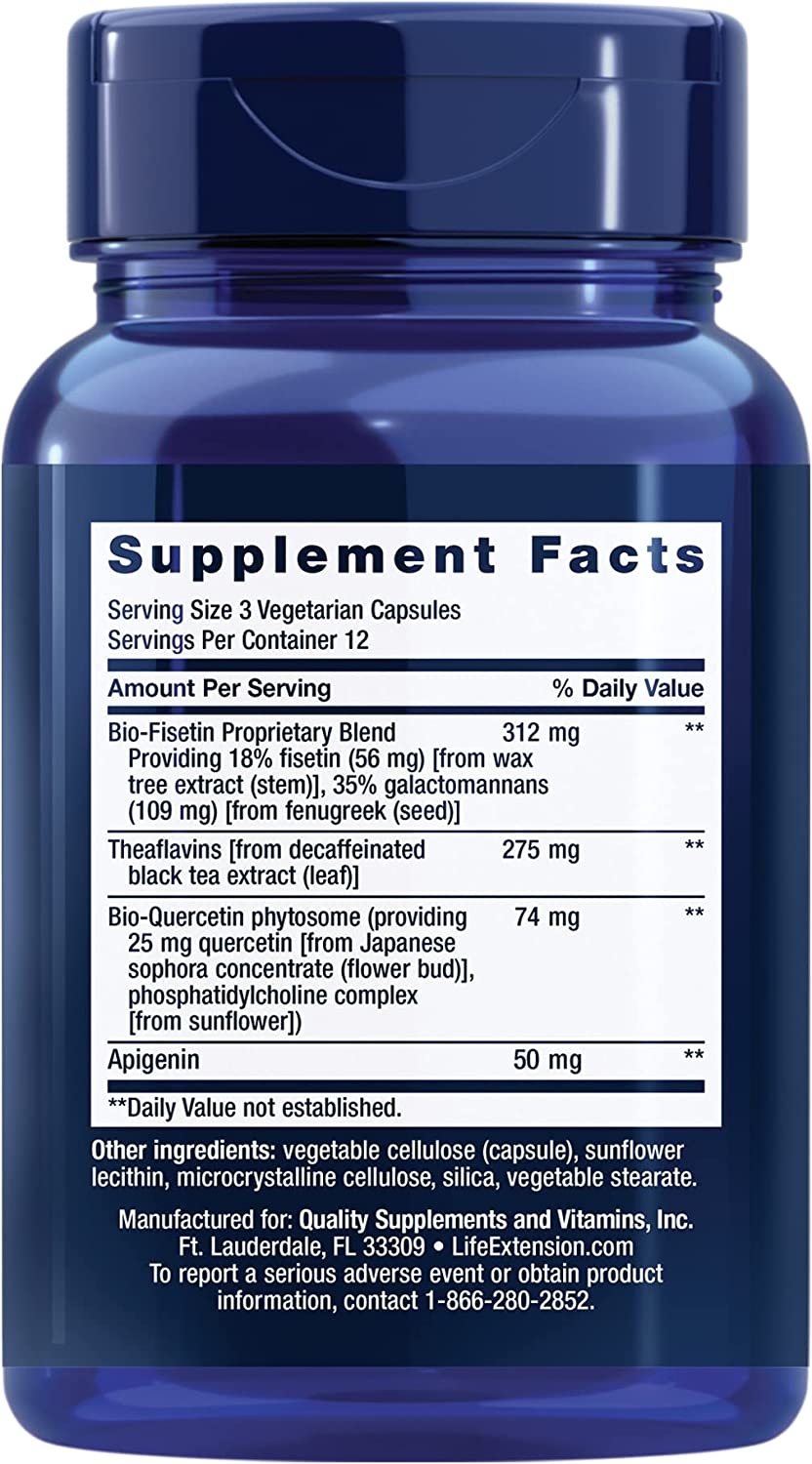
Two parts of the listing disagree. The short description names quercetin, theaflavins and apigenin, and leaves out fisetin; the long description and the label include it. The 312 mg “Bio-Fisetin proprietary blend” provides 18 percent fisetin (56 mg) and 35 percent galactomannans (109 mg) from fenugreek seed, and the 74 mg “Bio-Quercetin phytosome” provides 25 mg of quercetin, so the headline milligrams overstate the active compounds. The fenugreek fraction is easy to miss because it sits inside the blend: NIH’s National Center for Complementary and Integrative Health says fenugreek “can cause allergic reactions, including serious reactions, in some people” and is not safe in pregnancy in amounts greater than those found in food (NCCIH, updated February 2025). We do not know how 109 mg of a seed extract compares with food amounts, so anyone allergic to fenugreek should treat this as a reason to skip it.
| This product (per weekly serving) | Typical human-trial dose | Official intake guidance | Tolerable Upper Limit | |
|---|---|---|---|---|
| Fisetin | 56 mg | About 20 mg/kg/day for 2 days: about 1,400 mg a day for 70 kg (osteoarthritis and AFFIRM registry records) | None found | None found |
| Quercetin | 25 mg (74 mg phytosome) | 1,000 mg a day for 3 days with dasatinib (Hickson, 2019); 1,250 mg a day, 3 days a week for 3 weeks (Justice, 2019) | None found | None found; no adequate data beyond 12 weeks at 1,000 mg or more (Andres, 2018) |
| Theaflavins and apigenin | 275 mg and 50 mg | No human senolytic trial dose found | None found | None found |
Fisetin comes out at about 0.8 mg per kilogram for a 70 kg adult, roughly 25 times less per day than the trial dose, and a trial course lasted two days, which makes it about 50 times less per course. Quercetin is about 40 times less per day than the 1,000 mg used with dasatinib. I found no recommended intake or Tolerable Upper Intake Level for either flavonoid, and the empty cell reflects absent evidence, not a clean safety record.
The store’s long description says the formulas use “the precise substances and dosages utilized in the studies that served as their inspiration.” That is a manufacturer claim, and it does not match the human trial doses above. Likewise “boost lifespan” is marketing language; the only lifespan data are mouse results. Our vitamin C and quercetin article covers a different quercetin claim, immune support.
Who Might Consider It, and Who Should Skip It
Who this is for: healthy adults who are curious about ageing research, who understand that the human evidence is early and that this label’s doses sit far below those in trials, and who have talked it through with a clinician.
Who should skip it: most people, honestly, if the goal is a result the trials can back; anyone taking prescription drugs, who should check interactions first; anyone with kidney disease or a hormone-sensitive condition, given the animal-study cautions; anyone pregnant or breastfeeding; and anyone hoping it will do what dasatinib plus quercetin did in a few biopsies. No published trial shows this capsule changes lifespan, bone, memory or function.
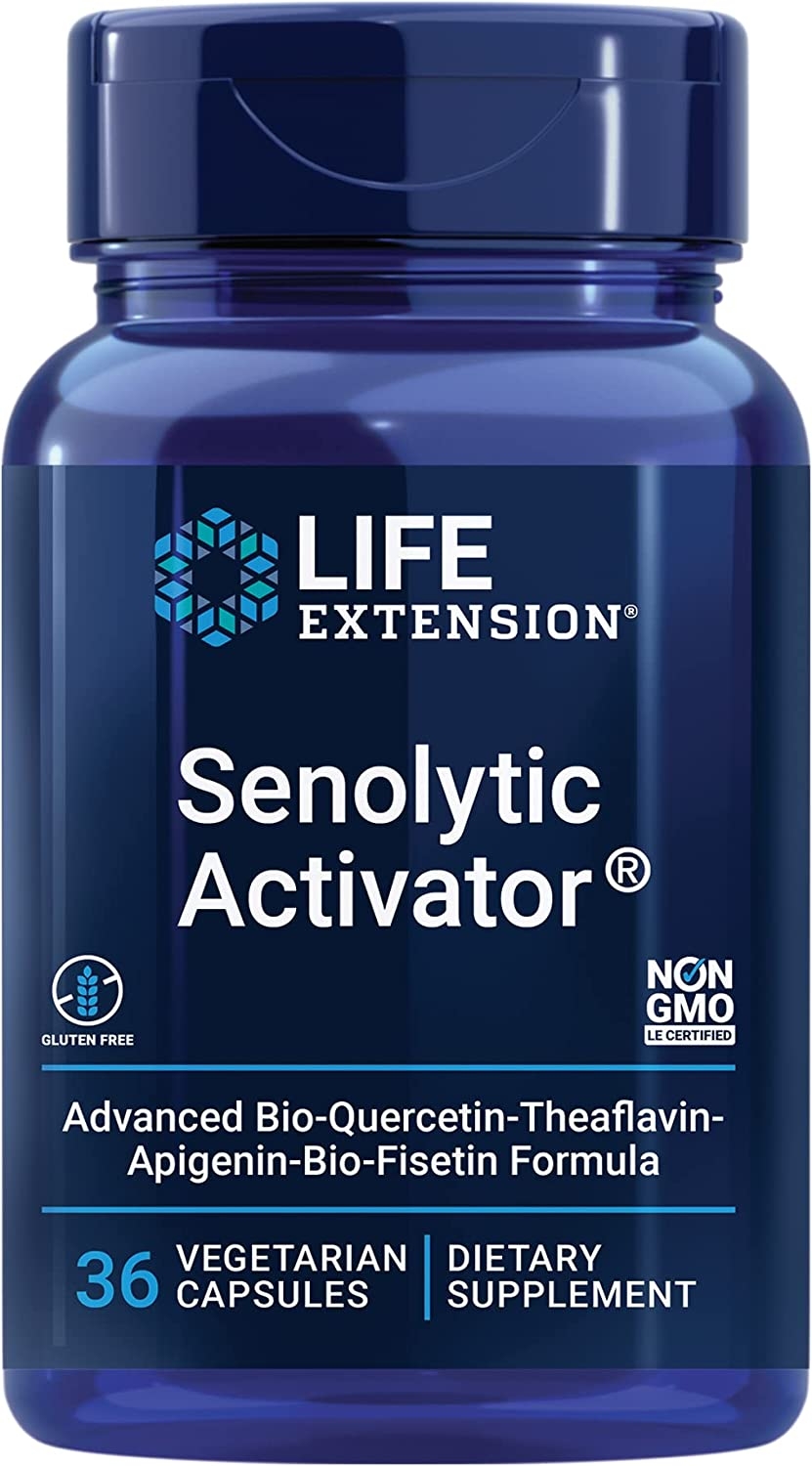
Life Extension Senolytic Activator – 36 Vegetarian Capsules
Fisetin, quercetin phytosome, theaflavins and apigenin in a once-weekly, three-capsule serving; 12 servings per bottle. Doses are well below those used in human trials. See more in our supplements range.
View Product DetailsFrequently Asked Questions
What is a senolytic supplement?
It is a product that claims to clear senescent cells, cells that have stopped dividing and release inflammatory signals as we age. In supplements the ingredients are usually plant flavonoids such as fisetin and quercetin. Published human senolytic trials mostly used a drug, dasatinib, alongside quercetin, so supplement evidence is much thinner.
Does fisetin slow aging in humans?
Not shown. Fisetin extended lifespan in mice (Yousefzadeh, 2018), but the completed placebo-controlled human trial I found, in 75 people with knee osteoarthritis, showed no difference from placebo on walking, pain or cartilage measures in its registry results. A Mayo frailty trial has not posted results.
Does quercetin work as a senolytic on its own?
Human senolytic trials gave quercetin together with dasatinib, so they cannot show what quercetin does alone. In the Alzheimer’s trial quercetin was not detected in spinal fluid. A 2024 trial of the pair in 60 women missed its primary bone endpoint. No trial I found tested quercetin alone as a senolytic.
How often do you take Senolytic Activator?
The label says take three capsules once weekly, or as recommended by a healthcare practitioner, and warns not to exceed the recommended dose.
Is it safe to take fisetin and quercetin together?
I found no safety study of this exact combination. A 2018 review found quercetin adverse effects were rare and mild but lacked data beyond 12 weeks at 1,000 mg or more, and flagged kidney, hormone-sensitive cancer and drug-interaction concerns from animal and short-term studies. Ask a clinician if you take medicine.
Why do the studies use dasatinib?
Dasatinib was part of the original senolytic combination, and the trials tested it with quercetin, so most human results describe the pair. This capsule contains no dasatinib. Trial findings therefore cannot be carried over to this product.
What dose of fisetin did the trials use?
Registered trials used about 20 mg per kilogram of body weight daily for two consecutive days, repeated in cycles; the osteoarthritis trial used 100 mg capsules. For a 70 kg adult that is about 1,400 mg a day. This product provides 56 mg of fisetin per weekly serving, about 25 times less per day.
Who should not take senolytic supplements?
Anyone pregnant or breastfeeding, anyone on prescription medicine until an interaction check, and people with kidney disease or hormone-sensitive conditions given the animal-study cautions in the quercetin review. The label itself advises consulting your physician if you are undergoing treatment for a medical condition.
Sources
- Hickson LJ, et al. “Senolytics decrease senescent cells in humans: Preliminary report from a clinical trial of Dasatinib plus Quercetin in individuals with diabetic kidney disease.” EBioMedicine 2019;47:446–456. Accessed 23 October 2026. ncbi.nlm.nih.gov/pmc
- Justice JN, et al. “Senolytics in idiopathic pulmonary fibrosis: Results from a first-in-human, open-label, pilot study.” EBioMedicine 2019;40:554–563. Accessed 23 October 2026. doi.org/10.1016/j.ebiom.2018.12.052
- Gonzales MM, et al. “Senolytic therapy in mild Alzheimer’s disease: a phase 1 feasibility trial.” Nature Medicine 2023;29(10):2481–2488. Accessed 23 October 2026. pmc.ncbi.nlm.nih.gov
- Farr JN, et al. “Effects of intermittent senolytic therapy on bone metabolism in postmenopausal women: a phase 2 randomized controlled trial.” Nature Medicine 2024;30(9):2605–2612. Accessed 23 October 2026. nature.com
- Yousefzadeh MJ, et al. “Fisetin is a senotherapeutic that extends health and lifespan.” EBioMedicine 2018;36:18–28. Accessed 23 October 2026. doi.org/10.1016/j.ebiom.2018.09.015
- Andres S, et al. “Safety Aspects of the Use of Quercetin as a Dietary Supplement.” Molecular Nutrition & Food Research 2018;62(1). Abstract via NCBI PubMed record 29127724. Accessed 23 October 2026. ncbi.nlm.nih.gov
- ClinicalTrials.gov. “Senolytic Drugs Attenuate Osteoarthritis-Related Articular Cartilage Degeneration: A Clinical Trial” (NCT04210986). Record last updated 19 September 2024. Accessed 23 October 2026. clinicaltrials.gov
- ClinicalTrials.gov. “AFFIRM: A Phase 2 Randomized, Placebo-Controlled Study of Alleviation by Fisetin of Frailty, Inflammation, and Related Measures in Older Women” (NCT03430037). Record last updated 11 May 2026. Accessed 23 October 2026. clinicaltrials.gov
- U.S. Food and Drug Administration. “Dietary Supplements.” Content current as of 1 October 2024. Accessed 23 October 2026. fda.gov
- National Center for Complementary and Integrative Health (NIH). “Fenugreek.” Last updated February 2025. Accessed 23 October 2026. nccih.nih.gov
This article is for educational purposes only and is not medical advice. It is not intended to diagnose, treat, cure, or prevent any disease. These statements have not been evaluated by the Food and Drug Administration; product statements come from its store listing and label photos. Talk to your doctor before using any supplement, especially if you take prescription medicine, have kidney disease or a hormone-sensitive condition, or are pregnant or breastfeeding.