
The FDA has let phosphatidylserine be marketed since 2003 with a claim that it “may reduce the risk” of dementia in the elderly, but the wording it required says the supporting research is “very limited and preliminary” — and the best-known positive trial used 300 mg a day, three times the 100 mg in this capsule. Phosphatidylserine (PS) is a phospholipid, a fat-based molecule that is part of the membrane around nerve cells. The stake is simple: five published trials of PS gave positive, null and heavily qualified results, and the National Institute on Aging says no supplement is recommended for preventing cognitive decline.
Key Takeaways
- FDA letters dated 24 February 2003, 13 May 2003 and 24 November 2004 cover PS and dementia; the required disclaimer calls the research “very limited and preliminary” (FDA, letters page, accessed 2026).
- A 1991 trial of 149 people with age-associated memory impairment gave 300 mg a day (100 mg three times daily) for 12 weeks and found gains on some memory tests (Neurology, 1991).
- A 2001 trial of 120 older adults gave 300 mg or 600 mg of soy PS for 12 weeks and found no significant difference on any outcome (Nutritional Neuroscience, 2001).
- A 2010 trial of 78 older Japanese adults gave 100 mg or 300 mg a day for 6 months; scores rose in every group, placebo included (J Clin Biochem Nutr, 2010).
- This product supplies 100 mg a day on the label, one-third of the 300 mg used in the 1991 and 2001 trials; a 2018 review of 38 trials found evidence insufficient to recommend any over-the-counter cognitive supplement (Annals of Internal Medicine, 2018).
In this article:
- What Phosphatidylserine Is, and Whether You Lack It
- What the FDA’s “Qualified Claim” Actually Says
- The Trials: One Positive, One Null, Three Qualified
- What the Large Reviews and the NIA Conclude
- Inside Life Extension PS Caps 100 mg
- Safety, and What We Could Not Verify
- Who Might Consider It, and Who Should Skip It
- Frequently Asked Questions
What Phosphatidylserine Is, and Whether You Lack It
A 2015 review in Nutrition (Glade and Smith, 127 articles) describes PS as an endogenous phospholipid and dietary nutrient, meaning the body makes it and food supplies some. It says PS is required for healthy nerve cell membranes and myelin, the insulating sheath around nerve fibres.
The 1991 trial used a brain-cortex preparation labelled BC-PS, and the group behind a later safety study notes that earlier trials used brain-cortex-derived PS. A 2010 Japanese trial describes its soy PS as made from soybean lecithin by an enzymatic reaction with L-serine. Our lecithin guide covers that parent ingredient.
None of the sources we read sets an RDA or Adequate Intake for PS, or describes a deficiency in healthy adults. So the case for PS rests entirely on whether extra of it changes memory in trials, not on closing a nutritional gap.
What the FDA’s “Qualified Claim” Actually Says
This is the fact most PS marketing leans on, so it is worth reading carefully. FDA’s qualified health claims page lists three PS letters under “Cognitive Function”: 24 February 2003, 13 May 2003, and an update dated 24 November 2004. The claims allowed are that PS may reduce the risk of dementia, and of cognitive dysfunction, in the elderly.
A “qualified” claim is not an approval. As we read the letters, FDA found there was not significant scientific agreement among qualified experts that PS reduces dementia risk, and allowed the claim only with a disclaimer saying the supporting research is “very limited and preliminary.” We read the letter text through an archived FDA copy, so that phrase is the only wording we quote.
The claim is about reducing disease risk, a different statement from “supports memory,” and this capsule’s front label uses only the second. The FDA also does not approve supplements before sale, as its dietary supplements page says.
| Source | Date | Scope | Position |
|---|---|---|---|
| FDA qualified health claim letters | 2003; updated 2004 | PS, dementia and cognitive dysfunction in the elderly | Claim allowed with a disclaimer: research “very limited and preliminary” |
| Butler et al., Annals of Internal Medicine | 2018 | 38 trials of over-the-counter supplements, adults without dementia | Evidence insufficient to recommend any such supplement for cognitive protection |
| Hersant et al., CNS Drugs | 2023 | 103 memory supplements, 18 most common ingredients | “Some current evidence” for PS; the field lacks a solid scientific foundation for its marketing |
| National Institute on Aging | Reviewed June 2024 | Vitamins and supplements, Alzheimer’s and cognitive decline | No vitamin or supplement is recommended for prevention |
| Glade and Smith, Nutrition | 2015 | 127 articles, narrative literature review | Favourable; describes 300–800 mg a day as the range discussed |
The Trials: One Positive, One Null, Three Qualified
Crook and colleagues treated 149 people meeting criteria for age-associated memory impairment (AAMI) with BC-PS 100 mg three times daily or placebo for 12 weeks. Treated patients improved relative to placebo on tests of learning and memory and tasks of daily life. Low scorers at the start were the most likely to respond, and the authors called it a “promising candidate,” not a proven one.
A decade later the soy version was tested. In Jorissen et al. (2001), 120 people over 57 with AAMI received placebo, 300 mg or 600 mg of soy PS daily, with assessments at baseline, 6 and 12 weeks and after a 3-week washout.
“No significant differences were found in any of the outcome variables between the treatment groups.”
— Jorissen et al., Nutritional Neuroscience, 2001, abstractThe later trials each come with a catch. Kato-Kataoka et al. (2010) gave 78 Japanese adults aged 50–69 with memory complaints 100 mg, 300 mg or placebo for 6 months. Test scores rose in all groups, including placebo; memory scores rose against baseline only among people who started with relatively low scores, mostly in delayed verbal recall. A 2010 trial of a PS-omega-3 (PS-DHA) complex in 157 older adults reported better immediate verbal recall at 15 weeks, with the stronger effects found in a post-hoc subgroup of people with relatively good baseline scores, and its authors called it exploratory.
The newest, a 2025 Chinese trial in Journal of Affective Disorders, randomised 190 adults with mild cognitive impairment to a capsule for 12 months. Each capsule held 31.5 mg PS, 144 mg alpha-linolenic acid and 3.6 mg of ginkgo flavonoids, taken two a day. The treated group improved on arithmetic, similarity and short-term memory tests, but the capsule also contained vitamins B1 and B6 and folic acid, so with six ingredients the result cannot be credited to PS.
| Trial | People | Daily PS dose | Length | What was reported |
|---|---|---|---|---|
| Crook, 1991 | 149, AAMI | 300 mg (brain-cortex PS) | 12 weeks | Improvement on some memory tests; strongest in low scorers |
| Jorissen, 2001 | 120, AAMI | 300 or 600 mg (soy PS) | 12 weeks | No significant difference on any outcome |
| Kato-Kataoka, 2010 | 78, memory complaints | 100 or 300 mg (soy PS) | 6 months | All groups improved, placebo too; low scorers gained in PS groups |
| Vakhapova, 2010 | 157, memory complaints | PS-DHA complex (dose not in abstract) | 15 weeks | Better immediate recall; exploratory, post-hoc subgroup of higher baseline scorers |
| Duan, 2025 | 190, mild cognitive impairment | 63 mg (2 × 31.5 mg), in a six-ingredient capsule | 12 months | Better arithmetic, similarity and short-term memory scores |
What the Large Reviews and the NIA Conclude
Zooming out, the picture is cautious. The 2018 systematic review in Annals of Internal Medicine (Butler et al.) covered 38 trials of at least 6 months in adults without dementia. Its abstract names omega-3s, soy, ginkgo, B vitamins, vitamin D with calcium, vitamins C and E and multi-ingredient products, not PS specifically. Its conclusion was that evidence is insufficient to recommend any over-the-counter supplement for cognitive protection in adults with normal cognition or mild cognitive impairment.
A 2023 review in CNS Drugs looked at the other side: it surveyed 103 memory supplements on pharmacy shelves, found the 18 most common ingredients, and judged that PS had some current evidence of memory benefit, alongside ashwagandha, choline, curcumin and Lion’s Mane. The same abstract says these products are a billion-dollar industry “lacking a solid scientific foundation for their marketing claims.”
“At this time, no vitamin or supplement is recommended for preventing Alzheimer’s or other forms of cognitive decline.”
— National Institute on Aging, “Cognitive Health and Older Adults” (content reviewed 11 June 2024)Mayo Clinic Minute, “3 factors to help prevent memory loss,” cited as background on non-supplement approaches.
Inside Life Extension PS Caps 100 mg
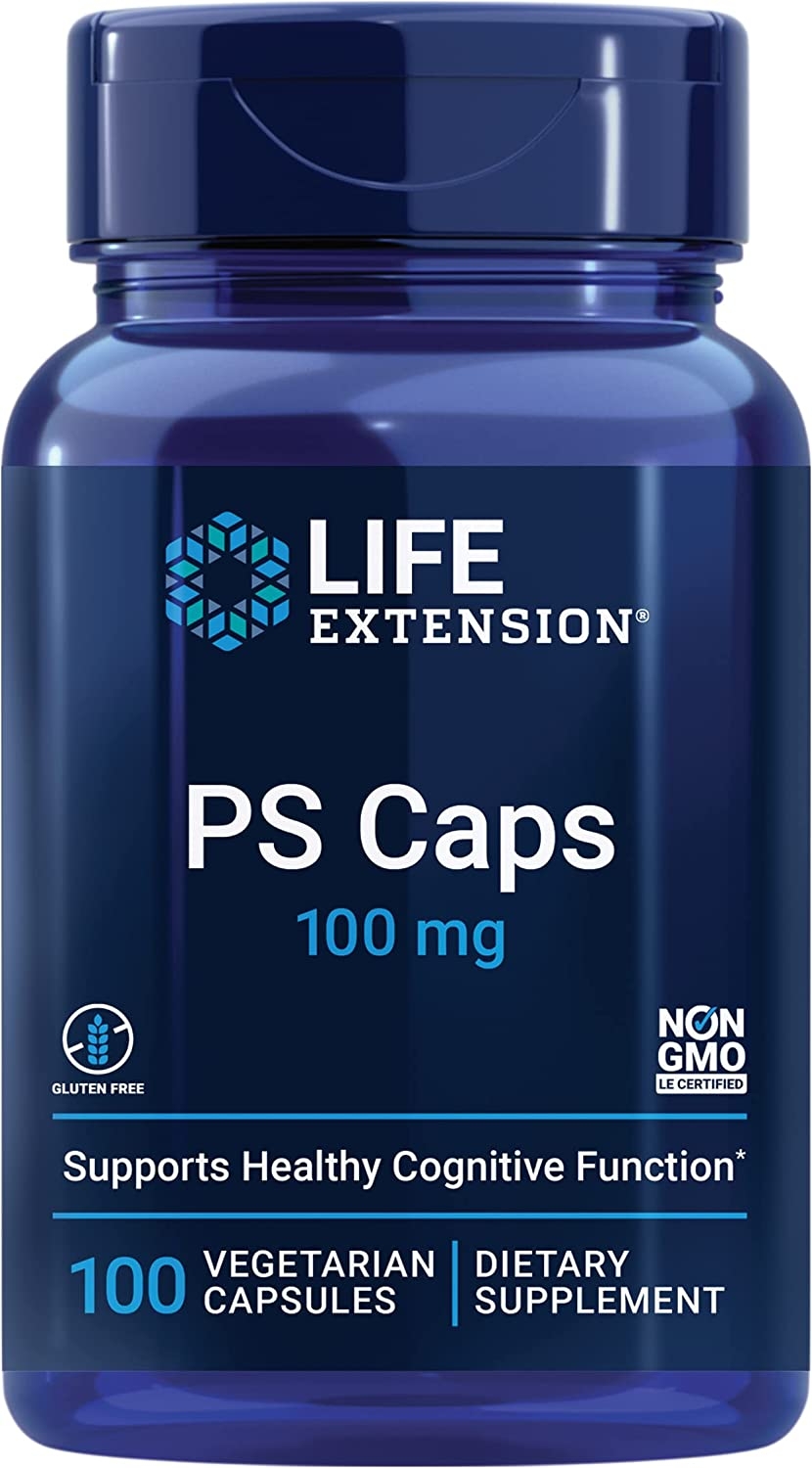
The product is Life Extension PS Caps, 100 mg of phosphatidylserine per capsule, 100 vegetarian capsules. The front label (from the bottle photo on the product page) reads “Supports Healthy Cognitive Function” with a dietary-supplement asterisk, and carries gluten-free and Non-GMO marks. The listing directs one capsule daily, so a bottle lasts about 100 days.
The Supplement Facts panel (the second photo on the product page) lists one ingredient: phosphatidylserine, 100 mg per vegetarian capsule, with no Daily Value established. The other ingredients are microcrystalline cellulose, vegetable cellulose (the capsule), dicalcium phosphate, sunflower lecithin, maltodextrin, silica, calcium silicate and stearic acid. The label does not say whether the PS itself is soy-derived. Its warnings panel says not to exceed the recommended dose, and tells anyone pregnant, lactating or being treated for a medical condition to consult a physician.
| This product | Doses used in trials | NIH RDA / AI | Tolerable Upper Limit | |
|---|---|---|---|---|
| Phosphatidylserine, per day | 100 mg (one capsule, per listing) | 100–600 mg (soy PS); 300 mg (brain-cortex PS) | None found in the sources we checked; the body makes PS and food supplies some | None found in the sources we checked; soy PS up to 600 mg a day showed no safety differences from placebo over 12 weeks (Jorissen, 2002) |
Three points stand out. The label dose equals the lowest dose in Kato-Kataoka (2010), where everyone improved and only low scorers gained, and is one-third of the 300 mg in the 1991 and 2001 trials. Glade and Smith’s 300–800 mg range is 3 to 8 times the capsule dose (our arithmetic).
The listing also says the formulation uses “the dosage from the most recent clinical research,” but the trials above used 300 mg or more in most arms. It says PS “is difficult for your body to absorb,” while Glade and Smith say exogenous PS is absorbed efficiently. And its claims of “razor-sharp focus” and of clinical trials showing support for “memory and attention” are manufacturer statements; the trials we reviewed measured memory and word recall, not focus.
Safety, and What We Could Not Verify
The safety record in trials is reassuring in a narrow way. Jorissen et al. (2002) tested soy PS at 300 mg and 600 mg a day in 120 older adults and found no significant differences from placebo in blood chemistry, blood counts, blood pressure, heart rate or adverse events, concluding it was safe up to 200 mg three times a day. Kato-Kataoka reported none at 100 or 300 mg.
Here is what that does not cover. These were older adults followed for 12 weeks to 12 months. Beyond the bottle’s own warning to consult a physician if pregnant, lactating or under treatment, we did not find an authoritative source on pregnancy, breastfeeding, children, long-term use beyond a year, or interactions with blood thinners or Alzheimer’s medicines, and we will not guess. If you take prescription medicine or are pregnant or breastfeeding, ask a pharmacist or doctor first, and see a clinician about any memory change.
Who Might Consider It, and Who Should Skip It
Who this is for: older adults with mild, self-noticed memory complaints who have already seen a clinician, are managing blood pressure, sleep and medicines, and want to try a low-dose, short-term experiment with a doctor’s agreement, knowing the trial results were mixed. The strongest gains in the 1991 trial and the 2010 Japanese trial came in people who started with lower scores, although the 2010 PS-DHA trial found the reverse.
Who should skip it: most healthy adults, and anyone hoping it will prevent dementia, since no supplement is recommended for that. Also skip it if you are pregnant or breastfeeding without medical advice, take blood thinners or Alzheimer’s medicines without checking first, or have a soy allergy and have not confirmed the source.
Life Extension PS Caps 100 mg, 100 Vegetarian Capsules
100 mg of phosphatidylserine per capsule, 100 capsules, with the listing directing one capsule daily or as advised by a healthcare practitioner. Browse more in our supplements range.
View Product DetailsFrequently Asked Questions
What is phosphatidylserine?
Phosphatidylserine (PS) is a phospholipid, a fat-based molecule that forms part of cell membranes. A 2015 review says it is required for healthy nerve cell membranes and myelin. The body makes it and food supplies some.
Does phosphatidylserine improve memory?
The trials disagree. A 1991 trial found gains on some tests at 300 mg a day, a 2001 trial found none at 300 or 600 mg, and in a 2010 trial placebo groups improved too.
How much phosphatidylserine should you take a day?
No official intake is set in the sources we checked. Trials used 100 to 600 mg a day, mostly 300 mg. This product’s label dose is one 100 mg capsule, and the label says not to exceed it. Ask a clinician.
Has the FDA approved phosphatidylserine for dementia?
No. FDA letters from 2003 (updated 2004) allow a qualified claim that PS may reduce dementia risk in the elderly, with a disclaimer that the research is “very limited and preliminary.”
Is it safe to take phosphatidylserine every day?
In trials of older adults, soy PS at 300 and 600 mg a day for 12 weeks showed no significant safety differences from placebo, and 100 or 300 mg for 6 months caused no reported side effects. We found no data beyond a year or for pregnancy.
Is soy phosphatidylserine different from brain-derived PS?
Early trials, including the 1991 one, used brain-cortex PS. A 2010 trial describes soy PS as made from soybean lecithin and L-serine. Soy PS was tested separately, with mixed results.
Who should not take phosphatidylserine?
We found no authoritative contraindication list, so we cannot give one. Be cautious if you are pregnant, breastfeeding, allergic to soy, or taking blood thinners or Alzheimer’s drugs, and speak to a doctor or pharmacist first.
What else helps protect memory as you age?
The NIA lists managing blood pressure, diabetes and depression, treating hearing or vision loss, limiting alcohol, not smoking, a nutrient-dense diet and seven to nine hours of sleep.
Sources
- U.S. Food and Drug Administration. “Qualified Health Claims: Letters of Enforcement Discretion” (Cognitive Function section). Current page. Accessed 11 October 2026. fda.gov
- U.S. Food and Drug Administration. “Dietary Supplements.” Current page. Accessed 11 October 2026. fda.gov
- Crook et al. “Effects of phosphatidylserine in age-associated memory impairment.” Neurology, May 1991. Accessed 11 October 2026. PubMed 2027477
- Jorissen et al. “The influence of soy-derived phosphatidylserine on cognition in age-associated memory impairment.” Nutritional Neuroscience, 2001. Accessed 11 October 2026. PubMed 11842880
- Jorissen et al. “Safety of soy-derived phosphatidylserine in elderly people.” Nutritional Neuroscience, October 2002. Accessed 11 October 2026. PubMed 12385596
- Kato-Kataoka et al. “Soybean-derived phosphatidylserine improves memory function of the elderly Japanese subjects with memory complaints.” Journal of Clinical Biochemistry and Nutrition, November 2010. Accessed 11 October 2026. PubMed 21103034
- Vakhapova et al. “Phosphatidylserine containing omega-3 fatty acids may improve memory abilities in non-demented elderly with memory complaints.” Dementia and Geriatric Cognitive Disorders, 2010. Accessed 11 October 2026. PubMed 20523044
- Duan et al. “Effects of a food supplement containing phosphatidylserine on cognitive function in Chinese older adults with mild cognitive impairment.” Journal of Affective Disorders, 15 January 2025. Accessed 11 October 2026. PubMed 39317299
- Glade and Smith. “Phosphatidylserine and the human brain.” Nutrition, June 2015. Accessed 11 October 2026. PubMed 25933483
- Butler et al. “Over-the-counter supplement interventions to prevent cognitive decline, mild cognitive impairment, and clinical Alzheimer-type dementia.” Annals of Internal Medicine, 2018. Accessed 11 October 2026. PubMed 29255909
- Hersant et al. “Over the counter supplements for memory: a review of available evidence.” CNS Drugs, September 2023. Accessed 11 October 2026. PubMed 37603263
- National Institute on Aging. “Cognitive Health and Older Adults.” Content reviewed 11 June 2024. Accessed 11 October 2026. nia.nih.gov
This article is for educational purposes only and is not medical advice. It is not intended to diagnose, treat, cure, or prevent any disease. These statements have not been evaluated by the Food and Drug Administration. Talk to your doctor before starting any new supplement, especially if you have a memory concern, are pregnant or breastfeeding, or take any prescription medication.