
A 2012 Cochrane review of 10 randomised trials in 577 people with diabetes called the effect of cinnamon on fasting blood glucose “inconclusive” and found no significant change in HbA1c, yet the front of this capsule bottle advertises “9,000 mg,” a figure the Supplement Facts panel shows is a herbal equivalent of just 450 mg of extract. Ceylon cinnamon (Cinnamomum verum) is the dried bark of a tree grown mainly in Sri Lanka and known as “true” cinnamon, and bitter melon (Momordica charantia) is a tropical fruit used as food and in traditional medicine (NCCIH, updated November 2024; Memorial Sloan Kettering, updated December 2021). The stake is whether a bottle sold for “glucose support” reaches any dose trials tested.
Key Takeaways
- The 2012 Cochrane review of cinnamon covered 10 trials and 577 people, at a mean dose of 2 g a day for 4 to 16 weeks, and found “insufficient evidence” for use in diabetes (Leach and Kumar, 2012).
- A 2013 meta-analysis of 10 trials (543 patients, 120 mg to 6 g a day) found fasting glucose fell 24.59 mg/dL but HbA1c did not change significantly (−0.16%) (Allen et al., 2013).
- The label’s 9,000 mg of Ceylon cinnamon is made from 450 mg of 20:1 extract, and its bitter melon 300 mg comes from 30 mg of 10:1 extract, per 2-capsule serving (product label).
- A 2012 Cochrane review of bitter melon found 4 trials in 479 people and no significant difference in glycaemic control versus placebo (Ooi et al., 2012).
- Cassia, not Ceylon, is “the most common type sold in North America,” and the Cochrane trials used mainly cassia (NCCIH, 2024; Leach and Kumar, 2012).
In this article:
- Two Botanicals, and Which Cinnamon the Trials Used
- Cinnamon and Blood Sugar: What Three Pooled Analyses Found
- Bitter Melon: Small Trials and a Cochrane Verdict
- Inside NatureBell Ceylon Cinnamon 9,000 mg + Bitter Melon
- Safety, and What We Could Not Verify
- Who Might Consider It, and Who Should Skip It
- Frequently Asked Questions
Two Botanicals, and Which Cinnamon the Trials Used
Cinnamon is not one product. According to the NIH National Center for Complementary and Integrative Health (NCCIH, updated November 2024), Ceylon cinnamon (Cinnamomum verum) is “true” cinnamon, while cassia (Cinnamomum aromaticum), grown in southeastern Asia, “is the most common type sold in North America.”
That matters because the best-known trials mostly did not test Ceylon. The 2012 Cochrane review reported trials using cinnamon “predominantly Cinnamomum cassia.” A 2018 paper (Oketch-Rabah et al.) was blunter: with species inadequately described, “safety and efficacy data are not generalizable or transferable.”
Bitter melon is a different plant altogether. Memorial Sloan Kettering Cancer Center (MSK, last updated 22 December 2021) describes it as a perennial with an edible fruit used as both food and medicine.
Cinnamon and Blood Sugar: What Three Pooled Analyses Found
Three pooled analyses from 2012 to 2019 are the evidence usually behind a “glucose support” label. They agree only that results are inconsistent.
| Analysis | Trials and participants | Dose and length | Fasting glucose | HbA1c |
|---|---|---|---|---|
| Leach and Kumar, Cochrane, 2012 | 10 trials; 577 participants | Mean 2 g a day (mostly cassia); 4 to 16 weeks | “Inconclusive” | No significant difference |
| Allen et al., Annals of Family Medicine, 2013 (searched to February 2012) | 10 trials; 543 patients | 120 mg to 6 g a day; 4 to 18 weeks | −24.59 mg/dL (95% CI −40.52 to −8.67) | −0.16% (95% CI −0.39 to 0.02), not significant |
| Namazi et al., Complementary Therapies in Medicine, 2019 (searched to 2018) | 18 studies | Not stated in the abstract | −19.26 mg/dL (95% CI −28.08 to −10.45; I² 96.5%) | −0.24% (95% CI −0.48 to −0.01; I² 76.8%); listed by the authors as not significant |
The Cochrane authors (2012 abstract) rated risk of bias “high or unclear in all but two trials.” Allen’s team (2013 abstract) reported that the high heterogeneity “may limit the ability to apply these results to patient care, because the preferred dose and duration of therapy are unclear.” Namazi and colleagues (2019 abstract) concluded that “due to high heterogeneity findings should be interpreted with great caution.”
Read together: fasting glucose falls by roughly 19 to 25 mg/dL in the later pooled data, but HbA1c, the measure of average control over about three months, barely moves. The 2019 authors listed their HbA1c result among the effects that were not significant, even though its interval only just excludes zero.
“We don’t have reliable evidence that any herbal supplements can help to control diabetes or its complications.”
— NCCIH, “Diabetes and Dietary Supplements: What You Need To Know,” updated November 2023Cleveland Clinic, “Cinnamon health benefits.” General background; we have not checked every statement in it, so treat it as context, not evidence.
Another supplement judged against a diabetes outcome: our alpha-lipoic acid guide.
Bitter Melon: Small Trials and a Cochrane Verdict
Bitter melon evidence is thinner still. The Cochrane review (Ooi et al., August 2012) found four randomised trials, up to three months long, in 479 people with type 2 diabetes. It did not attempt a meta-analysis, because “no similar preparation was tested twice.”
| Study | Design | Main result |
|---|---|---|
| Ooi et al., Cochrane, 2012 | 4 trials; 479 participants; up to 3 months | No significant difference in glycaemic control versus placebo; “insufficient evidence” |
| Dans et al., J Clin Epidemiol, 2007 | 40 patients on standard therapy; 2 capsules three times a day for 3 months; double-blind, placebo-controlled | HbA1c difference of 0.22% in favour of bitter melon (95% CI −0.40 to 0.84; P = 0.4825); the achieved power was 11% |
| Kim et al., Complement Ther Med, 2020 | 90 participants analysed; 12 weeks; placebo-controlled | HbA1c unchanged in both groups; average fasting glucose fell in the bitter melon group (p = 0.014); no serious adverse events |
The 2007 trial (Dans et al.) was designed to detect a 1% HbA1c fall, but the decline it observed was only 0.24%, giving an achieved power of just 11%, and its authors could not reach “a definite conclusion.” The 2020 trial (Kim et al.) saw the same split as cinnamon: fasting glucose fell, HbA1c did not. Neither abstract states the extract strength, so neither dose can be compared with this label.
MSK says bitter melon “cannot be recommended as a replacement therapy for insulin or hypoglycemic drugs,” and that meta-analyses “conclude the evidence is low quality with sparse safety data.”
Inside NatureBell Ceylon Cinnamon 9,000 mg + Bitter Melon
The Supplement Facts panel in the product photos lists 2 capsules per serving and 120 servings per container, a 120-day supply at the listing’s directions. It reads “Organic Ceylon Cinnamon (Cinnamon verum)(Bark) 9,000 mg (From 450mg of 20:1 Extract)” and “Organic Bitter Melon (Momordica charantia)(Fruit) 300 mg (From 30mg of 10:1 Extract),” with Daily Value “not established.” Other ingredients are organic rice flour and gelatin. The listing directs 2 capsules daily, preferably with meals.
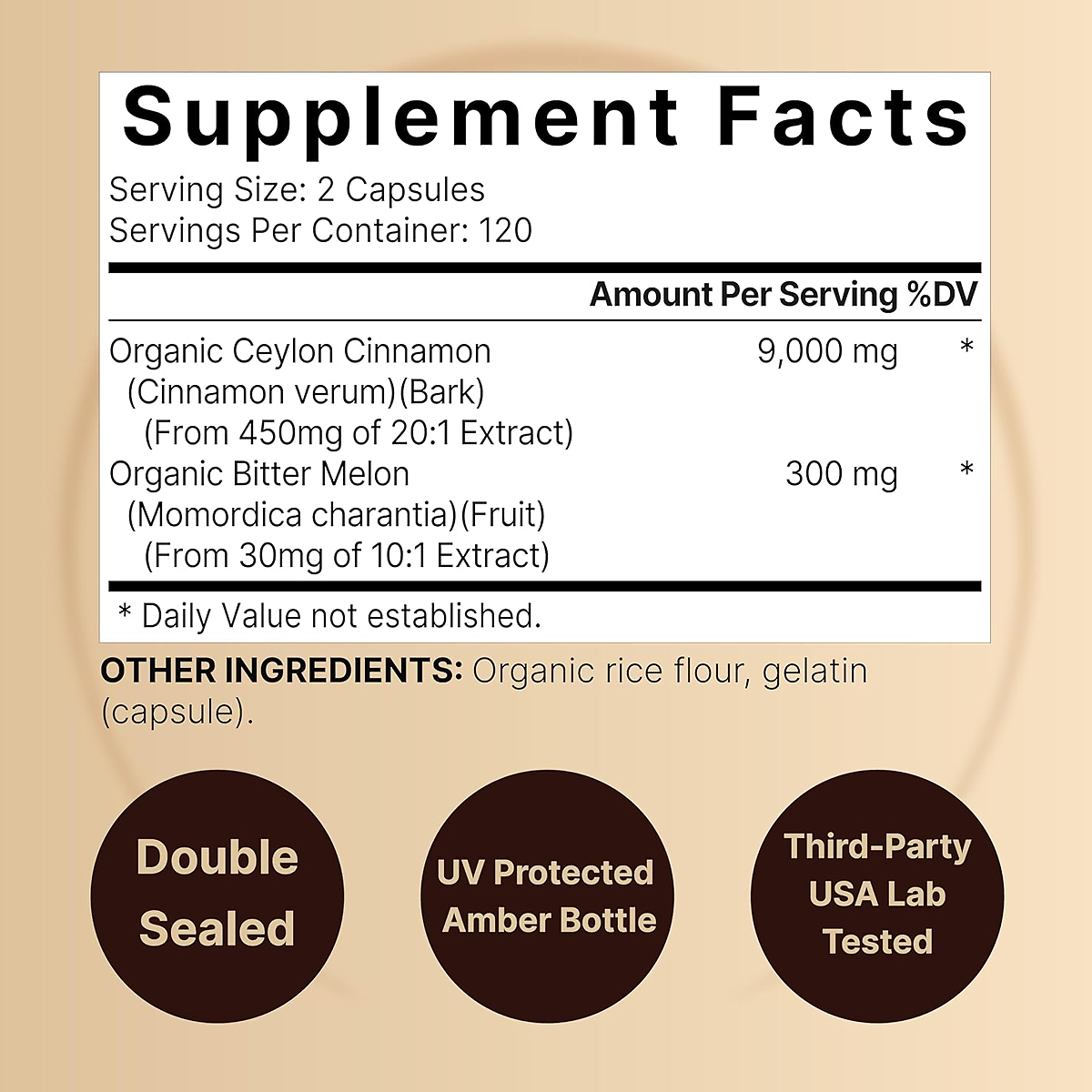
Each capsule holds 225 mg of cinnamon extract and 15 mg of bitter melon extract. The front label’s “9,000 mg” is marked “herbal equivalent”: the raw bark the extract was concentrated from at 20:1. A concentration ratio does not measure active content, and we found no trial of this extract.
| This product (per 2-capsule serving) | Doses in the trials above | NIH RDA / AI | Tolerable Upper Limit | |
|---|---|---|---|---|
| Ceylon cinnamon | 9,000 mg herbal equivalent, from 450 mg of 20:1 extract | Mean 2 g a day (Cochrane, 2012); 120 mg to 6 g a day (Allen, 2013) | None: a Daily Value is not established | None established; NCCIH (2023) says cinnamon below 6 g a day “does not appear to pose a health risk” |
| Bitter melon | 300 mg herbal equivalent, from 30 mg of 10:1 extract | Dans 2007: 6 capsules a day for 3 months, strength not stated; others not stated in the abstracts | None: a Daily Value is not established | None established in the sources we read |
In raw-bark terms, 9,000 mg is 4.5 times the Cochrane mean of 2 g and 1.5 times the top of Allen’s range. In extract terms, 450 mg is 22.5% of that mean, inside Allen’s 120 mg to 6 g range. We cannot say how a 20:1 extract maps onto trial doses, so we do not claim either number is effective. The same gap applies to safety: the 9,000 mg herbal equivalent is above the 6 g a day that NCCIH (2023) says does not appear to pose a health risk, while the 450 mg of extract is far below it, and no source we read says which figure applies to a concentrated extract. Ask a clinician before taking it daily for months.
The label does one thing right: it names Cinnamomum verum, which NCCIH says products often fail to specify. The store listing differs from the panel. It says each serving contains “9,000mg of 20:1 organic Ceylon cinnamon bark extract and 300mg of 10:1 organic bitter melon fruit extract,” which would be 20 and 10 times the extract the panel shows, so trust the panel. The short description calls the two botanicals “two of the most-researched botanicals for healthy glucose metabolism,” yet the Cochrane reviews above found insufficient evidence for each. The listing’s testimonials are anecdotes, and we saw no results behind the “Third-Party USA Lab Tested” badge.
Safety, and What We Could Not Verify
NCCIH (2024) says cinnamon is “likely safe when consumed in the amounts commonly used in foods,” while “larger amounts or for long periods of time” are sometimes linked to stomach upset or allergic reactions. A 2019 systematic review (Hajimonfarednejad et al.) found mostly self-limiting gastrointestinal and allergic events, but advised monitoring medicinal use “with larger doses or longer duration of use.”
On the liver, NCCIH says some cassia products contain high levels of coumarin and prolonged use could be an issue for people with liver disease, while Ceylon “may contain a trace amount.” That favours this bottle, but we saw no coumarin test. Our green tea extract guide covers another extract with a liver warning.
Safety warning: NCCIH states that “Ceylon cinnamon in larger amounts during pregnancy is considered unsafe,” and MSK lists bitter melon as “Do Not Take if” you are pregnant, noting that animal studies suggest it may cause birth defects. MSK also warns of additive effects with insulin and diabetes medications. Talk to your prescriber first if either applies.
MSK (2021) adds that bitter melon may raise concentrations of drugs moved by P-glycoprotein and inhibits the enzyme CYP2C9, with unknown clinical significance, and lists case reports of harm after large amounts of juice or extract, including a gastric ulcer and severe kidney injury.
The FDA’s dietary supplement Q&A (content current as of 27 August 2026) states: “Under DSHEA, FDA does not have the authority to approve dietary supplements before they are marketed.” Not verified: this product’s purity, potency or coumarin content, any trial of this exact extract, and the full trial texts; every figure above comes from an abstract or web page.
Who Might Consider It, and Who Should Skip It
Who this is for: adults who are not pregnant, take no diabetes medication and have no liver condition, and who want to try a Ceylon cinnamon extract knowing the pooled trials show an inconsistent effect on fasting glucose, little on HbA1c, and mostly tested another species. Anyone with diabetes should decide with their clinician.
Who should skip it: most people. We found no trial of this extract showing a benefit. Skip it, or ask first, if you are pregnant or breastfeeding, take insulin or any diabetes medicine, have liver disease, take drugs handled by P-glycoprotein or CYP2C9, or hope it will replace prescribed treatment.
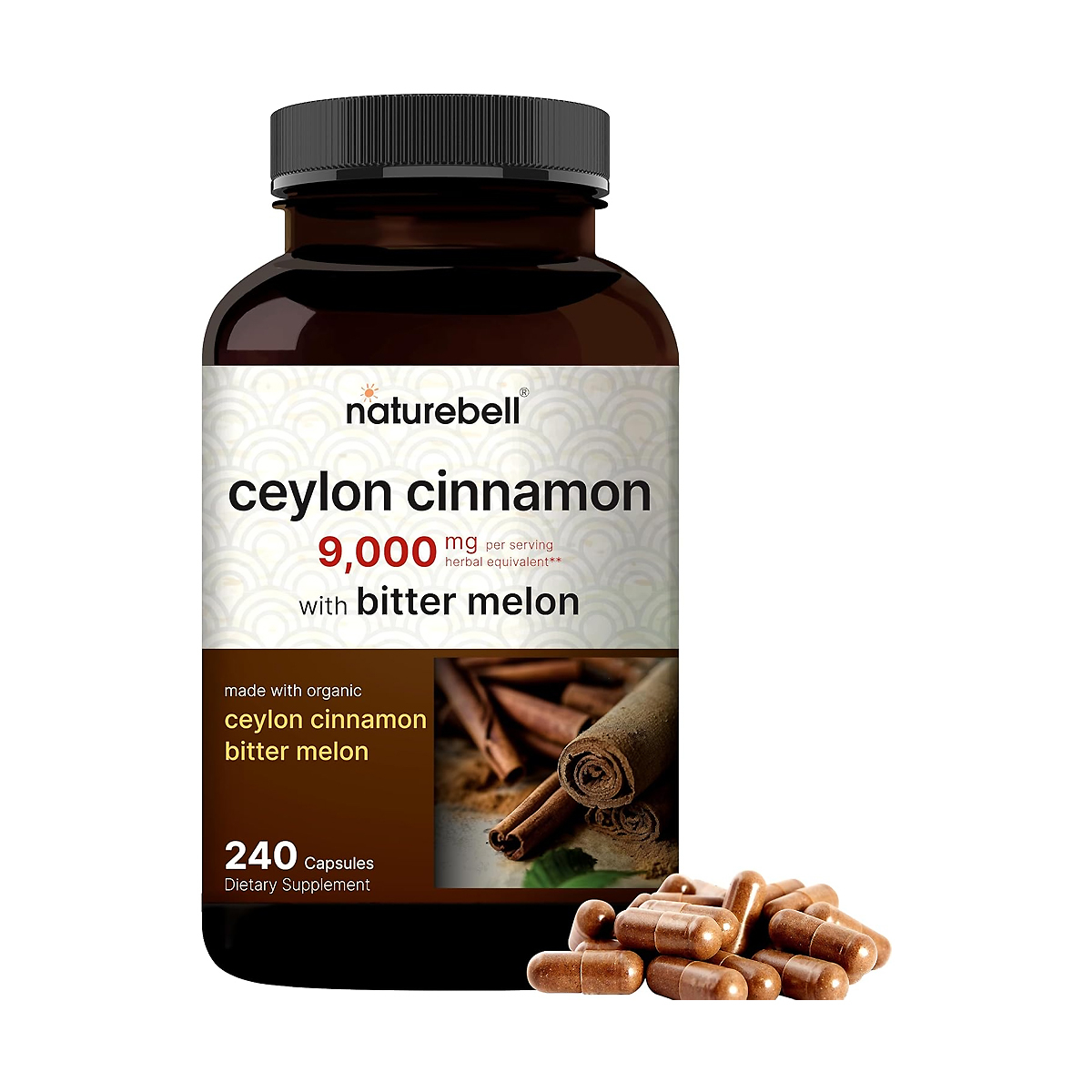
NatureBell Ceylon Cinnamon 9,000 mg + Bitter Melon, 240 Capsules
Organic Ceylon cinnamon bark and organic bitter melon fruit extracts, 240 capsules. Browse more herbal supplements.
View Product DetailsFrequently Asked Questions
What is Ceylon cinnamon?
Ceylon cinnamon (Cinnamomum verum) is the dried bark of a tree grown mainly in Sri Lanka, called “true” cinnamon. NCCIH said in 2024 that cassia is the most common type sold in North America, so many trials and many store products involve the other species.
Does Ceylon cinnamon lower blood sugar?
The evidence is inconsistent. A 2012 Cochrane review of 10 trials called the effect on fasting glucose inconclusive; a 2013 meta-analysis found a 24.59 mg/dL fall but no significant HbA1c change. Most trials used cassia, so results may not transfer.
Does bitter melon lower blood sugar?
Not reliably. A 2012 Cochrane review of 4 trials in 479 people found no significant difference in glycaemic control versus placebo, and a 2020 trial of 90 people saw HbA1c stay unchanged. Fasting glucose fell in that trial, so the picture is mixed rather than empty.
How much Ceylon cinnamon should you take a day?
No dose is established. The 2013 meta-analysis covered 120 mg to 6 g a day, and the Cochrane mean was 2 g. NCCIH said in 2023 that cinnamon below 6 g a day does not appear to pose a health risk. Ask your clinician first.
Is Ceylon cinnamon safer than cassia?
It contains less coumarin. NCCIH says cassia can contain high coumarin levels, with possible liver effects in sensitive people, while Ceylon may hold a trace. NCCIH also calls larger amounts of Ceylon cinnamon in pregnancy unsafe, and no coumarin test for this product was seen.
What does “herbal equivalent” mean on the label?
It is the raw bark the extract was concentrated from, not the amount in the capsules. This panel shows 9,000 mg is made from 450 mg of 20:1 extract per 2-capsule serving, so each capsule holds 225 mg of cinnamon extract.
Can you take cinnamon and bitter melon with diabetes medication?
Ask your prescriber first. NCCIH says herbal supplements such as cinnamon can cause unwanted side effects with conventional diabetes drugs, and MSK lists additive effects between bitter melon and insulin or diabetes medications. Never adjust prescribed doses on your own because of a supplement.
Who should not take bitter melon?
MSK’s “Do Not Take if” list includes pregnancy, because animal studies suggest possible birth defects, and use with insulin or diabetes medications. It also flags possible interactions with drugs handled by P-glycoprotein and CYP2C9, although their clinical significance is not known.
Sources
- NIH NCCIH. “Cinnamon: Usefulness and Safety.” Last updated November 2024. Accessed 15 October 2026. nccih.nih.gov
- NIH NCCIH. “Diabetes and Dietary Supplements: What You Need To Know.” Last updated November 2023. Accessed 15 October 2026. nccih.nih.gov
- Leach and Kumar. “Cinnamon for diabetes mellitus.” Cochrane Database of Systematic Reviews, September 2012. Accessed 15 October 2026. PubMed record 22972104 (NLM)
- Allen et al. “Cinnamon use in type 2 diabetes: an updated systematic review and meta-analysis.” Annals of Family Medicine, September-October 2013. Accessed 15 October 2026. PubMed record 24019277 (NLM)
- Namazi et al. “The impact of cinnamon on anthropometric indices and glycemic status in patients with type 2 diabetes: a systematic review and meta-analysis of clinical trials.” Complementary Therapies in Medicine, April 2019. Accessed 15 October 2026. PubMed record 30935562 (NLM)
- Oketch-Rabah, Marles and Brinckmann. “Cinnamon and cassia nomenclature confusion: a challenge to the applicability of clinical data.” Clinical Pharmacology & Therapeutics, September 2018. Accessed 15 October 2026. PubMed record 29947417 (NLM)
- Hajimonfarednejad et al. “Cinnamon: a systematic review of adverse events.” Clinical Nutrition, April 2019. Accessed 15 October 2026. PubMed record 29661513 (NLM)
- Ooi, Yassin and Hamid. “Momordica charantia for type 2 diabetes mellitus.” Cochrane Database of Systematic Reviews, August 2012. Accessed 15 October 2026. PubMed record 22895968 (NLM)
- Dans et al. “The effect of Momordica charantia capsule preparation on glycemic control in type 2 diabetes mellitus needs further studies.” Journal of Clinical Epidemiology, June 2007. Accessed 15 October 2026. PubMed record 17493509 (NLM)
- Kim et al. “Hypoglycemic efficacy and safety of Momordica charantia (bitter melon) in patients with type 2 diabetes mellitus.” Complementary Therapies in Medicine, August 2020. Accessed 15 October 2026. PubMed record 32951763 (NLM)
- Memorial Sloan Kettering. “Bitter Melon.” Last updated 22 December 2021. Accessed 15 October 2026. mskcc.org
- U.S. Food and Drug Administration. “Questions and Answers on Dietary Supplements.” Content current as of 27 August 2026. Accessed 15 October 2026. fda.gov
This article is for educational purposes only and is not medical advice. It is not intended to diagnose, treat, cure, or prevent any disease. These statements have not been evaluated by the Food and Drug Administration. Talk to your doctor before starting any new supplement, especially if you have diabetes, liver disease, are pregnant or breastfeeding, or take any prescription medication.