
Pooled analyses of randomized trials report that black seed lowers fasting blood sugar, but in a 2026 review the trials behind that number disagreed so completely that the between-trial inconsistency statistic (I²) reached 99.2 percent (Endocrinology, Diabetes & Metabolism, 2026), while the jar of ground seed reviewed here is labeled as a seasoning to use instead of black pepper. Black seed, also called black cumin or kalonji, is the seed of Nigella sativa, an annual flowering plant used as a spice and in traditional medicine. This article reads the pooled trials, one safety case report, and the label.
Key Takeaways
- A 2025 meta-analysis of 82 studies with 5,026 participants, using 200 to 4,600 mg a day for 1 to 48 weeks, called black seed a “promising adjunct” (Jafari, Pharmacological Research, 2025).
- Pooled blood-pressure falls are small: about 3 mmHg systolic in 11 trials with 860 people (Sahebkar, Journal of Hypertension, 2016) and 3.25 mmHg in 31 trials (Musazadeh, 2026).
- Inconsistency is extreme: I² was 99.2% for fasting glucose and 98.6% for HbA1c (Musazadeh, 2026).
- Thymoquinone, the compound the store listing names, ranged from 3.08 to 809.4 mg per 100 g across six oils and five oil capsules (Khaikin, Nutrients, 2022); this jar’s label states no figure.
- The label serving is 1 teaspoon (3 g), within the 0.5 to 3 g a day used in powder trials, but the label directs seasoning use, not a daily dose.
In this article:
- What Black Seed Is, and What the Jar Holds
- What the Pooled Trials Report
- Why Those Numbers Deserve Caution
- Thymoquinone: The Compound Nobody Can Read Off the Label
- Safety, Interactions and What Is Unknown
- Inside the Jar: Label Versus Listing
- Who Might Consider It, and Who Should Skip It
- Frequently Asked Questions
What Black Seed Is, and What the Jar Holds
Black seed goes by several names, including black cumin, black caraway, nigella and kalonji. It is sold as a ground spice, as an oil and in capsules, and the research does not all use the same form.
The product is Amazing Herbs Premium Black Cumin Seed Ground Powder, 16 oz (454 g), listed at $22.40 and in stock on 24 October 2026. Its label photo shows one ingredient, ground black cumin seed, and a 1 teaspoon (3 g) serving with 10 calories, 2 g of carbohydrate, 1 g of fibre and 0.5 mg of iron, across 151 servings.
What the Pooled Trials Report
A meta-analysis combines the results of many smaller trials. I read the abstracts, or the full text, of six on black seed; all find some favourable change, and four of the six say more research is needed.
| Review (year) | What was pooled | Headline result | Authors’ caveat |
|---|---|---|---|
| Sahebkar, J Hypertens (2016) | 11 trials, 860 people, mean 8.3 weeks | Systolic −3.26, diastolic −2.80 mmHg versus control | More evidence needed on long-term effect |
| Kavyani, Phytother Res (2023) | Adults; searched to August 2022 | Systolic −3.06, diastolic −2.69 mmHg | I² 84.7% and 97.3% |
| Shirvani, Prostaglandins Other Lipid Mediat (2024) | 30 trials | Fasting glucose and HbA1c lower; insulin and HOMA-IR unchanged | I² 92.7% and 95.7%; ideal dose unknown |
| Karimi, Complement Ther Med (2025) | 16 trials in type 2 diabetes | Glucose −21.43 mg/dL; HbA1c −0.44; cholesterol −18.80 mg/dL | No effect on insulin, triglycerides, liver or kidney markers, or weight |
| Jafari, Pharmacol Res (2025) | 82 studies, 5,026 people, 200–4,600 mg/day | Most cardiometabolic markers improved | Called a “promising adjunct” |
| Musazadeh, Endocrinol Diabetes Metab (2026) | 31 trials, 2,145 people with metabolic disease | Weight −1.59 kg; systolic −3.25 mmHg; glucose −18.62 mg/dL; HbA1c −0.56 | No effect on insulin, HOMA-IR or waist; “interpreted cautiously” |
The 2026 review’s authors call these “modest improvements.” The blood-pressure changes are a few mmHg; the glucose figures look larger, which is why they deserve the closer reading below.
That 2016 review found powder and oil differed, “in favour of the former,” and concluded that short-term powder “can significantly reduce SBP and DBP levels,” adding that “more evidence is needed” on long-term effect. Powder is this jar’s form, but the same review found no association between the size of the fall and the dose, duration or type of black seed.
Why Those Numbers Deserve Caution
I² estimates how much variation between trials is real disagreement rather than chance; the closer to 100 percent, the less the trials agree. In the 2026 review, fasting glucose across 23 trials had I² of 99.2 percent and HbA1c had 98.6 percent. A pooled average of 18.62 mg/dL therefore summarizes trials that point in very different directions.
The same review reports “significant evidence of small-study effects” for fasting glucose, and ran a trim-and-fill analysis for publication bias. With two imputed studies added the result stayed significant (−21.14 mg/dL), which is reassuring but no substitute for large trials. Its authors say weight, waist, fasting glucose and HOMA-IR findings “should be interpreted with caution.”
Form matters. In that review’s subgroup table, fasting glucose fell 27.08 mg/dL in 12 oil trials but 10.77 mg/dL in 11 capsule trials. Trials labelled powder were few; the four I could identify in its trial table used 0.5 g a day for 8 weeks, 1 g for 6 weeks, 2 g for 48 weeks and 3 g for 8 weeks, and two of those gave the powder in capsules.
The NIH view is cautious too. The National Center for Complementary and Integrative Health (NCCIH, updated November 2023) says a few supplements have “weak evidence of a possible benefit” for blood sugar, and that most studies “differ from each other in participant characteristics, supplement formulations and dosing, length of study, and results.” Black seed is not named on that page. Our guide to Ceylon cinnamon and bitter melon shows the same pattern for another kitchen spice sold for blood sugar.
Thymoquinone: The Compound Nobody Can Read Off the Label
The store’s short description says black cumin “is naturally rich in thymoquinone, the active compound studied for its role in supporting healthy immune response and antioxidant defense.” Thymoquinone is real and much studied, but neither the listing nor the supplement facts panel gives an amount.
Content varies enormously. A 2022 analysis in Nutrients (Khaikin and colleagues) measured six black seed oils and five oil capsules and found thymoquinone “varied from 3.08 to 809.4 mg/100 g (mean),” a spread of about 260-fold.
“These findings suggest that black seed products should be regulated regarding TQ content to enable consumers to buy black seed food supplements of known content for the maintenance and improvement of health.”
— Khaikin et al., Nutrients (2022), conclusion of the abstractThat study tested oils and oil capsules, so it cannot say how much thymoquinone is in this powder. Its estimate of a safe daily dose, under 48.6 mg per adult, is the authors’ figure, not an official limit.
Safety, Interactions and What Is Unknown
I found no NIH Office of Dietary Supplements fact sheet or NCCIH page on black seed; the NCCIH address I tried returned a 404 on 24 October 2026. So I have no official intake or Tolerable Upper Intake Level to cite.
One case report is worth knowing. In Hospital Pharmacy (Arab and colleagues, 2026), a 51-year-old man with colon cancer, taking dual antiplatelet therapy and chemotherapy, developed a large hematoma during a trial of black seed oil. It followed escalation to 2,000 mg a day, with low platelets, and resolved within 10 days; the authors scored the link only as a “possible adverse drug reaction.”
What that case does and does not show. It is one report in a person with several other bleeding risks, and it involved an oil. It does not show that black seed causes bleeding in healthy people, but it is a reason for anyone on blood thinners or chemotherapy, or facing surgery, to ask a clinician first. NCCIH makes the general point that supplements “may interact with your medications or pose risks if you have certain medical problems or are going to have surgery.”
My own inference, not a documented interaction: because pooled trials report lower blood sugar and pressure on average, anyone taking medicine for either should tell their prescriber first. NCCIH also notes that many supplements “haven’t been tested in pregnant women, nursing mothers, or children”; I found no black-seed-specific pregnancy data.
U.S. Food and Drug Administration, “Dietary Supplements Overview”: general background on supplement regulation from the agency itself; I have not checked every claim in it.
Supplements are not pre-approved. The FDA (page current as of 1 October 2024) says manufacturers “are responsible for evaluating the safety and labeling of their products before marketing.” NCCIH adds that supplements you buy “may differ in important ways from products tested in studies.”
Inside the Jar: Label Versus Listing
The label and the store listing say different things. The back label directs: “Adds a bit of peppery zest to foods. Use instead of black pepper. Sprinkle on foods like soups, salads, meats, vegetables, or pasta.” The front says “Great in smoothies, yogurt & more.” Neither names a health purpose or a daily amount.
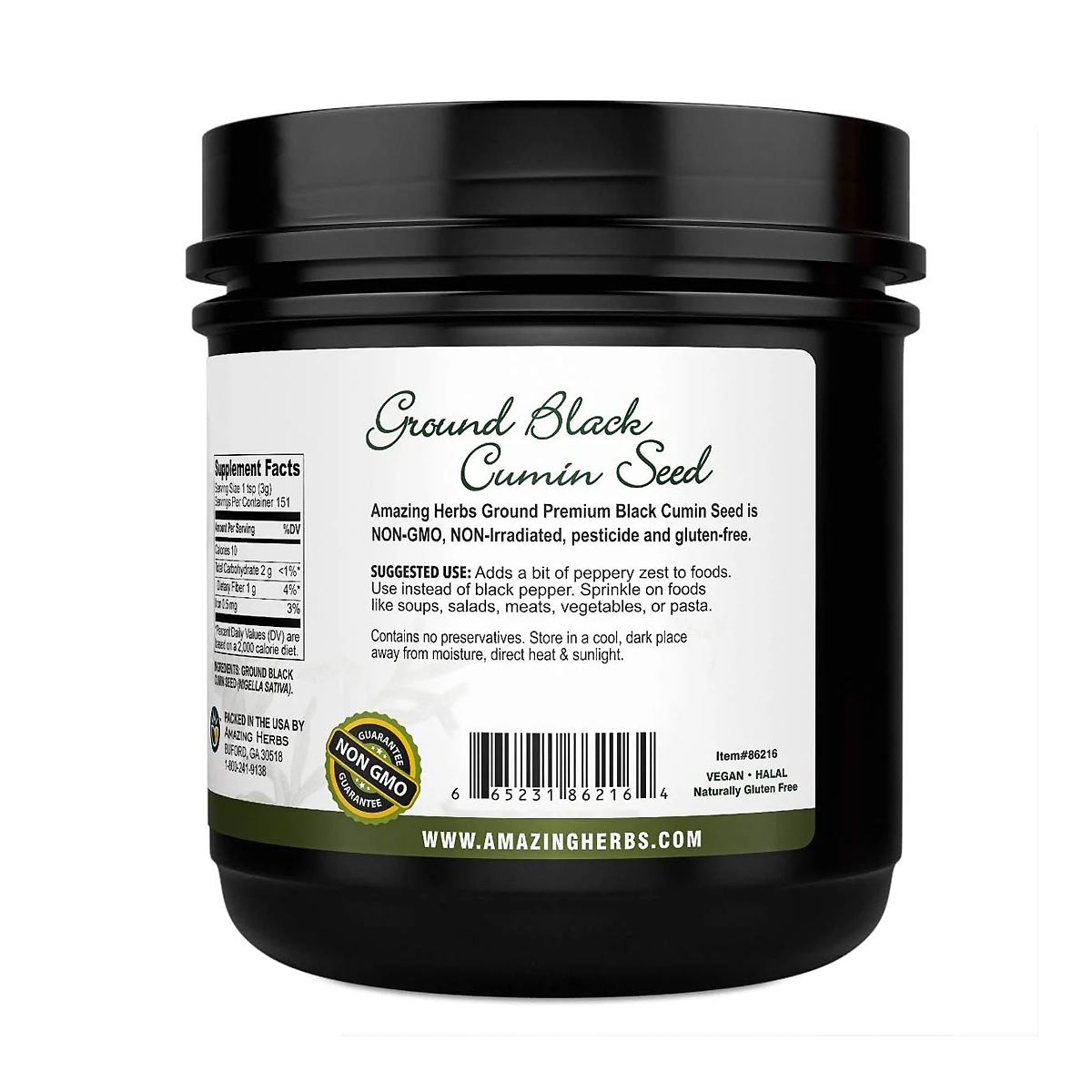
| Topic | Label photo | Store listing (manufacturer copy) |
|---|---|---|
| Purpose | Seasoning; use instead of black pepper | Supports immune, cardiovascular, digestive, lung and brain health |
| Diabetes | Not mentioned | Heading “Aids Diabetes Management”; FAQ says it “can aid in blood sugar regulation” |
| Thymoquinone | No amount stated | “Naturally rich in thymoquinone”; no figure |
| Quality | Non-GMO, non-irradiated, pesticide and gluten-free; vegan, halal | “Third-Party Lab Tested”; no certificate shown |
| How much | 1 tsp (3 g) serving; no daily amount | “Start with a small amount and gradually increase as desired” |
Everything in the listing column is a manufacturer claim. On diabetes, NCCIH says “for most supplements, there isn’t evidence to support a beneficial effect on diabetes or its complications,” and the pooled trials above tested black seed as an add-on, not a replacement for treatment.
| This product | Typical human-trial dose | Official intake guidance | Tolerable Upper Limit | |
|---|---|---|---|---|
| Black seed (ground seed) | 3 g per 1 tsp serving; no daily amount stated | Powder trials: 0.5 g/day for 8 weeks, 1 g/day for 6 weeks, 2 g/day for 48 weeks, 3 g/day for 8 weeks (Musazadeh, 2026); all forms 200–4,600 mg/day (Jafari, 2025) | None found | None found for the seed |
| Thymoquinone | Not stated on label | Not reported in the abstracts I read | None found | None found; one analysis estimates a safe dose under 48.6 mg/day (Khaikin, 2022) |
One teaspoon sits at the top of the powder-trial range, unusual in this series, where labels commonly fall far below trial doses. But nothing on the jar says to take a teaspoon daily, so the serving matches the trials’ size; it does not show the product works at that size. The empty cells reflect missing guidance, not a clean safety record. Our garlic supplements for blood pressure guide covers another pantry ingredient where two 2025 reviews disagreed by a factor of two.
Who Might Consider It, and Who Should Skip It
Who this is for: adults who like the taste and want a ground spice for salads, soups or yogurt; people curious about black seed who accept that the pooled-trial benefit is small and inconsistent; and anyone on medicine for blood sugar or pressure who has first talked to a clinician.
Who should skip it: most people, if the goal is a measurable change in blood sugar or pressure, since diet, activity and medical care are better evidenced; anyone on blood thinners or chemotherapy, or facing surgery, until a clinician weighs in; anyone pregnant or breastfeeding; and anyone considering it in place of diabetes treatment. This product itself was not tested in any trial.
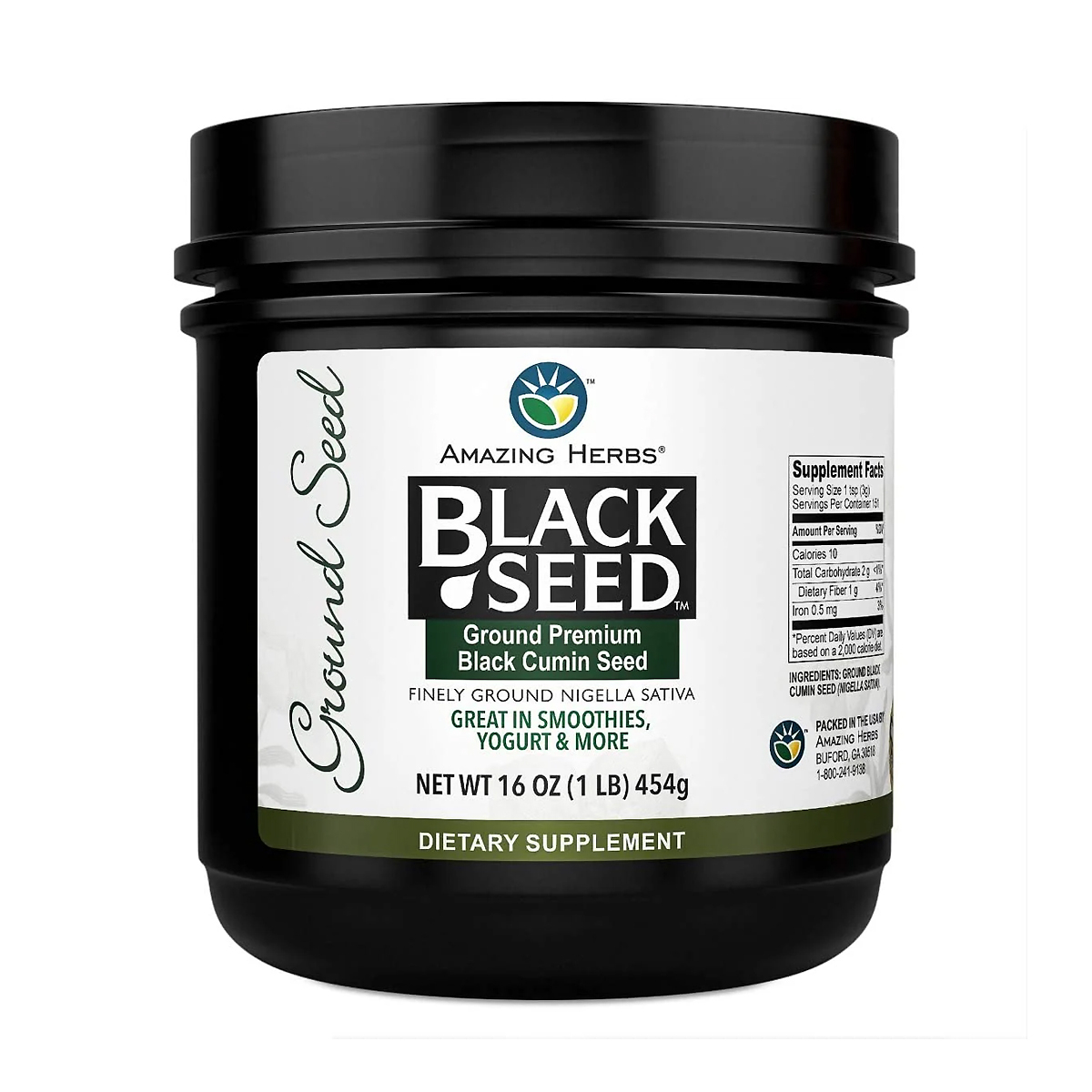
Amazing Herbs Premium Black Cumin Seed Ground Powder – 16 oz
Finely ground Nigella sativa seed, 454 g, 151 servings; the label suggests using it like pepper and gives no thymoquinone content. See more in our supplements range.
View Product DetailsFrequently Asked Questions
What is black seed (Nigella sativa)?
Black seed, also called black cumin or kalonji, is the seed of the flowering plant Nigella sativa. It is used as a spice and in traditional medicine, and is sold ground, as an oil and in capsules. This jar’s label compares the taste to pepper. Research reviews cover several forms.
Does black seed lower blood sugar?
Pooled trials report lower fasting glucose: 18.62 mg/dL across 23 trials (2026 review) and 21.43 mg/dL across 16 trials in type 2 diabetes (2025). But the trials disagree strongly (I² 99.2 percent). It is not a substitute for diabetes treatment.
Does black seed lower blood pressure?
Reviews report small average falls of about 3 mmHg systolic and 2.7 to 2.8 mmHg diastolic (2016, 2023 and 2026). The 2016 review covered 11 trials averaging 8.3 weeks and called for more evidence on long-term effect. The 2026 review’s authors call such changes “modest.”
How much black seed powder did trials use?
Across all forms, the 2025 review’s trials used 200 to 4,600 mg a day for 1 to 48 weeks. The powder trials I could identify in the 2026 review used 0.5 g a day for 8 weeks, 1 g for 6 weeks, 2 g for 48 weeks and 3 g for 8 weeks. One teaspoon of this product is 3 g.
Is black seed powder different from black seed oil?
Yes, and the results differ. In the 2026 review, fasting glucose fell 27.08 mg/dL in 12 oil trials versus 10.77 mg/dL in 11 capsule trials, and the 2016 blood-pressure review found powder and oil differed. Results from one form should not be applied to another.
Is black seed safe to take every day?
I found no official recommended intake or upper limit and no long-term safety summary. The longest powder trial in the 2026 review’s table ran 48 weeks at 2 g a day, and a 2026 case report links black seed oil to bleeding in one man with other bleeding risks. Ask a clinician if unsure.
Can I take black seed with diabetes or blood pressure medicine?
Ask your prescriber first. No source I read documents a specific drug interaction, but pooled trials report lower blood sugar and pressure on average, so a combined effect is plausible; that is my inference. NCCIH warns that supplements may interact with medicines.
Does this black cumin powder list its thymoquinone content?
No. The label photo lists calories, carbohydrate, fibre and iron per 3 g serving, and the store listing calls the seed “naturally rich in thymoquinone” without a figure. A 2022 analysis found 3.08 to 809.4 mg per 100 g across oil products, so content cannot be assumed.
Sources
- Musazadeh V, et al. “The Effect of Nigella sativa Supplementation on Cardiometabolic Health in Patients With Metabolic Diseases.” Endocrinology, Diabetes & Metabolism 2026;9(2):e70207. Accessed 24 October 2026. pmc.ncbi.nlm.nih.gov
- Jafari A, et al. “Does Nigella sativa supplementation improve cardiovascular disease risk factors?” Pharmacological Research 2025;219:107882. Accessed 24 October 2026. doi.org/10.1016/j.phrs.2025.107882
- Karimi M, et al. “Effects of black seed (Nigella sativa L.) on cardiometabolic indices in type 2 diabetic patients.” Complementary Therapies in Medicine 2025;90:103174. Accessed 24 October 2026. doi.org/10.1016/j.ctim.2025.103174
- Shirvani S, et al. “The effect of Nigella sativa supplementation on glycemic status in adults.” Prostaglandins & Other Lipid Mediators 2024;174:106885. Accessed 24 October 2026. doi.org/10.1016/j.prostaglandins.2024.106885
- Kavyani Z, et al. “Antihypertensive effects of Nigella sativa supplementation.” Phytotherapy Research 2023;37(8):3224–3238. Abstract via NCBI PubMed record 37341696. Accessed 24 October 2026. ncbi.nlm.nih.gov
- Sahebkar A, et al. “Effects of supplementation with Nigella sativa (black seed) on blood pressure.” Journal of Hypertension 2016;34(11):2127–2135. Abstract via NCBI PubMed record 27512971. Accessed 24 October 2026. ncbi.nlm.nih.gov
- Khaikin E, et al. “Screening of Thymoquinone Content in Commercial Nigella sativa Products.” Nutrients 2022;14(17):3501. Accessed 24 October 2026. pmc.ncbi.nlm.nih.gov
- Arab A, et al. “Extensive Subcutaneous Hematoma in a Patient Receiving Nigella sativa Oil, Dual Antiplatelet Therapy, and Oxaliplatin-Based Chemotherapy.” Hospital Pharmacy 2026 (online 31 August 2026). Abstract via NCBI PubMed record 42682876. Accessed 24 October 2026. ncbi.nlm.nih.gov
- National Center for Complementary and Integrative Health. “Diabetes and Dietary Supplements: What You Need To Know.” Last updated November 2023. Accessed 24 October 2026. nccih.nih.gov
- National Center for Complementary and Integrative Health. “Using Dietary Supplements Wisely.” Last updated January 2019. Accessed 24 October 2026. nccih.nih.gov
- U.S. Food and Drug Administration. “Dietary Supplements.” Content current as of 1 October 2024. Accessed 24 October 2026. fda.gov
This article is for educational purposes only and is not medical advice. It is not intended to diagnose, treat, cure, or prevent any disease. These statements have not been evaluated by the Food and Drug Administration; product statements come from its store listing and label photos. Talk to your doctor before using any supplement, especially if you take prescription medicine, are being treated for diabetes or high blood pressure, take blood thinners, are facing surgery, or are pregnant or breastfeeding.